Introduction
Infrastructure Monitoring Tools help teams track the health, performance, availability, and reliability of servers, cloud resources, containers, databases, networks, applications, and services. In simple words, these tools help IT and DevOps teams know when something is slow, broken, overloaded, misconfigured, or at risk before users are badly affected.
Modern infrastructure is no longer simple. Companies now run workloads across cloud, hybrid environments, Kubernetes, microservices, edge systems, databases, APIs, and SaaS platforms. Without proper monitoring, teams may miss early warning signs like high CPU usage, memory leaks, disk pressure, network latency, failed nodes, or service downtime.
Common use cases include:
- Server and cloud resource monitoring
- Kubernetes and container monitoring
- Network and database performance tracking
- Alerting and incident response
- Capacity planning and cost visibility
- SLA and uptime monitoring
Buyers should evaluate ease of setup, dashboard quality, alerting, scalability, integrations, AI/ML detection, log and metric support, cloud-native coverage, security, pricing, and reporting.
Best for: DevOps teams, SRE teams, IT operations, cloud engineers, platform teams, MSPs, enterprises, SaaS companies, and businesses running critical digital services.
Not ideal for: very small teams with only one or two basic websites, teams that only need simple uptime checks, or companies already using a complete observability platform that fully meets their needs.
Key Trends in Infrastructure Monitoring Tools
- AI-based anomaly detection: Tools are using AI to detect unusual behavior before outages happen.
- Full-stack observability: Buyers prefer tools that combine metrics, logs, traces, events, and alerts.
- Kubernetes-first monitoring: Container and Kubernetes visibility is now a major requirement.
- Cloud-native integrations: AWS, Azure, Google Cloud, Kubernetes, Docker, and serverless support are expected.
- AIOps-driven alert reduction: Teams want fewer noisy alerts and better root-cause suggestions.
- Hybrid infrastructure monitoring: Companies need visibility across cloud, on-premises, and edge systems.
- Cost-aware monitoring: Teams are watching monitoring data volume, log ingestion, and pricing more carefully.
- Security and compliance visibility: Audit logs, RBAC, SSO, encryption, and access control are important.
- OpenTelemetry adoption: More teams want vendor-neutral telemetry collection.
- Developer-friendly dashboards: Monitoring is moving closer to developers, not only IT operations.
How We Selected These Tools
The tools below were selected based on:
- Market adoption and industry mindshare
- Infrastructure monitoring feature depth
- Cloud, hybrid, container, and Kubernetes support
- Dashboarding, alerting, and reporting strength
- Integrations with DevOps and IT operations tools
- Support for metrics, logs, traces, and events
- Fit for SMB, mid-market, and enterprise teams
- Security and access control capabilities
- Community, documentation, and support quality
- Practical use across modern infrastructure environments
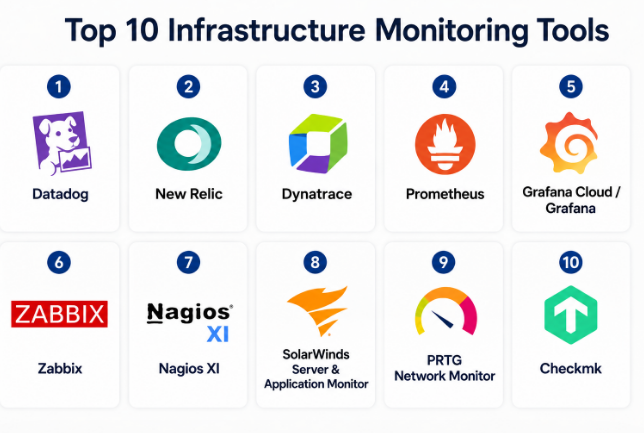
Top 10 Infrastructure Monitoring Tools
#1 — Datadog
Short description :
Datadog is a cloud-based monitoring and observability platform used by DevOps, SRE, and cloud teams. It provides infrastructure monitoring, application performance monitoring, log management, security monitoring, synthetic monitoring, and dashboards. It is especially useful for teams that want one platform to monitor cloud, containers, databases, networks, and applications. Datadog is strong for fast-growing SaaS and enterprise environments.
Key Features
- Infrastructure metrics and host monitoring
- Kubernetes and container monitoring
- Cloud service integrations
- Log management and APM support
- Custom dashboards and alerting
- AI-based anomaly detection
- Network and database monitoring options
Pros
- Strong all-in-one observability platform
- Large integration ecosystem
- Good dashboards and alerting experience
Cons
- Pricing can become complex at scale
- Data volume needs careful control
- May feel too broad for very small teams
Platforms / Deployment
Web / Linux / Windows / macOS agent support
Cloud / Hybrid
Security & Compliance
Supports SSO, SAML, MFA, RBAC, encryption, audit logs, and enterprise security controls. Specific certifications should be validated during procurement.
Integrations & Ecosystem
Datadog has a very large integration ecosystem for cloud, DevOps, databases, containers, and security workflows.
- AWS, Azure, Google Cloud
- Kubernetes and Docker
- CI/CD tools
- Databases and queues
- Incident management tools
- Security platforms
Support & Community
Datadog provides strong documentation, onboarding guides, enterprise support tiers, and a large user community.
#2 — New Relic
Short description :
New Relic is an observability platform that helps teams monitor infrastructure, applications, logs, browser performance, mobile apps, and user experience. It is useful for teams that want infrastructure monitoring connected with application-level insights. New Relic is commonly used by engineering, DevOps, and SRE teams that need performance visibility across the full software stack.
Key Features
- Infrastructure monitoring
- APM and distributed tracing
- Logs and metrics in one platform
- Kubernetes monitoring
- Custom dashboards
- Alerting and incident workflows
- Synthetic monitoring support
Pros
- Strong application and infrastructure visibility
- Useful for engineering-led teams
- Good full-stack observability coverage
Cons
- Pricing and data ingestion should be reviewed carefully
- Advanced setup may need tuning
- Some teams may not need the full platform
Platforms / Deployment
Web / Linux / Windows / macOS agent support
Cloud / Hybrid
Security & Compliance
Supports RBAC, SSO/SAML, MFA, encryption, and audit-related controls. Specific certifications should be verified with the vendor.
Integrations & Ecosystem
New Relic integrates with cloud, DevOps, incident response, and engineering workflows.
- AWS, Azure, Google Cloud
- Kubernetes
- CI/CD platforms
- Slack and incident tools
- OpenTelemetry
- Databases and infrastructure services
Support & Community
New Relic has strong documentation, guided onboarding, community resources, and enterprise support options.
#3 — Dynatrace
Short description :
Dynatrace is an enterprise-grade observability and infrastructure monitoring platform known for automation, AI-assisted root cause analysis, and deep visibility. It is widely used by large organizations that need monitoring across applications, infrastructure, Kubernetes, cloud platforms, digital experience, and security. Dynatrace is especially strong for enterprises with complex distributed systems.
Key Features
- Infrastructure and cloud monitoring
- Kubernetes and container visibility
- AI-assisted root cause analysis
- Application performance monitoring
- Digital experience monitoring
- Security and runtime insights
- Automated dependency mapping
Pros
- Strong AI and automation capabilities
- Good for large, complex environments
- Deep end-to-end observability
Cons
- Can be expensive for smaller teams
- Implementation may require planning
- Feature depth may feel heavy for simple use cases
Platforms / Deployment
Web / Linux / Windows / Kubernetes environments
Cloud / Self-hosted / Hybrid
Security & Compliance
Supports enterprise security controls such as SSO, RBAC, encryption, and audit features. Specific certifications should be validated directly.
Integrations & Ecosystem
Dynatrace integrates with cloud, DevOps, ITSM, security, and enterprise operations platforms.
- AWS, Azure, Google Cloud
- Kubernetes and OpenShift
- ServiceNow
- CI/CD tools
- Security platforms
- OpenTelemetry
Support & Community
Dynatrace offers enterprise-grade documentation, professional services, onboarding support, and a strong enterprise customer ecosystem.
#4 — Prometheus
Short description :
Prometheus is an open-source monitoring and alerting tool widely used for cloud-native infrastructure and Kubernetes environments. It collects metrics, stores time-series data, and supports powerful querying through PromQL. Prometheus is a strong choice for teams that want open-source, developer-friendly monitoring with strong Kubernetes adoption.
Key Features
- Open-source metrics monitoring
- Time-series database
- PromQL query language
- Kubernetes-native monitoring support
- Alertmanager integration
- Exporter ecosystem
- Pull-based metrics collection
Pros
- Strong open-source community
- Excellent for Kubernetes and cloud-native systems
- Flexible and developer-friendly
Cons
- Requires setup and maintenance
- Long-term storage needs extra components
- Dashboards usually require Grafana or similar tools
Platforms / Deployment
Linux / Kubernetes / Container environments
Self-hosted / Hybrid
Security & Compliance
Security depends on deployment, access control, network design, and supporting tools. Specific compliance certifications are Not publicly stated.
Integrations & Ecosystem
Prometheus has a large exporter and cloud-native ecosystem.
- Kubernetes
- Grafana
- Alertmanager
- Node exporter
- Cloud exporters
- Service mesh metrics
Support & Community
Prometheus has strong open-source documentation, wide community adoption, and broad support across Kubernetes ecosystems.
#5 — Grafana Cloud / Grafana
Short description :
Grafana is widely used for dashboards, visualization, metrics, logs, traces, and observability workflows. Grafana Cloud adds managed monitoring capabilities, while self-hosted Grafana is popular with Prometheus and other data sources. It is a strong option for teams that want flexible dashboards and open observability integrations.
Key Features
- Powerful dashboards and visualizations
- Supports metrics, logs, and traces
- Works with Prometheus and many data sources
- Alerting and notification workflows
- Managed and self-hosted options
- OpenTelemetry support
- Plugin ecosystem
Pros
- Excellent dashboard flexibility
- Strong open-source and cloud options
- Works well with many monitoring stacks
Cons
- Needs proper data source design
- Advanced observability may require multiple components
- Self-hosting needs operational effort
Platforms / Deployment
Web / Linux / Windows / macOS support varies
Cloud / Self-hosted / Hybrid
Security & Compliance
Supports access controls, authentication integrations, RBAC in relevant editions, and enterprise security features. Specific certifications should be validated during review.
Integrations & Ecosystem
Grafana has a strong ecosystem across monitoring, logging, tracing, and data platforms.
- Prometheus
- Loki
- Tempo
- Graphite
- Elasticsearch
- Cloud monitoring services
Support & Community
Grafana has excellent documentation, a large open-source community, commercial support, and many community dashboards.
#6 — Zabbix
Short description :
Zabbix is an open-source infrastructure monitoring platform used for servers, networks, virtual machines, applications, and cloud resources. It is popular among IT operations teams that need a cost-effective and self-hosted monitoring solution. Zabbix is especially useful for organizations that prefer strong control over their monitoring stack.
Key Features
- Server, network, and application monitoring
- Agent and agentless monitoring options
- Alerting and escalation
- Dashboards and reports
- Auto-discovery
- Template-based monitoring
- Open-source deployment model
Pros
- Strong open-source monitoring platform
- Good for infrastructure and network visibility
- No mandatory SaaS dependency
Cons
- Interface may feel less modern than some SaaS tools
- Setup and tuning require technical skill
- Large environments need careful architecture
Platforms / Deployment
Linux / Windows / Network devices / Web
Self-hosted / Hybrid
Security & Compliance
Supports user roles, authentication options, encryption features, and audit-related controls depending on configuration. Specific certifications are Not publicly stated.
Integrations & Ecosystem
Zabbix integrates with IT operations, alerting, and infrastructure systems.
- Linux and Windows servers
- Network devices
- Databases
- Cloud services
- Alerting tools
- Custom scripts and APIs
Support & Community
Zabbix has strong documentation, community templates, forums, and commercial support options.
#7 — Nagios XI
Short description :
Nagios XI is a well-known infrastructure monitoring solution used for servers, networks, applications, services, and IT systems. It is built on the long history of Nagios monitoring and is often used by IT operations teams that need reliable alerting and infrastructure visibility. Nagios XI is suitable for traditional infrastructure and mixed environments.
Key Features
- Server and network monitoring
- Application and service checks
- Alerting and escalation
- Dashboards and reports
- Plugin-based extensibility
- Capacity planning features
- Monitoring templates
Pros
- Mature monitoring ecosystem
- Strong plugin flexibility
- Good fit for traditional IT operations
Cons
- User experience may feel older than modern SaaS tools
- Advanced observability needs extra tools
- Plugin management can become complex
Platforms / Deployment
Linux / Windows monitoring support / Network devices
Self-hosted / Hybrid
Security & Compliance
Supports role-based access and administrative controls. Specific compliance certifications are Not publicly stated.
Integrations & Ecosystem
Nagios has a large plugin ecosystem and supports many infrastructure monitoring scenarios.
- Servers
- Network devices
- Databases
- Applications
- Custom plugins
- Alerting systems
Support & Community
Nagios has long-standing documentation, community plugins, and commercial support options for Nagios XI.
#8 — SolarWinds Server & Application Monitor
Short description :
SolarWinds Server & Application Monitor is designed for monitoring servers, applications, infrastructure, and performance across hybrid IT environments. It is commonly used by IT teams that need visibility into Windows, Linux, virtualization, databases, and business applications. It is a strong fit for traditional enterprise IT operations.
Key Features
- Server and application monitoring
- Windows and Linux monitoring
- Application dependency mapping
- Performance dashboards
- Alerting and reporting
- Hybrid infrastructure visibility
- Prebuilt monitoring templates
Pros
- Strong fit for IT operations teams
- Good application and server monitoring depth
- Useful dashboards and templates
Cons
- May feel heavy for small teams
- Licensing should be reviewed carefully
- Best value comes in broader SolarWinds environments
Platforms / Deployment
Windows / Linux monitoring support / Web
Self-hosted / Hybrid
Security & Compliance
Supports access controls, authentication features, and administrative controls. Specific certifications should be validated directly.
Integrations & Ecosystem
SolarWinds integrates well within IT operations and network management environments.
- Windows Server
- Linux servers
- Virtualization platforms
- Databases
- Network tools
- IT service workflows
Support & Community
SolarWinds provides documentation, support plans, customer resources, and a mature IT operations user base.
#9 — PRTG Network Monitor
Short description :
PRTG Network Monitor is an infrastructure and network monitoring tool used by IT teams to monitor devices, servers, bandwidth, applications, and services. It is known for sensor-based monitoring and is often used by SMB and mid-market IT teams. PRTG is a practical choice for teams that need network and infrastructure visibility without building a complex observability stack.
Key Features
- Sensor-based monitoring model
- Network, server, and application monitoring
- Bandwidth monitoring
- Alerting and notifications
- Dashboards and maps
- Auto-discovery
- Remote probes
Pros
- Easy to understand sensor-based model
- Good for network-heavy environments
- Suitable for SMB and mid-market teams
Cons
- Sensor count can affect pricing
- Not as deep for modern cloud-native observability
- Advanced DevOps tracing needs other tools
Platforms / Deployment
Windows / Web / Mobile apps
Self-hosted / Cloud options vary
Security & Compliance
Supports user permissions and secure access features depending on edition and configuration. Specific certifications are Not publicly stated.
Integrations & Ecosystem
PRTG works well with network devices, servers, and IT operations workflows.
- SNMP devices
- Windows and Linux servers
- Network infrastructure
- Virtualization platforms
- Notification tools
- Custom sensors
Support & Community
PRTG provides documentation, support resources, knowledge base articles, and an active IT monitoring user base.
#10 — Checkmk
Short description :
Checkmk is an infrastructure and application monitoring platform used for servers, networks, cloud systems, containers, databases, and enterprise IT environments. It is known for efficient monitoring, auto-discovery, and strong support for complex infrastructure. Checkmk is a good option for teams that want flexible monitoring with both open-source and enterprise choices.
Key Features
- Server, network, and application monitoring
- Auto-discovery and inventory
- Agent-based and agentless monitoring options
- Kubernetes and cloud monitoring support
- Dashboards and alerting
- Large plugin and check ecosystem
- Open-source and enterprise editions
Pros
- Strong infrastructure monitoring depth
- Efficient for large environments
- Good open-source and commercial balance
Cons
- Interface and setup may require learning
- Advanced tuning takes time
- Smaller teams may prefer simpler SaaS tools
Platforms / Deployment
Linux / Windows monitoring support / Network devices / Web
Self-hosted / Hybrid
Security & Compliance
Supports access controls and secure monitoring configuration depending on edition. Specific certifications are Not publicly stated.
Integrations & Ecosystem
Checkmk supports a wide range of infrastructure, cloud, and enterprise monitoring use cases.
- Linux and Windows servers
- Network devices
- Kubernetes
- Databases
- Cloud services
- Notification and incident workflows
Support & Community
Checkmk offers documentation, community resources, enterprise support, and a strong infrastructure monitoring user base.
Comparison Table
| Tool Name | Best For | Platform(s) Supported | Deployment | Standout Feature | Public Rating |
|---|---|---|---|---|---|
| Datadog | Cloud and DevOps teams | Web, Linux, Windows, macOS agent support | Cloud / Hybrid | Full-stack observability | N/A |
| New Relic | Engineering and SRE teams | Web, Linux, Windows, macOS agent support | Cloud / Hybrid | App and infrastructure visibility | N/A |
| Dynatrace | Large enterprises | Web, Linux, Windows, Kubernetes | Cloud / Self-hosted / Hybrid | AI-assisted root cause analysis | N/A |
| Prometheus | Kubernetes and open-source teams | Linux, Kubernetes, containers | Self-hosted / Hybrid | Open-source metrics monitoring | N/A |
| Grafana Cloud / Grafana | Dashboard and observability teams | Web, Linux, Windows, macOS support varies | Cloud / Self-hosted / Hybrid | Flexible visualization | N/A |
| Zabbix | Self-hosted IT monitoring | Linux, Windows, network devices | Self-hosted / Hybrid | Open-source infrastructure monitoring | N/A |
| Nagios XI | Traditional IT operations | Linux, Windows monitoring support, network devices | Self-hosted / Hybrid | Plugin-based monitoring | N/A |
| SolarWinds Server & Application Monitor | Enterprise IT operations | Windows, Linux monitoring support, Web | Self-hosted / Hybrid | Server and application templates | N/A |
| PRTG Network Monitor | SMB and network teams | Windows, Web, mobile apps | Self-hosted / Cloud options vary | Sensor-based monitoring | N/A |
| Checkmk | Complex infrastructure teams | Linux, Windows monitoring support, network devices | Self-hosted / Hybrid | Auto-discovery and efficient monitoring | N/A |
Evaluation & Infrastructure Monitoring Tools
| Tool Name | Core (25%) | Ease (15%) | Integrations (15%) | Security (10%) | Performance (10%) | Support (10%) | Value (15%) | Weighted Total (0–10) |
|---|---|---|---|---|---|---|---|---|
| Datadog | 9 | 8 | 10 | 9 | 8 | 9 | 7 | 8.50 |
| New Relic | 9 | 8 | 9 | 8 | 8 | 8 | 8 | 8.35 |
| Dynatrace | 10 | 7 | 9 | 9 | 9 | 9 | 7 | 8.65 |
| Prometheus | 8 | 6 | 8 | 6 | 8 | 8 | 9 | 7.65 |
| Grafana Cloud / Grafana | 8 | 8 | 9 | 8 | 8 | 8 | 8 | 8.15 |
| Zabbix | 8 | 6 | 7 | 7 | 8 | 8 | 9 | 7.55 |
| Nagios XI | 7 | 6 | 7 | 6 | 7 | 8 | 8 | 6.95 |
| SolarWinds Server & Application Monitor | 8 | 7 | 8 | 7 | 8 | 8 | 7 | 7.60 |
| PRTG Network Monitor | 7 | 8 | 7 | 7 | 7 | 7 | 8 | 7.30 |
| Checkmk | 8 | 7 | 7 | 7 | 8 | 8 | 8 | 7.55 |
These scores are comparative and should not be treated as a universal ranking. A cloud-native team may prefer Datadog, New Relic, Dynatrace, Prometheus, or Grafana. A traditional IT team may prefer Zabbix, Nagios XI, SolarWinds, PRTG, or Checkmk. The right score for your company depends on infrastructure size, skills, budget, cloud strategy, security needs, and operational maturity.
Which Infrastructure Monitoring Tools Should You Choose?
Solo / Freelancer
Solo users and freelancers should choose simple, affordable, and low-maintenance tools. Grafana Cloud, New Relic, PRTG, or a lightweight Prometheus setup can work well. If the work is mostly small websites or simple servers, a full enterprise observability platform may be unnecessary.
SMB
SMBs should focus on fast setup, clear alerts, simple dashboards, and predictable cost. PRTG, Zabbix, Checkmk, Grafana Cloud, and New Relic are practical options. If the SMB is cloud-native, Datadog or New Relic may be better. If the SMB prefers self-hosting, Zabbix or Checkmk can be strong choices.
Mid-Market
Mid-market companies usually need better integrations, role-based access, alert management, and cloud visibility. Datadog, New Relic, Grafana, SolarWinds, and Checkmk are strong options. Teams using Kubernetes should also consider Prometheus with Grafana or a managed observability platform.
Enterprise
Enterprises should prioritize scalability, compliance controls, support, automation, AI-assisted analysis, and cross-team visibility. Dynatrace, Datadog, New Relic, SolarWinds, and Grafana enterprise offerings are strong candidates. Traditional enterprises with large server and network estates may also evaluate Zabbix, Checkmk, Nagios XI, and PRTG.
Budget vs Premium
Open-source tools like Prometheus, Grafana, Zabbix, and Checkmk can reduce software cost but require internal expertise. Premium tools like Datadog, Dynatrace, and New Relic may cost more but offer managed infrastructure, better onboarding, support, automation, and integrated observability. The best value depends on team size and operational workload.
Feature Depth vs Ease of Use
Datadog, Dynatrace, and New Relic offer broad feature depth but may require careful setup and cost control. PRTG is easier for network-focused teams. Zabbix and Checkmk offer strong control but need technical skill. Prometheus is excellent for cloud-native teams but requires supporting tools for dashboards and long-term storage.
Integrations & Scalability-
If integrations are the main priority, Datadog, New Relic, Dynatrace, Grafana, and Prometheus are strong options. For traditional IT environments, SolarWinds, Zabbix, PRTG, Nagios XI, and Checkmk provide broad infrastructure coverage. For scalability, test data ingestion, alert volume, storage retention, and dashboard performance before final adoption.
Security & Compliance Needs
Security-focused teams should check SSO, SAML, MFA, RBAC, audit logs, encryption, data residency, retention controls, and access policies. Enterprises should validate compliance claims directly during procurement. Self-hosted tools give more control, while SaaS tools reduce operational burden but require vendor security review.
Frequently Asked Questions
1. What are Infrastructure Monitoring Tools?
Infrastructure Monitoring Tools track the health and performance of servers, cloud resources, networks, containers, databases, and services. They help teams detect issues early and reduce downtime.
2. Why are infrastructure monitoring tools important?
They help teams avoid blind spots. Without monitoring, failures may only become visible after users complain, which can damage customer trust and business operations.
3. What is the difference between monitoring and observability?
Monitoring tells you when something is wrong using known signals. Observability helps you understand why something is wrong using metrics, logs, traces, events, and context.
4. Which tool is best for Kubernetes monitoring?
Prometheus and Grafana are very popular in Kubernetes environments. Datadog, New Relic, and Dynatrace are also strong for teams that want managed Kubernetes observability.
5. Are open-source monitoring tools enough?
Open-source tools can be enough if the team has strong technical skills. However, companies may need commercial support, easier setup, compliance features, or managed services as they scale.
6. What pricing models are common?
Common pricing models include per host, per metric, per user, per sensor, per data volume, per feature module, or enterprise subscription. If pricing is unclear, treat it as Varies / N/A.
7. How long does onboarding take?
A small setup can be completed quickly, but full enterprise onboarding takes planning. Teams must define dashboards, alert rules, integrations, escalation paths, retention, and ownership.
8. What are common mistakes when using monitoring tools?
Common mistakes include creating too many alerts, ignoring alert fatigue, not defining service ownership, collecting unnecessary data, and failing to review dashboard quality regularly.
9. Can infrastructure monitoring tools help with security?
Yes, they can help detect unusual behavior, unauthorized changes, exposed systems, failed services, and suspicious performance patterns. However, they do not replace dedicated security tools.
10. Do these tools support cloud monitoring?
Most modern tools support cloud monitoring. Buyers should check AWS, Azure, Google Cloud, Kubernetes, serverless, database, and container integrations before choosing.
Conclusion
Infrastructure Monitoring Tools are essential for modern IT, DevOps, SRE, and cloud operations because they help teams see what is happening across servers, networks, containers, databases, applications, and cloud services. The best tool depends on your environment, not only on feature count. Datadog, New Relic, and Dynatrace are strong choices for teams that want full-stack observability. Prometheus and Grafana are excellent for open-source and Kubernetes-focused teams.
