Introduction
Telemedicine platforms are digital solutions that enable healthcare providers to deliver medical services remotely through video consultations, messaging, and digital health tools. These platforms connect patients and clinicians without requiring physical visits, making healthcare more accessible, efficient, and scalable.
In today’s healthcare environment, telemedicine has moved from being optional to essential. With increasing demand for remote care, digital-first patient experiences, and cost optimization, telemedicine platforms play a central role in modern healthcare delivery. They are especially important for managing chronic conditions, reducing hospital visits, and expanding access to care in underserved regions.
Real-world use cases include:
- Virtual doctor consultations for primary care
- Mental health therapy sessions
- Follow-up appointments after treatment
- Remote triaging and urgent care
- Specialist consultations across geographies
What buyers should evaluate:
- Video quality and reliability
- EHR/EMR integration capabilities
- Patient scheduling and workflow management
- Security and compliance standards
- Mobile accessibility for patients and providers
- AI-driven automation (chatbots, triage)
- Billing and insurance integration
- Scalability across locations
- Ease of onboarding for patients
Best for: Hospitals, clinics, telehealth startups, insurers, and enterprise healthcare providers looking to scale remote care.
Not ideal for: Providers requiring continuous real-time monitoring (better suited for RPM platforms) or those without stable digital infrastructure.
Key Trends in Telemedicine Platforms
- AI-powered triage and chatbots for patient intake and symptom checking
- Hybrid care models combining in-person and virtual visits
- Integration with RPM platforms for continuous patient monitoring
- Mobile-first design improving patient accessibility
- Cloud-native architecture enabling scalability and performance
- Advanced analytics dashboards for clinical insights
- Automation of scheduling and billing workflows
- Expansion into mental health and wellness services
- Stronger compliance frameworks with encryption and identity controls
- Global telehealth expansion supporting cross-border consultations
How We Selected These Tools (Methodology)
- Evaluated market presence and adoption in healthcare systems
- Assessed feature completeness across video, messaging, and workflow tools
- Reviewed performance reliability and uptime indicators
- Considered compliance readiness (HIPAA, GDPR where applicable)
- Analyzed integration capabilities with EHR, billing, and devices
- Examined usability for both clinicians and patients
- Evaluated scalability for different organization sizes
- Considered innovation in AI and automation features
- Reviewed ecosystem partnerships and extensibility
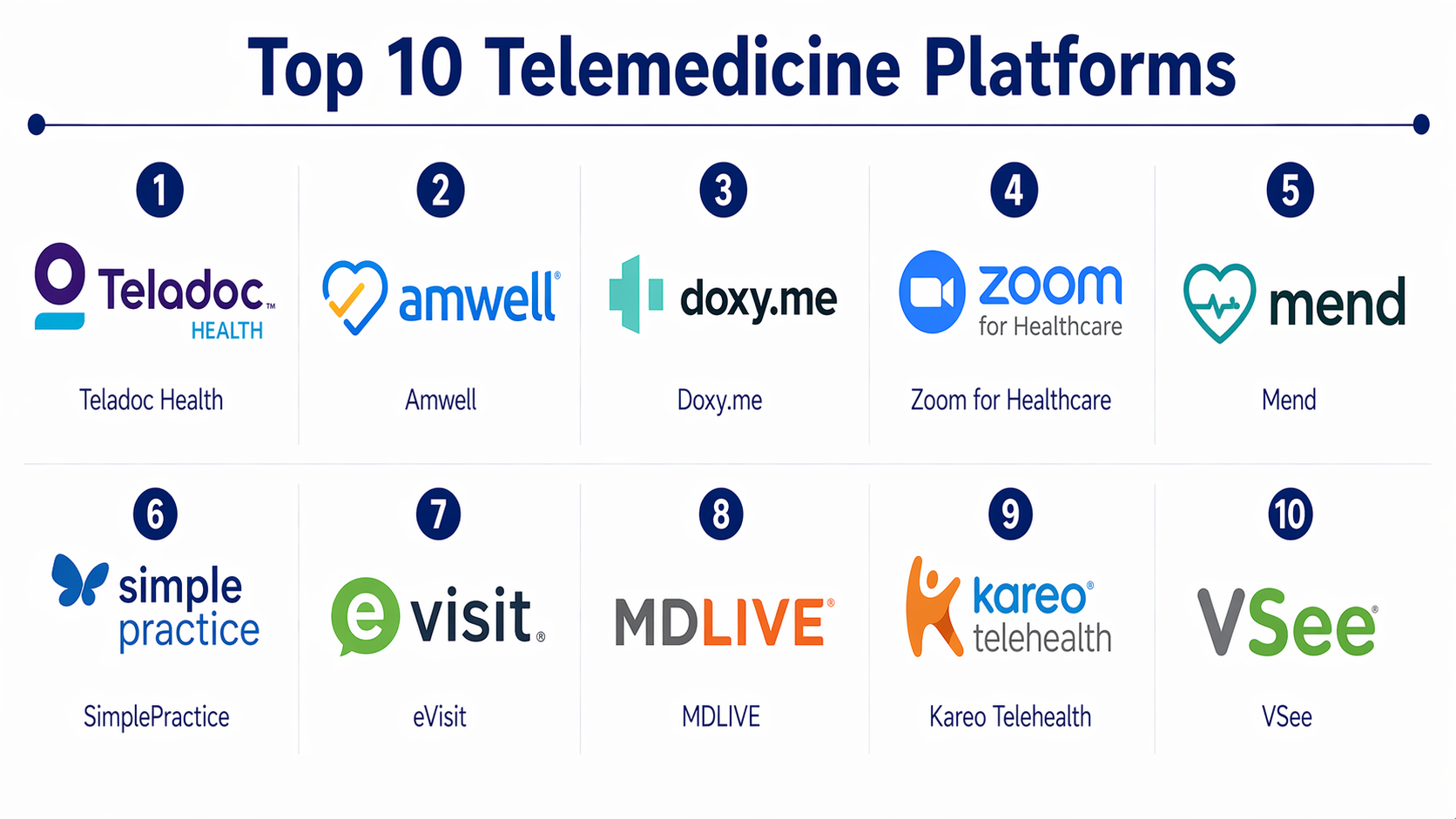
Top 10 Telemedicine Platforms
#1 — Teladoc Health
Short description:
A leading telemedicine platform offering virtual care across primary care, mental health, and chronic condition management. Designed for large healthcare providers and enterprises.
Key Features
- Video and phone consultations
- Mental health services
- Chronic care programs
- AI-driven triage
- Mobile app support
Pros
- Comprehensive care coverage
- Scalable enterprise solution
Cons
- Complex pricing
- Less customization for smaller providers
Platforms / Deployment
Web / iOS / Android
Cloud
Security & Compliance
HIPAA, encryption, MFA
Integrations & Ecosystem
Integrates with healthcare systems and enterprise tools
- EHR integrations
- Mobile health apps
- Analytics platforms
Support & Community
Strong enterprise support with onboarding and training
#2 — Amwell
Short description:
A telehealth platform focused on hospitals and health systems, providing virtual care delivery with strong clinical integrations.
Key Features
- Video consultations
- Care coordination tools
- Scheduling system
- Clinical workflows
- Mobile access
Pros
- Strong hospital integration
- Reliable performance
Cons
- High cost
- Enterprise-focused
Platforms / Deployment
Web / Mobile
Cloud
Security & Compliance
HIPAA
Integrations & Ecosystem
- EHR systems
- Hospital systems
- APIs
Support & Community
Enterprise-level support
#3 — Doxy.me
Short description:
A simple browser-based telemedicine platform designed for small practices and independent providers.
Key Features
- No-download video calls
- Waiting room feature
- Custom branding
- Patient check-in
- Secure communication
Pros
- Easy to use
- Quick setup
Cons
- Limited advanced features
- Basic integrations
Platforms / Deployment
Web
Cloud
Security & Compliance
HIPAA
Integrations & Ecosystem
- Basic integrations
- Limited API support
Support & Community
Good documentation for small users
#4 — Zoom for Healthcare
Short description:
A healthcare-focused version of a popular video platform, offering secure telemedicine capabilities.
Key Features
- HD video conferencing
- Virtual waiting rooms
- Screen sharing
- Scheduling integrations
- Recording options
Pros
- Familiar interface
- High-quality video
Cons
- Not healthcare-specific by default
- Requires configuration
Platforms / Deployment
Web / Desktop / Mobile
Cloud
Security & Compliance
HIPAA, encryption
Integrations & Ecosystem
- Calendar tools
- EHR integrations
- APIs
Support & Community
Strong global support ecosystem
#5 — Mend
Short description:
A telemedicine platform focused on patient engagement, scheduling, and virtual visits.
Key Features
- Appointment scheduling
- Video visits
- Automated reminders
- Patient engagement tools
- Analytics
Pros
- Strong patient experience
- Automation features
Cons
- Limited advanced analytics
- Smaller ecosystem
Platforms / Deployment
Cloud
Security & Compliance
HIPAA
Integrations & Ecosystem
- EHR systems
- Scheduling tools
Support & Community
Reliable support for providers
#6 — SimplePractice
Short description:
A telehealth and practice management platform designed for therapists and small clinics.
Key Features
- Telehealth video sessions
- Billing and payments
- Scheduling
- Client management
- Documentation
Pros
- All-in-one solution
- Easy onboarding
Cons
- Limited enterprise features
- Not ideal for large hospitals
Platforms / Deployment
Web / Mobile
Cloud
Security & Compliance
HIPAA
Integrations & Ecosystem
- Payment systems
- Calendar integrations
Support & Community
Strong user community
#7 — eVisit
Short description:
A telemedicine platform tailored for hospitals and health systems to deliver virtual care.
Key Features
- Virtual visits
- Workflow management
- Patient triage
- Analytics
- Care coordination
Pros
- Built for healthcare workflows
- Scalable
Cons
- Requires implementation effort
- Enterprise pricing
Platforms / Deployment
Cloud
Security & Compliance
HIPAA
Integrations & Ecosystem
- EHR integrations
- APIs
Support & Community
Enterprise-level support
#8 — MDLIVE
Short description:
A telehealth platform focused on providing virtual care services for patients and employers.
Key Features
- Video consultations
- Behavioral health services
- Urgent care
- Mobile app
- Scheduling
Pros
- Wide service coverage
- Easy patient access
Cons
- Less customizable
- Limited enterprise control
Platforms / Deployment
Web / Mobile
Cloud
Security & Compliance
HIPAA
Integrations & Ecosystem
- Insurance providers
- Healthcare networks
Support & Community
Patient-focused support
#9 — Kareo Telehealth
Short description:
A telemedicine solution integrated with practice management tools for small to mid-sized clinics.
Key Features
- Video visits
- Billing integration
- Scheduling
- Patient records
- Reporting
Pros
- Integrated billing
- Easy setup
Cons
- Limited scalability
- Basic features
Platforms / Deployment
Cloud
Security & Compliance
Not publicly stated
Integrations & Ecosystem
- Billing systems
- EHR integrations
Support & Community
Good support for SMB clinics
#10 — VSee
Short description:
A telemedicine platform offering secure video communication and customizable telehealth workflows.
Key Features
- Secure video calls
- Workflow customization
- Mobile support
- Remote monitoring integration
- API access
Pros
- Flexible platform
- Strong security
Cons
- Requires setup effort
- UI not modern
Platforms / Deployment
Web / Mobile / Desktop
Cloud / Hybrid
Security & Compliance
HIPAA, encryption
Integrations & Ecosystem
- APIs
- Device integrations
- Healthcare systems
Support & Community
Developer-friendly documentation
Comparison Table (Top 10)
| Tool Name | Best For | Platform(s) Supported | Deployment | Standout Feature | Public Rating |
|---|---|---|---|---|---|
| Teladoc Health | Enterprise telehealth | Web, Mobile | Cloud | Full-service care | N/A |
| Amwell | Hospitals | Web, Mobile | Cloud | Clinical workflows | N/A |
| Doxy.me | Small practices | Web | Cloud | No-download access | N/A |
| Zoom for Healthcare | Video consultations | Web, Desktop, Mobile | Cloud | HD video quality | N/A |
| Mend | Patient engagement | Cloud | Cloud | Automated workflows | N/A |
| SimplePractice | Therapists | Web, Mobile | Cloud | All-in-one tool | N/A |
| eVisit | Health systems | Cloud | Cloud | Workflow management | N/A |
| MDLIVE | Patient services | Web, Mobile | Cloud | Wide coverage | N/A |
| Kareo Telehealth | SMB clinics | Cloud | Cloud | Billing integration | N/A |
| VSee | Custom telehealth | Web, Mobile | Hybrid | Flexible workflows | N/A |
Evaluation & Telemedicine Platforms
| Tool Name | Core (25%) | Ease (15%) | Integrations (15%) | Security (10%) | Performance (10%) | Support (10%) | Value (15%) | Weighted Total |
|---|---|---|---|---|---|---|---|---|
| Teladoc | 9 | 8 | 9 | 9 | 9 | 8 | 7 | 8.5 |
| Amwell | 8 | 7 | 8 | 9 | 8 | 8 | 7 | 7.9 |
| Doxy.me | 6 | 9 | 6 | 8 | 7 | 7 | 9 | 7.5 |
| Zoom | 7 | 9 | 8 | 8 | 9 | 9 | 8 | 8.3 |
| Mend | 7 | 8 | 7 | 8 | 7 | 8 | 8 | 7.7 |
| SimplePractice | 7 | 9 | 7 | 8 | 7 | 8 | 8 | 7.9 |
| eVisit | 8 | 7 | 8 | 9 | 8 | 8 | 7 | 7.9 |
| MDLIVE | 7 | 8 | 7 | 8 | 7 | 7 | 7 | 7.4 |
| Kareo | 7 | 8 | 7 | 7 | 7 | 7 | 8 | 7.4 |
| VSee | 8 | 7 | 8 | 9 | 8 | 7 | 7 | 7.9 |
Interpretation:
These scores compare tools relative to each other across key dimensions. A higher score indicates better balance across features, usability, and value. However, the best choice depends on your use case—enterprise systems prioritize integration and compliance, while smaller clinics benefit more from ease of use and affordability.
Which Telemedicine Platforms
Solo / Freelancer
Doxy.me and SimplePractice are ideal due to simplicity and quick setup.
SMB
Kareo Telehealth and Mend provide a balance of features and affordability.
Mid-Market
eVisit and Zoom for Healthcare offer scalability and integration capabilities.
Enterprise
Teladoc Health and Amwell provide advanced features and compliance.
Budget vs Premium
- Budget: Doxy.me, Kareo
- Premium: Teladoc, Amwell
Feature Depth vs Ease of Use
- Feature-heavy: Teladoc, Amwell
- Easy to use: Doxy.me, SimplePractice
Integrations & Scalability
Choose Teladoc, Zoom, or eVisit for strong integration ecosystems.
Security & Compliance Needs
Teladoc, Amwell, and VSee offer stronger compliance readiness.
Frequently Asked Questions (FAQs)
1. What is a telemedicine platform?
A telemedicine platform enables remote healthcare services through video, chat, and digital tools.
2. How much do telemedicine platforms cost?
Costs vary based on features, users, and scale, typically subscription-based.
3. Are telemedicine platforms secure?
Most platforms use encryption and comply with healthcare regulations, but security varies.
4. How long does implementation take?
Small setups can be deployed quickly, while enterprise deployments take longer.
5. Can telemedicine integrate with EHR systems?
Yes, most platforms support integration with healthcare systems.
6. What equipment is needed?
Basic requirements include a device with camera, internet, and software access.
7. What are common mistakes?
Choosing tools without considering integration and patient usability.
8. Is telemedicine scalable?
Yes, especially cloud-based platforms designed for growth.
9. Can small clinics use telemedicine?
Yes, many platforms are designed for small practices.
10. What are alternatives?
In-person consultations or basic communication tools without healthcare workflows.
Conclusion
Telemedicine platforms have become a foundational part of modern healthcare, enabling providers to deliver care efficiently, reduce costs, and improve patient access. From simple video consultation tools to enterprise-grade virtual care ecosystems, the market offers solutions for every type of organization. However, selecting the right platform requires careful consideration of your specific needs—whether it’s ease of use, integration depth, compliance requirements, or scalability.
