Introduction
Remote Patient Monitoring (RPM) platforms are healthcare technologies that allow doctors and care teams to track patients’ health data remotely using connected devices like wearables, sensors, and mobile apps. These platforms collect real-time data such as heart rate, blood pressure, glucose levels, and oxygen saturation, helping clinicians make informed decisions without requiring frequent hospital visits.
In the current healthcare landscape, RPM has become essential due to rising chronic diseases, aging populations, and the need for cost-efficient care delivery. It supports value-based care models and improves patient engagement while reducing hospital readmissions.
Real-world use cases include:
- Monitoring chronic conditions like diabetes or hypertension
- Post-surgery recovery tracking
- Elderly care and fall detection
- Remote ICU and home-based care
- Clinical trial data collection
What buyers should evaluate:
- Device compatibility and connectivity
- Data accuracy and real-time analytics
- Integration with EHR/EMR systems
- Security and compliance standards
- AI/automation capabilities
- Scalability and performance
- Patient engagement features
- Pricing and reimbursement support
Best for: Hospitals, clinics, telehealth providers, insurers, and digital health startups managing remote care programs.
Not ideal for: Small practices without digital infrastructure or providers needing only basic teleconsultation without continuous monitoring.
Key Trends in Remote Patient Monitoring (RPM) Platforms
- AI-driven analytics: Predictive alerts for early detection of health risks
- Wearable ecosystem expansion: Integration with consumer and medical-grade devices
- Shift to home-based care models: Reducing hospital dependency
- Interoperability focus: Seamless integration with EHR, FHIR APIs, and health systems
- Automation in workflows: Alerts, triaging, and care plan adjustments
- Value-based care alignment: Outcome-driven reimbursement models
- Data security enhancements: Stronger encryption and compliance frameworks
- Cloud-first deployments: Scalability and real-time data access
- Patient engagement tools: Apps, reminders, and behavioral nudges
- Remote clinical trials support: Decentralized study monitoring
How We Selected These Tools (Methodology)
- Evaluated market adoption and healthcare provider usage
- Assessed feature completeness across monitoring, analytics, and engagement
- Considered reliability and performance indicators
- Reviewed security and compliance readiness
- Checked integration capabilities with EHR and devices
- Analyzed scalability across small to enterprise healthcare setups
- Considered usability for both clinicians and patients
- Evaluated ecosystem strength and partnerships
- Looked at innovation in AI and automation features
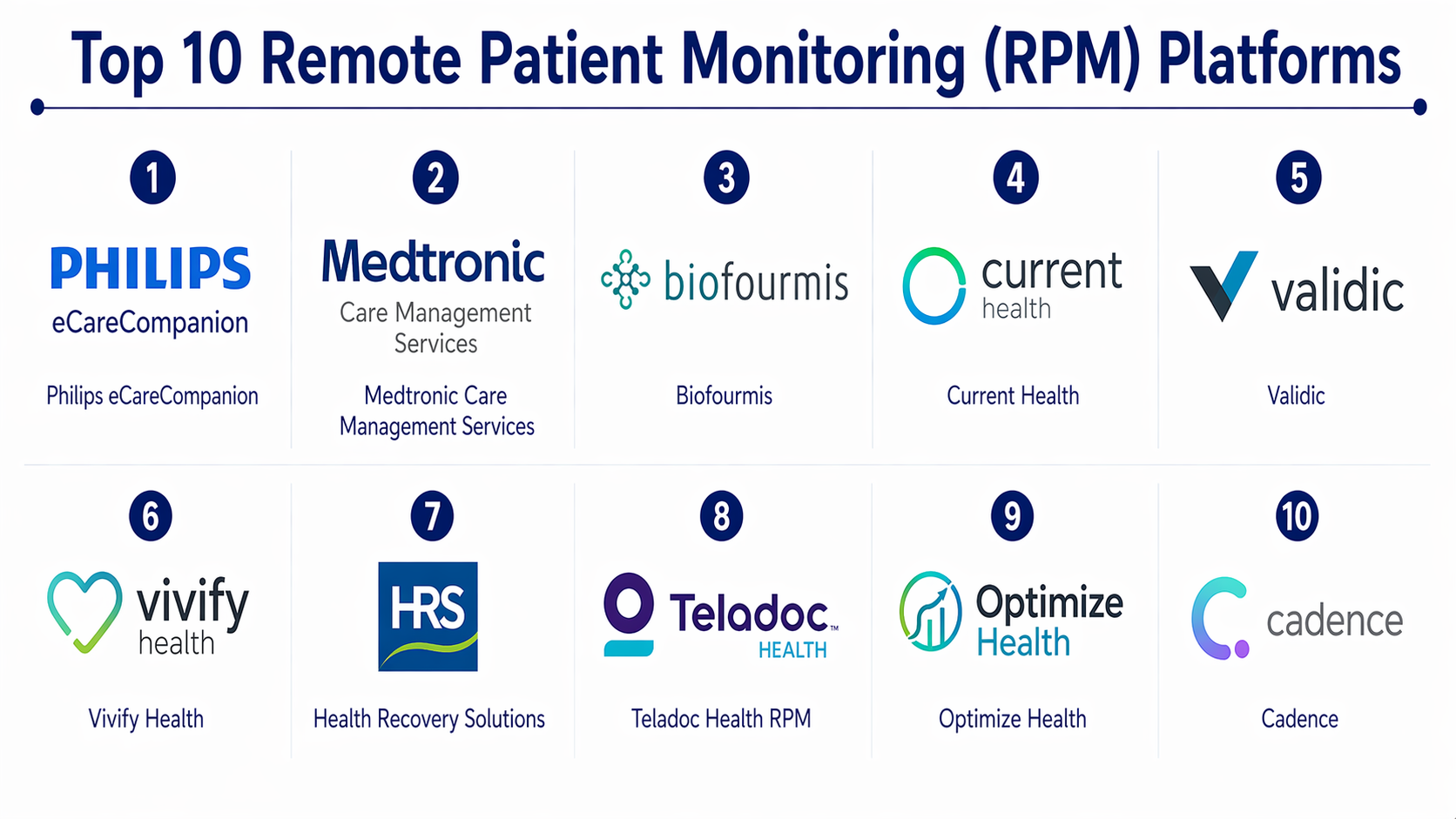
Top 10 Remote Patient Monitoring (RPM) Platforms
#1 — Philips eCareCompanion
Short description:
A comprehensive RPM solution designed for hospitals and enterprise healthcare systems. It focuses on chronic disease management and post-discharge monitoring with strong clinical integration.
Key Features
- Real-time patient data monitoring
- Clinical decision support tools
- Integration with hospital systems
- Alerts and notifications
- Patient engagement dashboards
Pros
- Strong enterprise capabilities
- Reliable clinical-grade monitoring
Cons
- Complex implementation
- High cost for smaller providers
Platforms / Deployment
Web / iOS / Android
Cloud / Hybrid
Security & Compliance
HIPAA, encryption, RBAC
Integrations & Ecosystem
Integrates with hospital systems and medical devices
- EHR integrations
- Device APIs
- Data analytics tools
Support & Community
Enterprise-grade support with onboarding assistance
#2 — Medtronic Care Management Services
Short description:
A specialized RPM platform focusing on cardiac and chronic condition monitoring, widely used by healthcare providers.
Key Features
- Device-based monitoring
- Remote alerts
- Data analytics
- Patient reporting
- Care coordination tools
Pros
- Strong clinical accuracy
- Trusted medical device integration
Cons
- Limited flexibility
- Device dependency
Platforms / Deployment
Varies / N/A
Security & Compliance
HIPAA
Integrations & Ecosystem
- Medical devices
- Clinical systems
Support & Community
Varies / Not publicly stated
#3 — Biofourmis
Short description:
AI-powered RPM platform focused on predictive analytics and personalized care pathways.
Key Features
- AI-based predictions
- Continuous monitoring
- Clinical insights
- Wearable integration
- Remote alerts
Pros
- Advanced AI capabilities
- Strong analytics
Cons
- Requires data maturity
- Higher complexity
Platforms / Deployment
Cloud
Security & Compliance
Not publicly stated
Integrations & Ecosystem
- Wearables
- APIs
Support & Community
Growing ecosystem support
#4 — Current Health
Short description:
An RPM platform focused on hospital-at-home programs and continuous patient monitoring.
Key Features
- Continuous vital monitoring
- Remote care management
- Patient dashboards
- Alerts and notifications
- Device integration
Pros
- Strong home care support
- Scalable
Cons
- Limited customization
- Enterprise focus
Platforms / Deployment
Cloud
Security & Compliance
HIPAA
Integrations & Ecosystem
- EHR systems
- Device integrations
Support & Community
Enterprise-level support
#5 — Validic
Short description:
A data connectivity platform enabling RPM by integrating multiple health data sources.
Key Features
- Data aggregation
- API-first architecture
- Device integration
- Real-time data access
- Analytics tools
Pros
- Strong integration capabilities
- Developer-friendly
Cons
- Requires technical setup
- Not a full RPM solution
Platforms / Deployment
Cloud
Security & Compliance
Not publicly stated
Integrations & Ecosystem
- APIs
- Device ecosystem
- Health apps
Support & Community
Developer-focused documentation
#6 — Vivify Health
Short description:
An RPM platform designed for patient engagement and chronic disease management.
Key Features
- Patient engagement tools
- Data tracking
- Alerts
- Care coordination
- Analytics
Pros
- Easy to use
- Strong patient interface
Cons
- Limited AI features
- Basic analytics
Platforms / Deployment
Cloud
Security & Compliance
HIPAA
Integrations & Ecosystem
- EHR systems
- Devices
Support & Community
Good onboarding support
#7 — Health Recovery Solutions (HRS)
Short description:
A comprehensive RPM platform for post-acute care and chronic condition management.
Key Features
- Remote monitoring
- Patient engagement
- Alerts
- Analytics
- Device connectivity
Pros
- Strong patient engagement
- Scalable
Cons
- Pricing not transparent
- Implementation effort
Platforms / Deployment
Cloud
Security & Compliance
Not publicly stated
Integrations & Ecosystem
- Devices
- Healthcare systems
Support & Community
Varies / Not publicly stated
#8 — Teladoc Health RPM
Short description:
Part of a broader telehealth ecosystem, offering RPM capabilities integrated with virtual care.
Key Features
- Telehealth + RPM
- Patient monitoring
- Analytics
- Care coordination
- Mobile apps
Pros
- Integrated ecosystem
- Scalable
Cons
- Less specialized RPM
- Pricing complexity
Platforms / Deployment
Web / iOS / Android
Cloud
Security & Compliance
HIPAA
Integrations & Ecosystem
- Telehealth services
- EHR integrations
Support & Community
Strong enterprise support
#9 — Optimize Health
Short description:
Focused RPM platform with billing and reimbursement features for providers.
Key Features
- Patient monitoring
- Billing support
- Analytics
- Alerts
- Reporting
Pros
- Strong billing integration
- Easy to deploy
Cons
- Limited advanced features
- Smaller ecosystem
Platforms / Deployment
Cloud
Security & Compliance
Not publicly stated
Integrations & Ecosystem
- EHR systems
- Billing tools
Support & Community
Good provider support
#10 — Cadence
Short description:
A modern RPM platform combining care teams, technology, and analytics for chronic care management.
Key Features
- AI-driven insights
- Remote monitoring
- Care coordination
- Patient engagement
- Analytics
Pros
- Strong care model integration
- AI capabilities
Cons
- Limited public information
- Newer platform
Platforms / Deployment
Cloud
Security & Compliance
Not publicly stated
Integrations & Ecosystem
- EHR integrations
- Device connectivity
Support & Community
Emerging support ecosystem
Comparison Table (Top 10)
| Tool Name | Best For | Platform(s) Supported | Deployment | Standout Feature | Public Rating |
|---|---|---|---|---|---|
| Philips eCareCompanion | Enterprise hospitals | Web, Mobile | Hybrid | Clinical integration | N/A |
| Medtronic Care | Cardiac monitoring | Varies | Varies | Device ecosystem | N/A |
| Biofourmis | AI analytics | Cloud | Cloud | Predictive insights | N/A |
| Current Health | Hospital-at-home | Cloud | Cloud | Continuous monitoring | N/A |
| Validic | Data integration | Cloud | Cloud | API-first model | N/A |
| Vivify Health | Patient engagement | Cloud | Cloud | Ease of use | N/A |
| HRS | Post-acute care | Cloud | Cloud | Engagement tools | N/A |
| Teladoc RPM | Telehealth integration | Web, Mobile | Cloud | Ecosystem integration | N/A |
| Optimize Health | Billing-focused RPM | Cloud | Cloud | Reimbursement support | N/A |
| Cadence | Modern RPM | Cloud | Cloud | AI + care model | N/A |
Evaluation & Remote Patient Monitoring (RPM) Platforms
| Tool Name | Core (25%) | Ease (15%) | Integrations (15%) | Security (10%) | Performance (10%) | Support (10%) | Value (15%) | Weighted Total |
|---|---|---|---|---|---|---|---|---|
| Philips | 9 | 7 | 9 | 9 | 9 | 8 | 7 | 8.4 |
| Medtronic | 8 | 7 | 8 | 9 | 8 | 7 | 7 | 7.9 |
| Biofourmis | 9 | 6 | 8 | 7 | 8 | 7 | 7 | 7.9 |
| Current Health | 8 | 8 | 8 | 8 | 8 | 8 | 7 | 8.0 |
| Validic | 7 | 6 | 9 | 7 | 8 | 7 | 8 | 7.7 |
| Vivify | 7 | 9 | 7 | 8 | 7 | 8 | 8 | 7.9 |
| HRS | 8 | 7 | 7 | 7 | 8 | 7 | 7 | 7.6 |
| Teladoc | 8 | 8 | 9 | 8 | 8 | 8 | 7 | 8.1 |
| Optimize | 7 | 8 | 7 | 7 | 7 | 8 | 9 | 7.8 |
| Cadence | 8 | 7 | 7 | 7 | 8 | 7 | 7 | 7.6 |
How to interpret scores:
These scores are comparative across tools in this category. A higher score indicates better overall balance across features, usability, and value. However, the “best” tool depends on your specific needs—enterprise vs SMB, integration depth, and compliance requirements.
Which Remote Patient Monitoring (RPM) Platforms
Solo / Freelancer
Lightweight tools like Vivify or Optimize Health are easier to deploy and manage without heavy IT support.
SMB
Optimize Health and Vivify Health offer a good balance of affordability and usability.
Mid-Market
Current Health and HRS provide scalability and better care coordination features.
Enterprise
Philips, Teladoc, and Biofourmis are ideal due to advanced analytics and integrations.
Budget vs Premium
- Budget: Optimize Health, Vivify
- Premium: Philips, Biofourmis
Feature Depth vs Ease of Use
- Feature-heavy: Philips, Biofourmis
- Easy to use: Vivify, Optimize
Integrations & Scalability
Choose Validic or Teladoc for strong ecosystem integration.
Security & Compliance Needs
Enterprise tools like Philips and Teladoc offer stronger compliance support.
Frequently Asked Questions (FAQs)
1. What is RPM in healthcare?
RPM allows doctors to monitor patients remotely using connected devices and digital platforms.
2. How much do RPM platforms cost?
Pricing varies widely based on features, scale, and deployment; often subscription-based.
3. Is RPM secure?
Most platforms include encryption and compliance features, but levels vary.
4. How long does implementation take?
From a few weeks for small setups to months for enterprise deployments.
5. What devices are supported?
Common devices include wearables, blood pressure monitors, glucose meters, etc.
6. Can RPM integrate with EHR systems?
Yes, most modern platforms support EHR integration.
7. What are common mistakes?
Ignoring integration needs and underestimating onboarding complexity.
8. Is RPM scalable?
Yes, especially cloud-based platforms designed for large healthcare systems.
9. Can small clinics use RPM?
Yes, but they should choose simpler, cost-effective tools.
10. What are alternatives to RPM?
Telehealth platforms without continuous monitoring or manual patient tracking systems.
Conclusion
Remote Patient Monitoring platforms are transforming healthcare delivery by enabling continuous, data-driven patient care beyond hospital walls. The right platform can improve patient outcomes, reduce operational costs, and enhance care coordination. However, the “best” solution depends heavily on your organization’s size, technical maturity, integration needs, and compliance requirements.
