Introduction
Patient Engagement Platforms are digital solutions designed to help healthcare providers actively involve patients in their own care journey. In simple terms, these platforms connect patients and providers through tools like messaging, reminders, education, feedback systems, and remote monitoring. The goal is to improve outcomes, increase satisfaction, and reduce operational inefficiencies.
healthcare landscape, patient engagement is no longer optional—it is a core strategy. Patients expect personalized communication, mobile access, and proactive care experiences. At the same time, healthcare providers need to reduce missed appointments, improve adherence, and manage large patient populations efficiently.
Common real-world use cases include:
- Automated appointment reminders and follow-ups
- Patient education and care plan tracking
- Two-way communication (chat, SMS, email)
- Remote monitoring for chronic conditions
- Feedback collection and patient satisfaction tracking
Key evaluation criteria for buyers:
- Ease of use and patient adoption
- Communication capabilities (SMS, email, app)
- Integration with EHR/EMR systems
- Automation and workflow capabilities
- Personalization and AI-driven insights
- Mobile-first experience
- Security and compliance readiness
- Scalability across patient populations
- Analytics and reporting
Best for: Hospitals, clinics, telehealth providers, and healthcare networks aiming to improve patient retention, engagement, and care outcomes.
Not ideal for: Very small practices with low patient volume or those that rely primarily on in-person interactions without digital engagement needs.
Key Trends in Patient Engagement Platforms
- AI-driven engagement: Smart reminders, chatbots, and predictive patient outreach
- Omnichannel communication: SMS, email, voice, and app-based engagement
- Remote patient monitoring integration: Continuous care beyond hospital walls
- Behavioral health and wellness tracking: Holistic patient care focus
- Automation of patient journeys: From onboarding to follow-ups
- Personalized care pathways: Tailored messages based on patient data
- Mobile-first and app-based engagement: Increased adoption through smartphones
- Interoperability and APIs: Seamless integration with healthcare ecosystems
- Data-driven insights: Analytics for improving patient outcomes
- Cloud-native deployment: Faster scalability and reduced IT overhead
How We Selected These Tools (Methodology)
- Considered market presence and adoption across healthcare providers
- Evaluated feature depth in engagement and communication tools
- Reviewed integration capabilities with EHR and clinical systems
- Assessed ease of use for both patients and healthcare staff
- Examined automation and workflow capabilities
- Evaluated security and compliance readiness
- Considered scalability across SMB, mid-market, and enterprise organizations
- Reviewed support quality and onboarding experience
- Analyzed innovation in AI and patient engagement features
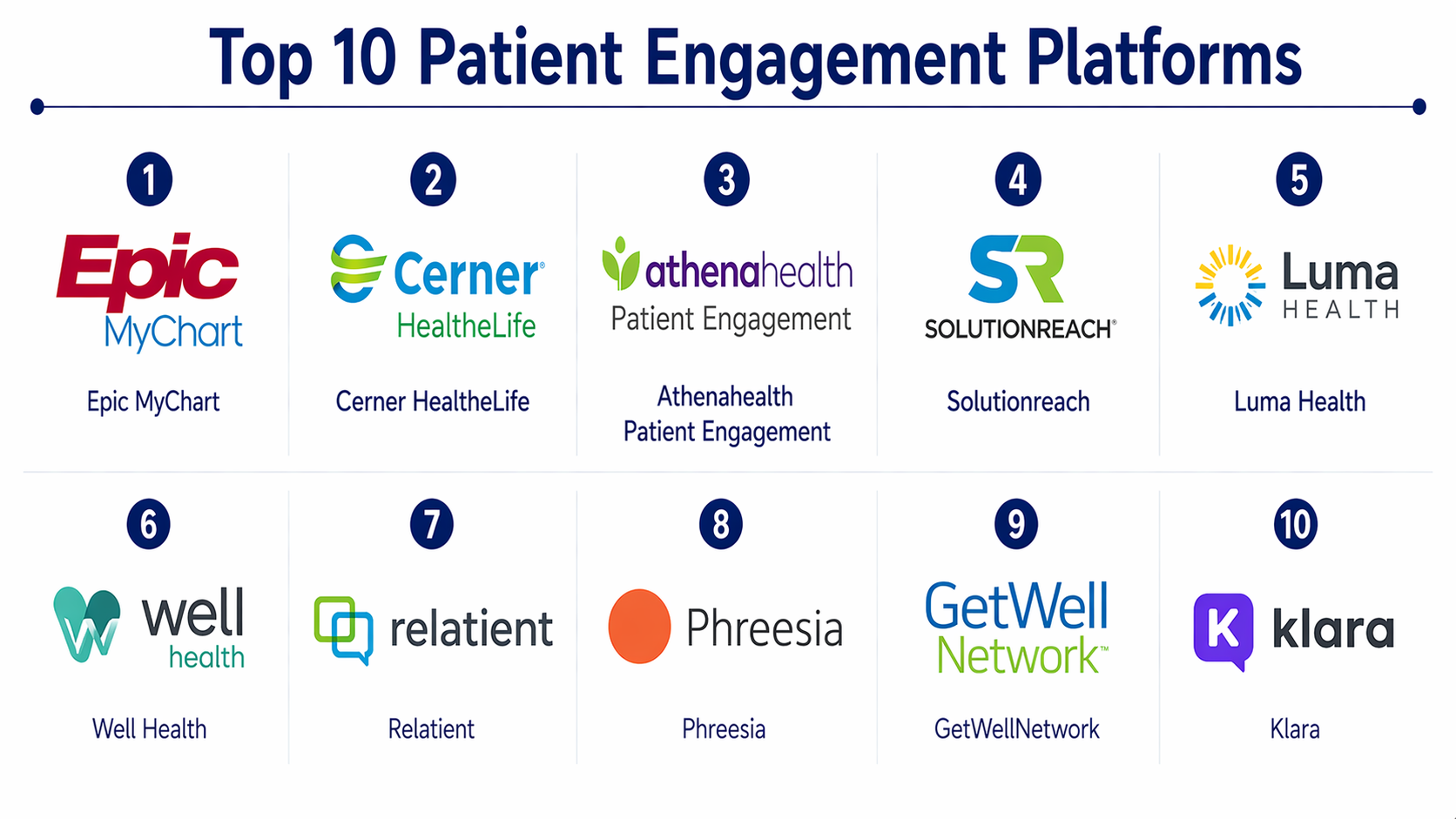
Top 10 Patient Engagement Platforms
#1 — Epic MyChart
Short description :
Epic MyChart is a widely adopted patient engagement platform integrated with the Epic ecosystem. It allows patients to interact with healthcare providers, access records, and manage appointments. It is best suited for large hospitals and health systems already using Epic. Its strength lies in seamless data access and strong patient-provider communication. It also supports telehealth and mobile engagement.
Key Features
- Secure messaging with providers
- Appointment scheduling and reminders
- Telehealth integration
- Access to medical records
- Billing and payments
- Mobile app support
Pros
- Strong integration with Epic systems
- High scalability and reliability
Cons
- Limited outside Epic ecosystem
- Complex implementation
Platforms / Deployment
- Web / iOS / Android
- Cloud / Hybrid
Security & Compliance
- HIPAA-ready capabilities, encryption, MFA (details not fully publicly stated)
Integrations & Ecosystem
Deep integration within Epic ecosystem.
- EHR systems
- Billing tools
- Telehealth solutions
Support & Community
Enterprise-level support with strong documentation.
#2 — Cerner HealtheLife
Short description:
Cerner HealtheLife enables patient engagement through communication, scheduling, and health data access. It is commonly used by large healthcare systems and integrates with Cerner EHR.
Key Features
- Messaging and communication
- Appointment scheduling
- Health record access
- Notifications and alerts
- Patient education tools
Pros
- Enterprise-grade scalability
- Strong EHR integration
Cons
- UI can be less intuitive
- Limited customization
Platforms / Deployment
- Web / Mobile
- Cloud
Security & Compliance
- Not publicly stated
Integrations & Ecosystem
- Cerner EHR integration
- Lab systems
- Billing systems
Support & Community
Varies; enterprise-level support available.
#3 — Athenahealth Patient Engagement
Short description:
Athenahealth provides a cloud-based patient engagement solution designed for modern clinics. It focuses on ease of use, communication, and workflow automation.
Key Features
- Appointment scheduling
- Automated reminders
- Patient messaging
- Billing integration
- Mobile-friendly UI
Pros
- Easy to use
- Cloud-native platform
Cons
- Limited deep customization
- Pricing varies
Platforms / Deployment
- Web / Mobile
- Cloud
Security & Compliance
- Not publicly stated
Integrations & Ecosystem
- EHR integration
- APIs for extensions
Support & Community
Strong onboarding and support for SMB and mid-market.
#4 — Solutionreach
Short description:
Solutionreach focuses on patient communication and engagement through automation. It helps reduce no-shows and improve patient satisfaction.
Key Features
- Automated reminders
- Two-way messaging
- Surveys and feedback
- Campaign management
- Reporting and analytics
Pros
- Strong automation features
- Improves patient retention
Cons
- Limited clinical data features
- Not a full EHR solution
Platforms / Deployment
- Web / Mobile
- Cloud
Security & Compliance
- Not publicly stated
Integrations & Ecosystem
- EHR integrations
- Communication tools
Support & Community
Good customer support and onboarding.
#5 — Luma Health
Short description:
Luma Health is a modern patient engagement platform focused on access and communication. It helps streamline patient workflows and improve scheduling efficiency.
Key Features
- Smart scheduling
- Automated outreach
- Messaging and chat
- Referral management
- Workflow automation
Pros
- Modern UI
- Strong automation
Cons
- Requires integration setup
- Pricing varies
Platforms / Deployment
- Web / Mobile
- Cloud
Security & Compliance
- Not publicly stated
Integrations & Ecosystem
- EHR integrations
- APIs available
Support & Community
Strong support for healthcare providers.
#6 — Well Health
Short description:
Well Health focuses on omnichannel communication and patient engagement. It centralizes communication across channels.
Key Features
- SMS, email, voice communication
- Patient messaging
- Scheduling support
- Campaign management
- Analytics
Pros
- Omnichannel communication
- Scalable
Cons
- Limited clinical features
- Setup complexity
Platforms / Deployment
- Web
- Cloud
Security & Compliance
- Not publicly stated
Integrations & Ecosystem
- EHR systems
- Communication tools
Support & Community
Varies / Not publicly stated.
#7 — Relatient
Short description:
Relatient specializes in patient scheduling and engagement. It focuses on improving patient access and reducing no-shows.
Key Features
- Scheduling tools
- Appointment reminders
- Messaging
- Patient intake
- Feedback collection
Pros
- Strong scheduling features
- Easy adoption
Cons
- Limited broader engagement features
- Less customization
Platforms / Deployment
- Web / Mobile
- Cloud
Security & Compliance
- Not publicly stated
Integrations & Ecosystem
- EHR integrations
- Scheduling systems
Support & Community
Good SMB-level support.
#8 — Phreesia
Short description:
Phreesia provides patient intake and engagement solutions. It helps automate front-office processes and improve patient experience.
Key Features
- Digital check-in
- Patient intake forms
- Payment processing
- Communication tools
- Analytics
Pros
- Strong front-office automation
- Improves efficiency
Cons
- Limited full engagement scope
- Pricing complexity
Platforms / Deployment
- Web / Mobile
- Cloud
Security & Compliance
- Not publicly stated
Integrations & Ecosystem
- EHR integration
- Billing systems
Support & Community
Strong onboarding and support.
#9 — GetWellNetwork
Short description:
GetWellNetwork focuses on patient engagement across the care continuum, including in-hospital and remote engagement.
Key Features
- Patient education
- Remote engagement tools
- Surveys and feedback
- Care plan tracking
- Analytics
Pros
- Strong patient education tools
- Enterprise-ready
Cons
- Complex implementation
- Higher cost
Platforms / Deployment
- Web / Mobile
- Cloud
Security & Compliance
- Not publicly stated
Integrations & Ecosystem
- EHR integration
- Patient monitoring tools
Support & Community
Enterprise-level support.
#10 — Klara
Short description:
Klara is a communication-first patient engagement platform designed for clinics and small healthcare providers.
Key Features
- Messaging and chat
- Appointment reminders
- Workflow automation
- Patient intake
- Mobile-friendly interface
Pros
- Easy to use
- Strong communication features
Cons
- Limited enterprise features
- Scalability constraints
Platforms / Deployment
- Web / Mobile
- Cloud
Security & Compliance
- Not publicly stated
Integrations & Ecosystem
- EHR integrations
- Communication APIs
Support & Community
Good support for SMB users.
Comparison Table (Top 10)
| Tool Name | Best For | Platform(s) Supported | Deployment | Standout Feature | Public Rating |
|---|---|---|---|---|---|
| Epic MyChart | Enterprise hospitals | Web, Mobile | Cloud/Hybrid | Deep integration | N/A |
| Cerner HealtheLife | Large systems | Web, Mobile | Cloud | Enterprise scalability | N/A |
| Athenahealth | Mid-sized clinics | Web, Mobile | Cloud | Easy UI | N/A |
| Solutionreach | Engagement automation | Web, Mobile | Cloud | Automation | N/A |
| Luma Health | Workflow automation | Web, Mobile | Cloud | Smart scheduling | N/A |
| Well Health | Omnichannel comms | Web | Cloud | Multi-channel messaging | N/A |
| Relatient | Scheduling-focused | Web, Mobile | Cloud | Appointment tools | N/A |
| Phreesia | Intake automation | Web, Mobile | Cloud | Digital check-in | N/A |
| GetWellNetwork | Enterprise engagement | Web, Mobile | Cloud | Patient education | N/A |
| Klara | SMB communication | Web, Mobile | Cloud | Messaging | N/A |
Evaluation & Patient Engagement Platforms
| Tool Name | Core | Ease | Integrations | Security | Performance | Support | Value | Weighted Total |
|---|---|---|---|---|---|---|---|---|
| Epic MyChart | 9 | 7 | 9 | 8 | 9 | 8 | 7 | 8.3 |
| Cerner HealtheLife | 8 | 7 | 8 | 8 | 8 | 7 | 7 | 7.8 |
| Athenahealth | 8 | 8 | 7 | 7 | 8 | 8 | 8 | 7.9 |
| Solutionreach | 7 | 8 | 7 | 6 | 7 | 8 | 7 | 7.2 |
| Luma Health | 8 | 8 | 8 | 7 | 8 | 8 | 7 | 7.9 |
| Well Health | 7 | 7 | 7 | 6 | 7 | 7 | 7 | 7.0 |
| Relatient | 7 | 8 | 7 | 6 | 7 | 7 | 7 | 7.1 |
| Phreesia | 8 | 7 | 8 | 7 | 8 | 8 | 7 | 7.7 |
| GetWellNetwork | 8 | 6 | 8 | 7 | 8 | 8 | 6 | 7.4 |
| Klara | 7 | 9 | 7 | 6 | 7 | 7 | 8 | 7.4 |
How to interpret scores:
These scores are comparative and meant to highlight relative strengths across key dimensions. A higher score indicates better overall performance, but the right choice depends on your use case, scale, and budget.
Which Patient Engagement Platforms
Solo / Freelancer
Klara and Kareo-like tools work best due to simplicity and ease of use.
SMB
Athenahealth, Solutionreach, and Relatient offer balanced features and affordability.
Mid-Market
Luma Health and Phreesia provide automation and scalability.
Enterprise
Epic MyChart, Cerner HealtheLife, and GetWellNetwork are best for large systems.
Budget vs Premium
- Budget: Klara, Relatient
- Premium: Epic, Cerner
Feature Depth vs Ease of Use
- Feature-rich: Epic, Cerner
- Easy: Klara, Athenahealth
Integrations & Scalability
Epic and Cerner dominate large-scale integration needs.
Security & Compliance Needs
Enterprise platforms provide stronger compliance readiness.
Frequently Asked Questions (FAQs)
1. What is a patient engagement platform?
It is a system that helps healthcare providers interact with patients through communication, reminders, and digital tools.
2. How much do these platforms cost?
Costs vary widely depending on features, scale, and deployment model.
3. Are these platforms secure?
Most platforms include encryption and authentication features, but compliance details vary.
4. Do they integrate with EHR systems?
Yes, integration with EHR systems is a core capability.
5. How long does implementation take?
It can range from a few weeks to several months.
6. Can small clinics use these tools?
Yes, many platforms are designed specifically for small practices.
7. What are common mistakes?
Ignoring integration complexity and user adoption challenges.
8. Are mobile apps supported?
Most modern platforms offer mobile-friendly experiences or apps.
9. Can these platforms scale?
Yes, especially cloud-based platforms designed for large patient populations.
10. Is switching platforms difficult?
Switching requires careful data migration and integration planning.
Conclusion
Patient engagement platforms are transforming how healthcare providers connect with patients. From improving communication to automating workflows and enhancing care outcomes, these tools play a crucial role in modern healthcare delivery. However, there is no one-size-fits-all solution. Enterprise organizations may prioritize deep integration and scalability, while smaller clinics may focus on ease of use and affordability.
