Introduction
A Hospital Information System (HIS) is a centralized software platform that manages all core hospital operations—clinical, administrative, financial, and operational—within a single ecosystem. In simple terms, it acts as the digital backbone of a hospital, connecting patient records, billing, appointments, diagnostics, and workflows.
In the 2026+ healthcare landscape, HIS platforms are no longer optional. Rising patient volumes, regulatory pressure, telemedicine expansion, and AI-driven diagnostics demand real-time, secure, and integrated systems. Hospitals are shifting from fragmented tools to unified platforms that improve care quality and operational efficiency.
Real-world use cases:
- Managing patient admissions, discharges, and transfers (ADT)
- Digitizing electronic health records (EHR)
- Automating billing, insurance claims, and revenue cycle
- Integrating lab, pharmacy, and radiology systems
- Enabling telemedicine and remote patient monitoring
What buyers should evaluate:
- Scalability and performance
- Integration capabilities (EHR, LIS, PACS)
- Security and compliance readiness
- Ease of use for medical staff
- Customization and workflow flexibility
- Vendor support and onboarding
- Cost structure and ROI
- Reporting and analytics features
Best for: Large hospitals, multi-specialty clinics, healthcare networks, and government health systems that require centralized data management and compliance.
Not ideal for: Small clinics or solo practitioners who may prefer lightweight EMR tools instead of full-scale HIS platforms.
Key Trends in Hospital Information Systems
- AI-powered diagnostics and decision support improving clinical accuracy
- Cloud-first deployments replacing legacy on-premise systems
- Interoperability standards (FHIR, HL7) becoming mandatory
- Real-time data analytics dashboards for operational insights
- Mobile-first interfaces for doctors and nurses
- Cybersecurity enhancements including zero-trust architecture
- Automation of administrative workflows (billing, scheduling)
- Telehealth integration as a standard feature
- Patient engagement platforms with portals and apps
- Subscription-based pricing models replacing large upfront costs
How We Selected These Tools (Methodology)
- Strong global adoption and hospital deployments
- Comprehensive feature coverage across clinical and admin workflows
- Proven reliability and uptime performance
- Security and compliance alignment with healthcare standards
- Integration capabilities with healthcare ecosystems
- Flexibility across hospital sizes and specialties
- Vendor reputation and long-term sustainability
- Innovation in AI, analytics, and automation
- Usability for both clinical and non-clinical users
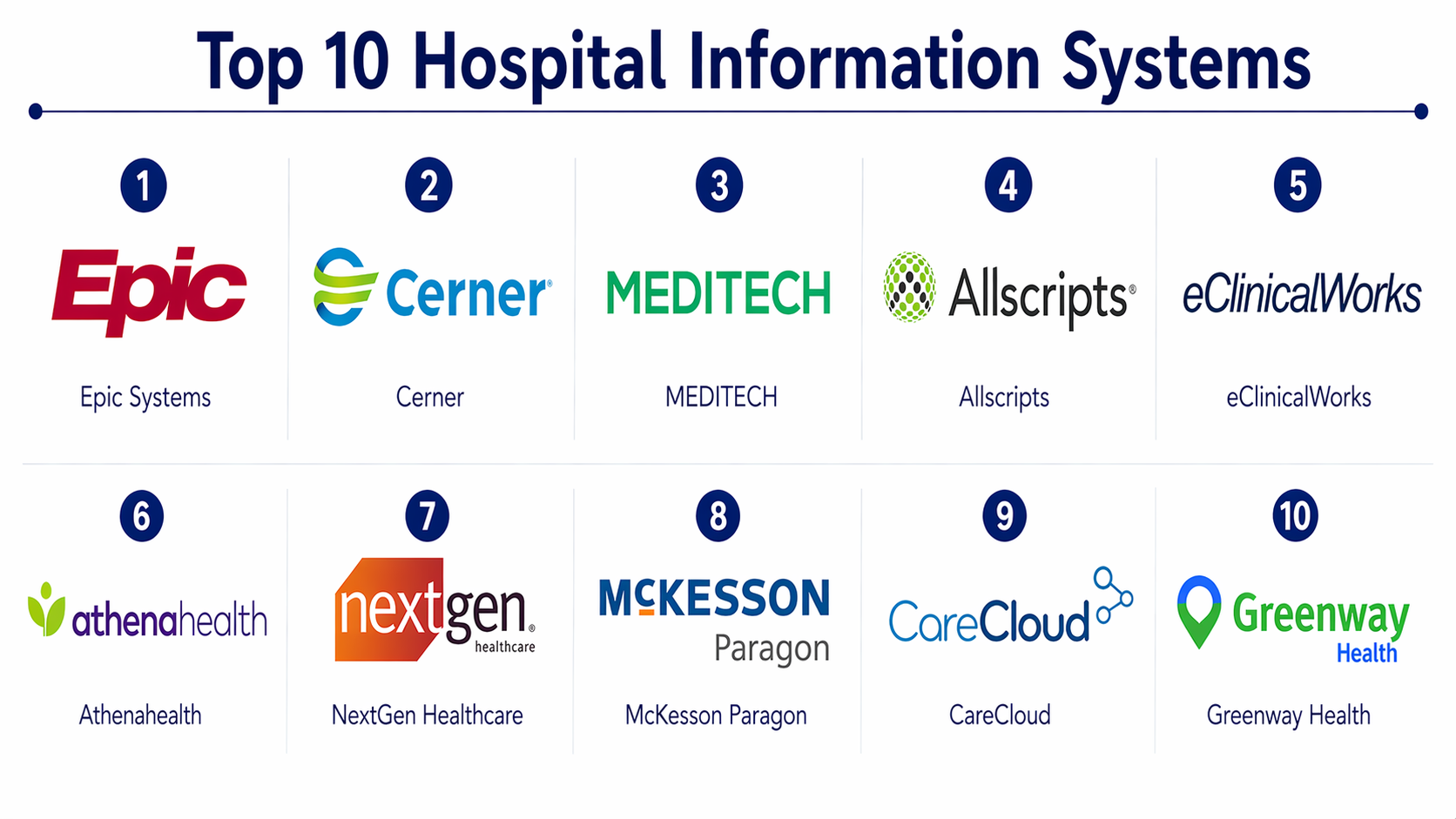
Top 10 Hospital Information Systems
#1 — Epic Systems
Short description :
Epic Systems is one of the most widely used enterprise-grade hospital information systems globally. It offers a fully integrated platform covering EHR, billing, patient engagement, and analytics. Known for its scalability, Epic is widely adopted by large hospitals and academic medical centers. It provides deep customization and strong interoperability capabilities. However, it requires significant implementation effort and investment.
Key Features
- Comprehensive EHR system
- Advanced analytics and reporting
- Patient portal and engagement tools
- Revenue cycle management
- Interoperability with third-party systems
- AI-driven clinical decision support
Pros
- Highly scalable for large healthcare systems
- Strong ecosystem and integration capabilities
Cons
- Expensive and complex implementation
- Requires extensive training
Platforms / Deployment
Web / Cloud / Hybrid
Security & Compliance
HIPAA, encryption, RBAC (others not publicly stated)
Integrations & Ecosystem
Epic integrates with major healthcare tools and devices through APIs and standard protocols.
- HL7 and FHIR support
- Lab and imaging systems
- Third-party healthcare apps
- Custom integrations via APIs
Support & Community
Strong enterprise support with structured onboarding and training programs.
#2 — Cerner
Short description :
Cerner provides a robust hospital information system focused on interoperability and data sharing. It is widely used by hospitals and government healthcare systems. Cerner emphasizes population health management and analytics. It offers a flexible architecture suitable for large deployments.
Key Features
- Unified patient records
- Population health analytics
- Clinical workflow automation
- Interoperability tools
- Revenue cycle management
Pros
- Strong interoperability capabilities
- Scalable for large healthcare systems
Cons
- Complex user interface
- Implementation can be lengthy
Platforms / Deployment
Cloud / Hybrid
Security & Compliance
HIPAA, encryption (others not publicly stated)
Integrations & Ecosystem
Cerner integrates with a wide healthcare ecosystem.
- Third-party clinical systems
- Government health databases
- APIs for custom integrations
Support & Community
Enterprise-grade support with global presence.
#3 — MEDITECH
Short description :
MEDITECH is a cost-effective HIS platform designed for mid-sized hospitals. It offers a web-based interface and modern cloud capabilities. The platform balances affordability with essential healthcare functionalities.
Key Features
- Web-based EHR
- Clinical documentation
- Patient management
- Billing and finance modules
- Data analytics tools
Pros
- More affordable than enterprise systems
- Modern web interface
Cons
- Limited customization compared to Epic
- Smaller ecosystem
Platforms / Deployment
Web / Cloud
Security & Compliance
Not publicly stated
Integrations & Ecosystem
Supports integrations with healthcare systems.
- HL7 compatibility
- Third-party lab systems
Support & Community
Moderate support with growing user base.
#4 — Allscripts
Short description :
Allscripts offers flexible HIS solutions focusing on interoperability and open APIs. It supports hospitals looking for customizable workflows and modular deployments.
Key Features
- Open API architecture
- Clinical decision support
- Patient engagement tools
- Revenue cycle management
- Data analytics
Pros
- Highly customizable
- Strong interoperability
Cons
- UI can feel outdated
- Integration complexity
Platforms / Deployment
Cloud / Hybrid
Security & Compliance
Not publicly stated
Integrations & Ecosystem
Strong API-driven ecosystem.
- Third-party healthcare apps
- Integration frameworks
Support & Community
Varies / Not publicly stated
#5 — eClinicalWorks
Short description :
eClinicalWorks provides a cloud-based HIS platform targeting small to mid-sized healthcare providers. It focuses on usability and patient engagement.
Key Features
- Cloud-based EHR
- Telehealth integration
- Patient portals
- Billing automation
- Analytics dashboards
Pros
- User-friendly interface
- Affordable pricing
Cons
- Limited enterprise features
- Customization constraints
Platforms / Deployment
Web / Cloud
Security & Compliance
HIPAA (others not publicly stated)
Integrations & Ecosystem
Integrates with healthcare services and tools.
- Labs and pharmacies
- Telehealth platforms
Support & Community
Good onboarding and support for SMB users.
#6 — Athenahealth
Short description :
Athenahealth is a cloud-based HIS platform known for its strong revenue cycle management and analytics capabilities. It is widely used by outpatient and ambulatory care providers.
Key Features
- Cloud-native platform
- Revenue cycle management
- Patient engagement tools
- Analytics and reporting
- Interoperability
Pros
- Strong billing and financial tools
- Easy cloud deployment
Cons
- Less suited for large hospitals
- Limited deep customization
Platforms / Deployment
Cloud
Security & Compliance
HIPAA (others not publicly stated)
Integrations & Ecosystem
Robust integration ecosystem.
- Healthcare APIs
- Third-party applications
Support & Community
Reliable support and training resources.
#7 — NextGen Healthcare
Short description :
NextGen Healthcare provides a flexible HIS platform focused on specialty practices. It offers customizable workflows and strong analytics capabilities.
Key Features
- Specialty-specific workflows
- EHR integration
- Analytics tools
- Billing and scheduling
- Patient engagement
Pros
- Flexible customization
- Strong specialty support
Cons
- Learning curve
- Integration challenges
Platforms / Deployment
Cloud / Hybrid
Security & Compliance
Not publicly stated
Integrations & Ecosystem
Supports integrations with healthcare systems.
- APIs and data exchange tools
Support & Community
Moderate support quality.
#8 — McKesson Paragon
Short description :
McKesson Paragon is designed for community hospitals and smaller healthcare providers. It offers a unified platform for clinical and financial workflows.
Key Features
- Integrated clinical and financial systems
- Patient management
- Reporting tools
- Billing automation
Pros
- Suitable for smaller hospitals
- Integrated workflows
Cons
- Limited scalability
- Older architecture
Platforms / Deployment
Varies / N/A
Security & Compliance
Not publicly stated
Integrations & Ecosystem
Basic integrations available.
- Healthcare systems
- Internal modules
Support & Community
Varies / Not publicly stated
#9 — CareCloud
Short description :
CareCloud is a modern cloud-based HIS platform focused on usability and analytics. It is suitable for small to mid-sized healthcare providers.
Key Features
- Cloud-native architecture
- Revenue cycle management
- Patient engagement
- Analytics dashboards
Pros
- Modern UI
- Easy deployment
Cons
- Limited enterprise capabilities
- Smaller ecosystem
Platforms / Deployment
Cloud
Security & Compliance
Not publicly stated
Integrations & Ecosystem
Supports integrations via APIs.
- Third-party healthcare tools
Support & Community
Good SMB support.
#10 — Greenway Health
Short description :
Greenway Health provides HIS solutions tailored for ambulatory care and specialty clinics. It focuses on usability and compliance.
Key Features
- EHR and practice management
- Patient engagement
- Compliance tools
- Reporting and analytics
Pros
- Easy to use
- Strong compliance focus
Cons
- Limited scalability
- Fewer advanced features
Platforms / Deployment
Cloud
Security & Compliance
Not publicly stated
Integrations & Ecosystem
Supports integrations with healthcare tools.
- APIs and third-party integrations
Support & Community
Varies / Not publicly stated
Comparison Table (Top 10)
| Tool Name | Best For | Platform(s) Supported | Deployment | Standout Feature | Public Rating |
|---|---|---|---|---|---|
| Epic Systems | Large hospitals | Web | Hybrid | Full ecosystem integration | N/A |
| Cerner | Enterprise healthcare | Web | Hybrid | Interoperability | N/A |
| MEDITECH | Mid-sized hospitals | Web | Cloud | Cost-effective | N/A |
| Allscripts | Custom workflows | Web | Hybrid | Open APIs | N/A |
| eClinicalWorks | SMB healthcare | Web | Cloud | User-friendly | N/A |
| Athenahealth | Ambulatory care | Web | Cloud | Revenue cycle tools | N/A |
| NextGen Healthcare | Specialty practices | Web | Hybrid | Custom workflows | N/A |
| McKesson Paragon | Community hospitals | N/A | N/A | Integrated workflows | N/A |
| CareCloud | Small providers | Web | Cloud | Modern UI | N/A |
| Greenway Health | Clinics | Web | Cloud | Compliance tools | N/A |
Evaluation & Hospital Information Systems
| Tool Name | Core (25%) | Ease (15%) | Integrations (15%) | Security (10%) | Performance (10%) | Support (10%) | Value (15%) | Weighted Total |
|---|---|---|---|---|---|---|---|---|
| Epic Systems | 10 | 6 | 9 | 9 | 9 | 9 | 6 | 8.4 |
| Cerner | 9 | 6 | 9 | 9 | 9 | 8 | 7 | 8.3 |
| MEDITECH | 7 | 8 | 7 | 7 | 8 | 7 | 8 | 7.5 |
| Allscripts | 8 | 6 | 8 | 7 | 8 | 7 | 7 | 7.6 |
| eClinicalWorks | 7 | 9 | 7 | 7 | 8 | 8 | 8 | 7.9 |
| Athenahealth | 8 | 9 | 8 | 8 | 8 | 8 | 7 | 8.1 |
| NextGen Healthcare | 8 | 7 | 8 | 7 | 8 | 7 | 7 | 7.6 |
| McKesson Paragon | 6 | 6 | 6 | 6 | 7 | 6 | 7 | 6.4 |
| CareCloud | 7 | 9 | 7 | 7 | 8 | 7 | 8 | 7.8 |
| Greenway Health | 7 | 8 | 7 | 7 | 7 | 7 | 7 | 7.3 |
How to interpret scores:
These scores are comparative, not absolute. A higher score indicates stronger overall capability across multiple dimensions. Enterprise tools score high in features and integrations but may lag in ease of use. SMB-focused tools often excel in usability and value but may lack deep functionality. Choose based on your specific priorities rather than the highest score.
Which Hospital Information Systems
Solo / Freelancer
Lightweight EMR tools are better. Full HIS platforms are overkill.
SMB
Best options: eClinicalWorks, CareCloud, Greenway Health
Focus on ease of use and affordability.
Mid-Market
Best options: MEDITECH, Athenahealth, NextGen
Balance between features and cost.
Enterprise
Best options: Epic Systems, Cerner
Strong scalability and integrations.
Budget vs Premium
- Budget: MEDITECH, CareCloud
- Premium: Epic, Cerner
Feature Depth vs Ease of Use
- Deep features: Epic, Cerner
- Easy to use: Athenahealth, eClinicalWorks
Integrations & Scalability
Choose Epic or Cerner for large-scale integrations.
Security & Compliance Needs
Enterprise tools offer better compliance readiness.
Frequently Asked Questions (FAQs)
1. What is the cost of a Hospital Information System?
Costs vary widely depending on size and deployment. Enterprise systems are expensive, while cloud-based solutions are more affordable.
2. How long does implementation take?
Implementation can take months to years depending on system complexity and hospital size.
3. Is cloud HIS secure?
Yes, if properly configured with encryption, MFA, and compliance standards.
4. Can HIS integrate with existing systems?
Most modern HIS platforms support integration via APIs and standards like HL7.
5. What are common implementation mistakes?
Poor planning, lack of training, and ignoring integration needs.
6. Can small clinics use HIS?
Yes, but lightweight EMR solutions are often better suited.
7. How scalable are these systems?
Enterprise HIS platforms are highly scalable; SMB tools have limitations.
8. What security features should I look for?
Encryption, access control, audit logs, and compliance certifications.
9. Can I switch HIS platforms later?
Yes, but data migration can be complex and costly.
10. Are AI features important?
Increasingly yes, for diagnostics, analytics, and automation.
Conclusion
Hospital Information Systems have become a critical foundation for modern healthcare operations. From managing patient records to enabling AI-driven insights, these platforms play a central role in improving efficiency and care quality. However, there is no one-size-fits-all solution. Large hospitals may benefit from enterprise-grade platforms like Epic or Cerner, while smaller providers may find better value in cloud-native solutions like Athenahealth or CareCloud.
