Introduction
Smart Home Platforms are software ecosystems that connect, control, and automate devices inside homes—such as lighting, thermostats, cameras, appliances, and voice assistants. In simple terms, they act as a central hub that allows users to manage multiple smart devices from a single interface, often through mobile apps, voice commands, or automation routines.
In the modern connected world, smart home platforms have become more than just convenience tools. With increasing focus on energy efficiency, security, and automation, they are now essential for modern living. From adjusting temperature automatically to monitoring home security remotely, these platforms play a crucial role in improving quality of life and reducing operational costs.
Real-world use cases:
- Automating lighting and temperature based on occupancy
- Remote home monitoring via cameras and sensors
- Voice-controlled device management
- Energy optimization and smart scheduling
- Smart security systems with alerts and automation
What buyers should evaluate:
- Device compatibility and ecosystem support
- Automation capabilities and rule engines
- Voice assistant integration
- Mobile app usability
- Security and privacy controls
- Cloud vs local control options
- Scalability and extensibility
- Offline functionality
- Integration with third-party apps
Best for: Homeowners, tech enthusiasts, families, and property managers looking to automate and secure residential environments.
Not ideal for: Users with minimal smart devices or those preferring manual control without automation complexity.
Key Trends in Smart Home Platforms
- AI-powered automation for predictive home behavior
- Matter protocol adoption improving interoperability
- Voice-first interfaces becoming standard
- Edge computing for faster local automation
- Energy management integration with smart grids
- Privacy-first designs with local data processing
- Subscription services for premium features
- Mobile-first user experiences
- Cross-platform ecosystems connecting multiple brands
- Integration with EV charging and solar systems
How We Selected These Tools (Methodology)
- Considered market popularity and adoption across regions
- Evaluated device compatibility and ecosystem strength
- Assessed automation capabilities and flexibility
- Reviewed performance and reliability
- Analyzed security features and privacy controls
- Checked ease of use and onboarding experience
- Evaluated integration with third-party apps and services
- Considered scalability for growing smart homes
- Included platforms for different user segments
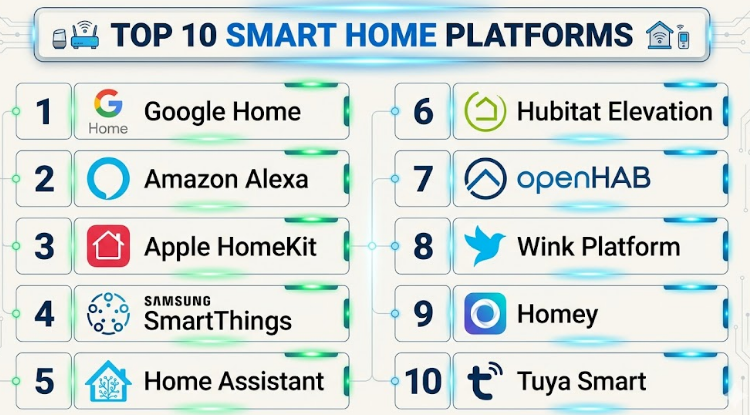
Top 10 Smart Home Platforms
#1 — Google Home
Short description (5-6 lines):
Google Home is a widely used smart home platform that integrates seamlessly with Google Assistant. It allows users to control devices, create automation routines, and manage their homes via voice and mobile apps. It supports a broad range of third-party devices. Ideal for users already invested in the Google ecosystem.
Key Features
- Voice control with Google Assistant
- Automation routines
- Device grouping and scenes
- Integration with thousands of devices
- Mobile app control
- Smart notifications
Pros
- Easy to use
- Wide device compatibility
Cons
- Cloud dependency
- Limited offline automation
Platforms / Deployment
Android / iOS / Cloud
Security & Compliance
MFA, encryption; certifications not publicly stated
Integrations & Ecosystem
Large ecosystem with smart device manufacturers.
- Smart lights, cameras, thermostats
- APIs and integrations
- Voice assistant integrations
Support & Community
Strong community and extensive documentation
#2 — Amazon Alexa
Short description (5-6 lines):
Amazon Alexa is a leading smart home platform focused on voice-driven automation. It connects a wide range of devices and offers extensive customization through skills. It is widely adopted globally.
Key Features
- Voice control
- Skill-based extensibility
- Smart routines
- Multi-device support
- Notifications and alerts
Pros
- Large ecosystem
- Flexible integrations
Cons
- Privacy concerns for some users
- Cloud dependency
Platforms / Deployment
Android / iOS / Cloud
Security & Compliance
MFA, encryption; not publicly stated
Integrations & Ecosystem
Extensive integrations across brands.
- Smart home devices
- APIs
- Voice integrations
Support & Community
Large community and strong support
#3 — Apple HomeKit
Short description (5-6 lines):
Apple HomeKit offers a privacy-focused smart home platform integrated with iOS devices. It provides secure automation and seamless device control. Ideal for Apple ecosystem users.
Key Features
- Secure device control
- Automation routines
- Siri integration
- Home app management
- Local processing support
Pros
- Strong privacy controls
- Seamless Apple integration
Cons
- Limited device compatibility
- Apple-only ecosystem
Platforms / Deployment
iOS / macOS / Cloud
Security & Compliance
Encryption, secure pairing
Integrations & Ecosystem
Focused on certified devices.
- Smart home accessories
- APIs
Support & Community
Strong Apple support ecosystem
#4 — Samsung SmartThings
Short description (5-6 lines):
SmartThings is a versatile smart home platform that supports a wide range of devices. It offers automation and monitoring capabilities. Suitable for both beginners and advanced users.
Key Features
- Device automation
- Multi-device control
- Smart scenes
- Monitoring tools
- Integration with IoT devices
Pros
- Broad compatibility
- Flexible automation
Cons
- UI complexity
- Cloud reliance
Platforms / Deployment
Android / iOS / Cloud
Security & Compliance
Not publicly stated
Integrations & Ecosystem
Supports many devices.
- IoT integrations
- APIs
Support & Community
Active community support
#5 — Home Assistant
Short description (5-6 lines):
Home Assistant is an open-source platform focused on local control and privacy. It provides powerful automation capabilities and extensive customization. Ideal for advanced users.
Key Features
- Local control
- Advanced automation
- Open-source flexibility
- Integration with many devices
- Custom dashboards
Pros
- Highly customizable
- Privacy-focused
Cons
- Requires technical knowledge
- Setup complexity
Platforms / Deployment
Linux / Self-hosted
Security & Compliance
Varies / N/A
Integrations & Ecosystem
Extensive open integrations.
- APIs
- IoT devices
- Custom plugins
Support & Community
Strong open-source community
#6 — Hubitat Elevation
Short description (5-6 lines):
Hubitat is a local-first smart home platform designed for fast automation. It focuses on reliability and offline functionality. Suitable for advanced users.
Key Features
- Local automation
- Device compatibility
- Rule engine
- Fast response times
- Offline support
Pros
- No cloud dependency
- Reliable performance
Cons
- Complex setup
- Limited UI polish
Platforms / Deployment
Local hub / Self-hosted
Security & Compliance
Not publicly stated
Integrations & Ecosystem
Supports integrations via hubs.
- APIs
- IoT devices
Support & Community
Active niche community
#7 — openHAB
Short description (5-6 lines):
openHAB is an open-source smart home platform offering flexibility and extensibility. It supports many devices and protocols. Suitable for technical users.
Key Features
- Open-source platform
- Extensive integrations
- Automation rules
- Cross-platform support
- Local control
Pros
- Flexible
- No vendor lock-in
Cons
- Steep learning curve
- Requires maintenance
Platforms / Deployment
Windows / Linux / macOS / Self-hosted
Security & Compliance
Varies / N/A
Integrations & Ecosystem
Large plugin ecosystem.
- APIs
- IoT devices
Support & Community
Strong community-driven support
#8 — Wink Platform
Short description (5-6 lines):
Wink provides a simplified smart home experience with a focus on ease of use. It supports multiple device types and offers automation features.
Key Features
- Simple UI
- Automation rules
- Device compatibility
- Remote access
- Notifications
Pros
- User-friendly
- Easy setup
Cons
- Limited updates
- Smaller ecosystem
Platforms / Deployment
Cloud
Security & Compliance
Not publicly stated
Integrations & Ecosystem
Moderate integrations.
- IoT devices
Support & Community
Limited support
#9 — Homey
Short description (5-6 lines):
Homey is a smart home platform combining ease of use with advanced automation. It supports multiple protocols and provides a centralized hub.
Key Features
- Multi-protocol support
- Automation flows
- Device compatibility
- Voice integration
- Mobile app
Pros
- Easy to use
- Strong automation
Cons
- Premium pricing
- Hardware dependency
Platforms / Deployment
Cloud / Hub
Security & Compliance
Not publicly stated
Integrations & Ecosystem
Supports wide integrations.
- IoT devices
- APIs
Support & Community
Growing community
#10 — Tuya Smart
Short description (5-6 lines):
Tuya Smart is a cloud-based platform powering many white-label smart devices. It is widely used by manufacturers and consumers.
Key Features
- Device control
- Automation routines
- Cloud management
- White-label support
- Mobile app
Pros
- Affordable ecosystem
- Wide device availability
Cons
- Privacy concerns
- Heavy cloud reliance
Platforms / Deployment
Android / iOS / Cloud
Security & Compliance
Not publicly stated
Integrations & Ecosystem
Large device ecosystem.
- APIs
- Smart devices
Support & Community
Moderate support
Comparison Table (Top 10)
| Tool Name | Best For | Platform(s) Supported | Deployment | Standout Feature | Public Rating |
|---|---|---|---|---|---|
| Google Home | Beginners | Android/iOS | Cloud | Voice assistant | N/A |
| Amazon Alexa | Voice automation | Android/iOS | Cloud | Skill ecosystem | N/A |
| Apple HomeKit | Apple users | iOS/macOS | Cloud | Privacy | N/A |
| SmartThings | Flexibility | Android/iOS | Cloud | Device compatibility | N/A |
| Home Assistant | Advanced users | Linux | Self-hosted | Local control | N/A |
| Hubitat | Offline control | Local hub | Self-hosted | Fast automation | N/A |
| openHAB | Open-source | Multi-platform | Self-hosted | Extensibility | N/A |
| Wink | Simplicity | Web | Cloud | Ease of use | N/A |
| Homey | Automation | Hub | Cloud | Multi-protocol | N/A |
| Tuya Smart | Budget users | Android/iOS | Cloud | Wide device support | N/A |
Evaluation & Scoring of Smart Home Platforms
| Tool Name | Core | Ease | Integrations | Security | Performance | Support | Value | Weighted Total |
|---|---|---|---|---|---|---|---|---|
| Google Home | 9 | 9 | 9 | 7 | 8 | 9 | 8 | 8.6 |
| Alexa | 9 | 8 | 9 | 7 | 8 | 9 | 8 | 8.4 |
| HomeKit | 8 | 8 | 7 | 9 | 8 | 9 | 7 | 8.0 |
| SmartThings | 8 | 7 | 9 | 7 | 8 | 8 | 8 | 8.0 |
| Home Assistant | 9 | 6 | 9 | 8 | 9 | 8 | 8 | 8.3 |
| Hubitat | 8 | 6 | 7 | 8 | 9 | 7 | 7 | 7.6 |
| openHAB | 8 | 6 | 9 | 7 | 8 | 7 | 8 | 7.8 |
| Wink | 6 | 8 | 6 | 6 | 6 | 6 | 7 | 6.5 |
| Homey | 8 | 8 | 8 | 7 | 8 | 7 | 7 | 7.8 |
| Tuya | 7 | 9 | 8 | 6 | 7 | 7 | 9 | 7.8 |
Scores are comparative and reflect strengths within this list.
Which Smart Home Platforms
Solo / Freelancer
Google Home and Alexa for simplicity.
SMB
SmartThings and Homey offer flexibility.
Mid-Market
Home Assistant and openHAB provide customization.
Enterprise
Not typical; consider IoT platforms instead.
Budget vs Premium
Tuya for budget; HomeKit/Homey for premium.
Feature Depth vs Ease of Use
Home Assistant offers depth; Google Home offers ease.
Integrations & Scalability
Alexa and SmartThings lead in integrations.
Security & Compliance Needs
HomeKit is best for privacy-focused users.
Frequently Asked Questions (FAQs)
1. What is a smart home platform?
It is a system that connects and automates devices within a home.
2. Do I need internet for smart homes?
Most platforms rely on internet, but some support offline automation.
3. Which platform is best for beginners?
Google Home and Alexa are easiest to start with.
4. Are smart homes secure?
Security depends on platform and device configurations.
5. Can I mix devices from different brands?
Yes, most platforms support multiple brands.
6. What is Matter protocol?
It is a standard that improves compatibility across devices.
7. Do smart homes save energy?
Yes, through automation and efficient usage.
8. Is setup difficult?
Depends on platform; some are plug-and-play.
9. Can I control devices remotely?
Yes, through mobile apps.
10. Are there subscription costs?
Some features may require subscriptions.
Conclusion
Smart home platforms have evolved into powerful ecosystems that go far beyond simple device control. They now combine automation, AI-driven insights, voice interaction, and energy optimization into unified experiences that significantly enhance convenience, efficiency, and home security. However, there is no one-size-fits-all solution. Your ideal platform depends on factors such as your preferred ecosystem, technical expertise, device compatibility needs, and privacy expectations. Beginners may benefit from platforms like Google Home or Alexa, while advanced users will appreciate the flexibility of Home Assistant or openHAB. The best next step is to shortlist two or three platforms, test compatibility with your existing devices, and run small automation scenarios before fully committing to a long-term setup.
