Introduction
Release Management Tools are platforms that help teams plan, schedule, coordinate, and deploy software releases in a controlled and efficient manner. In simple terms, they ensure that code moves smoothly from development to production with minimal risk and maximum visibility.
As organizations adopt continuous delivery and DevOps practices, managing releases has become more complex. Multiple teams, environments, and dependencies must be coordinated, making manual processes error-prone. Release management tools provide automation, governance, and visibility across the entire release lifecycle.
Common use cases include:
- Coordinating software releases across environments
- Automating deployment workflows
- Managing release schedules and approvals
- Tracking release status and progress
- Reducing deployment risks and failures
Key evaluation criteria:
- Release automation and orchestration capabilities
- Integration with CI/CD pipelines
- Environment and dependency management
- Approval workflows and governance
- Visibility and reporting
- Ease of use and onboarding
- Scalability for large teams
- Security and compliance features
- Integration ecosystem
- Pricing and flexibility
Best for: DevOps teams, release managers, developers, and enterprises managing complex deployment pipelines.
Not ideal for: Small teams with simple deployment processes or those already fully automated with minimal coordination needs.
Key Trends in Release Management Tools
- End-to-end automation: From build to deployment without manual intervention
- GitOps adoption: Managing releases through version-controlled configurations
- AI-driven release insights: Predicting risks and optimizing deployment strategies
- Progressive delivery: Canary releases, blue-green deployments
- Multi-cloud and hybrid support: Managing releases across environments
- Compliance and audit trails: Tracking approvals and changes
- Low-code/no-code workflows: Simplifying release orchestration
- Integration with observability tools: Monitoring release performance
- Shift-left testing integration: Embedding testing in release pipelines
- Centralized dashboards: Real-time visibility into releases
How We Selected These Tools (Methodology)
We evaluated Release Management Tools based on:
- Market adoption and credibility
- Feature completeness (automation, orchestration, visibility)
- Ease of use and onboarding
- Integration with CI/CD and DevOps tools
- Scalability across environments and teams
- Security and compliance capabilities
- Performance and reliability
- Flexibility and customization
- Community and vendor support
- Overall value for cost
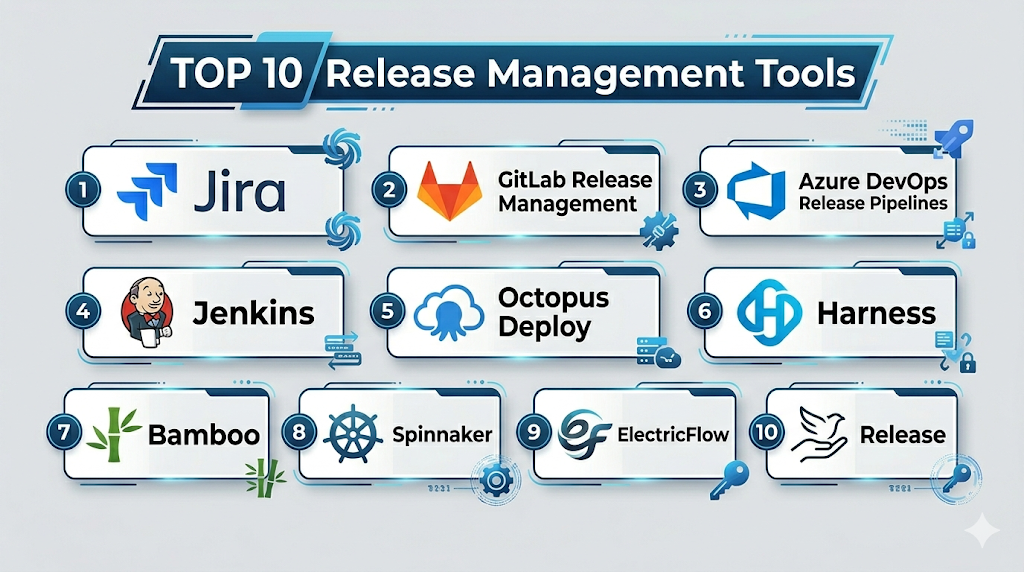
Top 10 Release Management Tools
#1 — Jira (Release Management)
Short description: A widely used project management tool with strong release tracking and planning capabilities for Agile teams.
Key Features
- Release planning and tracking
- Version management
- Workflow automation
- Integration with DevOps tools
- Reporting and dashboards
- Issue tracking
Pros
- Highly flexible and customizable
- Strong ecosystem
Cons
- Requires configuration for release management
- Can become complex at scale
Platforms / Deployment
Cloud / Self-hosted
Security & Compliance
SSO, RBAC, audit logs
Integrations & Ecosystem
Jira integrates with a broad ecosystem of development and DevOps tools.
- CI/CD tools
- SCM platforms
- Testing tools
Support & Community
Large community and strong vendor support.
#2 — GitLab Release Management
Short description: Built-in release management capabilities within GitLab, offering end-to-end DevOps integration.
Key Features
- Release pipelines
- Version tagging
- CI/CD integration
- Deployment tracking
- Environment management
Pros
- All-in-one DevOps platform
- Strong automation
Cons
- Learning curve
- Performance depends on setup
Platforms / Deployment
Cloud / Self-hosted
Security & Compliance
RBAC, encryption, audit logs
Integrations & Ecosystem
Deep integration within GitLab ecosystem.
- CI/CD pipelines
- Kubernetes
- Monitoring tools
Support & Community
Strong community and enterprise support.
#3 — Azure DevOps Release Pipelines
Short description: A comprehensive release management solution integrated into Azure DevOps.
Key Features
- Release pipelines
- Environment management
- Approval workflows
- Deployment automation
- Integration with Azure services
Pros
- Strong Microsoft ecosystem
- Enterprise-ready
Cons
- Complex UI
- Best suited for Azure users
Platforms / Deployment
Cloud
Security & Compliance
RBAC, encryption, audit logs
Integrations & Ecosystem
Works seamlessly within Microsoft ecosystem.
- Azure services
- CI/CD tools
Support & Community
Enterprise support.
#4 — Jenkins (with plugins)
Short description: An open-source automation server used for building, testing, and managing releases with plugins.
Key Features
- Pipeline automation
- Plugin-based extensibility
- Integration with CI/CD tools
- Custom workflows
- Distributed builds
Pros
- Highly flexible
- Open-source
Cons
- Requires maintenance
- Complex configuration
Platforms / Deployment
Self-hosted
Security & Compliance
Not publicly stated
Integrations & Ecosystem
Jenkins integrates with a vast range of tools through plugins.
- CI/CD tools
- SCM systems
- Cloud platforms
Support & Community
Very large open-source community.
#5 — Octopus Deploy
Short description: A dedicated deployment automation and release management tool for complex environments.
Key Features
- Deployment automation
- Environment management
- Release versioning
- Approval workflows
- Multi-tenant deployments
Pros
- Strong deployment capabilities
- User-friendly
Cons
- Paid tool
- Limited outside deployment scope
Platforms / Deployment
Cloud / Self-hosted
Security & Compliance
RBAC, encryption, audit logs
Integrations & Ecosystem
Integrates with development and deployment tools.
- CI/CD tools
- Cloud platforms
Support & Community
Strong vendor support.
#6 — Harness
Short description: A modern DevOps platform offering continuous delivery and release management with automation and AI insights.
Key Features
- Continuous delivery pipelines
- Release automation
- AI-driven insights
- Canary deployments
- Feature flags
Pros
- Advanced automation
- Intelligent insights
Cons
- Expensive
- Learning curve
Platforms / Deployment
Cloud
Security & Compliance
RBAC, encryption, audit logs
Integrations & Ecosystem
Harness integrates with modern DevOps ecosystems.
- CI/CD tools
- Cloud platforms
Support & Community
Enterprise support.
#7 — Bamboo (by Atlassian)
Short description: A CI/CD tool with release management capabilities, designed for integration with Atlassian products.
Key Features
- Build and deployment pipelines
- Release tracking
- Integration with Jira
- Automation
- Environment management
Pros
- Strong Atlassian integration
- Easy to use
Cons
- Limited compared to modern tools
- Requires licensing
Platforms / Deployment
Self-hosted
Security & Compliance
RBAC, encryption
Integrations & Ecosystem
Works within Atlassian ecosystem.
- Jira
- Bitbucket
Support & Community
Vendor support available.
#8 — Spinnaker
Short description: An open-source continuous delivery platform for multi-cloud release management.
Key Features
- Multi-cloud deployments
- Continuous delivery pipelines
- Canary deployments
- Rollback capabilities
- Integration with cloud providers
Pros
- Strong cloud support
- Advanced deployment strategies
Cons
- Complex setup
- Requires expertise
Platforms / Deployment
Cloud / Self-hosted
Security & Compliance
RBAC, authentication
Integrations & Ecosystem
Works with major cloud providers and tools.
- AWS
- Google Cloud
- Kubernetes
Support & Community
Active open-source community.
#9 — ElectricFlow (CloudBees CD)
Short description: An enterprise-grade release orchestration platform for complex pipelines.
Key Features
- Pipeline orchestration
- Release automation
- Compliance tracking
- Environment management
- Reporting
Pros
- Enterprise-grade capabilities
- Strong governance
Cons
- Expensive
- Complex
Platforms / Deployment
Cloud / Self-hosted
Security & Compliance
RBAC, audit logs
Integrations & Ecosystem
Integrates with enterprise DevOps tools.
- CI/CD tools
- SCM systems
Support & Community
Enterprise support.
#10 — Release (release.com)
Short description: A modern release management platform focused on simplifying software delivery workflows.
Key Features
- Release orchestration
- Environment management
- Workflow automation
- Integration with CI/CD tools
- Monitoring
Pros
- Easy to use
- Modern interface
Cons
- Smaller ecosystem
- Less mature
Platforms / Deployment
Cloud
Security & Compliance
Not publicly stated
Integrations & Ecosystem
Supports modern DevOps workflows.
- CI/CD tools
- Cloud platforms
Support & Community
Growing support.
Comparison Table (Top 10)
| Tool Name | Best For | Platform(s) Supported | Deployment | Standout Feature | Public Rating |
|---|---|---|---|---|---|
| Jira | Planning | Web | Hybrid | Release tracking | N/A |
| GitLab | DevOps | Web | Hybrid | Integrated pipeline | N/A |
| Azure DevOps | Enterprise | Web | Cloud | Pipelines | N/A |
| Jenkins | Open-source | Cross-platform | Self-hosted | Flexibility | N/A |
| Octopus Deploy | Deployments | Web | Hybrid | Automation | N/A |
| Harness | Advanced DevOps | Web | Cloud | AI insights | N/A |
| Bamboo | Atlassian users | Web | Self-hosted | Integration | N/A |
| Spinnaker | Multi-cloud | Cross-platform | Hybrid | Canary releases | N/A |
| ElectricFlow | Enterprise | Cross-platform | Hybrid | Orchestration | N/A |
| Release | Simplicity | Web | Cloud | Ease of use | N/A |
Release Management Tools Scoring
| Tool Name | Core (25%) | Ease (15%) | Integrations (15%) | Security (10%) | Performance (10%) | Support (10%) | Value (15%) | Weighted Total |
|---|---|---|---|---|---|---|---|---|
| Jira | 8 | 8 | 9 | 8 | 8 | 9 | 8 | 8.3 |
| GitLab | 9 | 8 | 10 | 9 | 9 | 9 | 8 | 9.0 |
| Azure DevOps | 9 | 8 | 9 | 9 | 9 | 9 | 8 | 8.8 |
| Jenkins | 8 | 6 | 10 | 7 | 8 | 9 | 9 | 8.2 |
| Octopus | 9 | 9 | 8 | 9 | 9 | 9 | 8 | 8.9 |
| Harness | 9 | 8 | 9 | 9 | 9 | 9 | 7 | 8.8 |
| Bamboo | 7 | 8 | 8 | 8 | 8 | 8 | 7 | 7.8 |
| Spinnaker | 9 | 6 | 9 | 8 | 9 | 8 | 8 | 8.3 |
| ElectricFlow | 10 | 7 | 9 | 10 | 9 | 9 | 7 | 8.9 |
| Release | 8 | 9 | 7 | 7 | 8 | 7 | 8 | 7.9 |
How to interpret scores:
- Scores are relative comparisons across tools
- Enterprise tools score higher in orchestration and governance
- Open-source tools provide flexibility and value
- Simpler tools score higher in ease of use
- Choose based on complexity and team needs
Which Release Management Tools Is Right for You?
Solo / Freelancer
- Use Jira or simple CI/CD tools
- Focus on lightweight workflows
SMB
- GitLab or Octopus Deploy
- Balance automation and usability
Mid-Market
- Azure DevOps or Harness
- Focus on scalability and integrations
Enterprise
- ElectricFlow or Spinnaker
- Focus on orchestration and governance
Budget vs Premium
- Open-source tools provide cost efficiency
- Enterprise tools offer advanced features
Feature Depth vs Ease of Use
- Spinnaker = powerful
- Release = simple
Integrations & Scalability
- Choose tools with strong CI/CD integrations
- Ensure support for multi-environment deployments
Security & Compliance Needs
- Enterprises should prioritize audit logs and approvals
- Smaller teams can focus on automation
Frequently Asked Questions (FAQs)
What is release management?
It is the process of planning, scheduling, and deploying software releases.
Why are release management tools important?
They reduce risk and improve deployment efficiency.
Are these tools part of CI/CD?
Many integrate with or are part of CI/CD pipelines.
Can releases be automated?
Yes, most tools support automation.
What is a release pipeline?
A sequence of steps to deploy software.
Do I need release management tools?
Depends on complexity and team size.
Can I manage multi-cloud releases?
Yes, many tools support multi-cloud environments.
Are these tools secure?
Most offer security features like RBAC and audit logs.
How long does implementation take?
Varies from days to weeks.
Can I switch tools later?
Yes, but workflows may need adjustment.
Conclusion
Release Management Tools are essential for coordinating and automating software delivery in modern development environments. They help reduce risk, improve visibility, and ensure smooth deployments across teams and environments.
