Introduction
Disaster Recovery (DR) tools are software platforms designed to help organizations restore systems, data, and operations after unexpected disruptions such as cyberattacks, hardware failures, natural disasters, or human errors. In simple terms, DR tools ensure business continuity by minimizing downtime and data loss when things go wrong.
Modern DR solutions go beyond simple backups. They include automated failover, real-time replication, orchestration, and testing capabilities to ensure that recovery processes are fast, reliable, and predictable. As organizations increasingly depend on digital systems, cloud infrastructure, and distributed environments, having a robust disaster recovery strategy is no longer optional.
Common use cases include:
- Data backup and recovery
- System failover and failback
- Business continuity planning
- Protection against ransomware attacks
- Disaster recovery testing and simulation
Key evaluation criteria buyers should consider:
- Recovery Time Objective (RTO) and Recovery Point Objective (RPO)
- Backup and replication capabilities
- Automation and orchestration features
- Cloud and hybrid environment support
- Scalability and performance
- Security features (encryption, access control)
- Compliance and audit readiness
- Integration with existing IT infrastructure
- Ease of use and deployment
- Pricing and licensing model
Best for: Enterprises, IT teams, cloud-native companies, and organizations that require high availability and business continuity.
Not ideal for: Very small teams with minimal critical infrastructure or organizations relying solely on basic backup solutions without complex recovery needs.
Key Trends in Portfolio & Disaster Recovery (DR) Tools for the Future
- Cloud-based DR (DRaaS): Disaster Recovery as a Service becoming the default model
- Automation-first recovery: Minimal manual intervention during failover
- Ransomware resilience: Immutable backups and rapid recovery capabilities
- Hybrid and multi-cloud support: Protecting workloads across environments
- Continuous data protection (CDP): Near-zero data loss recovery
- AI-driven anomaly detection: Identifying threats before disasters occur
- Regular testing and simulation: Automated DR drills
- Integration with cybersecurity tools: Unified protection and response
- Cost optimization features: Tiered storage and usage-based pricing
- Compliance-driven DR: Built-in reporting for regulatory requirements
How We Selected These Tools (Methodology)
- Evaluated market adoption and industry credibility
- Assessed backup, replication, and failover capabilities
- Reviewed automation and orchestration features
- Considered RTO/RPO performance indicators
- Analyzed cloud and hybrid environment support
- Included tools for SMB, mid-market, and enterprise use cases
- Balanced ease of use with advanced capabilities
- Evaluated security and compliance features
- Considered integration ecosystems with cloud and IT platforms
- Reviewed support, documentation, and community strength
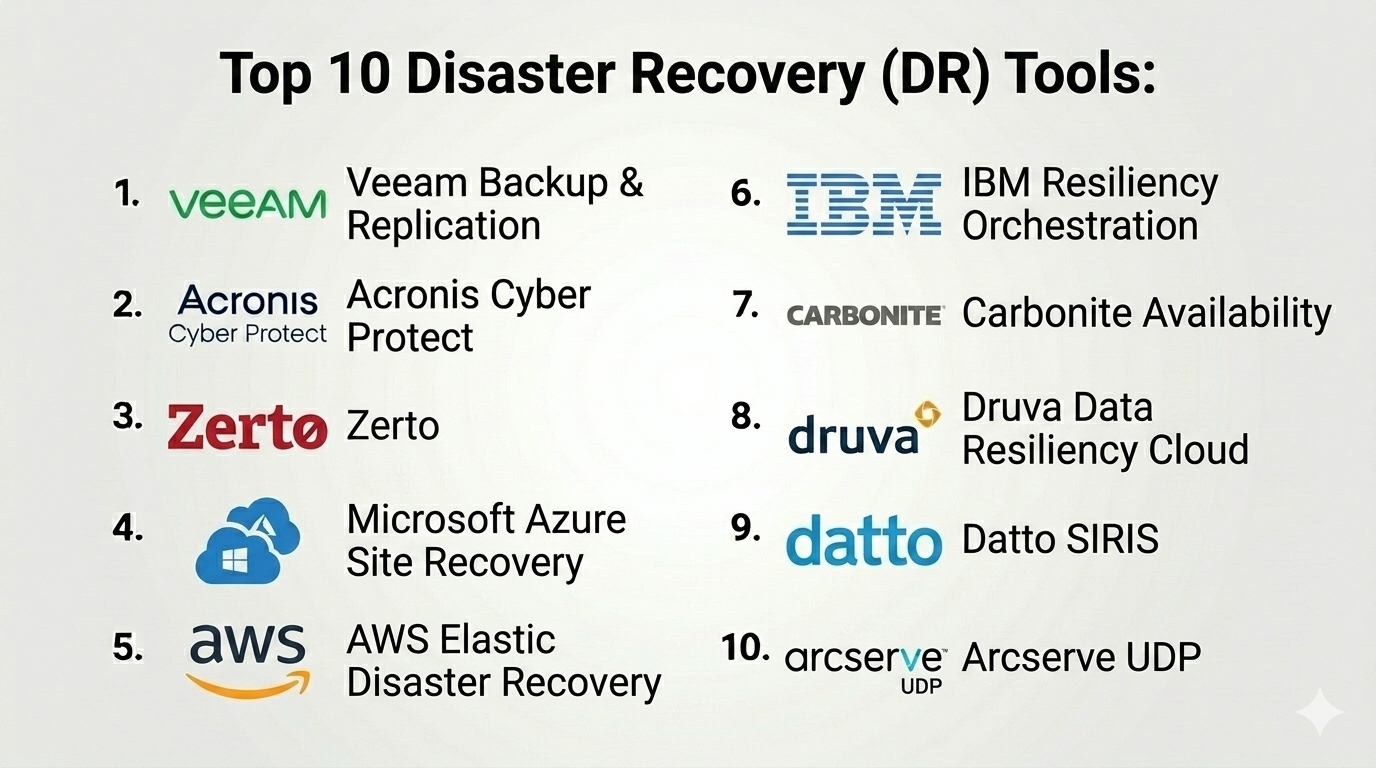
Top 10 Disaster Recovery (DR) Tools
#1 — Veeam Backup & Replication
Short description: A leading DR solution offering backup, replication, and fast recovery for virtual, physical, and cloud workloads.
Key Features
- Backup and replication
- Instant VM recovery
- Continuous data protection
- Cloud integration
- Automated recovery testing
- Ransomware protection
Pros
- Strong performance and reliability
- Broad platform support
Cons
- Complex configuration for beginners
- Pricing can scale quickly
Platforms / Deployment
Web / Windows
Cloud / On-premise / Hybrid
Security & Compliance
- Encryption, RBAC
- Compliance varies
Integrations & Ecosystem
Veeam integrates with major virtualization and cloud platforms.
- VMware, Hyper-V
- Cloud providers
- APIs
Support & Community
Strong global community and enterprise support.
#2 — Acronis Cyber Protect
Short description: A DR and backup solution combining cybersecurity and data protection in a single platform.
Key Features
- Backup and recovery
- Anti-ransomware protection
- Disk imaging
- Cloud backup
- Automation
- Reporting
Pros
- Integrated security features
- Easy to use
Cons
- Limited enterprise depth
- Performance varies by workload
Platforms / Deployment
Web / Windows / macOS
Cloud / On-premise
Security & Compliance
- Encryption, anti-malware
- Compliance varies
Integrations & Ecosystem
- Cloud platforms
- APIs
Support & Community
Good support for SMB and mid-market.
#3 — Zerto
Short description: A disaster recovery platform focused on continuous data protection and rapid failover.
Key Features
- Continuous data protection (CDP)
- Automated failover
- Multi-cloud support
- DR testing
- Orchestration
Pros
- Near-zero RPO
- Fast recovery times
Cons
- Higher cost
- Complex setup
Platforms / Deployment
Web
Cloud / Hybrid
Security & Compliance
Not publicly stated
Integrations & Ecosystem
- Cloud platforms
- Virtualization tools
- APIs
Support & Community
Enterprise-level support.
#4 — Microsoft Azure Site Recovery
Short description: A cloud-based DR solution for replicating and recovering workloads to Azure.
Key Features
- Replication and failover
- Automated recovery plans
- Integration with Azure
- Monitoring and reporting
- Hybrid support
Pros
- Strong cloud integration
- Scalable
Cons
- Best for Azure users
- Requires cloud expertise
Platforms / Deployment
Web
Cloud
Security & Compliance
- Encryption, identity integration
- Compliance varies
Integrations & Ecosystem
- Azure services
- Microsoft ecosystem
- APIs
Support & Community
Extensive documentation and support.
#5 — AWS Elastic Disaster Recovery
Short description: A DR service designed to minimize downtime and data loss for AWS workloads.
Key Features
- Continuous replication
- Automated failover
- Recovery orchestration
- Monitoring
- Testing
Pros
- Strong AWS integration
- Scalable
Cons
- Limited outside AWS ecosystem
- Learning curve
Platforms / Deployment
Web
Cloud
Security & Compliance
- Encryption, IAM integration
- Compliance varies
Integrations & Ecosystem
- AWS services
- APIs
Support & Community
Strong cloud support.
#6 — IBM Resiliency Orchestration
Short description: An enterprise DR orchestration platform focused on automation and business continuity.
Key Features
- DR orchestration
- Automation workflows
- Testing and simulation
- Reporting
- Compliance support
Pros
- Strong automation
- Enterprise focus
Cons
- Complex implementation
- Expensive
Platforms / Deployment
Web
Cloud / Hybrid
Security & Compliance
Not publicly stated
Integrations & Ecosystem
- IBM ecosystem
- APIs
Support & Community
Enterprise-level support.
#7 — Carbonite Availability
Short description: A DR solution offering data replication and failover for SMBs and enterprises.
Key Features
- Data replication
- Failover and failback
- Backup
- Monitoring
- Reporting
Pros
- Easy to deploy
- Reliable replication
Cons
- Limited advanced features
- UI improvements needed
Platforms / Deployment
Web / Windows
Cloud / On-premise
Security & Compliance
Not publicly stated
Integrations & Ecosystem
- IT tools
- APIs
Support & Community
Reliable support.
#8 — Druva Data Resiliency Cloud
Short description: A cloud-native DR and backup platform with strong SaaS and endpoint protection.
Key Features
- Cloud backup
- Disaster recovery
- Ransomware protection
- Automation
- Reporting
Pros
- Fully cloud-native
- Easy to scale
Cons
- Limited on-premise support
- Pricing varies
Platforms / Deployment
Web
Cloud
Security & Compliance
Not publicly stated
Integrations & Ecosystem
- Cloud platforms
- SaaS tools
- APIs
Support & Community
Strong cloud support.
#9 — Datto SIRIS
Short description: A DR solution designed for MSPs with backup and business continuity features.
Key Features
- Backup and recovery
- Failover
- Business continuity
- Monitoring
- Reporting
Pros
- MSP-friendly
- Easy deployment
Cons
- Limited enterprise features
- Smaller ecosystem
Platforms / Deployment
Web
Cloud / On-premise
Security & Compliance
Not publicly stated
Integrations & Ecosystem
- MSP tools
- APIs
Support & Community
Strong MSP support.
#10 — Arcserve UDP
Short description: A unified data protection platform offering backup and disaster recovery capabilities.
Key Features
- Backup and recovery
- Replication
- High availability
- Automation
- Reporting
Pros
- Comprehensive features
- Flexible deployment
Cons
- UI complexity
- Requires expertise
Platforms / Deployment
Web
Cloud / On-premise
Security & Compliance
Not publicly stated
Integrations & Ecosystem
- IT tools
- APIs
Support & Community
Reliable enterprise support.
Comparison Table (Top 10)
| Tool Name | Best For | Platform(s) Supported | Deployment | Standout Feature | Public Rating |
|---|---|---|---|---|---|
| Veeam | Enterprise | Web, Windows | Hybrid | Instant recovery | N/A |
| Acronis | SMB | Web, Windows, macOS | Hybrid | Security integration | N/A |
| Zerto | Enterprise | Web | Hybrid | CDP | N/A |
| Azure Site Recovery | Cloud users | Web | Cloud | Azure integration | N/A |
| AWS Elastic DR | AWS users | Web | Cloud | AWS integration | N/A |
| IBM Resiliency | Enterprise | Web | Hybrid | Orchestration | N/A |
| Carbonite | SMB | Web, Windows | Hybrid | Replication | N/A |
| Druva | Cloud-native | Web | Cloud | SaaS protection | N/A |
| Datto SIRIS | MSPs | Web | Hybrid | MSP focus | N/A |
| Arcserve UDP | Enterprise | Web | Hybrid | Unified protection | N/A |
Disaster Recovery (DR) Tools
| Tool Name | Core (25%) | Ease (15%) | Integrations (15%) | Security (10%) | Performance (10%) | Support (10%) | Value (15%) | Weighted Total |
|---|---|---|---|---|---|---|---|---|
| Veeam | 9 | 7 | 9 | 8 | 9 | 9 | 7 | 8.4 |
| Acronis | 8 | 8 | 7 | 8 | 8 | 8 | 8 | 7.9 |
| Zerto | 9 | 6 | 8 | 7 | 9 | 9 | 6 | 8.1 |
| Azure Site Recovery | 8 | 7 | 9 | 8 | 8 | 9 | 7 | 8.1 |
| AWS Elastic DR | 8 | 6 | 9 | 8 | 8 | 9 | 7 | 8.0 |
| IBM Resiliency | 9 | 5 | 8 | 8 | 9 | 9 | 5 | 7.8 |
| Carbonite | 7 | 8 | 6 | 7 | 7 | 7 | 8 | 7.3 |
| Druva | 8 | 8 | 7 | 7 | 8 | 8 | 7 | 7.7 |
| Datto SIRIS | 7 | 8 | 6 | 7 | 7 | 8 | 8 | 7.4 |
| Arcserve UDP | 8 | 6 | 7 | 7 | 8 | 8 | 7 | 7.5 |
How to interpret scores:
- Scores are comparative across tools
- Higher scores indicate stronger DR capabilities
- Enterprise tools excel in performance and automation
- SMB tools lead in ease of use and value
- Choose based on RTO/RPO requirements and infrastructure
Which Disaster Recovery (DR) Tools Is Right for You?
Solo / Freelancer
- Best choices: Acronis, Carbonite
- Focus on simplicity and affordability
SMB
- Best choices: Acronis, Datto, Carbonite
- Balance usability and reliability
Mid-Market
- Best choices: Druva, Arcserve
- Need scalability and cloud support
Enterprise
- Best choices: Veeam, Zerto, Azure Site Recovery
- Prioritize performance, automation, and compliance
Budget vs Premium
- Budget: Carbonite, Acronis
- Premium: Veeam, Zerto
Feature Depth vs Ease of Use
- Easy: Acronis, Druva
- Advanced: Veeam, Zerto
Integrations & Scalability
- Strong: AWS, Azure, Veeam
- Flexible: Arcserve
Security & Compliance Needs
- High: Veeam, Azure, AWS
- Moderate: SMB tools
Frequently Asked Questions (FAQs)
What is disaster recovery software?
It helps restore systems and data after disruptions.
How is DR different from backup?
Backup stores data; DR restores full operations.
What are RTO and RPO?
RTO is recovery time; RPO is acceptable data loss.
Are DR tools cloud-based?
Most offer cloud or hybrid deployments.
Can small businesses use DR tools?
Yes, there are SMB-friendly options.
Do DR tools protect against ransomware?
Yes, many include ransomware protection.
How often should DR be tested?
Regularly, often quarterly or annually.
What integrations are important?
Cloud, ITSM, and security tools.
Is DR expensive?
Costs vary based on scale and requirements.
What is DRaaS?
Disaster Recovery as a Service delivered via cloud.
Conclusion
Disaster Recovery (DR) tools are critical for ensuring business continuity in an increasingly digital and risk-prone environment. From protecting against cyberattacks to recovering from system failures, these tools help organizations minimize downtime and safeguard critical data.
