Introduction
Applicant Tracking Systems (ATS) are software platforms designed to streamline and manage the recruitment process—from job posting and candidate sourcing to interview scheduling and hiring decisions. In simple terms, an ATS acts as a central hub where recruiters can track applicants, automate workflows, and collaborate with hiring teams.
With increasing competition for talent and high application volumes, manual hiring processes are no longer scalable. ATS platforms help organizations filter candidates efficiently, improve hiring speed, and deliver a better candidate experience. Modern ATS tools also incorporate automation, AI-assisted screening, and deep integrations with HR systems.
Common use cases include:
- Posting jobs across multiple job boards
- Resume parsing and candidate screening
- Managing hiring pipelines and stages
- Scheduling interviews and coordinating teams
- Automating communication with candidates
Key evaluation criteria:
- Candidate sourcing and job distribution
- Resume parsing and screening capabilities
- Workflow automation and pipeline customization
- Collaboration features for hiring teams
- Integration with HR, payroll, and assessment tools
- Reporting and analytics
- Candidate experience (UX/UI)
- Compliance and data security
- Scalability for growing hiring needs
- Cost and overall value
Best for: HR teams, recruiters, talent acquisition leaders, startups scaling hiring, and enterprises managing high-volume recruitment.
Not ideal for: Very small teams with occasional hiring needs, where simpler tools or manual processes may be sufficient.
Key Trends in Portfolio & Applicant Tracking Systems
- AI-assisted candidate screening: Automated resume parsing, ranking, and matching.
- ATS + CRM convergence: Tools combining applicant tracking with candidate relationship management.
- Automated candidate communication: Email, SMS, and chatbot-driven engagement.
- Diversity-focused hiring tools: Features to reduce bias and improve inclusive hiring.
- Integration-first architecture: Seamless connectivity with HRIS, payroll, and assessment tools.
- Mobile-first recruiting workflows: Recruiters and candidates interacting via mobile devices.
- Data-driven hiring decisions: Advanced analytics for pipeline optimization.
- Video interviewing integration: Built-in or integrated video interview tools.
- Talent pipeline nurturing: Long-term candidate relationship management.
- Cloud-native platforms: Scalable and continuously updated SaaS solutions.
How We Selected These Tools (Methodology)
The tools in this list were selected based on a structured evaluation approach:
- Strong market adoption and recruiter mindshare
- Comprehensive feature set covering sourcing to hiring
- Proven reliability in real-world hiring environments
- Availability of automation and AI features
- Integration ecosystem with HR and business tools
- Ease of use for recruiters and hiring managers
- Candidate experience and usability
- Vendor maturity and product innovation
- Security and compliance capabilities
- Suitability across SMB, mid-market, and enterprise segments
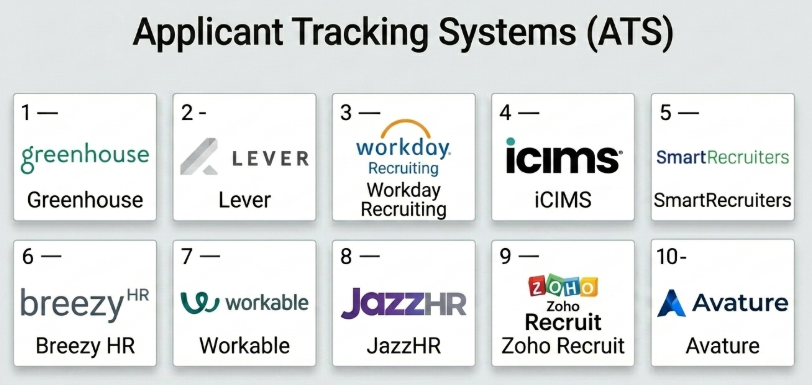
Top 10 Applicant Tracking Systems (ATS)
#1 — Greenhouse
Short description: A leading ATS focused on structured hiring and data-driven recruitment for scaling and enterprise organizations.
Key Features
- Structured hiring workflows
- Interview scorecards and feedback tracking
- Candidate pipeline management
- Reporting and analytics dashboards
- DEI-focused hiring tools
- Integration marketplace
Pros
- Strong collaboration across hiring teams
- Advanced analytics and reporting
Cons
- Higher cost for small teams
- Requires setup for full optimization
Platforms / Deployment
Web
Cloud
Security & Compliance
SSO, RBAC
Not publicly stated certifications
Integrations & Ecosystem
Greenhouse offers a large ecosystem with integrations across hiring and HR tools.
- HRIS platforms
- Assessment tools
- Job boards
- APIs for customization
Support & Community
Strong enterprise support, onboarding, and documentation.
#2 — Lever
Short description: A combined ATS and CRM platform designed to build and manage long-term candidate relationships.
Key Features
- Candidate relationship management (CRM)
- Pipeline tracking and automation
- Interview scheduling
- Email automation and templates
- Analytics dashboards
Pros
- Excellent for talent pipeline nurturing
- Clean and intuitive interface
Cons
- Requires configuration to unlock full value
- Pricing may be high for smaller teams
Platforms / Deployment
Web
Cloud
Security & Compliance
Not publicly stated
Integrations & Ecosystem
Strong integrations with recruiting and HR tools.
- HR systems
- Communication platforms
- APIs
Support & Community
Reliable onboarding and support services.
#3 — Workday Recruiting
Short description: Recruitment module within Workday HCM, designed for enterprise organizations.
Key Features
- End-to-end recruitment workflows
- Integration with HR and finance systems
- Workforce analytics
- Global hiring capabilities
- Compliance tracking
Pros
- Seamless integration with Workday ecosystem
- Enterprise scalability
Cons
- Complex user interface
- Less specialized than standalone ATS tools
Platforms / Deployment
Web / Mobile
Cloud
Security & Compliance
SSO, MFA
Not publicly stated certifications
Integrations & Ecosystem
Deep integration with enterprise systems and APIs.
- HR systems
- Finance platforms
- APIs
Support & Community
Enterprise-level support and services.
#4 — iCIMS
Short description: Enterprise ATS with strong customization and candidate experience capabilities.
Key Features
- Applicant tracking and CRM features
- Career site builder
- AI-assisted candidate matching
- Interview scheduling
- Reporting and analytics
Pros
- Highly customizable
- Strong enterprise features
Cons
- Complex setup and configuration
- Higher cost
Platforms / Deployment
Web
Cloud
Security & Compliance
Not publicly stated
Integrations & Ecosystem
Extensive integration ecosystem.
- HR systems
- Assessment tools
- APIs
Support & Community
Strong enterprise support and onboarding.
#5 — SmartRecruiters
Short description: Modern ATS focused on collaboration and user experience.
Key Features
- Collaborative hiring workflows
- Candidate sourcing tools
- Interview scheduling
- Reporting dashboards
- Mobile accessibility
Pros
- Intuitive and modern interface
- Strong team collaboration features
Cons
- Advanced features require higher-tier plans
- Pricing varies
Platforms / Deployment
Web / Mobile
Cloud
Security & Compliance
Not publicly stated
Integrations & Ecosystem
Supports integrations across recruiting and HR tools.
- Job boards
- HR systems
- APIs
Support & Community
Good onboarding and customer support.
#6 — Breezy HR
Short description: User-friendly ATS designed for SMBs with automation and drag-and-drop workflows.
Key Features
- Drag-and-drop recruitment pipelines
- Candidate messaging (email and SMS)
- Interview scheduling
- Automation workflows
- Reporting tools
Pros
- Easy to use and implement
- Good automation features
Cons
- Limited advanced analytics
- Feature access depends on plan
Platforms / Deployment
Web
Cloud
Security & Compliance
Not publicly stated
Integrations & Ecosystem
Integrates with common business tools and APIs.
- Communication tools
- HR platforms
- APIs
Support & Community
Moderate support; varies by subscription tier.
#7 — Workable
Short description: Popular ATS for SMBs and growing companies with strong sourcing capabilities.
Key Features
- Job posting automation
- Resume parsing
- Candidate tracking
- Interview scheduling
- Reporting dashboards
Pros
- Easy to deploy and use
- Strong candidate sourcing tools
Cons
- Limited enterprise-level customization
- Costs increase with hiring scale
Platforms / Deployment
Web / Mobile
Cloud
Security & Compliance
Not publicly stated
Integrations & Ecosystem
Supports integrations with HR tools and job boards.
- HR systems
- Job boards
- APIs
Support & Community
Strong support for SMB users.
#8 — JazzHR
Short description: Budget-friendly ATS designed for startups and small businesses.
Key Features
- Applicant tracking
- Workflow automation
- Interview scheduling
- Candidate communication
- Reporting tools
Pros
- Affordable pricing
- Easy to use
Cons
- Limited scalability
- Basic analytics
Platforms / Deployment
Web
Cloud
Security & Compliance
Not publicly stated
Integrations & Ecosystem
Basic integration support with APIs.
- HR tools
- APIs
Support & Community
Good support for small teams.
#9 — Zoho Recruit
Short description: Flexible ATS within the Zoho ecosystem for SMBs and staffing agencies.
Key Features
- Resume parsing
- Candidate tracking
- Workflow automation
- Custom reporting
- Automation rules
Pros
- Cost-effective
- Highly customizable workflows
Cons
- UI learning curve
- Limited enterprise features
Platforms / Deployment
Web / Mobile
Cloud
Security & Compliance
Not publicly stated
Integrations & Ecosystem
Part of Zoho ecosystem with broad integrations.
- Zoho apps
- APIs
- Third-party tools
Support & Community
Strong ecosystem support and documentation.
#10 — Avature
Short description: Highly customizable ATS built for enterprise and global hiring needs.
Key Features
- Custom recruitment workflows
- Candidate relationship management
- Event and campus recruiting tools
- Automation capabilities
- Global hiring support
Pros
- Extremely flexible and customizable
- Enterprise-ready
Cons
- Complex implementation
- Requires technical expertise
Platforms / Deployment
Web
Cloud
Security & Compliance
Not publicly stated
Integrations & Ecosystem
Advanced integration capabilities with enterprise tools.
- HR systems
- APIs
- Custom integrations
Support & Community
Enterprise-grade support and services.
Comparison Table (Top 10)
| Tool Name | Best For | Platform(s) Supported | Deployment | Standout Feature | Public Rating |
|---|---|---|---|---|---|
| Greenhouse | Mid/Enterprise | Web | Cloud | Structured hiring | N/A |
| Lever | ATS + CRM | Web | Cloud | Talent pipeline | N/A |
| Workday Recruiting | Enterprise | Web, Mobile | Cloud | HR integration | N/A |
| iCIMS | Enterprise | Web | Cloud | Customization | N/A |
| SmartRecruiters | Mid-market | Web, Mobile | Cloud | Collaboration | N/A |
| Breezy HR | SMB | Web | Cloud | Automation | N/A |
| Workable | SMB | Web, Mobile | Cloud | Job sourcing | N/A |
| JazzHR | Startups | Web | Cloud | Affordability | N/A |
| Zoho Recruit | SMB | Web, Mobile | Cloud | Custom workflows | N/A |
| Avature | Enterprise | Web | Cloud | Flexibility | N/A |
Evaluation & Scoring of Applicant Tracking Systems
| Tool Name | Core (25%) | Ease (15%) | Integrations (15%) | Security (10%) | Performance (10%) | Support (10%) | Value (15%) | Weighted Total |
|---|---|---|---|---|---|---|---|---|
| Greenhouse | 9 | 7 | 9 | 7 | 9 | 8 | 6 | 8.1 |
| Lever | 8 | 8 | 8 | 6 | 8 | 8 | 7 | 7.8 |
| Workday Recruiting | 9 | 6 | 9 | 7 | 9 | 8 | 6 | 8.0 |
| iCIMS | 9 | 6 | 8 | 7 | 9 | 8 | 6 | 7.9 |
| SmartRecruiters | 8 | 8 | 8 | 6 | 8 | 7 | 7 | 7.8 |
| Breezy HR | 7 | 9 | 7 | 6 | 7 | 7 | 8 | 7.5 |
| Workable | 7 | 8 | 7 | 6 | 7 | 7 | 8 | 7.4 |
| JazzHR | 6 | 8 | 6 | 6 | 7 | 7 | 9 | 7.1 |
| Zoho Recruit | 7 | 7 | 8 | 6 | 7 | 7 | 9 | 7.5 |
| Avature | 9 | 6 | 9 | 7 | 9 | 8 | 6 | 8.0 |
How to interpret scores:
- Scores are comparative and not absolute benchmarks.
- Enterprise tools score higher on features but may sacrifice usability.
- SMB tools offer better value and ease of use.
- Choose based on hiring volume and complexity.
- The highest score does not always mean the best fit for your needs.
Which Applicant Tracking System Is Right for You?
Solo / Freelancer
Most individuals don’t need a full ATS. Basic hiring tools or manual tracking are sufficient.
SMB
Workable, Breezy HR, JazzHR, and Zoho Recruit are ideal for affordability and ease of use.
Mid-Market
Greenhouse, Lever, and SmartRecruiters offer a balance of features and usability.
Enterprise
Workday Recruiting, iCIMS, and Avature are best for complex, global hiring operations.
Budget vs Premium
- Budget: JazzHR, Zoho Recruit
- Premium: Greenhouse, Workday
Feature Depth vs Ease of Use
- Feature-rich: Avature, Workday
- Easy to use: Breezy HR, Workable
Integrations & Scalability
- Strong integrations: Greenhouse, Lever
- Moderate: SMB tools
Security & Compliance Needs
- High compliance: Enterprise ATS
- Basic: SMB tools
Frequently Asked Questions (FAQs)
What is an Applicant Tracking System (ATS)?
An ATS is software that helps manage job applications, resumes, and hiring workflows in one platform.
How does an ATS improve hiring?
It automates repetitive tasks, organizes candidates, and improves collaboration across hiring teams.
Is ATS only for large companies?
No, there are ATS tools specifically designed for startups and SMBs.
Can ATS screen resumes automatically?
Yes, many ATS tools use AI to parse and rank resumes.
Does ATS integrate with HR systems?
Most modern ATS platforms integrate with HRIS, payroll, and other tools.
How much does an ATS cost?
Pricing varies depending on features, hiring volume, and organization size.
Is ATS secure?
Security depends on the vendor; look for encryption and access controls.
How long does implementation take?
SMB tools can be set up quickly, while enterprise tools may take longer.
Can candidates track their application status?
Many ATS platforms provide candidate portals for status tracking.
What are common mistakes when choosing an ATS?
Ignoring integrations, scalability, and candidate experience.
Conclusion
Applicant Tracking Systems are essential for modern recruitment, enabling organizations to manage hiring efficiently, reduce manual effort, and improve candidate experience. From lightweight tools for small teams to enterprise-grade platforms, the right ATS depends on your hiring needs and organizational complexity.
