Introduction
Business Rules & Decision Management Systems (BRMS/DMN platforms) are specialized tools that help organizations define, manage, and automate business logic and decision-making processes. Instead of embedding rules directly into application code, these platforms externalize decision logic—making it easier to update, audit, and scale decisions across systems.
These systems are critical in environments where decisions must be consistent, compliant, and adaptable—such as finance, insurance, healthcare, and e-commerce. By combining rule engines, decision modeling, and sometimes AI-driven logic, organizations can improve agility while reducing risk.
Common use cases include:
- Credit scoring and risk evaluation
- Pricing and discount rules
- Fraud detection and compliance checks
- Eligibility and approval workflows
- Policy and claims processing
What buyers should evaluate:
- Rule authoring and management capabilities
- Decision modeling support (e.g., DMN standards)
- Integration with applications and APIs
- Performance and scalability
- Versioning and governance
- Ease of use for business users
- Analytics and decision tracking
- Security and compliance features
- Deployment flexibility
Best for:
Enterprises, financial institutions, insurance companies, e-commerce platforms, and organizations requiring consistent and auditable decision logic.
Not ideal for:
Small teams with minimal rule complexity or static logic that rarely changes.
Key Trends in Business Rules & Decision Management Systems
- Low-code decision modeling: Business users can define rules without coding
- AI-assisted decisioning: Combining rules with machine learning
- Real-time decision engines: Instant responses for high-volume applications
- DMN standard adoption: Standardized decision modeling frameworks
- Cloud-native decision services: Scalable and flexible deployment
- Explainable AI (XAI): Transparent decision-making processes
- Integration with BPM and RPA: End-to-end automation ecosystems
- Versioning and governance improvements: Better auditability and compliance
How We Selected These Tools (Methodology)
We evaluated BRMS/decision management tools based on:
- Market adoption and credibility
- Rule engine capabilities and flexibility
- Decision modeling support (DMN, rule sets)
- Integration and extensibility
- Performance and scalability
- Security and compliance readiness
- Ease of use for both business and technical users
- Support and community ecosystem
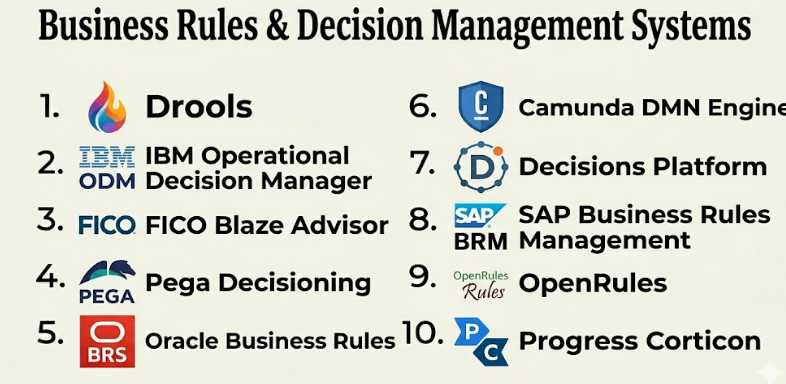
Top 10 Business Rules & Decision Management Systems
#1 — Drools (Red Hat Decision Manager)
Short description: Open-source rule engine widely used for complex rule processing and decision automation.
Key Features
- Rule engine with forward and backward chaining
- Decision tables and rule flows
- DMN support
- Complex event processing
- Integration with Java applications
Pros
- Open-source and flexible
- Highly powerful rule processing
Cons
- Requires technical expertise
- Limited UI for business users
Platforms / Deployment
Cloud / On-premise
Security & Compliance
RBAC, encryption. Compliance: Not publicly stated
Integrations & Ecosystem
Drools integrates strongly within the Java ecosystem:
- Spring-based applications
- APIs
- Enterprise systems
Support & Community
Strong open-source community with enterprise support via Red Hat.
#2 — IBM Operational Decision Manager
Short description: Enterprise-grade decision management platform with advanced rule and event processing.
Key Features
- Business rule management
- Decision tables
- Event processing
- Rule governance
- Analytics and reporting
Pros
- Strong governance features
- Scalable and reliable
Cons
- Expensive
- Complex setup
Platforms / Deployment
Cloud / On-premise
Security & Compliance
Enterprise-grade controls. Compliance: Not publicly stated
Integrations & Ecosystem
- IBM ecosystem
- APIs
- Databases
Support & Community
Strong enterprise support.
#3 — FICO Blaze Advisor
Short description: Decision management system focused on financial services and risk management.
Key Features
- Rule authoring tools
- Decision strategies
- Simulation and testing
- Analytics
- Integration tools
Pros
- Industry-specific expertise
- Strong analytics
Cons
- High cost
- Limited outside finance use
Platforms / Deployment
Cloud / On-premise
Security & Compliance
Not publicly stated
Integrations & Ecosystem
- Financial systems
- APIs
- Data platforms
Support & Community
Enterprise-level support.
#4 — Pega Decisioning
Short description: AI-powered decision management platform integrated with BPM capabilities.
Key Features
- Real-time decisioning
- AI-driven recommendations
- Rule management
- Customer decision hub
- Analytics
Pros
- Strong AI capabilities
- Enterprise scalability
Cons
- Complex implementation
- Expensive
Platforms / Deployment
Cloud / On-premise
Security & Compliance
RBAC, encryption. Compliance: Not publicly stated
Integrations & Ecosystem
- CRM systems
- APIs
- Enterprise apps
Support & Community
Strong enterprise support.
#5 — Oracle Business Rules
Short description: Rule engine integrated within Oracle middleware and BPM ecosystem.
Key Features
- Rule authoring
- Decision tables
- Integration with Oracle apps
- Workflow integration
- Monitoring
Pros
- Strong Oracle ecosystem
- Reliable
Cons
- Vendor lock-in
- Complex setup
Platforms / Deployment
On-premise / Cloud
Security & Compliance
Enterprise-grade controls. Compliance: Not publicly stated
Integrations & Ecosystem
- Oracle Cloud
- ERP systems
- Databases
Support & Community
Strong enterprise support.
#6 — Camunda DMN Engine
Short description: Decision engine focused on DMN-based modeling and microservices integration.
Key Features
- DMN decision tables
- BPMN integration
- REST APIs
- Lightweight engine
- Developer-friendly
Pros
- Open and flexible
- Microservices-ready
Cons
- Requires technical expertise
- Limited UI for business users
Platforms / Deployment
Cloud / Self-hosted
Security & Compliance
Not publicly stated
Integrations & Ecosystem
- Microservices
- APIs
- BPM tools
Support & Community
Strong open-source community.
#7 — Decisions Platform
Short description: Low-code decision and workflow platform combining rules and process automation.
Key Features
- Visual rule designer
- Workflow automation
- Decision tables
- Integration tools
- Reporting
Pros
- Business-user friendly
- Visual interface
Cons
- Limited enterprise scale
- Smaller ecosystem
Platforms / Deployment
Cloud / On-premise
Security & Compliance
RBAC. Compliance: Not publicly stated
Integrations & Ecosystem
- APIs
- SaaS tools
Support & Community
Moderate support.
#8 — SAP Business Rules Management
Short description: Rule management solution integrated with SAP ecosystem.
Key Features
- Rule modeling
- Decision tables
- Integration with SAP apps
- Workflow automation
- Monitoring
Pros
- Strong SAP integration
- Enterprise-ready
Cons
- Limited outside SAP
- Complex setup
Platforms / Deployment
Cloud / On-premise
Security & Compliance
Enterprise-grade controls. Compliance: Not publicly stated
Integrations & Ecosystem
- SAP ERP
- SAP Cloud
- Enterprise systems
Support & Community
Strong enterprise support.
#9 — OpenRules
Short description: Lightweight rule engine for business rule automation and decision tables.
Key Features
- Decision tables
- Rule execution
- Integration tools
- Excel-based rules
- APIs
Pros
- Simple and flexible
- Cost-effective
Cons
- Limited advanced features
- Smaller community
Platforms / Deployment
Cloud / On-premise
Security & Compliance
Not publicly stated
Integrations & Ecosystem
- APIs
- Enterprise systems
Support & Community
Moderate support.
#10 — Progress Corticon
Short description: Business rule engine focused on decision automation and compliance.
Key Features
- Rule modeling
- Decision services
- Compliance tools
- Integration APIs
- Analytics
Pros
- Strong compliance capabilities
- Scalable
Cons
- Complex setup
- Cost considerations
Platforms / Deployment
Cloud / On-premise
Security & Compliance
RBAC, encryption. Compliance: Not publicly stated
Integrations & Ecosystem
- APIs
- Enterprise apps
- Data systems
Support & Community
Enterprise support.
Comparison Table (Top 10)
| Tool Name | Best For | Platform(s) Supported | Deployment | Standout Feature | Public Rating |
|---|---|---|---|---|---|
| Drools | Developers | Web | Hybrid | Rule engine | N/A |
| IBM ODM | Enterprise | Web | Hybrid | Governance | N/A |
| FICO Blaze | Finance | Web | Hybrid | Risk decisioning | N/A |
| Pega | AI decisions | Web | Hybrid | AI engine | N/A |
| Oracle Rules | Oracle users | Web | Hybrid | Ecosystem | N/A |
| Camunda DMN | Developers | Web | Hybrid | DMN support | N/A |
| Decisions | SMB | Web | Hybrid | Visual rules | N/A |
| SAP BRM | SAP users | Web | Hybrid | SAP integration | N/A |
| OpenRules | Budget | Web | Hybrid | Simplicity | N/A |
| Corticon | Compliance | Web | Hybrid | Decision services | N/A |
Evaluation & Scoring of Business Rules & Decision Management Systems
| Tool Name | Core (25%) | Ease (15%) | Integrations (15%) | Security (10%) | Performance (10%) | Support (10%) | Value (15%) | Weighted Total |
|---|---|---|---|---|---|---|---|---|
| Drools | 9 | 6 | 9 | 7 | 9 | 8 | 9 | 8.4 |
| IBM ODM | 9 | 6 | 9 | 9 | 9 | 9 | 6 | 8.3 |
| FICO Blaze | 9 | 6 | 8 | 8 | 9 | 8 | 6 | 8.0 |
| Pega | 9 | 6 | 8 | 8 | 9 | 8 | 6 | 8.0 |
| Oracle Rules | 8 | 6 | 8 | 8 | 8 | 8 | 6 | 7.7 |
| Camunda DMN | 8 | 7 | 9 | 7 | 8 | 8 | 8 | 8.0 |
| Decisions | 7 | 8 | 7 | 7 | 7 | 7 | 8 | 7.4 |
| SAP BRM | 8 | 6 | 8 | 8 | 8 | 8 | 6 | 7.6 |
| OpenRules | 7 | 8 | 6 | 6 | 7 | 6 | 9 | 7.2 |
| Corticon | 8 | 6 | 7 | 8 | 8 | 7 | 6 | 7.5 |
Which Business Rules & Decision Management System Is Right for You?
Solo / Freelancer
- Best: OpenRules
- Focus on simplicity and low cost
SMB
- Best: Decisions Platform
- Easy-to-use rule management
Mid-Market
- Best: Camunda DMN, Drools
- Flexibility and scalability
Enterprise
- Best: IBM ODM, Pega, FICO Blaze
- Governance and compliance
Budget vs Premium
- Budget: OpenRules, Drools
- Premium: IBM, FICO
Feature Depth vs Ease of Use
- Deep features: IBM, Pega
- Easy to use: Decisions
Integrations & Scalability
- Strong integrations: Drools
- Scalable: IBM
Security & Compliance Needs
- High security: IBM, Corticon
- Moderate: Open-source tools
Frequently Asked Questions (FAQs)
What is a BRMS?
A system for managing and automating business rules separately from application code.
How is it different from BPM?
BRMS focuses on decisions, while BPM manages workflows.
Do I need coding skills?
Some tools are low-code, but advanced setups may require developers.
Are these tools expensive?
Enterprise tools can be costly; open-source options are available.
Can BRMS integrate with applications?
Yes, integration via APIs is common.
What industries use BRMS?
Finance, insurance, healthcare, retail, and more.
Is BRMS scalable?
Yes, most platforms are designed for high-volume decisioning.
What is DMN?
A standard for modeling and executing decisions.
Can AI be used with BRMS?
Yes, many tools combine rules with AI.
What are common challenges?
Complex setup, governance, and rule management.
Conclusion
Business Rules & Decision Management Systems play a critical role in enabling consistent, scalable, and auditable decision-making across organizations. By externalizing business logic, they improve agility and reduce dependency on development cycles.
