Introduction
Integration Platform as a Service (iPaaS) is a cloud-based solution that enables organizations to connect applications, data sources, APIs, and systems across cloud and on-premise environments. It provides a centralized platform to design, manage, and automate integrations without building everything from scratch.
As businesses adopt multiple SaaS tools and distributed architectures, seamless data flow between systems becomes critical. iPaaS platforms simplify this complexity by offering pre-built connectors, workflow automation, and data transformation capabilities—helping teams move faster while maintaining consistency and control.
Common use cases include:
- Syncing data between CRM, ERP, and marketing tools
- Automating business workflows across applications
- Integrating legacy systems with modern SaaS platforms
- Managing API-based integrations
- Building event-driven data pipelines
What buyers should evaluate:
- Number and quality of pre-built connectors
- Workflow automation capabilities
- Data transformation and mapping features
- Scalability and performance
- Security and compliance controls
- Ease of use (low-code vs developer-first)
- Deployment flexibility (cloud, hybrid)
- Monitoring and error handling
- Pricing transparency
Best for:
IT teams, integration engineers, SaaS companies, enterprises, and fast-growing businesses managing multiple tools and complex workflows.
Not ideal for:
Small teams with minimal integrations or simple workflows may find lightweight automation tools sufficient instead of a full iPaaS solution.
Key Trends in Integration Platform as a Service (iPaaS)
- Rise of low-code/no-code integrations: Business users can build workflows without heavy coding
- AI-assisted automation: Intelligent mapping, anomaly detection, and workflow suggestions
- Event-driven integrations: Real-time data processing using event streams and webhooks
- API-first integration strategies: APIs are central to modern integration design
- Hybrid integration support: Connecting cloud apps with on-premise systems
- Composable architecture: Modular integrations that can be reused across teams
- Security-first design: Encryption, identity management, and governance
- Vertical-specific integrations: Industry-focused connectors and templates
- Scalable automation pipelines: Handling large volumes of data and events
How We Selected These Tools (Methodology)
We evaluated iPaaS tools based on:
- Market presence and adoption
- Breadth and quality of connectors
- Workflow automation and orchestration capabilities
- Performance and scalability
- Security and compliance features
- Ease of use and learning curve
- Integration ecosystem and extensibility
- Suitability for different business sizes
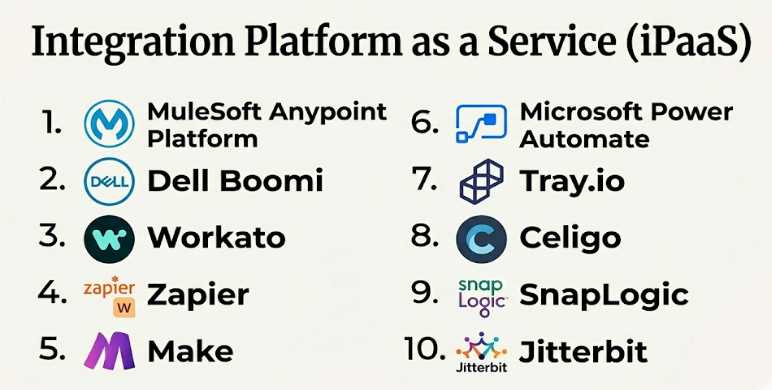
Top 10 Integration Platform as a Service (iPaaS)
#1 — MuleSoft Anypoint Platform
Short description: A leading enterprise iPaaS platform focused on API-led connectivity and complex integrations.
Key Features
- API lifecycle management
- Data integration and transformation
- Pre-built connectors
- Workflow automation
- Monitoring and analytics
- Hybrid deployment support
Pros
- Powerful enterprise capabilities
- Strong API integration features
Cons
- High cost
- Complex implementation
Platforms / Deployment
Cloud / Hybrid
Security & Compliance
SSO, RBAC, encryption. Compliance: Not publicly stated
Integrations & Ecosystem
MuleSoft offers a rich integration ecosystem:
- Salesforce
- SAP
- Databases
- SaaS applications
Support & Community
Strong enterprise support with extensive documentation.
#2 — Dell Boomi
Short description: Cloud-native iPaaS platform known for ease of use and fast deployment.
Key Features
- Drag-and-drop workflow builder
- Pre-built connectors
- API management
- Data transformation
- Real-time integration
Pros
- User-friendly interface
- Quick deployment
Cons
- Pricing complexity
- Limited advanced customization
Platforms / Deployment
Cloud
Security & Compliance
Encryption, RBAC. Compliance: Not publicly stated
Integrations & Ecosystem
- SaaS apps
- Databases
- ERP systems
Support & Community
Active user community and strong documentation.
#3 — Workato
Short description: Automation-focused iPaaS platform combining integration and workflow automation.
Key Features
- Low-code automation
- Pre-built recipes
- API integrations
- Real-time triggers
- Data mapping
Pros
- Easy to use
- Strong automation features
Cons
- Expensive at scale
- Limited deep customization
Platforms / Deployment
Cloud
Security & Compliance
SSO, RBAC. Compliance: Not publicly stated
Integrations & Ecosystem
- CRM tools
- Marketing platforms
- SaaS apps
Support & Community
Strong support and growing community.
#4 — Zapier
Short description: Popular no-code automation platform for connecting apps and automating workflows.
Key Features
- Thousands of app integrations
- Workflow automation
- Trigger-based actions
- No-code interface
- Task scheduling
Pros
- Very easy to use
- Large integration library
Cons
- Limited enterprise features
- Can become expensive
Platforms / Deployment
Cloud
Security & Compliance
Not publicly stated
Integrations & Ecosystem
- SaaS apps
- APIs
- Automation tools
Support & Community
Large global user base.
#5 — Make (formerly Integromat)
Short description: Visual automation platform with advanced workflow customization.
Key Features
- Visual workflow builder
- Data transformation
- Scheduling and triggers
- App integrations
- Error handling
Pros
- Flexible workflows
- Visual interface
Cons
- Learning curve
- Not developer-focused
Platforms / Deployment
Cloud
Security & Compliance
Not publicly stated
Integrations & Ecosystem
- SaaS apps
- APIs
- Automation tools
Support & Community
Active community support.
#6 — Microsoft Power Automate
Short description: Integration and automation platform within the Microsoft ecosystem.
Key Features
- Workflow automation
- Pre-built connectors
- AI-based automation
- Integration with Microsoft apps
- RPA capabilities
Pros
- Strong Microsoft integration
- Easy for business users
Cons
- Limited outside Microsoft ecosystem
- Performance constraints at scale
Platforms / Deployment
Cloud
Security & Compliance
SSO, RBAC. Compliance: Not publicly stated
Integrations & Ecosystem
- Office 365
- Dynamics
- Azure services
Support & Community
Strong enterprise support.
#7 — Tray.io
Short description: Developer-friendly iPaaS platform focused on automation and integrations.
Key Features
- Low-code builder
- API integrations
- Workflow automation
- Data processing
- Custom connectors
Pros
- Flexible and powerful
- Good for scaling
Cons
- Learning curve
- Pricing not transparent
Platforms / Deployment
Cloud
Security & Compliance
RBAC, encryption. Compliance: Not publicly stated
Integrations & Ecosystem
- SaaS apps
- APIs
- Data platforms
Support & Community
Good support; moderate community.
#8 — Celigo
Short description: iPaaS platform focused on business process automation and SaaS integrations.
Key Features
- Pre-built integration templates
- Workflow automation
- Data synchronization
- Monitoring tools
- Error handling
Pros
- Business-focused integrations
- Easy setup
Cons
- Limited customization
- Smaller ecosystem
Platforms / Deployment
Cloud
Security & Compliance
Not publicly stated
Integrations & Ecosystem
- ERP systems
- CRM tools
- SaaS apps
Support & Community
Moderate community support.
#9 — SnapLogic
Short description: Enterprise iPaaS platform with AI-powered integration capabilities.
Key Features
- AI-assisted workflows
- Data integration
- API management
- Pre-built connectors
- Real-time processing
Pros
- Advanced features
- Scalable
Cons
- Expensive
- Complex setup
Platforms / Deployment
Cloud / Hybrid
Security & Compliance
Encryption, RBAC. Compliance: Not publicly stated
Integrations & Ecosystem
- Cloud services
- Databases
- Enterprise apps
Support & Community
Strong enterprise support.
#10 — Jitterbit
Short description: Integration platform focused on API integration and business automation.
Key Features
- API integration
- Workflow automation
- Data transformation
- Pre-built connectors
- Monitoring tools
Pros
- Balanced features
- Good for mid-market
Cons
- UI limitations
- Smaller ecosystem
Platforms / Deployment
Cloud / Hybrid
Security & Compliance
Not publicly stated
Integrations & Ecosystem
- SaaS apps
- Databases
- APIs
Support & Community
Moderate support and community.
Comparison Table (Top 10)
| Tool Name | Best For | Platform(s) Supported | Deployment | Standout Feature | Public Rating |
|---|---|---|---|---|---|
| MuleSoft | Enterprise | Web | Hybrid | API-led connectivity | N/A |
| Dell Boomi | Ease of use | Web | Cloud | Drag-drop builder | N/A |
| Workato | Automation | Web | Cloud | Recipes | N/A |
| Zapier | No-code users | Web | Cloud | Integrations | N/A |
| Make | Visual workflows | Web | Cloud | Visual builder | N/A |
| Power Automate | Microsoft users | Web | Cloud | Office integration | N/A |
| Tray.io | Developers | Web | Cloud | Custom workflows | N/A |
| Celigo | Business automation | Web | Cloud | Templates | N/A |
| SnapLogic | Enterprise AI | Web | Hybrid | AI workflows | N/A |
| Jitterbit | Mid-market | Web | Hybrid | API integration | N/A |
Evaluation & Scoring of Integration Platform as a Service (iPaaS) Tools
| Tool Name | Core (25%) | Ease (15%) | Integrations (15%) | Security (10%) | Performance (10%) | Support (10%) | Value (15%) | Weighted Total |
|---|---|---|---|---|---|---|---|---|
| MuleSoft | 9 | 6 | 9 | 8 | 9 | 9 | 6 | 8.1 |
| Boomi | 8 | 8 | 8 | 7 | 8 | 8 | 7 | 7.9 |
| Workato | 8 | 9 | 9 | 7 | 8 | 8 | 7 | 8.2 |
| Zapier | 7 | 10 | 10 | 6 | 7 | 9 | 7 | 8.0 |
| Make | 8 | 8 | 9 | 6 | 7 | 8 | 8 | 7.9 |
| Power Automate | 8 | 9 | 8 | 7 | 7 | 8 | 8 | 8.0 |
| Tray.io | 8 | 7 | 8 | 7 | 8 | 7 | 7 | 7.7 |
| Celigo | 7 | 8 | 7 | 6 | 7 | 7 | 8 | 7.3 |
| SnapLogic | 9 | 6 | 8 | 8 | 9 | 8 | 6 | 8.0 |
| Jitterbit | 7 | 7 | 7 | 6 | 7 | 7 | 7 | 7.0 |
How to interpret the scores:
- Scores reflect relative comparison across tools
- Higher scores indicate balanced capabilities
- Enterprise tools score higher in features but lower in ease
- No-code tools score higher in usability
- Choose based on your priorities
Which Integration Platform as a Service (iPaaS) Tool Is Right for You?
Solo / Freelancer
- Best: Zapier, Make
- Focus on simplicity and automation
SMB
- Best: Make, Power Automate
- Balance ease and cost
Mid-Market
- Best: Workato, Tray.io
- Need scalability and flexibility
Enterprise
- Best: MuleSoft, SnapLogic, Boomi
- Focus on governance and performance
Budget vs Premium
- Budget: Zapier, Make
- Premium: MuleSoft, SnapLogic
Feature Depth vs Ease of Use
- Deep features: MuleSoft
- Easy to use: Zapier
Integrations & Scalability
- Strong integrations: Workato, Boomi
- Scalable: SnapLogic
Security & Compliance Needs
- High security: MuleSoft
- Moderate: Zapier
Frequently Asked Questions (FAQs)
What is iPaaS?
It is a cloud platform for integrating applications and automating workflows.
How is iPaaS different from middleware?
iPaaS is cloud-based and more flexible compared to traditional middleware.
Are iPaaS tools expensive?
Costs vary widely depending on usage and features.
Can non-developers use iPaaS?
Yes, many platforms offer low-code/no-code interfaces.
Is iPaaS secure?
Most platforms provide encryption and access control features.
How long does implementation take?
It depends on complexity—ranging from hours to months.
Can iPaaS scale?
Yes, most platforms are designed for scalability.
Do they support APIs?
Yes, APIs are central to iPaaS platforms.
What are common mistakes?
Poor planning, lack of governance, and over-automation.
Can I switch platforms later?
Yes, but migration can require effort.
Conclusion
Integration Platform as a Service (iPaaS) solutions are essential for modern businesses managing multiple systems and data flows. They reduce complexity, improve efficiency, and enable real-time integrations across diverse environments.
