Introduction
Customer Data Platforms (CDPs) are systems that collect, unify, and manage customer data from multiple sources to create a single, consistent customer profile. Unlike traditional analytics or CRM tools, CDPs are designed to centralize first-party data and make it accessible across marketing, sales, product, and support teams.
As businesses rely more on personalized experiences and privacy-compliant data strategies, CDPs have become critical infrastructure. They enable real-time segmentation, cross-channel orchestration, and data-driven decision-making, all while helping organizations reduce reliance on third-party cookies.
Common use cases:
- Building unified customer profiles
- Real-time audience segmentation
- Omnichannel marketing campaigns
- Personalization and recommendation systems
- Data activation across tools
What buyers should evaluate:
- Data ingestion and unification capabilities
- Identity resolution (cross-device, cross-channel)
- Real-time vs batch processing
- Integration ecosystem (CRM, analytics, ads, etc.)
- Data governance and privacy compliance
- Scalability and performance
- Ease of use for marketers and developers
- Activation capabilities (sending data to other tools)
- Pricing and data volume limits
Best for: Marketing teams, data teams, product teams, and enterprises focused on personalization and customer experience.
Not ideal for: Small businesses with limited data sources, teams without a data strategy, or organizations that only need basic analytics.
Key Trends in Customer Data Platforms (CDP)
- First-party data focus: Reducing dependence on third-party cookies
- Real-time CDPs: Instant data processing and activation
- Composable CDPs: Modular architectures with data warehouse integration
- AI-powered segmentation: Smarter audience targeting
- Privacy-first architecture: Compliance with global regulations
- Reverse ETL integration: Syncing warehouse data into tools
- Omnichannel orchestration: Unified customer journeys
- Identity resolution advancements: Better cross-device tracking
- No-code audience building: Empowering marketers
- Integration with personalization engines: End-to-end customer experience
How We Selected These Tools (Methodology)
- Evaluated market adoption and enterprise usage
- Assessed data unification and identity resolution capabilities
- Reviewed ease of use and onboarding
- Considered integration ecosystem and extensibility
- Analyzed real-time data processing capabilities
- Evaluated security and privacy features
- Included tools for SMBs to enterprise
- Reviewed activation and segmentation features
- Considered pricing and scalability
- Balanced traditional and composable CDPs
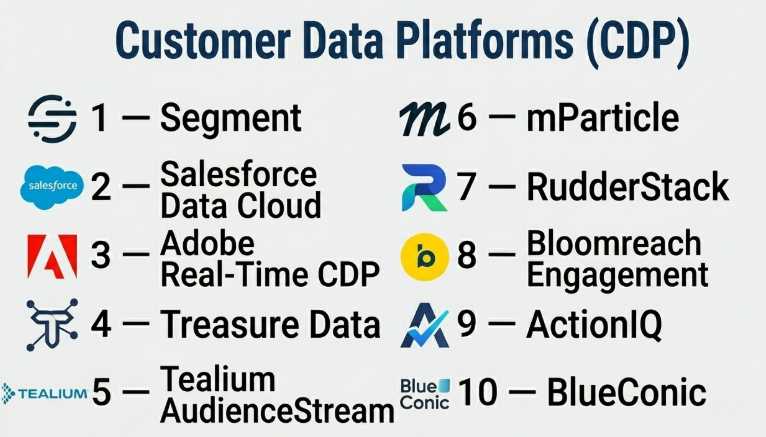
Top 10 Customer Data Platforms (CDP)
#1 — Segment
Short description: A widely used CDP that focuses on collecting, unifying, and routing customer data across tools.
Key Features
- Data collection and ingestion
- Identity resolution
- Audience segmentation
- Real-time data pipelines
- API-based integrations
- Data governance tools
Pros
- Strong integration ecosystem
- Developer-friendly
- Scalable
Cons
- Pricing can be high
- Requires setup
- Limited built-in analytics
Platforms / Deployment
Web / Cloud
Security & Compliance
Encryption, RBAC; Compliance: Not publicly stated
Integrations & Ecosystem
Extensive integrations with marketing, analytics, and data tools.
- CRM platforms
- Analytics tools
- APIs
- Data warehouses
Support & Community
Strong documentation; large community.
#2 — Salesforce Data Cloud (CDP)
Short description: An enterprise-grade CDP integrated within the Salesforce ecosystem.
Key Features
- Unified customer profiles
- Real-time data processing
- AI-powered segmentation
- Omnichannel activation
- CRM integration
- Identity resolution
Pros
- Deep Salesforce integration
- Enterprise-ready
- Strong data capabilities
Cons
- Expensive
- Complex implementation
- Requires Salesforce ecosystem
Platforms / Deployment
Web / Cloud
Security & Compliance
SSO, encryption; Compliance: Not publicly stated
Integrations & Ecosystem
Salesforce ecosystem integrations.
- CRM tools
- APIs
- marketing platforms
Support & Community
Enterprise support.
#3 — Adobe Real-Time CDP
Short description: A real-time CDP designed for large-scale customer data management and personalization.
Key Features
- Real-time data ingestion
- Identity resolution
- Audience segmentation
- AI-powered insights
- Omnichannel activation
- Data governance
Pros
- Strong real-time capabilities
- Advanced segmentation
- Enterprise-grade
Cons
- Expensive
- Complex setup
- Requires expertise
Platforms / Deployment
Web / Cloud
Security & Compliance
SSO, encryption; Compliance: Not publicly stated
Integrations & Ecosystem
Adobe ecosystem integrations.
- Analytics tools
- marketing platforms
- APIs
Support & Community
Enterprise support.
#4 — Treasure Data
Short description: A CDP focused on enterprise data management and customer journey orchestration.
Key Features
- Data unification
- Customer segmentation
- Journey orchestration
- Analytics integration
- Data governance
- Real-time processing
Pros
- Strong data management
- Scalable
- Flexible
Cons
- Complex implementation
- Pricing concerns
- Learning curve
Platforms / Deployment
Web / Cloud
Security & Compliance
Encryption; Compliance: Not publicly stated
Integrations & Ecosystem
Moderate integrations.
- APIs
- CRM tools
- analytics platforms
Support & Community
Enterprise support.
#5 — Tealium AudienceStream
Short description: A CDP focused on real-time customer data and audience segmentation.
Key Features
- Real-time data collection
- Audience segmentation
- Identity resolution
- Event tracking
- Data activation
- Integration capabilities
Pros
- Strong real-time capabilities
- Flexible
- Scalable
Cons
- Pricing concerns
- Setup complexity
- Requires expertise
Platforms / Deployment
Web / Cloud
Security & Compliance
Encryption; Compliance: Not publicly stated
Integrations & Ecosystem
Strong integrations.
- APIs
- marketing tools
- analytics platforms
Support & Community
Good support.
#6 — mParticle
Short description: A CDP designed for data pipelines, identity resolution, and customer data activation.
Key Features
- Data ingestion
- Identity resolution
- Audience segmentation
- Real-time pipelines
- Integration APIs
- Data governance
Pros
- Developer-friendly
- Strong integrations
- Scalable
Cons
- Complex setup
- Pricing concerns
- Limited UI for marketers
Platforms / Deployment
Web / Cloud
Security & Compliance
Encryption; Compliance: Not publicly stated
Integrations & Ecosystem
Extensive integrations.
- APIs
- analytics tools
- CRM platforms
Support & Community
Good support.
#7 — RudderStack
Short description: An open-source, warehouse-first CDP designed for modern data stacks.
Key Features
- Data pipelines
- Warehouse integration
- Identity resolution
- Event tracking
- API-first architecture
- Self-hosted option
Pros
- Open-source flexibility
- Warehouse-first approach
- Cost-effective
Cons
- Requires technical expertise
- Limited UI
- Smaller ecosystem
Platforms / Deployment
Web / Cloud / Self-hosted
Security & Compliance
Encryption; Compliance: Not publicly stated
Integrations & Ecosystem
Developer-focused integrations.
- APIs
- data warehouses
- analytics tools
Support & Community
Growing community.
#8 — Bloomreach Engagement
Short description: A CDP combined with marketing automation and personalization capabilities.
Key Features
- Customer data unification
- Personalization
- Campaign orchestration
- Analytics
- Segmentation
- Omnichannel support
Pros
- All-in-one platform
- Strong personalization
- Good for marketers
Cons
- Pricing concerns
- Complexity
- Learning curve
Platforms / Deployment
Web / Cloud
Security & Compliance
Encryption; Compliance: Not publicly stated
Integrations & Ecosystem
Moderate integrations.
- APIs
- marketing tools
- CRM platforms
Support & Community
Good support.
#9 — ActionIQ
Short description: An enterprise CDP focused on data orchestration and audience management.
Key Features
- Data unification
- Audience segmentation
- Campaign orchestration
- Analytics integration
- Data governance
- API access
Pros
- Strong enterprise capabilities
- Flexible
- Scalable
Cons
- Complex implementation
- Pricing concerns
- Requires expertise
Platforms / Deployment
Web / Cloud
Security & Compliance
Encryption; Compliance: Not publicly stated
Integrations & Ecosystem
Enterprise integrations.
- APIs
- data tools
- marketing platforms
Support & Community
Enterprise support.
#10 — BlueConic
Short description: A CDP designed for real-time customer data and marketing activation.
Key Features
- Real-time data collection
- Customer profiles
- Segmentation
- Personalization
- Data activation
- Analytics
Pros
- Real-time capabilities
- Easy to use
- Good for marketers
Cons
- Smaller ecosystem
- Limited advanced features
- Pricing concerns
Platforms / Deployment
Web / Cloud
Security & Compliance
Encryption; Compliance: Not publicly stated
Integrations & Ecosystem
Moderate integrations.
- APIs
- marketing tools
- CRM platforms
Support & Community
Good support.
Comparison Table (Top 10)
| Tool Name | Best For | Platform(s) Supported | Deployment | Standout Feature | Public Rating |
|---|---|---|---|---|---|
| Segment | Data pipelines | Web | Cloud | Integrations | N/A |
| Salesforce Data Cloud | Enterprise | Web | Cloud | CRM integration | N/A |
| Adobe Real-Time CDP | Enterprise | Web | Cloud | Real-time data | N/A |
| Treasure Data | Enterprise | Web | Cloud | Data orchestration | N/A |
| Tealium | Real-time | Web | Cloud | Event tracking | N/A |
| mParticle | Developers | Web | Cloud | Data pipelines | N/A |
| RudderStack | Open-source | Web | Hybrid | Warehouse-first | N/A |
| Bloomreach Engagement | Marketing | Web | Cloud | Personalization | N/A |
| ActionIQ | Enterprise | Web | Cloud | Audience mgmt | N/A |
| BlueConic | SMB | Web | Cloud | Ease of use | N/A |
Evaluation & Scoring of Customer Data Platforms (CDP)
| Tool Name | Core (25%) | Ease (15%) | Integrations (15%) | Security (10%) | Performance (10%) | Support (10%) | Value (15%) | Weighted Total |
|---|---|---|---|---|---|---|---|---|
| Segment | 9 | 7 | 10 | 9 | 9 | 9 | 7 | 8.8 |
| Salesforce Data Cloud | 10 | 6 | 10 | 9 | 9 | 9 | 6 | 8.7 |
| Adobe Real-Time CDP | 10 | 6 | 9 | 9 | 9 | 9 | 6 | 8.6 |
| Treasure Data | 9 | 6 | 8 | 8 | 8 | 8 | 7 | 7.9 |
| Tealium | 9 | 7 | 8 | 8 | 8 | 8 | 7 | 8.0 |
| mParticle | 9 | 6 | 9 | 8 | 8 | 8 | 7 | 8.1 |
| RudderStack | 8 | 6 | 8 | 8 | 8 | 7 | 9 | 8.0 |
| Bloomreach Engagement | 8 | 7 | 7 | 8 | 8 | 7 | 7 | 7.7 |
| ActionIQ | 9 | 6 | 8 | 8 | 8 | 8 | 6 | 7.8 |
| BlueConic | 8 | 8 | 7 | 7 | 8 | 7 | 7 | 7.7 |
How to interpret the scores:
- Scores are relative comparisons within the CDP category.
- Higher scores indicate stronger overall capabilities.
- Enterprise tools excel in scalability and integrations.
- Open-source tools provide flexibility and cost advantages.
- Choose based on your data maturity and use case.
Which Customer Data Platform (CDP) Is Right for You?
Solo / Freelancer
- CDPs are generally not necessary at this stage.
- Consider basic analytics or CRM tools instead.
SMB
- Best choices: BlueConic, RudderStack
- Focus on ease of use and affordability.
Mid-Market
- Best choices: Segment, mParticle, Tealium
- Balance between integrations and scalability.
Enterprise
- Best choices: Salesforce Data Cloud, Adobe Real-Time CDP, Treasure Data
- Focus on scalability, governance, and omnichannel orchestration.
Budget vs Premium
- Budget: RudderStack
- Premium: Adobe, Salesforce
Feature Depth vs Ease of Use
- Deep features: Adobe, Salesforce
- Easy tools: BlueConic
Integrations & Scalability
- Strong: Segment, Salesforce
- Moderate: Others
Security & Compliance Needs
- Strong: Enterprise CDPs
- Moderate: Others
Frequently Asked Questions (FAQs)
What is a CDP?
A platform that unifies customer data from multiple sources into one profile.
How is it different from a CRM?
CDPs collect and unify data; CRMs manage customer relationships.
Do I need a CDP?
If you have multiple data sources and need personalization, yes.
Is it expensive?
Pricing varies widely depending on scale.
Can it integrate with marketing tools?
Yes, integration is a core feature.
What is identity resolution?
Matching user data across devices and channels.
Is it real-time?
Some CDPs offer real-time capabilities.
Can small businesses use CDPs?
Yes, but simpler tools may be better initially.
Is it secure?
Most CDPs include strong data security measures.
Can I switch CDPs later?
Yes, but migration requires planning.
Conclusion
Customer Data Platforms (CDPs) are essential for businesses looking to unify customer data and deliver personalized, data-driven experiences. From enterprise solutions like Adobe Real-Time CDP to flexible options like RudderStack, there are tools for every level of data maturity.
