Introduction
Image Editing Software refers to applications used to modify, enhance, or create digital images. These tools range from simple editors for quick adjustments to advanced platforms capable of professional-grade photo manipulation, graphic design, and digital art creation.
With the rise of content marketing, social media, e-commerce, and digital branding, image editing software has become a core tool across industries. Businesses and creators rely on these tools to produce visually appealing content, maintain brand consistency, and communicate ideas effectively.
Common Use Cases
- Photo retouching and enhancement
- Social media content creation
- Marketing and advertising design
- UI/UX and web design assets
- Digital illustration and artwork
What Buyers Should Evaluate
When selecting image editing software, consider:
- Ease of use and learning curve
- Editing capabilities (layers, masks, filters, etc.)
- AI-powered features (background removal, auto-enhancement)
- File format support (RAW, PSD, SVG, etc.)
- Performance and system requirements
- Collaboration and cloud features
- Integration with other tools
- Pricing model (subscription vs one-time)
- Cross-platform availability
- Export and sharing options
Best for: Designers, photographers, marketers, content creators, agencies, and businesses of all sizes.
Not ideal for: Users needing only basic cropping or resizing (built-in tools may be sufficient) or those requiring specialized 3D or CAD editing.
Key Trends in Image Editing Software
- AI-assisted editing: Auto-enhancement, object removal, and generative fill features are becoming standard.
- Cloud collaboration: Real-time editing and sharing across teams.
- Non-destructive workflows: Editing without permanently altering original files.
- Cross-device editing: Seamless switching between desktop, tablet, and mobile.
- Template-driven design: Pre-built layouts for fast content creation.
- Subscription models: Ongoing updates and cloud storage bundled into pricing.
- Automation workflows: Batch processing and presets for efficiency.
- Integration ecosystems: Connectivity with CMS, DAM, and marketing tools.
- Performance optimization: GPU acceleration and faster rendering.
- Accessibility improvements: Tools designed for non-designers.
How We Selected These Tools (Methodology)
The tools below were selected based on:
- Market popularity and adoption
- Feature depth and innovation
- Performance and reliability
- Availability across platforms
- Suitability for different user segments (beginner to professional)
- Integration capabilities
- Community and support ecosystem
- Pricing flexibility
- Frequency of updates and improvements
- Balance between usability and advanced functionality
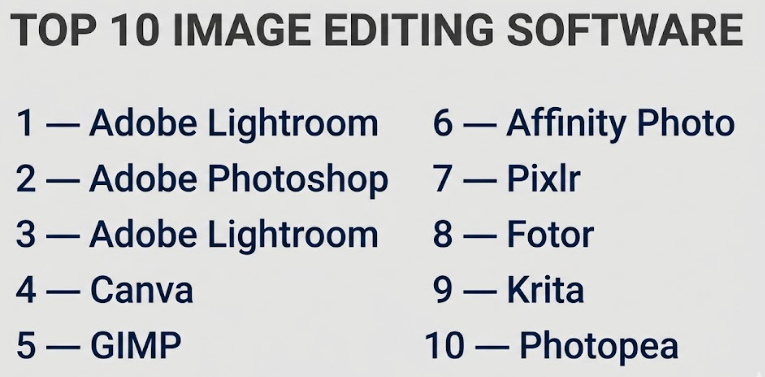
Top 10 Image Editing Software
#1 — Adobe Photoshop
Short description: Industry-standard image editing software used by professionals for advanced photo editing, design, and digital art.
Key Features
- Layer-based editing system
- Advanced retouching tools
- AI-powered features (object selection, generative fill)
- Extensive plugin ecosystem
- RAW file support
- Smart objects and masks
- 3D and advanced compositing tools
Pros
- Industry-leading capabilities
- Highly versatile
- Massive community and resources
Cons
- Subscription-based pricing
- Steep learning curve
Platforms / Deployment
Windows / macOS / iPad
Cloud + Local
Security & Compliance
SSO, encryption (details vary)
Integrations & Ecosystem
Photoshop integrates deeply with creative workflows.
- Creative Cloud apps
- Cloud storage
- Plugins and extensions
- Design tools
Support & Community
Extensive tutorials, forums, and professional community.
#2 — Adobe Lightroom
Short description: A photo-focused editing and management tool ideal for photographers.
Key Features
- Non-destructive editing
- RAW processing
- Presets and batch editing
- Cloud syncing
- AI enhancements
- Photo organization tools
Pros
- Excellent for photographers
- Easy workflow management
- Cloud syncing
Cons
- Limited graphic design features
- Subscription required
Platforms / Deployment
Windows / macOS / iOS / Android
Cloud + Local
Security & Compliance
Not publicly stated
Integrations & Ecosystem
Part of Adobe ecosystem.
- Photoshop
- Cloud storage
- Plugins
Support & Community
Strong community and tutorials.
#3 — Canva
Short description: A user-friendly design platform for quick image editing and content creation.
Key Features
- Drag-and-drop editor
- Templates for social media
- AI image tools
- Collaboration features
- Stock assets library
- Cloud-based
Pros
- Extremely easy to use
- Great for non-designers
- Fast content creation
Cons
- Limited advanced editing
- Internet required
Platforms / Deployment
Web / iOS / Android
Cloud
Security & Compliance
SSO (enterprise), encryption
Integrations & Ecosystem
Strong integrations with productivity tools.
- Google Drive
- Slack
- Social platforms
Support & Community
Large user base and help center.
#4 — GIMP
Short description: A free, open-source image editor with powerful capabilities.
Key Features
- Layer-based editing
- Custom brushes
- Plugin support
- Advanced image manipulation
- Open-source flexibility
Pros
- Free to use
- Highly customizable
- Cross-platform
Cons
- Outdated UI
- Steep learning curve
Platforms / Deployment
Windows / macOS / Linux
Local
Security & Compliance
Not publicly stated
Integrations & Ecosystem
Plugin-based ecosystem.
- Extensions
- Open-source tools
Support & Community
Active community and forums.
#5 — Affinity Photo
Short description: A professional photo editing tool with a one-time purchase model.
Key Features
- RAW editing
- Layer-based workflow
- High-performance engine
- Advanced retouching
- HDR and panorama tools
Pros
- No subscription
- High performance
- Professional features
Cons
- Smaller ecosystem
- Limited cloud features
Platforms / Deployment
Windows / macOS / iPad
Local
Security & Compliance
Not publicly stated
Integrations & Ecosystem
Limited but growing ecosystem.
- File exports
- Plugins
Support & Community
Good documentation and user base.
#6 — Corel PaintShop Pro
Short description: A feature-rich image editing tool aimed at enthusiasts and professionals.
Key Features
- AI tools
- Layer editing
- Photo correction tools
- Graphic design features
- Batch processing
Pros
- One-time purchase
- Rich feature set
- Good for Windows users
Cons
- Windows-only
- Less popular than Adobe
Platforms / Deployment
Windows
Local
Security & Compliance
Not publicly stated
Integrations & Ecosystem
Basic integrations.
- Plugins
- File exports
Support & Community
Moderate support and resources.
#7 — Pixlr
Short description: A browser-based image editor for quick and accessible editing.
Key Features
- Web-based editing
- AI tools
- Templates
- Background removal
- Filters and effects
Pros
- No installation required
- Easy to use
- Free tier available
Cons
- Limited advanced features
- Internet dependency
Platforms / Deployment
Web / Mobile
Cloud
Security & Compliance
Not publicly stated
Integrations & Ecosystem
Basic integrations.
- Cloud storage
- Browser tools
Support & Community
Basic documentation.
#8 — Fotor
Short description: An online photo editor with design and enhancement tools.
Key Features
- AI enhancement
- Filters and effects
- Design templates
- Collage maker
- Batch processing
Pros
- Beginner-friendly
- Quick edits
- Free version available
Cons
- Limited professional tools
- Ads in free version
Platforms / Deployment
Web / Mobile
Cloud
Security & Compliance
Not publicly stated
Integrations & Ecosystem
Limited integrations.
- Cloud tools
- Social sharing
Support & Community
Basic support resources.
#9 — Krita
Short description: A free, open-source tool focused on digital painting and illustration.
Key Features
- Brush engine
- Layer system
- Animation tools
- Customizable UI
- Open-source
Pros
- Excellent for artists
- Free
- Powerful brush tools
Cons
- Not ideal for photo editing
- Learning curve
Platforms / Deployment
Windows / macOS / Linux
Local
Security & Compliance
Not publicly stated
Integrations & Ecosystem
Open-source plugins.
- Extensions
- Community tools
Support & Community
Strong artist community.
#10 — Photopea
Short description: A web-based editor similar to Photoshop, supporting PSD files.
Key Features
- PSD support
- Layer editing
- Web-based interface
- No installation
- Multiple file formats
Pros
- Free and accessible
- Familiar interface
- Works in browser
Cons
- Ads in free version
- Performance depends on browser
Platforms / Deployment
Web
Cloud
Security & Compliance
Not publicly stated
Integrations & Ecosystem
Basic integrations.
- Cloud storage
- File imports
Support & Community
Moderate documentation.
Comparison Table (Top 10)
| Tool Name | Best For | Platform(s) Supported | Deployment | Standout Feature | Public Rating |
|---|---|---|---|---|---|
| Adobe Photoshop | Professionals | Win, macOS, iPad | Hybrid | Advanced editing | N/A |
| Lightroom | Photographers | Win, macOS, Mobile | Hybrid | Photo management | N/A |
| Canva | Beginners/teams | Web, Mobile | Cloud | Templates | N/A |
| GIMP | Free users | Win, macOS, Linux | Local | Open-source | N/A |
| Affinity Photo | Professionals | Win, macOS, iPad | Local | One-time purchase | N/A |
| PaintShop Pro | Windows users | Windows | Local | AI tools | N/A |
| Pixlr | Quick edits | Web | Cloud | Browser-based | N/A |
| Fotor | Beginners | Web, Mobile | Cloud | Easy enhancement | N/A |
| Krita | Artists | Win, macOS, Linux | Local | Digital painting | N/A |
| Photopea | Browser users | Web | Cloud | PSD support | N/A |
Evaluation & Scoring of Image Editing Software
| Tool Name | Core | Ease | Integrations | Security | Performance | Support | Value | Weighted Total |
|---|---|---|---|---|---|---|---|---|
| Photoshop | 10 | 7 | 9 | 7 | 9 | 10 | 6 | 8.6 |
| Lightroom | 9 | 8 | 8 | 6 | 9 | 9 | 7 | 8.3 |
| Canva | 7 | 10 | 9 | 7 | 8 | 8 | 9 | 8.6 |
| GIMP | 8 | 6 | 6 | 5 | 8 | 7 | 10 | 7.8 |
| Affinity Photo | 9 | 7 | 6 | 6 | 9 | 8 | 9 | 8.2 |
| PaintShop Pro | 8 | 7 | 6 | 5 | 8 | 7 | 8 | 7.6 |
| Pixlr | 6 | 9 | 6 | 5 | 7 | 6 | 9 | 7.5 |
| Fotor | 6 | 9 | 5 | 5 | 7 | 6 | 9 | 7.4 |
| Krita | 8 | 6 | 5 | 5 | 8 | 7 | 10 | 7.7 |
| Photopea | 7 | 8 | 6 | 5 | 7 | 6 | 9 | 7.6 |
How to interpret:
- Scores are comparative across tools in this category.
- A higher score indicates a stronger balance of features and usability.
- Enterprise users may prioritize security and integrations over value.
- Creators may prioritize core features and performance.
- Always validate tools against your specific workflow.
Which Image Editing Software Is Right for You?
Solo / Freelancer
- Canva, Photopea, Pixlr
- Focus on ease and affordability
SMB
- Canva, Affinity Photo, Lightroom
- Balance usability and features
Mid-Market
- Photoshop, Affinity Photo
- Professional outputs required
Enterprise
- Photoshop + ecosystem
- Integration and scalability focus
Budget vs Premium
- Budget: GIMP, Krita
- Premium: Photoshop, Lightroom
Feature Depth vs Ease of Use
- Deep features: Photoshop, Affinity
- Easy tools: Canva, Fotor
Integrations & Scalability
- Strong: Adobe ecosystem, Canva
- Limited: GIMP, Krita
Security & Compliance Needs
- Choose tools with enterprise controls
- Avoid web-only tools for sensitive work
Frequently Asked Questions (FAQs)
What is image editing software used for?
It is used to enhance, modify, or create images for design, marketing, or personal use.
Are there free image editing tools?
Yes, tools like GIMP, Krita, and Photopea offer free options.
Which is best for beginners?
Canva and Fotor are very beginner-friendly.
Which is best for professionals?
Adobe Photoshop remains the industry standard.
Can I use these tools online?
Yes, tools like Canva, Pixlr, and Photopea are web-based.
Do these tools support RAW files?
Many professional tools like Lightroom and Photoshop do.
Is subscription necessary?
Not always—Affinity Photo and GIMP are alternatives.
Are these tools secure?
Security varies; enterprise tools offer better controls.
Can I switch tools easily?
Yes, but file compatibility should be checked.
What are alternatives to Photoshop?
Affinity Photo, GIMP, and Photopea are popular alternatives.
Conclusion
Image editing software plays a critical role in modern digital workflows, from simple content creation to advanced professional design. The right tool depends on your skill level, budget, and specific use case.
Some tools excel in simplicity, while others offer unmatched depth and control. There is no universal best option—only the one that fits your workflow.
