Introduction
3D animation software enables creators to design, animate, and render objects and environments in a three-dimensional space. These tools are widely used across industries such as film, gaming, advertising, architecture, and product design to create realistic visuals and motion.
Today, 3D animation platforms have evolved into end-to-end production suites, combining modeling, rigging, simulation, rendering, and compositing in a single workflow. With advancements in real-time rendering, AI-assisted animation, and virtual production, these tools are becoming more powerful and accessible for both individuals and large studios.
Common use cases include:
- Film, TV, and VFX production
- Game development and real-time environments
- Product visualization and marketing content
- Architectural walkthroughs
- Educational and simulation content
What buyers should evaluate:
- Modeling and animation capabilities
- Rendering quality and speed
- Ease of use and learning curve
- Hardware requirements
- Integration with other tools (game engines, editors)
- Collaboration and pipeline support
- AI-assisted features
- Licensing and pricing flexibility
- Plugin ecosystem
- Scalability for large projects
Best for: 3D artists, animators, game developers, VFX studios, architects, and marketing teams that need high-quality visual content.
Not ideal for: Users looking for simple 2D animation or quick graphic design—lighter tools or video editors may be more suitable.
Key Trends in 3D Animation Software
- AI-assisted animation workflows: Auto-rigging, motion capture cleanup, and generative assets
- Real-time rendering engines: Faster iteration with near-instant visual feedback
- Cloud-based collaboration: Remote teams working on shared scenes and assets
- Procedural and node-based systems: Scalable and non-destructive workflows
- Virtual production adoption: Integration with LED stages and real-time environments
- Cross-tool interoperability: Improved file compatibility across software ecosystems
- GPU acceleration: Faster rendering and simulation performance
- Subscription pricing models: Flexible licensing replacing perpetual licenses
- AR/VR/XR content creation: Tools optimized for immersive experiences
- Automation and scripting: APIs and plugins for workflow optimization
How We Selected These Tools (Methodology)
The tools listed below were selected based on:
- Industry adoption and market reputation
- Feature completeness across animation pipelines
- Performance and rendering capabilities
- Integration with external tools and engines
- Accessibility for beginners, SMBs, and enterprises
- Strength of community and ecosystem
- Innovation in real-time and AI-driven workflows
- Cross-platform availability
- Vendor reliability and ongoing development
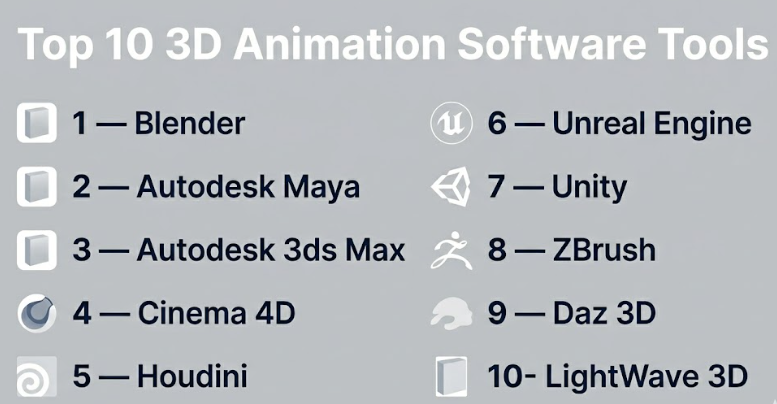
Top 10 3D Animation Software Tools
1 — Blender
Short description: A powerful open-source 3D creation suite suitable for modeling, animation, rendering, and more.
Key Features
- Full 3D pipeline (modeling, animation, rendering)
- Real-time rendering with Eevee
- Cycles physically-based renderer
- Node-based compositing and materials
- Sculpting and simulation tools
- Python scripting for automation
Pros
- Free and open-source
- Large and active community
- Frequent updates and improvements
Cons
- Steep learning curve for beginners
- Complex interface initially
- Limited enterprise support
Platforms / Deployment
Windows / macOS / Linux
Security & Compliance
Not publicly stated
Integrations & Ecosystem
Blender integrates well with various tools and engines:
- Unity and Unreal Engine support
- Extensive plugin ecosystem
- Python API for customization
Support & Community
Extremely strong community with tutorials, forums, and documentation.
2 — Autodesk Maya
Short description: Industry-standard software for character animation, VFX, and high-end production.
Key Features
- Advanced rigging and animation tools
- Bifrost procedural effects system
- Arnold renderer integration
- Motion graphics toolkit
- Simulation tools for particles and fluids
Pros
- Industry-standard for animation
- Powerful and flexible toolset
- Strong pipeline integration
Cons
- Expensive subscription
- Steep learning curve
- Requires high-end hardware
Platforms / Deployment
Windows / macOS / Linux
Security & Compliance
Not publicly stated
Integrations & Ecosystem
- Autodesk ecosystem integration
- Third-party plugins
- API support
Support & Community
Strong enterprise support and professional training resources.
3 — Autodesk 3ds Max
Short description: Popular for architectural visualization, modeling, and game asset creation.
Key Features
- Advanced modeling tools
- Arnold renderer
- Procedural workflows
- UV mapping capabilities
- Plugin support
Pros
- Excellent for visualization
- Mature toolset
- Strong plugin ecosystem
Cons
- Windows-only
- Expensive
- Complex interface
Platforms / Deployment
Windows
Security & Compliance
Not publicly stated
Integrations & Ecosystem
- Autodesk ecosystem
- Third-party plugins
- Game engine export support
Support & Community
Large user base with strong community support.
4 — Cinema 4D
Short description: A user-friendly 3D animation tool widely used for motion graphics and design.
Key Features
- Intuitive interface
- MoGraph toolset
- Fast rendering workflows
- Integration with Adobe tools
- Procedural animation features
Pros
- Easy to learn
- Excellent for motion graphics
- Smooth workflow
Cons
- Expensive subscription
- Limited advanced simulation
- Less suited for complex VFX
Platforms / Deployment
Windows / macOS
Security & Compliance
Not publicly stated
Integrations & Ecosystem
- Adobe After Effects integration
- Plugin ecosystem
- API support
Support & Community
Strong documentation and creative community.
5 — Houdini
Short description: Advanced procedural 3D animation software used for VFX and simulations.
Key Features
- Node-based procedural workflows
- Advanced simulations (fire, smoke, fluids)
- Scalable scene handling
- VFX-focused toolset
- Custom scripting
Pros
- Extremely powerful for simulations
- Highly scalable workflows
- Industry-standard for VFX
Cons
- Very steep learning curve
- Overkill for simple projects
- Expensive
Platforms / Deployment
Windows / macOS / Linux
Security & Compliance
Not publicly stated
Integrations & Ecosystem
- Pipeline integration tools
- Plugin support
- API access
Support & Community
Strong professional community with learning resources.
6 — Unreal Engine
Short description: A real-time 3D creation platform used for games, film, and virtual production.
Key Features
- Real-time rendering
- Blueprints visual scripting
- Cinematic tools
- Virtual production support
- High-fidelity graphics
Pros
- Real-time workflow
- Free to use (royalty-based)
- Strong for interactive content
Cons
- Requires learning engine concepts
- High system requirements
- Not a traditional modeling tool
Platforms / Deployment
Windows / macOS / Linux
Security & Compliance
Not publicly stated
Integrations & Ecosystem
- Asset marketplace
- Plugin ecosystem
- Integration with major 3D tools
Support & Community
Massive global community and extensive documentation.
7 — Unity
Short description: A cross-platform engine for creating interactive 3D content and animations.
Key Features
- Real-time rendering
- Cross-platform deployment
- Asset store
- AR/VR support
- Scripting environment
Pros
- Highly versatile
- Large developer community
- Strong for interactive experiences
Cons
- Requires coding knowledge
- Not focused purely on animation
- Performance tuning required
Platforms / Deployment
Windows / macOS / Linux / iOS / Android
Security & Compliance
Not publicly stated
Integrations & Ecosystem
- Asset Store
- Third-party tools
- API support
Support & Community
Very large ecosystem with extensive resources.
8 — ZBrush
Short description: A specialized tool for digital sculpting and high-detail modeling.
Key Features
- Advanced sculpting tools
- High-poly modeling
- Brush customization
- Texture painting
- Real-time feedback
Pros
- Best-in-class sculpting
- Handles high-detail assets
- Widely used in character design
Cons
- Not a full animation suite
- Unique interface
- Requires integration with other tools
Platforms / Deployment
Windows / macOS
Security & Compliance
Not publicly stated
Integrations & Ecosystem
- Integration with Maya and Blender
- Plugin support
Support & Community
Strong artist community and tutorials.
9 — Daz 3D
Short description: Beginner-friendly software focused on character creation and rendering.
Key Features
- Pre-built assets
- Character customization
- Rendering tools
- Asset marketplace
- Simple interface
Pros
- Easy to use
- Fast content creation
- Large asset library
Cons
- Limited customization
- Not ideal for complex animation
- Additional asset costs
Platforms / Deployment
Windows / macOS
Security & Compliance
Not publicly stated
Integrations & Ecosystem
- Asset marketplace
- Plugin support
Support & Community
Active user community with moderate documentation.
10 — LightWave 3D
Short description: A long-standing 3D animation tool used for modeling, rendering, and VFX.
Key Features
- Modeling and animation tools
- Node-based materials
- Rendering engine
- VFX capabilities
- Lightweight performance
Pros
- Faster rendering
- Lower hardware requirements
- Cost-effective
Cons
- Smaller community
- Slower updates
- Less modern interface
Platforms / Deployment
Windows / macOS
Security & Compliance
Not publicly stated
Integrations & Ecosystem
- Plugin support
- Limited integrations
Support & Community
Varies / Not publicly stated
Comparison Table (Top 10)
| Tool Name | Best For | Platform(s) Supported | Deployment | Standout Feature | Public Rating |
|---|---|---|---|---|---|
| Blender | Freelancers | Win/macOS/Linux | Self-hosted | Free full-suite | N/A |
| Maya | Film/VFX | Win/macOS/Linux | Self-hosted | Industry-standard animation | N/A |
| 3ds Max | Visualization | Windows | Self-hosted | Architectural workflows | N/A |
| Cinema 4D | Motion graphics | Win/macOS | Self-hosted | Ease of use | N/A |
| Houdini | VFX simulations | Win/macOS/Linux | Self-hosted | Procedural workflows | N/A |
| Unreal Engine | Real-time content | Win/macOS/Linux | Hybrid | Real-time rendering | N/A |
| Unity | Interactive content | Multi-platform | Hybrid | Cross-platform deployment | N/A |
| ZBrush | Sculpting | Win/macOS | Self-hosted | High-detail modeling | N/A |
| Daz 3D | Beginners | Win/macOS | Self-hosted | Asset-driven creation | N/A |
| LightWave 3D | Small studios | Win/macOS | Self-hosted | Lightweight performance | N/A |
Evaluation & Scoring of 3D Animation Software
| Tool Name | Core (25%) | Ease (15%) | Integrations (15%) | Security (10%) | Performance (10%) | Support (10%) | Value (15%) | Weighted Total |
|---|---|---|---|---|---|---|---|---|
| Blender | 9 | 7 | 8 | 5 | 8 | 9 | 10 | 8.3 |
| Maya | 10 | 6 | 9 | 5 | 9 | 9 | 6 | 8.2 |
| 3ds Max | 9 | 6 | 8 | 5 | 8 | 8 | 6 | 7.7 |
| Cinema 4D | 8 | 9 | 8 | 5 | 8 | 8 | 6 | 7.9 |
| Houdini | 10 | 5 | 8 | 5 | 9 | 8 | 6 | 7.9 |
| Unreal Engine | 9 | 6 | 9 | 5 | 10 | 9 | 9 | 8.6 |
| Unity | 8 | 7 | 9 | 5 | 8 | 9 | 8 | 8.1 |
| ZBrush | 8 | 6 | 7 | 5 | 8 | 8 | 7 | 7.4 |
| Daz 3D | 6 | 9 | 6 | 5 | 6 | 7 | 8 | 7.1 |
| LightWave 3D | 7 | 7 | 6 | 5 | 7 | 6 | 7 | 6.9 |
How to interpret the scores:
- These scores are comparative within the category, not absolute benchmarks.
- Higher Core scores indicate deeper animation and rendering capabilities.
- Ease scores reflect usability and onboarding speed.
- Value scores highlight cost-effectiveness.
- The Weighted Total helps identify the most balanced tools overall.
Which 3D Animation Software Tool Is Right for You?
Solo / Freelancer
- Recommended: Blender, Daz 3D
- Low cost, flexible, and strong community support
SMB
- Recommended: Cinema 4D, Unity
- Balance of usability and capability
Mid-Market
- Recommended: Maya, Unreal Engine
- Advanced features and scalability
Enterprise
- Recommended: Maya, Houdini
- High-end production and pipeline integration
Budget vs Premium
- Budget: Blender, Unreal Engine
- Premium: Maya, Houdini
Feature Depth vs Ease of Use
- Feature depth: Houdini, Maya
- Ease of use: Cinema 4D, Daz 3D
Integrations & Scalability
- Strong integrations: Unreal Engine, Unity, Maya
- Moderate: Blender, Cinema 4D
Security & Compliance Needs
- Most tools do not publicly disclose full compliance details.
- Enterprises should validate vendor security capabilities directly.
Frequently Asked Questions (FAQs)
What is 3D animation software used for?
It is used to create animated 3D objects and environments for films, games, marketing, and simulations.
Which 3D animation software is best for beginners?
Blender and Daz 3D are popular starting points due to accessibility and community support.
Do I need a powerful computer?
Yes, especially for rendering and simulations. A strong GPU is important.
Is Blender good for professional use?
Yes, many professionals and studios use Blender for production work.
What is real-time rendering?
It allows scenes to be rendered instantly, improving workflow speed.
Can these tools be used for game development?
Yes, many integrate with engines like Unity and Unreal Engine.
How long does it take to learn 3D animation?
Basic skills can take weeks, while mastery can take years.
Are there free 3D animation tools?
Yes, Blender is a powerful free and open-source option.
Can I switch tools later?
Yes, but expect a learning curve and workflow adjustments.
Do these tools support collaboration?
Some tools support collaboration, especially cloud-based or integrated platforms.
Conclusion
3D animation software has become an essential part of modern creative workflows, enabling everything from cinematic storytelling to real-time interactive experiences. Each tool in this category serves a different purpose—some prioritize ease of use and accessibility, while others focus on advanced simulations and production-grade pipelines.
There is no single “best” option for everyone. The right choice depends on your skill level, project requirements, budget, and workflow needs. For example, beginners may benefit from tools like Blender or Daz 3D, while professionals working in film or VFX may prefer Maya or Houdini
