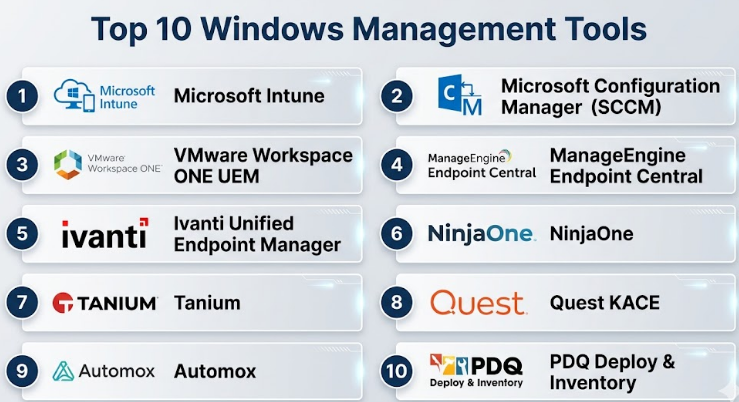
Introduction
Windows Management Tools help organizations deploy, configure, secure, monitor, update, and manage Windows devices across enterprise environments. In simple terms, these platforms allow IT teams to centrally control Windows desktops, laptops, virtual machines, servers, and endpoint configurations while improving security, operational efficiency, and user productivity.
In Windows management has become increasingly complex due to hybrid work, remote endpoints, cloud-native infrastructure, Zero Trust security models, and growing compliance requirements. Organizations now manage thousands of distributed Windows devices across multiple locations, making automation, endpoint visibility, patch management, policy enforcement, and remote troubleshooting critical operational priorities.
Modern Windows Management platforms combine endpoint management, patching, device compliance, automation workflows, software deployment, analytics, AI-driven remediation, and security enforcement into unified operational ecosystems.
Common real-world use cases include:
- Windows endpoint management
- Patch and update deployment
- Remote device troubleshooting
- Security policy enforcement
- Software deployment and inventory management
When evaluating Windows Management tools, buyers should consider:
- Endpoint management depth
- Patch management automation
- Remote support capabilities
- Security and compliance controls
- Scalability across distributed environments
- Automation and scripting support
- Integration ecosystem maturity
- Reporting and analytics quality
- Cloud and hybrid deployment support
- Ease of administration
Best for: Enterprise IT operations teams, managed service providers, hybrid workforce organizations, educational institutions, government agencies, and businesses managing large Windows environments.
Not ideal for: Very small businesses with only a handful of unmanaged devices or organizations using primarily non-Windows infrastructure.
Key Trends in Windows Management Tools
- Unified Endpoint Management (UEM) is replacing traditional desktop management models.
- AI-driven remediation and automation are reducing manual IT workloads.
- Cloud-native Windows management adoption is accelerating.
- Zero Trust endpoint management is becoming standard practice.
- Remote endpoint support capabilities continue to expand.
- Endpoint analytics and telemetry visibility are improving.
- Integration with cybersecurity platforms is becoming deeper.
- Automated patch management is increasingly AI-assisted.
- Device compliance monitoring is becoming more granular.
- Hybrid Active Directory and cloud identity integrations are expanding rapidly.
How We Selected These Tools (Methodology)
The tools in this list were selected based on enterprise adoption, management capabilities, scalability, and operational effectiveness.
Our evaluation process included:
- Market adoption and reputation
- Endpoint management functionality
- Patch management and automation capabilities
- Security and compliance features
- Integration ecosystem strength
- Scalability for enterprise environments
- Reporting and analytics quality
- Cloud and hybrid management support
- Ease of deployment and administration
- Vendor support and operational reliability
The final selection includes enterprise endpoint management leaders, UEM platforms, remote management vendors, and Windows administration solutions.
Windows Management Tools
#1 — Microsoft Intune
Short description :
Microsoft Intune is a cloud-based Unified Endpoint Management platform designed to manage Windows devices, mobile endpoints, applications, and security policies across enterprise environments. It is widely adopted by organizations using Microsoft 365 and hybrid workforce infrastructures. Intune helps IT teams automate endpoint management, enforce compliance, deploy applications, and support remote device operations at scale.
Key Features
- Cloud-based endpoint management
- Windows device compliance enforcement
- Patch and update management
- Application deployment and configuration
- Conditional access integration
- Remote device actions
- Endpoint security policy management
Pros
- Deep Microsoft ecosystem integration
- Strong cloud-native management capabilities
- Good support for hybrid work environments
Cons
- Best suited for Microsoft-centric organizations
- Advanced configurations may require expertise
- Some legacy management workflows vary
Platforms / Deployment
- Windows / macOS / iOS / Android
- Cloud
Security & Compliance
- MFA
- SSO/SAML
- RBAC
- Encryption
- Audit logs
- GDPR
- Conditional access controls
Integrations & Ecosystem
Intune integrates broadly across Microsoft enterprise and security ecosystems.
- Microsoft Entra ID
- Microsoft Defender
- Microsoft 365
- APIs
- Security platforms
- Endpoint analytics tools
Support & Community
Extensive enterprise documentation with a large global IT administrator community.
#2 — Microsoft Configuration Manager (SCCM)
Short description :
Microsoft Configuration Manager, formerly SCCM, is an enterprise endpoint management platform designed for Windows device administration, software deployment, operating system provisioning, and patch management. It remains widely used in large enterprise and hybrid environments.
Key Features
- Windows endpoint administration
- Operating system deployment
- Software distribution
- Patch management automation
- Hardware and software inventory
- Remote troubleshooting
- Compliance reporting
Pros
- Powerful enterprise management capabilities
- Mature Windows administration ecosystem
- Strong automation support
Cons
- Complex deployment and maintenance
- Infrastructure-heavy implementation
- Cloud-native workflows require hybrid integration
Platforms / Deployment
- Windows
- On-premises / Hybrid
Security & Compliance
- RBAC
- Audit logs
- Encryption
- MFA integration
- Active Directory integration
Integrations & Ecosystem
Configuration Manager integrates deeply with Microsoft enterprise ecosystems.
- Microsoft Intune
- Active Directory
- Microsoft Defender
- APIs
- Windows Server services
Support & Community
Large enterprise administrator community with extensive deployment resources.
#3 — VMware Workspace ONE UEM
Short description :
VMware Workspace ONE UEM provides unified endpoint management for Windows and cross-platform environments. It combines device management, application delivery, automation, compliance enforcement, and endpoint analytics within a centralized operational platform.
Key Features
- Unified endpoint management
- Windows policy enforcement
- Application lifecycle management
- Endpoint compliance monitoring
- Remote troubleshooting
- Automation workflows
- Device analytics dashboards
Pros
- Strong cross-platform management
- Good enterprise scalability
- Broad automation capabilities
Cons
- Advanced enterprise deployments can be complex
- Premium pricing for large environments
- Best suited for VMware-centric ecosystems
Platforms / Deployment
- Windows / macOS / Linux / iOS / Android
- Cloud / Hybrid
Security & Compliance
- MFA
- SSO/SAML
- RBAC
- Encryption
- Audit logs
- GDPR
Integrations & Ecosystem
Workspace ONE integrates with enterprise identity and virtualization ecosystems.
- VMware Horizon
- Microsoft 365
- Okta
- APIs
- Endpoint security tools
Support & Community
Strong enterprise support with extensive endpoint management expertise.
#4 — ManageEngine Endpoint Central
Short description :
ManageEngine Endpoint Central is a unified endpoint management and Windows administration platform designed for patching, software deployment, remote troubleshooting, and compliance management across enterprise environments.
Key Features
- Windows patch management
- Software deployment automation
- Remote desktop support
- Endpoint inventory management
- Configuration enforcement
- Compliance reporting
- Automation scripting
Pros
- Strong patch management functionality
- Good value for mid-sized organizations
- Broad endpoint visibility
Cons
- UI modernization could improve
- Advanced enterprise analytics vary
- Some workflows require manual tuning
Platforms / Deployment
- Windows / macOS / Linux / Mobile
- Cloud / On-premises
Security & Compliance
- MFA
- RBAC
- Encryption
- Audit logs
- GDPR
Integrations & Ecosystem
Endpoint Central integrates with IT operations and service management ecosystems.
- Active Directory
- ServiceDesk Plus
- APIs
- Endpoint security platforms
- ITSM tools
Support & Community
Large IT operations ecosystem with strong administrator documentation.
#5 — Ivanti Unified Endpoint Manager
Short description :
Ivanti Unified Endpoint Manager provides enterprise Windows management, endpoint security, automation, and device lifecycle management capabilities. It helps organizations manage distributed endpoints while enforcing compliance and operational policies.
Key Features
- Unified endpoint management
- Patch automation
- Endpoint security controls
- Remote troubleshooting
- Software distribution
- Compliance analytics
- Device lifecycle management
Pros
- Strong endpoint automation
- Good operational visibility
- Broad enterprise functionality
Cons
- Advanced deployments may require expertise
- Interface complexity for some workflows
- Premium enterprise pricing
Platforms / Deployment
- Windows / macOS / Linux / Mobile
- Cloud / Hybrid
Security & Compliance
- MFA
- SSO/SAML
- RBAC
- Encryption
- Audit logs
- GDPR
Integrations & Ecosystem
Ivanti integrates with enterprise security and operational ecosystems.
- ServiceNow
- Microsoft ecosystems
- APIs
- Endpoint security tools
- Identity providers
Support & Community
Enterprise-focused support organization with operational deployment guidance.
#6 — NinjaOne
Short description :
NinjaOne is a cloud-native endpoint management and remote monitoring platform widely used by MSPs and IT teams for Windows administration, automation, patching, and endpoint monitoring.
Key Features
- Remote endpoint management
- Windows patch automation
- Device monitoring
- Remote access support
- Software deployment
- Backup integrations
- Automation scripting
Pros
- Easy-to-use cloud interface
- Strong MSP-friendly workflows
- Fast deployment and onboarding
Cons
- Advanced enterprise analytics vary
- Some customization limitations
- Large-scale enterprise workflows may require additional tooling
Platforms / Deployment
- Windows / macOS / Linux / Mobile
- Cloud
Security & Compliance
- MFA
- RBAC
- Encryption
- Audit logs
- GDPR
Integrations & Ecosystem
NinjaOne integrates with IT operations and security ecosystems.
- TeamViewer
- Splashtop
- APIs
- Backup platforms
- PSA tools
Support & Community
Strong customer support reputation with growing MSP community adoption.
#7 — Tanium
Short description :
Tanium is an enterprise endpoint management and security platform focused on real-time endpoint visibility, patch management, compliance enforcement, and operational control across large-scale Windows environments.
Key Features
- Real-time endpoint visibility
- Patch and vulnerability management
- Endpoint compliance analytics
- Threat detection integration
- Asset inventory management
- Automation workflows
- Large-scale endpoint querying
Pros
- Excellent real-time visibility
- Strong enterprise scalability
- Powerful operational analytics
Cons
- Premium enterprise pricing
- Complex deployment requirements
- Advanced administration expertise needed
Platforms / Deployment
- Windows / macOS / Linux
- Cloud / Hybrid
Security & Compliance
- MFA
- SSO/SAML
- RBAC
- Encryption
- Audit logs
- SOC 2
- GDPR
Integrations & Ecosystem
Tanium integrates with enterprise security and operations ecosystems.
- ServiceNow
- SIEM platforms
- APIs
- Vulnerability management tools
- Endpoint security platforms
Support & Community
Enterprise-grade support with strong large-scale operational expertise.
#8 — Quest KACE
Short description :
Quest KACE provides systems management, patch automation, asset inventory, and software deployment functionality for organizations managing Windows endpoints and distributed device environments.
Key Features
- Systems management automation
- Patch deployment
- Software distribution
- Asset inventory
- Endpoint scripting
- Compliance reporting
- Service desk integration
Pros
- Strong endpoint inventory visibility
- Good mid-market functionality
- Useful deployment automation
Cons
- UI modernization could improve
- Advanced analytics vary
- Enterprise scalability limitations for very large deployments
Platforms / Deployment
- Windows / macOS
- On-premises / Hybrid
Security & Compliance
- RBAC
- Encryption
- Audit logs
- MFA integration
- GDPR
Integrations & Ecosystem
Quest KACE integrates with IT operations and service management ecosystems.
- Active Directory
- Service desk tools
- APIs
- Endpoint management platforms
Support & Community
Established IT operations customer base with solid documentation resources.
#9 — Automox
Short description :
Automox is a cloud-native endpoint management and patch automation platform designed to simplify Windows device management, policy enforcement, and operational automation for distributed environments.
Key Features
- Cloud-native patch management
- Policy automation
- Endpoint inventory visibility
- Configuration management
- Automation scripting
- Compliance monitoring
- Remote endpoint management
Pros
- Lightweight cloud-native deployment
- Strong automation workflows
- Good remote workforce support
Cons
- Advanced enterprise customization varies
- Limited legacy infrastructure management
- Some reporting depth limitations
Platforms / Deployment
- Windows / macOS / Linux
- Cloud
Security & Compliance
- MFA
- RBAC
- Encryption
- Audit logs
- GDPR
Integrations & Ecosystem
Automox integrates with security and operational ecosystems.
- Okta
- APIs
- SIEM tools
- Endpoint security platforms
- Automation tools
Support & Community
Growing cloud-native IT operations ecosystem with onboarding support resources.
#10 — PDQ Deploy & Inventory
Short description :
PDQ Deploy & Inventory is a Windows administration platform focused on software deployment, inventory management, patching, and automation for SMB and mid-market IT environments.
Key Features
- Software deployment automation
- Windows inventory management
- Patch deployment
- PowerShell automation
- Endpoint reporting
- Package management
- Administrative scripting
Pros
- Easy-to-use interface
- Strong Windows deployment automation
- Good value for SMB environments
Cons
- Primarily Windows-focused
- Limited enterprise-scale functionality
- Cloud-native management depth varies
Platforms / Deployment
- Windows
- On-premises
Security & Compliance
- RBAC
- Audit logs
- Encryption
- Active Directory integration
Integrations & Ecosystem
PDQ integrates with Windows administration and scripting ecosystems.
- Active Directory
- PowerShell
- APIs
- Windows administration tools
Support & Community
Strong SMB administrator community with practical deployment documentation.
Comparison Table (Top 10)
| Tool Name | Best For | Platform(s) Supported | Deployment | Standout Feature | Public Rating |
|---|---|---|---|---|---|
| Microsoft Intune | Cloud-native endpoint management | Cross-platform | Cloud | Microsoft cloud endpoint management | N/A |
| Microsoft Configuration Manager | Large enterprise Windows management | Windows | On-premises, Hybrid | Advanced Windows administration | N/A |
| VMware Workspace ONE UEM | Unified endpoint environments | Cross-platform | Cloud, Hybrid | Cross-platform UEM functionality | N/A |
| ManageEngine Endpoint Central | Mid-market endpoint management | Cross-platform | Cloud, On-premises | Patch management automation | N/A |
| Ivanti Unified Endpoint Manager | Enterprise endpoint operations | Cross-platform | Cloud, Hybrid | Unified operational visibility | N/A |
| NinjaOne | MSP and remote endpoint management | Cross-platform | Cloud | Lightweight cloud management | N/A |
| Tanium | Real-time endpoint visibility | Cross-platform | Cloud, Hybrid | Large-scale endpoint analytics | N/A |
| Quest KACE | Systems management automation | Windows, macOS | On-premises, Hybrid | Endpoint inventory management | N/A |
| Automox | Cloud-native patch automation | Cross-platform | Cloud | Lightweight automation workflows | N/A |
| PDQ Deploy & Inventory | SMB Windows administration | Windows | On-premises | Software deployment simplicity | N/A |
Evaluation & Windows Management Tools
| Tool Name | Core (25%) | Ease (15%) | Integrations (15%) | Security (10%) | Performance (10%) | Support (10%) | Value (15%) | Weighted Total (0–10) |
|---|---|---|---|---|---|---|---|---|
| Microsoft Intune | 9 | 8 | 10 | 9 | 9 | 9 | 8 | 8.85 |
| Microsoft Configuration Manager | 10 | 6 | 9 | 9 | 9 | 9 | 7 | 8.45 |
| VMware Workspace ONE UEM | 9 | 7 | 8 | 9 | 8 | 8 | 7 | 8.00 |
| ManageEngine Endpoint Central | 8 | 8 | 7 | 8 | 8 | 8 | 9 | 8.00 |
| Ivanti Unified Endpoint Manager | 8 | 7 | 8 | 8 | 8 | 8 | 7 | 7.70 |
| NinjaOne | 8 | 9 | 7 | 8 | 8 | 9 | 8 | 8.15 |
| Tanium | 10 | 6 | 9 | 10 | 10 | 8 | 6 | 8.55 |
| Quest KACE | 7 | 7 | 7 | 7 | 7 | 7 | 8 | 7.20 |
| Automox | 8 | 8 | 7 | 8 | 8 | 8 | 8 | 7.85 |
| PDQ Deploy & Inventory | 7 | 9 | 6 | 7 | 8 | 8 | 9 | 7.75 |
These scores are comparative evaluations designed to help organizations understand the relative strengths of Windows management platforms. Enterprise-focused tools often score highly in scalability and operational depth, while cloud-native and SMB-focused platforms may perform better in usability and deployment simplicity. Buyers should prioritize categories aligned with infrastructure complexity, security requirements, and operational maturity.
Which Windows Management Tools
Solo / Freelancer
Solo operators generally only require lightweight patch management or remote administration tools rather than enterprise-grade endpoint management platforms.
SMB
PDQ Deploy & Inventory, NinjaOne, and ManageEngine Endpoint Central provide strong usability, operational simplicity, and manageable deployment complexity for SMB environments.
Mid-Market
Automox, Ivanti Unified Endpoint Manager, and VMware Workspace ONE UEM work well for organizations balancing cloud-native management, automation, and endpoint visibility.
Enterprise
Microsoft Intune, Microsoft Configuration Manager, and Tanium are ideal for enterprises requiring advanced automation, compliance enforcement, real-time endpoint analytics, and operational scalability.
Budget vs Premium
Budget-conscious buyers may prefer PDQ Deploy or ManageEngine Endpoint Central, while premium enterprise buyers often invest in Tanium or Microsoft enterprise ecosystems for advanced operational visibility.
Feature Depth vs Ease of Use
Tanium and Configuration Manager provide deep operational functionality but may require experienced administration teams. NinjaOne and Automox generally provide easier onboarding and simpler cloud-native workflows.
Integrations & Scalability
Organizations heavily invested in Microsoft, VMware, ServiceNow, Azure, or security ecosystems should prioritize platforms with strong native integrations and API support.
Security & Compliance Needs
Highly regulated industries should prioritize Windows management platforms offering advanced audit logging, RBAC, encryption, compliance reporting, and endpoint security integrations.
Frequently Asked Questions (FAQs)
1. What are Windows Management Tools?
Windows Management Tools help organizations centrally manage, secure, update, monitor, and automate Windows endpoints across enterprise environments.
2. Why are Windows management platforms important?
Modern organizations manage large numbers of distributed devices that require centralized policy enforcement, patching, security controls, and operational visibility.
3. What is Unified Endpoint Management (UEM)?
UEM platforms combine management for Windows devices, mobile endpoints, applications, and security policies into a centralized administration platform.
4. Can Windows management tools improve security?
Yes. These tools help enforce security policies, automate patching, monitor compliance, and integrate with cybersecurity ecosystems.
5. What features matter most in Windows management platforms?
Important features include patch automation, endpoint visibility, software deployment, compliance enforcement, remote support, and analytics.
6. Are cloud-native Windows management tools replacing traditional systems?
Cloud-native management adoption is increasing rapidly, especially for remote work and hybrid infrastructure environments.
7. Which industries rely heavily on Windows management platforms?
Finance, healthcare, education, government, manufacturing, telecom, and managed service providers are major adopters.
8. Are Windows management tools difficult to implement?
Implementation complexity depends on organizational size, infrastructure architecture, endpoint volume, and security requirements.
9. What are common Windows management implementation mistakes?
Common mistakes include poor patch testing, weak policy governance, insufficient automation planning, and limited endpoint visibility.
10. Can smaller organizations benefit from Windows management tools?
Yes. SMBs can improve endpoint security, operational efficiency, and device management using lightweight cloud-native management platforms.
11. How do Windows management tools support hybrid work?
They provide remote patching, cloud-based management, compliance enforcement, remote support, and centralized policy administration for distributed workforces.
12. What is the difference between Intune and Configuration Manager?
Intune is cloud-native and optimized for modern endpoint management, while Configuration Manager provides deeper traditional Windows administration capabilities for enterprise environments.
Conclusion
Windows Management Tools have become essential operational platforms for organizations managing increasingly distributed, cloud-connected, and security-sensitive endpoint environments. In businesses require centralized visibility, automation, compliance enforcement, and scalable endpoint operations to maintain productivity, operational efficiency, and cybersecurity resilience.The ideal Windows management solution depends heavily on organizational size, infrastructure complexity, cloud adoption strategy, and operational maturity.
