Introduction
Supplier Risk Scoring Tools help organizations evaluate, monitor, and manage risks associated with vendors, suppliers, contractors, and third-party partners. These platforms combine risk data, compliance signals, financial insights, cybersecurity assessments, ESG indicators, operational performance metrics, and external intelligence into centralized risk scores that procurement and risk teams can act on.
In supplier ecosystems are more global, interconnected, and compliance-driven than ever before. Organizations are facing increasing pressure from cybersecurity regulations, ESG reporting requirements, geopolitical instability, supply chain disruptions, and stricter third-party risk governance expectations. A single supplier failure can disrupt operations, create regulatory exposure, or damage brand reputation.
Common use cases include:
- Third-party cybersecurity risk monitoring
- Vendor onboarding and due diligence
- ESG and sustainability scoring
- Financial stability assessments
- Continuous supply chain risk monitoring
- Regulatory compliance tracking
- Procurement risk segmentation
When evaluating Supplier Risk Scoring Tools, buyers should consider:
- Risk scoring accuracy and transparency
- Continuous monitoring capabilities
- Cybersecurity and compliance coverage
- Financial and operational risk visibility
- AI and predictive analytics features
- Workflow automation and remediation tools
- ERP/procurement integrations
- Scalability across global suppliers
- Reporting and dashboard quality
- Cost versus operational complexity
Best for: enterprise procurement teams, risk managers, compliance leaders, supply chain operations teams, cybersecurity teams, regulated industries, and global manufacturers managing large vendor ecosystems.
Not ideal for: very small businesses with limited supplier networks, companies with only a few low-risk vendors, or organizations that can manage supplier evaluations using lightweight procurement or spreadsheet-based workflows.
Key Trends in Supplier Risk Scoring Tools
- AI-driven predictive risk modeling is becoming standard, enabling earlier detection of supplier instability or cyber exposure.
- Continuous monitoring is replacing periodic assessments, especially for cybersecurity and operational risks.
- ESG and sustainability scoring are increasingly integrated into supplier risk platforms due to regulatory and investor pressure.
- Third-party cyber risk intelligence now often includes attack surface analysis, breach monitoring, and external security ratings.
- Integrated procurement ecosystems are growing, with tighter connections to ERP, GRC, sourcing, and contract lifecycle platforms.
- Automated remediation workflows are reducing manual follow-up and accelerating supplier issue resolution.
- Geopolitical and sanctions monitoring has become more important for multinational supply chains.
- API-first architectures are improving interoperability with procurement, analytics, and compliance systems.
- Low-code configuration is expanding, enabling risk teams to customize workflows without heavy IT involvement.
- Subscription pricing tied to supplier volume is becoming more common instead of purely enterprise licensing models.
How We Selected These Tools (Methodology)
The tools in this list were selected using a combination of market visibility, enterprise adoption, platform maturity, and functional depth.
Our evaluation considered:
- Broad recognition within procurement, supply chain, and third-party risk management markets
- Feature completeness across supplier risk scoring, monitoring, analytics, and workflows
- Support for cybersecurity, financial, operational, ESG, and compliance risk domains
- Enterprise scalability and global deployment readiness
- Availability of integrations with ERP, procurement, and GRC systems
- Automation and AI capabilities for risk identification and remediation
- Vendor ecosystem maturity and implementation support
- Reliability signals such as enterprise customer adoption and long-term market presence
- Suitability across SMB, mid-market, and enterprise environments
- Practical usability for procurement and risk operations teams
Supplier Risk Scoring Tools
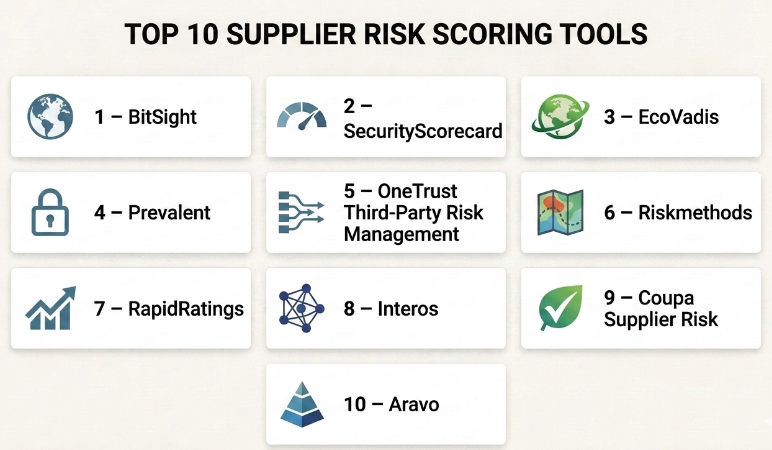
#1 — BitSight
Short description :BitSight is a widely recognized cyber risk ratings platform focused on external security posture assessment for suppliers and third parties. It helps organizations continuously monitor vendor cybersecurity exposure using externally observable signals. The platform is commonly used by enterprise security, procurement, and third-party risk teams. BitSight is especially valuable for organizations prioritizing cyber supply chain resilience. Large enterprises and regulated industries are among its primary users.
Key Features
- External cybersecurity risk scoring
- Continuous vendor monitoring
- Attack surface visibility
- Security benchmarking and peer comparisons
- Automated alerts and remediation tracking
- Third-party portfolio dashboards
- Risk analytics and reporting
Pros
- Strong cybersecurity risk intelligence capabilities
- Well-established enterprise adoption
- Effective for continuous monitoring programs
Cons
- Primarily focused on cyber risk rather than broader supplier risk
- May require additional platforms for ESG or operational risk
- Enterprise pricing can be expensive
Platforms / Deployment
- Web
- Cloud
Security & Compliance
- SSO/SAML
- MFA
- RBAC
- Audit logs
- GDPR support
- SOC 2 not publicly stated
Integrations & Ecosystem
BitSight integrates with security, procurement, and governance ecosystems to streamline third-party risk workflows.
- ServiceNow
- RSA Archer
- Splunk
- SIEM platforms
- APIs for custom integrations
Support & Community
BitSight provides enterprise onboarding, customer success programs, documentation, and professional services. Community resources exist but are more enterprise-oriented than open-community driven.
#2 — SecurityScorecard
Short description :SecurityScorecard specializes in cybersecurity ratings and supplier cyber risk monitoring. The platform continuously evaluates vendors across multiple risk domains using external intelligence and automated scoring methodologies. It is commonly used for vendor assessments, procurement security reviews, and cyber insurance evaluations. The platform appeals to enterprises seeking scalable third-party cyber risk visibility. Security and compliance teams are its primary audience.
Key Features
- Vendor cybersecurity scoring
- Continuous threat monitoring
- Supply chain cyber intelligence
- Breach and incident visibility
- Risk trend analysis
- Portfolio management dashboards
- Automated questionnaires
Pros
- Strong cyber-focused risk analytics
- Large vendor intelligence database
- Scalable for enterprise supplier ecosystems
Cons
- Less comprehensive for financial or ESG risk
- Advanced functionality may require training
- Some data interpretations may need manual validation
Platforms / Deployment
- Web
- Cloud
Security & Compliance
- MFA
- SSO/SAML
- Encryption
- Audit logs
- GDPR support
- ISO 27001 not publicly stated
Integrations & Ecosystem
The platform integrates with security operations and governance ecosystems for broader third-party risk management.
- ServiceNow
- Splunk
- APIs
- SIEM tools
- GRC platforms
Support & Community
SecurityScorecard offers enterprise support, onboarding assistance, documentation, and implementation services. Community engagement is moderate compared to developer-focused platforms.
#3 — EcoVadis
Short description :EcoVadis is a leading sustainability and ESG risk assessment platform used to evaluate supplier environmental, labor, ethics, and procurement practices. It is widely adopted across global supply chains for sustainability scoring and supplier compliance programs. The platform is particularly strong in ESG reporting and supplier sustainability benchmarking. Large multinational enterprises frequently use EcoVadis to support responsible sourcing initiatives.
Key Features
- ESG supplier scoring
- Sustainability benchmarking
- Supplier assessments and scorecards
- Carbon and environmental metrics
- Supplier improvement workflows
- Global sustainability database
- Compliance tracking
Pros
- Strong ESG and sustainability capabilities
- Large global supplier network
- Useful for regulatory and reporting initiatives
Cons
- Limited cybersecurity depth
- May not replace broader TPRM platforms
- Assessment cycles can take time
Platforms / Deployment
- Web
- Cloud
Security & Compliance
- SSO
- GDPR support
- Encryption
- RBAC
- SOC 2 not publicly stated
Integrations & Ecosystem
EcoVadis integrates with procurement and sourcing systems to support sustainable procurement programs.
- SAP Ariba
- Coupa
- Procurement suites
- APIs
- ERP integrations
Support & Community
The platform provides onboarding resources, sustainability guidance, and enterprise customer support. Strong ecosystem presence within procurement and ESG communities.
#4 — Prevalent
Short description :Prevalent is a third-party risk management platform designed to centralize supplier risk assessments, monitoring, and remediation workflows. It combines cyber, compliance, and operational risk visibility into a unified platform. Organizations use it to automate vendor onboarding and continuous monitoring processes. The platform is suitable for enterprises managing large vendor ecosystems and regulatory obligations.
Key Features
- Third-party risk assessments
- Continuous monitoring
- Vendor onboarding workflows
- Risk scoring dashboards
- Evidence collection automation
- Remediation tracking
- Compliance management
Pros
- Broad third-party risk functionality
- Good automation capabilities
- Strong workflow management
Cons
- Implementation complexity for large deployments
- User interface may require onboarding
- Pricing may be high for SMBs
Platforms / Deployment
- Web
- Cloud
Security & Compliance
- MFA
- SSO/SAML
- Audit logs
- Encryption
- GDPR support
Integrations & Ecosystem
Prevalent supports integrations across GRC, procurement, and security ecosystems.
- ServiceNow
- RSA Archer
- APIs
- Procurement systems
- SIEM integrations
Support & Community
Prevalent provides implementation support, documentation, training programs, and customer success resources. Community visibility is moderate.
#5 — OneTrust Third-Party Risk Management
Short description :OneTrust offers a broad governance, privacy, and third-party risk management platform with supplier risk scoring capabilities. It is commonly used for privacy compliance, vendor assessments, and regulatory governance workflows. Organizations benefit from centralized third-party oversight and workflow automation. The platform is especially attractive for enterprises already using OneTrust privacy or compliance products.
Key Features
- Third-party risk assessments
- Privacy and compliance workflows
- Vendor inventory management
- Risk scoring automation
- Regulatory compliance support
- Automated questionnaires
- Workflow orchestration
Pros
- Strong governance and compliance ecosystem
- Broad enterprise feature coverage
- Good automation capabilities
Cons
- Large platform can feel complex
- Some modules require additional licensing
- Configuration may require professional services
Platforms / Deployment
- Web
- Cloud
Security & Compliance
- MFA
- SSO/SAML
- GDPR support
- Audit logs
- RBAC
Integrations & Ecosystem
OneTrust integrates with enterprise governance, compliance, and procurement systems.
- ServiceNow
- SAP
- APIs
- Microsoft ecosystem
- GRC platforms
Support & Community
OneTrust provides enterprise onboarding, documentation, certification resources, and customer support programs. Large ecosystem presence within compliance and privacy markets.
#6 — Riskmethods
Short description :Riskmethods focuses on supply chain disruption monitoring and supplier risk intelligence. The platform uses AI and external data sources to detect operational, geopolitical, and financial risks affecting suppliers. Organizations use it for proactive supply chain resilience and incident response planning. It is especially useful for global manufacturing and logistics-heavy industries.
Key Features
- Supply chain disruption monitoring
- AI-driven risk alerts
- Geopolitical risk intelligence
- Supplier mapping
- Incident monitoring
- Financial risk indicators
- Predictive analytics
Pros
- Strong operational risk visibility
- Useful predictive monitoring
- Good for global supply chains
Cons
- More focused on operational risk than cyber risk
- Advanced analytics may require training
- SMB adoption may be limited
Platforms / Deployment
- Web
- Cloud
Security & Compliance
- SSO
- Encryption
- RBAC
- GDPR support
- ISO certifications not publicly stated
Integrations & Ecosystem
Riskmethods supports integrations with ERP and supply chain management systems.
- SAP
- ERP systems
- APIs
- Procurement platforms
- Analytics tools
Support & Community
The platform offers enterprise onboarding and consulting support. Community ecosystem is smaller compared to larger governance platforms.
#7 — RapidRatings
Short description :RapidRatings specializes in financial health analysis and supplier financial risk scoring. It helps organizations identify financially vulnerable suppliers using quantitative financial analytics. Procurement and finance teams use it to reduce supplier disruption risks related to insolvency or financial instability. The platform is widely recognized in financial risk intelligence.
Key Features
- Financial risk scoring
- Supplier financial analytics
- Risk benchmarking
- Predictive financial indicators
- Portfolio analysis
- Reporting dashboards
- Supplier health monitoring
Pros
- Strong financial risk specialization
- Useful predictive financial insights
- Good enterprise reporting capabilities
Cons
- Limited cybersecurity functionality
- Narrower scope than full TPRM suites
- Requires financial data interpretation expertise
Platforms / Deployment
- Web
- Cloud
Security & Compliance
- Encryption
- SSO
- RBAC
- Audit logs
- SOC 2 not publicly stated
Integrations & Ecosystem
RapidRatings integrates into procurement and finance risk workflows.
- ERP systems
- APIs
- Procurement platforms
- Analytics tools
Support & Community
RapidRatings offers enterprise onboarding, analytics guidance, and account management support. Documentation quality is generally strong.
#8 — Interos
Short description :Interos provides supply chain relationship mapping and risk intelligence across suppliers, logistics providers, and global trade networks. The platform uses AI to analyze interconnected supplier dependencies and detect operational or geopolitical risks. Enterprises use it to improve supply chain visibility and resilience. It is particularly valuable for complex multinational supply chains.
Key Features
- Supply chain relationship mapping
- AI-powered risk intelligence
- Geopolitical monitoring
- Multi-tier supplier visibility
- Real-time risk alerts
- Supplier dependency analysis
- Operational risk monitoring
Pros
- Strong network visibility capabilities
- Useful geopolitical intelligence
- Advanced AI analytics
Cons
- Enterprise-focused pricing
- May be complex for smaller organizations
- Requires mature supply chain governance processes
Platforms / Deployment
- Web
- Cloud
Security & Compliance
- MFA
- SSO
- Encryption
- RBAC
- Compliance certifications not publicly stated
Integrations & Ecosystem
Interos integrates with procurement, ERP, and analytics systems for enterprise supply chain visibility.
- SAP
- APIs
- Procurement suites
- Analytics platforms
Support & Community
Interos provides enterprise implementation support, onboarding assistance, and customer success services. Community ecosystem is growing.
#9 — Coupa Supplier Risk
Short description :Coupa Supplier Risk is part of the broader Coupa Business Spend Management ecosystem. It combines supplier risk intelligence with procurement, sourcing, and spend management workflows. Organizations use it to evaluate suppliers during sourcing and procurement activities. The platform is attractive for enterprises already invested in the Coupa ecosystem.
Key Features
- Supplier risk scoring
- Procurement workflow integration
- Supplier onboarding
- Risk segmentation
- Compliance tracking
- Spend-based analytics
- Automated assessments
Pros
- Tight integration with procurement workflows
- Unified spend and supplier visibility
- Strong enterprise ecosystem
Cons
- Best value comes within the broader Coupa suite
- May require significant implementation effort
- Pricing structure can be complex
Platforms / Deployment
- Web
- Cloud
Security & Compliance
- SSO/SAML
- MFA
- Audit logs
- Encryption
- GDPR support
Integrations & Ecosystem
Coupa integrates broadly across enterprise procurement and finance systems.
- ERP platforms
- Procurement systems
- APIs
- Finance systems
- Supplier networks
Support & Community
Coupa has a large enterprise customer base with mature onboarding, documentation, training, and partner ecosystems.
#10 — Aravo
Short description :Aravo is an enterprise-grade third-party risk management platform designed for supplier governance, compliance, and vendor lifecycle management. The platform centralizes supplier onboarding, risk assessments, compliance workflows, and continuous monitoring. It is commonly used in highly regulated industries. Large enterprises benefit from its configurable workflow architecture.
Key Features
- Vendor lifecycle management
- Supplier risk scoring
- Compliance workflow automation
- Third-party assessments
- Continuous monitoring
- Policy management
- Reporting and analytics
Pros
- Strong enterprise governance capabilities
- Flexible workflow configuration
- Suitable for regulated industries
Cons
- Enterprise implementation complexity
- Less suitable for small businesses
- Customization may require consulting support
Platforms / Deployment
- Web
- Cloud
Security & Compliance
- MFA
- SSO/SAML
- Encryption
- Audit logs
- GDPR support
Integrations & Ecosystem
Aravo supports integrations with governance, procurement, and ERP systems.
- SAP
- APIs
- GRC platforms
- Procurement systems
- ServiceNow
Support & Community
Aravo provides enterprise implementation support, onboarding assistance, and professional services. Documentation and training resources are available but enterprise-focused.
Comparison Table (Top 10)
| Tool Name | Best For | Platform(s) Supported | Deployment | Standout Feature | Public Rating |
|---|---|---|---|---|---|
| BitSight | Cybersecurity supplier monitoring | Web | Cloud | External cyber risk scoring | N/A |
| SecurityScorecard | Third-party cyber intelligence | Web | Cloud | Continuous cyber monitoring | N/A |
| EcoVadis | ESG and sustainability risk | Web | Cloud | Sustainability supplier scoring | N/A |
| Prevalent | Enterprise TPRM workflows | Web | Cloud | Automated vendor assessments | N/A |
| OneTrust Third-Party Risk Management | Governance and compliance | Web | Cloud | Integrated compliance workflows | N/A |
| Riskmethods | Supply chain disruption monitoring | Web | Cloud | AI-powered operational risk alerts | N/A |
| RapidRatings | Supplier financial stability | Web | Cloud | Financial health analytics | N/A |
| Interos | Multi-tier supply chain visibility | Web | Cloud | Relationship mapping intelligence | N/A |
| Coupa Supplier Risk | Procurement-integrated risk management | Web | Cloud | Spend and supplier integration | N/A |
| Aravo | Enterprise supplier governance | Web | Cloud | Configurable compliance workflows | N/A |
Evaluation & Supplier Risk Scoring Tools
| Tool Name | Core (25%) | Ease (15%) | Integrations (15%) | Security (10%) | Performance (10%) | Support (10%) | Value (15%) | Weighted Total (0–10) |
|---|---|---|---|---|---|---|---|---|
| BitSight | 9 | 8 | 8 | 9 | 9 | 8 | 7 | 8.35 |
| SecurityScorecard | 9 | 8 | 8 | 9 | 8 | 8 | 8 | 8.35 |
| EcoVadis | 9 | 8 | 7 | 8 | 8 | 8 | 7 | 7.95 |
| Prevalent | 8 | 7 | 8 | 8 | 8 | 8 | 7 | 7.75 |
| OneTrust Third-Party Risk Management | 9 | 7 | 9 | 9 | 8 | 8 | 7 | 8.20 |
| Riskmethods | 8 | 7 | 7 | 8 | 8 | 7 | 7 | 7.40 |
| RapidRatings | 8 | 8 | 7 | 8 | 8 | 8 | 7 | 7.65 |
| Interos | 9 | 7 | 8 | 8 | 8 | 7 | 6 | 7.70 |
| Coupa Supplier Risk | 9 | 7 | 9 | 9 | 8 | 8 | 7 | 8.20 |
| Aravo | 8 | 7 | 8 | 8 | 8 | 8 | 7 | 7.75 |
These scores are comparative rather than absolute. A higher score does not automatically mean a tool is the best fit for every organization. Some platforms specialize in cybersecurity, while others focus on ESG, financial stability, or procurement integration. Enterprise complexity, implementation maturity, supplier volume, and compliance requirements all influence which solution delivers the most value. Buyers should prioritize alignment with operational goals rather than relying only on weighted totals.
Which Supplier Risk Scoring Tools
Solo / Freelancer
Most solo operators and freelancers do not need enterprise supplier risk scoring platforms. Lightweight procurement tracking, manual vendor reviews, and spreadsheet-based assessments are often sufficient. If supplier cybersecurity visibility is important, smaller plans from cyber risk monitoring vendors may be worth considering.
SMB
SMBs should prioritize ease of implementation, usability, and cost efficiency. Platforms like SecurityScorecard or EcoVadis can provide focused capabilities without requiring large governance teams. SMBs should avoid overly complex enterprise suites unless regulatory requirements justify the investment.
Mid-Market
Mid-market organizations benefit from platforms that balance automation with operational simplicity. Prevalent and OneTrust can work well for organizations expanding supplier oversight programs. Integration support becomes increasingly important at this stage.
Enterprise
Large enterprises typically require advanced workflow automation, continuous monitoring, ERP integrations, and global scalability. Coupa Supplier Risk, Aravo, Interos, and OneTrust are strong candidates for enterprise-wide governance initiatives. Enterprises with mature security programs may also combine BitSight or SecurityScorecard with broader TPRM suites.
Budget vs Premium
Budget-focused organizations should prioritize focused tools solving specific risk problems instead of buying large governance suites. Premium enterprise platforms provide deeper automation, analytics, and integrations but require larger implementation investments.
Feature Depth vs Ease of Use
Highly configurable enterprise platforms often introduce complexity. Organizations with lean teams may prefer simpler solutions even if they sacrifice some customization. Ease of onboarding can significantly impact adoption and operational success.
Integrations & Scalability
Integration quality is critical for procurement-heavy organizations. Enterprises already using SAP, Coupa, or ServiceNow should evaluate native ecosystem compatibility carefully. API flexibility is increasingly important for long-term scalability.
Security & Compliance Needs
Regulated industries should prioritize platforms with strong governance controls, audit logging, SSO support, and compliance workflow capabilities. Cybersecurity-focused organizations may benefit from combining dedicated cyber risk scoring tools with broader supplier governance solutions.
Frequently Asked Questions (FAQs)
1. What are Supplier Risk Scoring Tools?
Supplier Risk Scoring Tools help organizations assess and monitor risks associated with vendors and third-party suppliers. These risks may include cybersecurity, financial stability, operational reliability, ESG performance, regulatory compliance, and geopolitical exposure.
2. Why are supplier risk platforms important in 2026?
Global supply chains have become more interconnected and vulnerable to cyberattacks, disruptions, regulatory changes, and sustainability requirements. Organizations now need continuous visibility into supplier risk rather than periodic manual reviews.
3. How do supplier risk scores work?
Most platforms aggregate multiple internal and external data sources into risk models that generate numerical or categorical scores. These scores help organizations prioritize vendor reviews and remediation activities.
4. Are these tools mainly for cybersecurity risk?
No. While some tools focus heavily on cyber risk, many platforms also evaluate ESG, operational, compliance, financial, and geopolitical risks. Organizations often combine multiple risk intelligence sources for broader coverage.
5. What industries benefit most from supplier risk scoring?
Industries with complex supply chains or regulatory requirements benefit the most. This includes manufacturing, healthcare, financial services, government, retail, logistics, energy, and technology sectors.
6. How long does implementation usually take?
Implementation timelines vary significantly depending on the platform and organization size. Smaller deployments may take a few weeks, while enterprise-wide governance implementations can take several months.
7. What are common mistakes when selecting a supplier risk platform?
Common mistakes include underestimating integration complexity, focusing only on cybersecurity, ignoring workflow usability, and choosing overly complex enterprise platforms without sufficient internal governance maturity.
8. Can these tools integrate with ERP and procurement systems?
Yes. Most enterprise-grade platforms support integrations with ERP, procurement, GRC, and ticketing systems. APIs and workflow connectors are increasingly common across modern platforms.
9. How are these platforms typically priced?
Pricing models vary widely. Some vendors charge based on supplier count, monitoring scope, feature modules, or enterprise licensing agreements. Public pricing is often not disclosed for enterprise deployments.
10. Can organizations switch supplier risk platforms later?
Yes, but migration complexity depends on workflow customization, historical risk data, integrations, and reporting structures. Organizations should evaluate portability and API access before committing long term.
Conclusion
Supplier Risk Scoring Tools have evolved from niche procurement utilities into strategic platforms for operational resilience, compliance, cybersecurity, and ESG governance. As organizations expand supplier ecosystems across global markets, continuous risk visibility is becoming essential rather than optional. Modern platforms now combine AI-driven analytics, automated monitoring, workflow orchestration, and ecosystem integrations to help organizations proactively manage third-party exposure.
