Introduction
Service Catalog Platforms help organizations centralize, organize, and automate the delivery of IT, business, and operational services through a unified request system. In simple terms, these platforms allow employees, customers, or departments to browse available services, submit requests, track approvals, and automate fulfillment workflows from a single portal.
In service catalog platforms are becoming essential as organizations continue adopting hybrid work models, AI-driven operations, IT service management (ITSM), and enterprise workflow automation. Modern businesses need standardized service delivery processes that reduce manual work, improve governance, and enhance user experiences. Service catalogs now extend far beyond IT and are increasingly used across HR, finance, procurement, legal, facilities, and customer operations.
Common real-world use cases include:
- IT service request management
- Employee onboarding workflows
- Hardware and software provisioning
- HR service request automation
- Enterprise self-service portals
When evaluating Service Catalog Platforms, buyers should consider:
- Workflow automation capabilities
- AI-powered request routing
- Integration ecosystem maturity
- Self-service experience quality
- Role-based access and governance
- Scalability across departments
- Customization and low-code tooling
- Reporting and analytics
- Security and compliance controls
- Multi-department service support
Best for: Enterprises, IT teams, internal operations departments, managed service providers, HR operations teams, and organizations implementing digital workflow automation.
Not ideal for: Very small businesses with minimal process automation needs or organizations that only require simple ticketing systems without structured service delivery workflows.
Key Trends in Service Catalog Platforms
- AI-powered virtual agents are increasingly integrated into service request workflows.
- Low-code and no-code workflow builders are becoming standard features.
- Unified enterprise service management (ESM) is replacing IT-only service catalogs.
- Self-service automation is expanding across HR, finance, procurement, and facilities teams.
- Predictive analytics and intelligent request routing are improving operational efficiency.
- Integration with identity providers and zero-trust security models is growing.
- Hybrid deployment models remain important for regulated industries.
- Employee experience platforms are converging with service catalog systems.
- API-first architecture is becoming more important for enterprise extensibility.
- Generative AI is helping automate knowledge creation and request categorization.
How We Selected These Tools (Methodology)
The platforms in this list were selected based on a balanced evaluation of enterprise readiness, usability, automation capabilities, and market adoption.
Our methodology included:
- Market visibility and adoption across industries
- Service catalog and workflow automation depth
- Enterprise scalability and governance
- AI and automation innovation
- Integration ecosystem maturity
- Security and compliance capabilities
- Support for ITSM and enterprise service management
- Ease of implementation and usability
- Flexibility for multi-department service workflows
- Vendor reputation and platform reliability
The final selection includes enterprise leaders, mid-market solutions, and flexible workflow automation platforms.
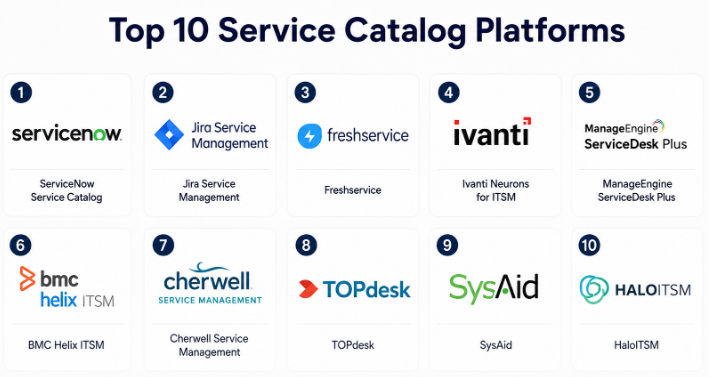
Service Catalog Platforms
#1 — ServiceNow Service Catalog
Short description :
ServiceNow Service Catalog is one of the most widely adopted enterprise service catalog platforms in the market. It enables organizations to automate service delivery workflows across IT, HR, finance, facilities, and customer operations. The platform provides a centralized self-service experience with deep workflow automation and AI capabilities. ServiceNow is especially strong in large enterprise environments with complex governance and operational requirements. Its scalability and ecosystem maturity make it a leading choice for enterprise service management initiatives.
Key Features
- Enterprise-grade workflow automation
- AI-powered virtual agents
- Multi-department service catalogs
- Role-based approvals and governance
- Employee self-service portals
- Low-code workflow builder
- Advanced analytics and reporting
Pros
- Excellent enterprise scalability
- Strong automation capabilities
- Deep ITSM integration
Cons
- High implementation complexity
- Premium pricing structure
- Requires dedicated administration resources
Platforms / Deployment
- Web / iOS / Android
- Cloud / Hybrid
Security & Compliance
- SSO/SAML
- MFA
- RBAC
- Audit logs
- Encryption
- SOC 2
- ISO 27001
- GDPR
Integrations & Ecosystem
ServiceNow integrates extensively across enterprise IT and operational ecosystems with strong API support and workflow extensibility.
- Microsoft Teams
- Salesforce
- Jira
- SAP
- Okta
- REST APIs
Support & Community
Large enterprise ecosystem with certified partners, extensive training resources, and mature enterprise support programs.
#2 — Jira Service Management
Short description :
Jira Service Management by Atlassian combines ITSM, service catalog management, and DevOps collaboration into a unified platform. It is popular among technology teams, software organizations, and mid-market enterprises. The platform provides strong workflow customization, incident management, and integration with Atlassian products. Jira Service Management is particularly effective for organizations already invested in Jira and Confluence ecosystems.
Key Features
- Customizable service request workflows
- Integration with Jira Software and Confluence
- DevOps incident management
- Automation rules engine
- Self-service portals
- SLA management
- Knowledge base integration
Pros
- Strong developer ecosystem
- Flexible workflow customization
- Good value for technical teams
Cons
- Complex workflows may require configuration expertise
- UI can feel technical for non-IT departments
- Enterprise governance depth varies
Platforms / Deployment
- Web / Windows / macOS / iOS / Android
- Cloud / Self-hosted
Security & Compliance
- SSO/SAML
- MFA
- Encryption
- Audit logs
- SOC 2
- GDPR
Integrations & Ecosystem
Jira Service Management benefits from Atlassian’s extensive marketplace and developer integrations.
- Confluence
- Slack
- GitHub
- Microsoft Teams
- Opsgenie
- Atlassian Marketplace apps
Support & Community
Very large global user community with extensive documentation and third-party integration support.
#3 — Freshservice
Short description :
Freshservice is a cloud-based ITSM and service catalog platform designed for SMBs and mid-sized organizations. It focuses on ease of use, automation, and rapid deployment. Freshservice provides service request management, asset management, workflow automation, and AI-powered support tools. It is particularly attractive for organizations seeking modern service management without enterprise-level complexity.
Key Features
- AI-powered ticket routing
- Service request automation
- Employee self-service portal
- Workflow orchestration
- Asset management
- Change management
- No-code automation builder
Pros
- Easy deployment and onboarding
- User-friendly interface
- Strong value for SMBs
Cons
- Enterprise customization limitations
- Advanced analytics may vary by tier
- Some integrations require premium plans
Platforms / Deployment
- Web / iOS / Android
- Cloud
Security & Compliance
- SSO/SAML
- MFA
- Encryption
- RBAC
- SOC 2
- GDPR
Integrations & Ecosystem
Freshservice supports integrations across IT operations, collaboration, and business productivity tools.
- Slack
- Microsoft Teams
- Jira
- Okta
- Zapier
- Freshworks ecosystem
Support & Community
Good onboarding experience with responsive support and active SMB-focused community adoption.
#4 — Ivanti Neurons for ITSM
Short description :
Ivanti Neurons for ITSM is an enterprise service management platform focused on automation, IT operations, and service delivery optimization. The platform combines service catalog management with AI-driven automation and endpoint management capabilities. It is commonly used in enterprises requiring unified IT operations and governance workflows.
Key Features
- AI-driven service automation
- Unified ITSM workflows
- Service catalog management
- Endpoint management integration
- Low-code workflow customization
- Asset discovery
- Analytics dashboards
Pros
- Strong automation focus
- Good IT operations visibility
- Broad enterprise capabilities
Cons
- Interface complexity for new users
- Higher implementation requirements
- Smaller community than some competitors
Platforms / Deployment
- Web / Windows / macOS / Mobile
- Cloud / Hybrid
Security & Compliance
- SSO/SAML
- MFA
- RBAC
- Encryption
- Audit logs
- GDPR
Integrations & Ecosystem
Ivanti integrates with enterprise IT infrastructure and endpoint management ecosystems.
- Active Directory
- Microsoft Teams
- SCCM
- VMware
- APIs
- Endpoint management tools
Support & Community
Enterprise-focused support structure with implementation services and professional consulting availability.
#5 — ManageEngine ServiceDesk Plus
Short description :
ManageEngine ServiceDesk Plus is an IT service management platform with integrated service catalog functionality. It is widely adopted by SMBs, educational institutions, and mid-sized enterprises seeking affordable ITSM capabilities. The platform combines incident management, asset tracking, and service automation into a single operational environment.
Key Features
- IT service catalog management
- Asset management
- Change and incident management
- Workflow automation
- SLA management
- Self-service portal
- Reporting dashboards
Pros
- Affordable pricing structure
- Broad ITSM functionality
- Flexible deployment options
Cons
- UI design may feel dated
- Advanced automation depth varies
- Enterprise scalability limitations for very large organizations
Platforms / Deployment
- Web / iOS / Android
- Cloud / Self-hosted
Security & Compliance
- SSO/SAML
- MFA
- Encryption
- RBAC
- Audit logs
- GDPR
Integrations & Ecosystem
ManageEngine integrates with IT infrastructure and operational tools.
- Active Directory
- Microsoft 365
- Jira
- Zoho ecosystem
- APIs
- Endpoint Central
Support & Community
Strong SMB and IT admin community with detailed documentation and affordable support options.
#6 — BMC Helix ITSM
Short description :
BMC Helix ITSM is an enterprise-grade service management platform designed for large-scale IT and operational service delivery. It combines AI-driven automation, predictive analytics, and advanced workflow orchestration. BMC Helix is often used in highly regulated industries and global enterprises requiring mature governance frameworks.
Key Features
- AI-powered service management
- Enterprise workflow orchestration
- Predictive analytics
- Intelligent automation
- Multi-cloud service management
- Service request management
- Advanced reporting
Pros
- Strong enterprise governance
- Advanced AI automation capabilities
- Scalable for global organizations
Cons
- Complex implementation process
- Higher operational costs
- Requires specialized administration expertise
Platforms / Deployment
- Web / Mobile
- Cloud / Hybrid
Security & Compliance
- SSO/SAML
- MFA
- Encryption
- Audit logs
- RBAC
- SOC 2
- GDPR
Integrations & Ecosystem
BMC Helix integrates with enterprise infrastructure, cloud platforms, and monitoring systems.
- AWS
- Azure
- Kubernetes
- Salesforce
- Jira
- APIs
Support & Community
Strong enterprise support ecosystem with global consulting and implementation services.
#7 — Cherwell Service Management
Short description :
Cherwell Service Management provides configurable ITSM and service catalog functionality for organizations seeking customizable workflows without heavy coding requirements. The platform supports enterprise service management use cases across multiple departments and industries.
Key Features
- Configurable service catalogs
- No-code workflow customization
- Incident and change management
- Self-service portals
- Automation workflows
- Knowledge management
- Reporting and dashboards
Pros
- Strong customization flexibility
- Good no-code capabilities
- Suitable for multi-department workflows
Cons
- UI modernization may lag competitors
- Smaller ecosystem presence
- Migration complexity may vary
Platforms / Deployment
- Web / Mobile
- Cloud / Hybrid
Security & Compliance
- SSO/SAML
- MFA
- Encryption
- RBAC
- GDPR
Integrations & Ecosystem
Cherwell integrates with IT operations and enterprise workflow environments.
- Active Directory
- Jira
- Microsoft Teams
- APIs
- Monitoring tools
- Identity providers
Support & Community
Offers enterprise support and implementation guidance with moderate community adoption.
#8 — TOPdesk
Short description :
TOPdesk is a service management and service catalog platform focused on simplifying internal service delivery. It is widely used in education, healthcare, government, and mid-market organizations. TOPdesk emphasizes usability, centralized service portals, and operational efficiency.
Key Features
- Unified self-service portal
- Incident and request management
- Asset and configuration management
- Workflow automation
- Knowledge base integration
- Reporting dashboards
- Multi-department service support
Pros
- User-friendly interface
- Good internal service management focus
- Strong mid-market suitability
Cons
- Limited advanced enterprise automation
- Smaller integration marketplace
- Some customization limitations
Platforms / Deployment
- Web / Mobile
- Cloud / Self-hosted
Security & Compliance
- SSO/SAML
- MFA
- Encryption
- GDPR
- RBAC
Integrations & Ecosystem
TOPdesk integrates with common enterprise productivity and IT operations tools.
- Microsoft Teams
- Azure AD
- Jira
- APIs
- Monitoring tools
- Email platforms
Support & Community
Known for strong customer onboarding and responsive support services.
#9 — SysAid
Short description :
SysAid is an ITSM and service automation platform offering integrated service catalog management, help desk workflows, and asset management. It is designed for organizations seeking straightforward IT service delivery automation without extensive complexity.
Key Features
- IT service request management
- Automation workflows
- Self-service portals
- Asset management
- Ticket automation
- Reporting and analytics
- Workflow customization
Pros
- Simple implementation process
- Affordable mid-market positioning
- Easy-to-use automation features
Cons
- Enterprise scalability limitations
- Smaller integration ecosystem
- Advanced analytics depth varies
Platforms / Deployment
- Web / Mobile
- Cloud / Self-hosted
Security & Compliance
- SSO/SAML
- MFA
- Encryption
- RBAC
- GDPR
Integrations & Ecosystem
SysAid supports integrations across IT operations and collaboration systems.
- Microsoft Teams
- Jira
- Active Directory
- APIs
- Endpoint tools
- Monitoring platforms
Support & Community
Provides structured onboarding and customer support with moderate community activity.
#10 — HaloITSM
Short description :
HaloITSM is a modern IT service management platform with strong service catalog and workflow automation capabilities. It is gaining traction among SMBs and mid-market organizations looking for modern ITSM functionality with flexible deployment options and competitive pricing.
Key Features
- Service catalog automation
- ITIL-aligned workflows
- Self-service portals
- Workflow customization
- Change management
- Asset management
- Reporting and dashboards
Pros
- Modern interface design
- Flexible deployment options
- Competitive feature-to-price ratio
Cons
- Smaller ecosystem compared to major vendors
- Enterprise brand recognition still growing
- Some advanced AI features are evolving
Platforms / Deployment
- Web / Windows / Mobile
- Cloud / Self-hosted
Security & Compliance
- SSO/SAML
- MFA
- Encryption
- RBAC
- GDPR
Integrations & Ecosystem
HaloITSM supports integrations with common business and IT operations platforms.
- Microsoft 365
- Azure AD
- Jira
- Slack
- APIs
- Monitoring tools
Support & Community
Growing customer community with responsive vendor support and implementation assistance.
Comparison Table (Top 10)
| Tool Name | Best For | Platform(s) Supported | Deployment | Standout Feature | Public Rating |
|---|---|---|---|---|---|
| ServiceNow Service Catalog | Large enterprises | Web, iOS, Android | Cloud, Hybrid | Enterprise workflow automation | N/A |
| Jira Service Management | DevOps and IT teams | Web, Desktop, Mobile | Cloud, Self-hosted | Atlassian ecosystem integration | N/A |
| Freshservice | SMB and mid-market IT teams | Web, iOS, Android | Cloud | Ease of deployment | N/A |
| Ivanti Neurons for ITSM | Enterprise IT operations | Web, Desktop, Mobile | Cloud, Hybrid | AI-driven automation | N/A |
| ManageEngine ServiceDesk Plus | Budget-conscious IT teams | Web, iOS, Android | Cloud, Self-hosted | Affordable ITSM suite | N/A |
| BMC Helix ITSM | Global enterprises | Web, Mobile | Cloud, Hybrid | Predictive analytics | N/A |
| Cherwell Service Management | Custom workflow environments | Web, Mobile | Cloud, Hybrid | No-code customization | N/A |
| TOPdesk | Internal service operations | Web, Mobile | Cloud, Self-hosted | User-friendly service delivery | N/A |
| SysAid | Mid-market IT teams | Web, Mobile | Cloud, Self-hosted | Simple automation workflows | N/A |
| HaloITSM | Modern ITSM deployments | Web, Windows, Mobile | Cloud, Self-hosted | Flexible deployment options | N/A |
Evaluation & Service Catalog Platforms
| Tool Name | Core (25%) | Ease (15%) | Integrations (15%) | Security (10%) | Performance (10%) | Support (10%) | Value (15%) | Weighted Total (0–10) |
|---|---|---|---|---|---|---|---|---|
| ServiceNow Service Catalog | 10 | 6 | 10 | 10 | 10 | 9 | 6 | 8.75 |
| Jira Service Management | 9 | 8 | 9 | 8 | 9 | 8 | 8 | 8.45 |
| Freshservice | 8 | 9 | 8 | 8 | 8 | 8 | 9 | 8.30 |
| Ivanti Neurons for ITSM | 8 | 7 | 8 | 8 | 8 | 7 | 7 | 7.70 |
| ManageEngine ServiceDesk Plus | 8 | 8 | 7 | 7 | 8 | 8 | 9 | 7.95 |
| BMC Helix ITSM | 9 | 6 | 9 | 10 | 9 | 8 | 6 | 8.10 |
| Cherwell Service Management | 8 | 7 | 7 | 8 | 8 | 7 | 7 | 7.45 |
| TOPdesk | 7 | 8 | 6 | 7 | 8 | 8 | 8 | 7.35 |
| SysAid | 7 | 8 | 6 | 7 | 7 | 7 | 8 | 7.15 |
| HaloITSM | 8 | 8 | 7 | 7 | 8 | 7 | 8 | 7.70 |
These scores are comparative evaluations designed to help buyers understand relative strengths across multiple categories. Enterprise-focused tools often score highly in governance and scalability but may require more implementation effort. SMB-focused platforms generally perform better in usability and value. Buyers should prioritize scoring categories aligned with their operational goals and organizational maturity.
Which Service Catalog Platforms
Solo / Freelancer
Solo operators and very small teams usually do not require enterprise-grade service catalog systems. Lightweight ITSM tools or ticketing systems may be more practical and affordable for simple workflows.
SMB
Freshservice, ManageEngine ServiceDesk Plus, and HaloITSM are strong options for SMBs due to their balance of automation, usability, and pricing flexibility.
Mid-Market
Jira Service Management, TOPdesk, and SysAid work well for mid-market organizations needing workflow customization, service automation, and operational scalability without excessive complexity.
Enterprise
Large enterprises should prioritize ServiceNow Service Catalog, BMC Helix ITSM, or Ivanti Neurons for ITSM due to their governance capabilities, scalability, AI automation, and multi-department workflow support.
Budget vs Premium
Budget-conscious organizations often find strong value in ManageEngine, Freshservice, and HaloITSM. Premium enterprise buyers may justify higher investments in ServiceNow or BMC for advanced automation and governance.
Feature Depth vs Ease of Use
ServiceNow and BMC provide deep enterprise functionality but require more administration. Freshservice and TOPdesk offer easier onboarding and operational simplicity.
Integrations & Scalability
Organizations already invested in Atlassian, Microsoft, Salesforce, or enterprise infrastructure ecosystems should prioritize platforms with strong native integration support to reduce operational complexity.
Security & Compliance Needs
Highly regulated industries should prioritize platforms with mature governance, audit logging, RBAC, encryption, and enterprise identity integration support. ServiceNow and BMC are particularly strong in these areas.
Frequently Asked Questions (FAQs)
1. What is a Service Catalog Platform?
A Service Catalog Platform centralizes service requests, approvals, and fulfillment workflows into a single self-service portal for employees or customers.
2. Are service catalog platforms only used for IT?
No. Modern service catalogs are widely used across HR, finance, procurement, facilities, legal, and other operational departments.
3. What are the biggest benefits of using a service catalog?
Key benefits include automation, improved service consistency, reduced manual work, better governance, and improved employee experiences.
4. How important is workflow automation?
Workflow automation is one of the most critical capabilities because it reduces operational bottlenecks and improves request fulfillment efficiency.
5. Can service catalogs integrate with existing business systems?
Yes. Most modern platforms integrate with identity systems, collaboration tools, CRM systems, monitoring platforms, and cloud infrastructure.
6. What deployment models are available?
Most vendors offer cloud deployments, while some also provide self-hosted or hybrid deployment options for compliance-sensitive environments.
7. How long does implementation typically take?
Implementation timelines vary based on complexity. SMB deployments may take days or weeks, while enterprise rollouts can take several months.
8. What industries benefit most from service catalog platforms?
Technology, healthcare, education, government, finance, telecom, and large enterprise organizations often gain significant operational efficiencies.
9. What are common implementation mistakes?
Common mistakes include overcomplicated workflows, poor service definitions, inadequate governance planning, and ignoring end-user experience design.
10. Are AI capabilities becoming important in service catalog systems?
Yes. AI is increasingly used for request routing, automation, chatbot assistance, predictive analytics, and workflow optimization.
11. How should buyers evaluate scalability?
Buyers should assess multi-department support, workflow flexibility, API maturity, automation depth, and integration capabilities when evaluating scalability.
12. Can smaller organizations benefit from service catalogs?
Yes. Even smaller businesses can improve operational efficiency and standardize service delivery using lightweight service catalog solutions.
Conclusion
Service Catalog Platforms have evolved into critical operational systems that help organizations standardize service delivery, automate workflows, improve governance, and enhance employee experiences. In beyond, businesses increasingly rely on service catalogs not only for IT support but also for broader enterprise service management across HR, finance, procurement, facilities, and customer operations.The best platform depends heavily on organizational size, technical maturity, automation goals, integration requirements, and compliance expectations.
