Introduction
Contact Center Platforms are software systems that enable businesses to manage customer interactions across multiple channels—such as voice, email, chat, SMS, and social media—from a centralized interface. In simple terms, they help support teams handle customer communication efficiently while maintaining quality, consistency, and visibility.
As customer expectations continue to rise, modern contact centers are evolving beyond traditional call centers. Today’s platforms integrate AI, automation, analytics, and omnichannel capabilities to deliver faster, more personalized customer experiences. These tools are essential for businesses aiming to scale support operations without compromising service quality.
Common use cases include:
- Customer support and helpdesk operations
- Sales and outbound calling campaigns
- Technical support and troubleshooting
- Customer success and retention management
- Omnichannel engagement across chat, voice, and email
Key evaluation criteria buyers should consider:
- Omnichannel capabilities (voice, chat, email, social)
- AI and automation (chatbots, routing, summaries)
- Call quality and reliability
- Workforce management and analytics
- Integration with CRM and business tools
- Scalability and performance
- Security and compliance standards
- Ease of use for agents and admins
- Reporting and dashboards
- Pricing and licensing flexibility
Best for: Customer support teams, BPOs, SaaS companies, eCommerce businesses, and enterprises handling high volumes of customer interactions.
Not ideal for: Small teams with minimal customer interaction needs or businesses that rely solely on asynchronous communication tools like email or ticketing systems.
Key Trends in Portfolio & Contact Center Platforms for the Future
- AI-powered customer interactions: Chatbots, voice bots, and AI agents handling first-level support.
- Omnichannel unification: Seamless customer journeys across voice, chat, email, and social media.
- Real-time agent assistance: AI suggestions, knowledge retrieval, and live coaching.
- Cloud-native platforms: Shift from on-premise to scalable cloud-based solutions.
- Hyper-personalization: Leveraging customer data for tailored interactions.
- Speech and sentiment analytics: Understanding customer emotions and intent.
- Low-code/no-code customization: Easier workflow automation without heavy development.
- Integration-first architecture: Deep CRM, ERP, and helpdesk integrations.
- Remote workforce enablement: Tools designed for distributed support teams.
- Usage-based pricing models: Pay-as-you-go and flexible billing structures.
How We Selected These Tools (Methodology)
- Evaluated market presence and adoption across industries
- Assessed feature completeness, including omnichannel and AI capabilities
- Reviewed performance and reliability indicators
- Considered security and compliance features
- Analyzed integration ecosystems with CRM and enterprise tools
- Included platforms for SMB, mid-market, and enterprise segments
- Balanced ease of use and advanced customization
- Considered scalability and deployment flexibility
- Evaluated support, onboarding, and documentation quality
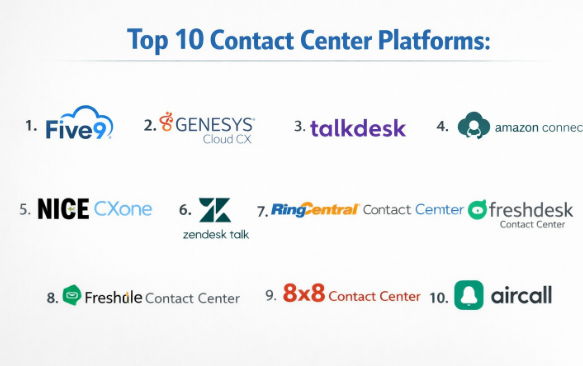
Top 10 Contact Center Platforms
#1 — Five9
Short description: A cloud-native contact center platform focused on AI-driven customer engagement and enterprise scalability.
Key Features
- Omnichannel support (voice, chat, email, social)
- Intelligent call routing
- AI virtual agents
- Workforce optimization tools
- Real-time analytics and reporting
- Predictive dialer
Pros
- Strong AI and automation capabilities
- Scales well for large enterprises
Cons
- Can be complex to implement
- Pricing may be higher for small teams
Platforms / Deployment
Web
Cloud
Security & Compliance
- SSO, encryption
- Compliance varies / Not publicly stated
Integrations & Ecosystem
Five9 integrates deeply with CRM and enterprise tools.
- Salesforce
- Microsoft Dynamics
- APIs for customization
Support & Community
Enterprise-grade support with structured onboarding.
#2 — Genesys Cloud CX
Short description: A leading enterprise contact center platform offering robust omnichannel capabilities and advanced analytics.
Key Features
- Omnichannel engagement
- AI-driven routing and bots
- Workforce engagement management
- Journey analytics
- Predictive engagement
Pros
- Comprehensive feature set
- Strong analytics and reporting
Cons
- Steep learning curve
- Higher cost for smaller businesses
Platforms / Deployment
Web
Cloud
Security & Compliance
- SSO, encryption
- Compliance standards vary
Integrations & Ecosystem
- CRM integrations
- APIs and SDKs
- Marketplace ecosystem
Support & Community
Strong enterprise support and partner ecosystem.
#3 — Talkdesk
Short description: A modern cloud contact center platform with AI-driven automation and industry-specific solutions.
Key Features
- AI-powered automation
- Omnichannel communication
- Workforce engagement tools
- Real-time reporting
- Industry-specific modules
Pros
- Modern UI and UX
- Strong AI capabilities
Cons
- Premium pricing
- Customization may require expertise
Platforms / Deployment
Web
Cloud
Security & Compliance
- Encryption, SSO
- Compliance varies
Integrations & Ecosystem
- Salesforce
- Zendesk
- APIs
Support & Community
Good support with onboarding assistance.
#4 — Amazon Connect
Short description: A cloud-based contact center service built on AWS, designed for scalability and pay-as-you-go pricing.
Key Features
- Voice and chat support
- AI integration with AWS services
- Real-time analytics
- Pay-as-you-go pricing
- Custom workflows
Pros
- Highly scalable
- Flexible pricing model
Cons
- Requires AWS expertise
- Setup complexity
Platforms / Deployment
Web
Cloud
Security & Compliance
- AWS security framework
- Compliance varies
Integrations & Ecosystem
- AWS services
- CRM integrations
- APIs
Support & Community
Strong developer community and AWS support.
#5 — NICE CXone
Short description: A comprehensive contact center platform with strong analytics and workforce optimization features.
Key Features
- Omnichannel routing
- Workforce optimization
- AI analytics
- Call recording
- Performance dashboards
Pros
- Strong analytics capabilities
- Enterprise-grade features
Cons
- Complex setup
- Higher pricing
Platforms / Deployment
Web
Cloud
Security & Compliance
- Encryption, SSO
- Compliance varies
Integrations & Ecosystem
- CRM integrations
- APIs
Support & Community
Enterprise-level support.
#6 — Zendesk Talk
Short description: A voice solution integrated into Zendesk’s customer service platform.
Key Features
- Call routing and recording
- Voicemail and IVR
- Integration with Zendesk Support
- Real-time monitoring
Pros
- Easy to use
- Tight Zendesk integration
Cons
- Limited standalone features
- Not ideal for large enterprises
Platforms / Deployment
Web / Desktop / Mobile
Cloud
Security & Compliance
Not publicly stated
Integrations & Ecosystem
- Zendesk ecosystem
- Third-party apps
Support & Community
Strong support via Zendesk.
#7 — RingCentral Contact Center
Short description: A cloud-based contact center solution integrated with RingCentral’s unified communications platform.
Key Features
- Omnichannel routing
- Workforce engagement
- Analytics and reporting
- AI assistance
Pros
- Unified communication platform
- Good scalability
Cons
- Pricing complexity
- Learning curve
Platforms / Deployment
Web / Desktop / Mobile
Cloud
Security & Compliance
- Encryption, SSO
- Compliance varies
Integrations & Ecosystem
- CRM tools
- APIs
Support & Community
Strong enterprise support.
#8 — Freshdesk Contact Center (Freshcaller)
Short description: A cloud-based contact center solution designed for SMBs and growing teams.
Key Features
- Cloud telephony
- Call routing
- IVR
- Analytics
- Omnichannel support
Pros
- Affordable
- Easy to use
Cons
- Limited enterprise features
- Fewer advanced analytics
Platforms / Deployment
Web / Mobile
Cloud
Security & Compliance
Not publicly stated
Integrations & Ecosystem
- Freshworks suite
- CRM integrations
Support & Community
Good SMB-focused support.
#9 — 8×8 Contact Center
Short description: A unified communications and contact center platform with global reach.
Key Features
- Omnichannel communication
- Voice and video
- Analytics
- Workforce tools
Pros
- Global infrastructure
- Unified platform
Cons
- Interface complexity
- Pricing may vary
Platforms / Deployment
Web / Desktop / Mobile
Cloud
Security & Compliance
- Encryption, SSO
- Compliance varies
Integrations & Ecosystem
- CRM tools
- APIs
Support & Community
Strong enterprise support.
#10 — Aircall
Short description: A cloud-based phone system designed for modern support and sales teams.
Key Features
- Call management
- IVR
- CRM integrations
- Analytics
- Call recording
Pros
- Easy setup
- Strong integrations
Cons
- Limited omnichannel capabilities
- Not ideal for large enterprises
Platforms / Deployment
Web / Desktop / Mobile
Cloud
Security & Compliance
Not publicly stated
Integrations & Ecosystem
- Salesforce
- HubSpot
- APIs
Support & Community
Good support and onboarding.
Comparison Table (Top 10)
| Tool Name | Best For | Platform(s) Supported | Deployment | Standout Feature | Public Rating |
|---|---|---|---|---|---|
| Five9 | Enterprise | Web | Cloud | AI routing | N/A |
| Genesys Cloud CX | Enterprise | Web | Cloud | Journey analytics | N/A |
| Talkdesk | Mid-market | Web | Cloud | AI automation | N/A |
| Amazon Connect | Developers | Web | Cloud | AWS scalability | N/A |
| NICE CXone | Enterprise | Web | Cloud | Workforce analytics | N/A |
| Zendesk Talk | SMB | Web, Mobile | Cloud | Zendesk integration | N/A |
| RingCentral CC | Enterprise | Web, Mobile | Cloud | Unified comms | N/A |
| Freshdesk CC | SMB | Web, Mobile | Cloud | Affordable | N/A |
| 8×8 Contact Center | Global teams | Web, Mobile | Cloud | Global reach | N/A |
| Aircall | SMB | Web, Mobile | Cloud | Easy setup | N/A |
Contact Center Platforms
| Tool Name | Core (25%) | Ease (15%) | Integrations (15%) | Security (10%) | Performance (10%) | Support (10%) | Value (15%) | Weighted Total |
|---|---|---|---|---|---|---|---|---|
| Five9 | 9 | 7 | 9 | 8 | 9 | 9 | 7 | 8.5 |
| Genesys Cloud CX | 9 | 6 | 9 | 9 | 9 | 9 | 6 | 8.4 |
| Talkdesk | 8 | 8 | 8 | 8 | 8 | 8 | 7 | 7.9 |
| Amazon Connect | 8 | 6 | 9 | 9 | 9 | 8 | 8 | 8.2 |
| NICE CXone | 9 | 6 | 8 | 9 | 9 | 9 | 6 | 8.3 |
| Zendesk Talk | 7 | 9 | 8 | 6 | 7 | 8 | 8 | 7.8 |
| RingCentral CC | 8 | 7 | 8 | 8 | 8 | 8 | 7 | 7.8 |
| Freshdesk CC | 7 | 9 | 7 | 6 | 7 | 7 | 9 | 7.9 |
| 8×8 Contact Center | 8 | 7 | 8 | 8 | 8 | 8 | 7 | 7.8 |
| Aircall | 7 | 9 | 8 | 6 | 7 | 7 | 8 | 7.7 |
How to interpret scores:
- Scores are relative comparisons across tools.
- Higher scores indicate better overall balance.
- Enterprise tools score higher in security and features.
- SMB tools excel in ease of use and value.
- Choose based on your priorities, not just the highest score.
Which Contact Center Platforms Is Right for You?
Solo / Freelancer
- Best choices: Aircall, Freshdesk Contact Center
- Focus on simplicity and affordability
SMB
- Best choices: Zendesk Talk, Freshdesk Contact Center, Aircall
- Balance between ease of use and integrations
Mid-Market
- Best choices: Talkdesk, RingCentral
- Need scalability and automation
Enterprise
- Best choices: Genesys Cloud CX, Five9, NICE CXone
- Prioritize security, analytics, and scalability
Budget vs Premium
- Budget: Freshdesk, Aircall
- Premium: Genesys, Five9
Feature Depth vs Ease of Use
- Easy: Freshdesk, Zendesk
- Advanced: Genesys, NICE
Integrations & Scalability
- Strong: Five9, Amazon Connect
- Flexible: Aircall
Security & Compliance Needs
- High: Genesys, NICE
- Moderate: SMB tools
Frequently Asked Questions (FAQs)
What is a contact center platform?
A system that manages customer interactions across multiple communication channels.
What is the difference between call center and contact center?
Call centers focus on voice; contact centers support multiple channels.
Are cloud contact centers better?
Cloud platforms offer scalability and flexibility compared to on-premise systems.
Do these platforms support AI?
Yes, many include AI for routing, chatbots, and analytics.
How long does implementation take?
It varies from days (SMB tools) to months (enterprise platforms).
What integrations are essential?
CRM, helpdesk, and communication tools are key.
Are these platforms secure?
Most offer encryption and compliance features, but levels vary.
Can small businesses use contact centers?
Yes, many tools are designed for SMBs.
What is the cost structure?
Pricing varies—subscription, usage-based, or hybrid models.
Can I switch platforms later?
Yes, but migration requires planning and training.
Conclusion
Contact Center Platforms have become essential for delivering modern, scalable, and efficient customer experiences. From AI-powered automation to omnichannel engagement, these tools enable businesses to meet rising customer expectations.
