Introduction
Procure-to-Pay (P2P) Suites are software platforms that streamline the entire procurement lifecycle, from requisition and purchase order creation to supplier invoicing, payment, and reconciliation. In plain English, a P2P suite automates purchasing, ensures compliance with procurement policies, improves supplier collaboration, and provides visibility into spend management.
P2P suites are increasingly critical as organizations manage global suppliers, complex workflows, regulatory requirements, and rising procurement costs. These platforms help reduce manual errors, accelerate purchase cycles, optimize cash flow, improve supplier relationships, and provide actionable analytics for strategic procurement decisions.
Common use cases include purchase requisition and approval, supplier onboarding, purchase order management, invoice automation, payment processing, spend analysis, compliance tracking, contract management, and supplier performance evaluation.
Buyers should evaluate workflow automation, supplier management, invoice processing, integration with ERP and accounting systems, spend analytics, compliance and audit support, reporting, scalability, ease of use, and supplier collaboration capabilities.
Best for: Procurement teams, finance and accounts payable departments, supply chain managers, and organizations of all sizes seeking to automate and optimize the full procure-to-pay lifecycle.
Not ideal for: Small organizations with limited procurement needs, low supplier volume, or minimal automation requirements; basic purchasing needs may be met with standalone tools or spreadsheets.
Key Trends in Procure-to-Pay Suites
- End-to-end automation: Increasingly, P2P suites automate requisitions, approvals, purchase orders, invoicing, and payments.
- Supplier collaboration platforms: Real-time communication, onboarding, and document exchange with suppliers improve efficiency.
- Cloud-based deployment: SaaS solutions offer scalability, remote access, and faster updates.
- AI-driven analytics: Platforms now leverage AI for spend analysis, predictive purchasing, and fraud detection.
- Integration with ERP and accounting systems: Seamless connectivity reduces manual data entry and errors.
- Mobile access: Teams can approve requisitions, view invoices, or track orders on mobile devices.
- Compliance and audit support: Platforms maintain policy adherence, approvals, and traceable audit trails.
- e-Invoicing and supplier portal adoption: Reduces manual invoice processing and accelerates payment cycles.
- Global P2P capabilities: Multi-currency, multi-entity, and regional compliance support for global operations.
- Analytics dashboards: Real-time dashboards provide insights on spend, supplier performance, and procurement efficiency.
How We Selected These Tools Methodology
- Evaluated market adoption among mid-market and enterprise procurement teams.
- Assessed workflow automation, supplier management, invoice processing, and approval features.
- Reviewed integration capabilities with ERP, accounting, and financial systems.
- Considered analytics, reporting, and dashboard functionalities.
- Focused on scalability and flexibility for global or multi-entity organizations.
- Assessed ease of implementation and user adoption.
- Avoided guessing pricing, certifications, or public ratings.
- Balanced established P2P platforms with cloud-first and emerging solutions.
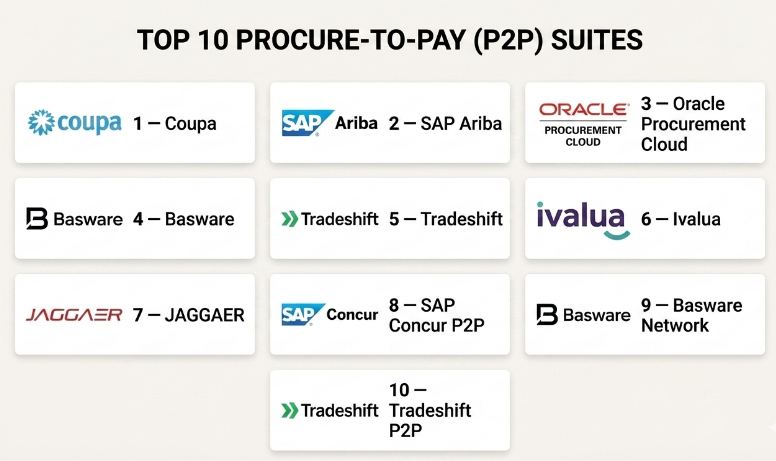
#1 — Coupa
Short description: Coupa is a cloud-based P2P suite that automates procurement workflows, expense management, and supplier collaboration. It helps organizations improve visibility, control spend, streamline approvals, and optimize supplier relationships. Coupa is widely used by enterprises seeking an integrated procurement and financial management solution.
Key Features
- Automated purchase requisitions and approvals.
- Supplier management and onboarding.
- Invoice automation and matching.
- Payment processing and reconciliation.
- Real-time spend analytics and dashboards.
- Compliance tracking and audit trails.
- Mobile approvals and supplier portal access.
Pros
- Strong automation capabilities across the P2P cycle.
- Comprehensive spend visibility and analytics.
- Supports supplier collaboration and compliance.
Cons
- Implementation may require training and change management.
- Premium pricing for advanced modules.
- May be complex for small teams.
Platforms / Deployment
- Web / iOS / Android
- Cloud
Security & Compliance
Not publicly stated.
Integrations & Ecosystem
Integrates with ERP, accounting, and financial systems. Supports workflow automation and supplier connectivity.
Support & Community
Enterprise support, training, and documentation available.
#2 — SAP Ariba
Short description: SAP Ariba is a global P2P platform for managing procurement, sourcing, supplier lifecycle, and invoice processing. It provides visibility into spend, supplier performance, and compliance. Widely used by large enterprises, SAP Ariba supports multi-entity, multi-currency, and multi-region operations.
Key Features
- Purchase requisition and order management.
- Supplier onboarding and performance tracking.
- e-Invoicing and automated matching.
- Payment processing and reconciliation.
- Analytics dashboards and reporting.
- Compliance and audit trail support.
- Integration with ERP systems.
Pros
- Strong global procurement support.
- Comprehensive supplier and spend management.
- Supports multi-currency and regulatory compliance.
Cons
- Can be complex to implement.
- Training required for full utilization.
- Higher cost for smaller organizations.
Platforms / Deployment
- Web / iOS / Android
- Cloud
Security & Compliance
Not publicly stated.
Integrations & Ecosystem
ERP, accounting, and treasury integrations; supplier collaboration portals.
Support & Community
Enterprise support, professional services, and documentation provided.
#3 — Oracle Procurement Cloud
Short description: Oracle Procurement Cloud provides end-to-end procurement and P2P automation for mid-market to enterprise organizations. It streamlines requisitions, purchase orders, invoicing, and supplier management while providing analytics and reporting.
Key Features
- Purchase requisition and approval workflows.
- Supplier management and collaboration.
- Invoice automation and payment processing.
- Spend analysis and reporting dashboards.
- Compliance and audit trail capabilities.
- Scenario simulation for procurement planning.
- Mobile access for approvals and monitoring.
Pros
- Integrated procurement and P2P suite.
- Supports analytics and spend visibility.
- Automation reduces manual effort.
Cons
- Complex for small organizations.
- Implementation may require expert resources.
- Learning curve for advanced features.
Platforms / Deployment
- Web / iOS / Android
- Cloud
Security & Compliance
Not publicly stated.
Integrations & Ecosystem
ERP, financial, and analytics system integration for end-to-end procurement workflows.
Support & Community
Documentation, training, and enterprise support available.
#4 — Basware
Short description: Basware P2P Suite helps organizations automate procurement, invoicing, and supplier collaboration. It provides visibility into spend, reduces manual processes, and accelerates invoice approvals and payments.
Key Features
- Purchase requisition and approval management.
- Supplier onboarding and portal access.
- Invoice automation and matching.
- Payment scheduling and reconciliation.
- Spend analytics and dashboards.
- Compliance tracking and audit logs.
- Mobile access for approvals.
Pros
- Strong automation and supplier collaboration.
- Reduces manual invoice processing.
- Provides visibility into spend and performance.
Cons
- Implementation may require specialized support.
- Smaller teams may find setup complex.
- Customization requires configuration expertise.
Platforms / Deployment
- Web / iOS / Android
- Cloud
Security & Compliance
Not publicly stated.
Integrations & Ecosystem
ERP, accounting, and treasury integration; supplier portals for collaboration.
Support & Community
Enterprise support and training available.
#5 — Tradeshift
Short description: Tradeshift provides cloud-based P2P automation and supplier collaboration. It streamlines purchase orders, invoice processing, and payments while providing dashboards and analytics for spend management.
Key Features
- Purchase requisition and approvals.
- Supplier onboarding and document exchange.
- e-Invoicing and automated matching.
- Payment processing and reconciliation.
- Spend analytics dashboards.
- Compliance and audit logs.
- Mobile approvals.
Pros
- Strong supplier collaboration features.
- Cloud-based, scalable solution.
- Supports automated invoicing and payments.
Cons
- Premium modules may increase cost.
- Training may be required for advanced features.
- May be complex for small organizations.
Platforms / Deployment
- Web / iOS / Android
- Cloud
Security & Compliance
Not publicly stated.
Integrations & Ecosystem
ERP, financial, and analytics integrations; supplier portal for collaboration.
Support & Community
Enterprise support and documentation provided.
#6 — Ivalua
Short description: Ivalua P2P suite helps automate procurement, supplier management, invoicing, and spend analysis. It provides visibility into supplier performance, compliance, and procurement workflows.
Key Features
- Purchase requisition and approvals.
- Supplier management and onboarding.
- Invoice automation and payment processing.
- Analytics and spend dashboards.
- Compliance and audit support.
- Scenario and workflow automation.
- Mobile access for approvals.
Pros
- Strong automation and analytics.
- Improves supplier collaboration.
- Supports compliance and reporting.
Cons
- Implementation can be complex.
- Training required for advanced features.
- Primarily for mid-market to enterprise.
Platforms / Deployment
- Web / iOS / Android
- Cloud
Security & Compliance
Not publicly stated.
Integrations & Ecosystem
ERP, accounting, and treasury integrations; supplier portal for collaboration.
Support & Community
Enterprise support, training, and documentation.
#7 — JAGGAER
Short description: JAGGAER P2P Suite automates procurement workflows, supplier management, invoicing, and payment processing. It provides dashboards for spend visibility, scenario planning, and compliance reporting.
Key Features
- Purchase requisition and approvals.
- Supplier onboarding and portal.
- Invoice automation and matching.
- Payment processing and reconciliation.
- Spend analysis dashboards.
- Compliance and audit support.
- Mobile approvals.
Pros
- Strong automation across P2P cycle.
- Provides actionable spend analytics.
- Supplier collaboration capabilities.
Cons
- Premium modules may increase cost.
- Training required for advanced features.
- Complex implementation for smaller organizations.
Platforms / Deployment
- Web / iOS / Android
- Cloud
Security & Compliance
Not publicly stated.
Integrations & Ecosystem
Integrates with ERP, treasury, and accounting systems for full P2P automation.
Support & Community
Enterprise support and documentation available.
#8 — SAP Concur P2P
Short description: SAP Concur P2P automates purchasing, invoicing, and expense workflows. It provides dashboards for spend visibility, supplier collaboration, and compliance reporting.
Key Features
- Purchase requisition and approval workflows.
- Supplier onboarding and portal access.
- Invoice automation and reconciliation.
- Payment processing.
- Analytics dashboards.
- Compliance and audit tracking.
- Mobile approvals.
Pros
- Streamlines procurement and invoicing.
- Cloud-based and scalable.
- Supports supplier collaboration.
Cons
- Integration with ERP may require setup.
- Training required for advanced modules.
- Premium cost for enterprise features.
Platforms / Deployment
- Web / iOS / Android
- Cloud
Security & Compliance
Not publicly stated.
Integrations & Ecosystem
Integrates with ERP, accounting, and treasury systems.
Support & Community
Enterprise support and documentation provided.
#9 — Basware Network
Short description: Basware Network P2P automates requisitions, supplier onboarding, invoice processing, and payments. It provides dashboards, analytics, and compliance tracking.
Key Features
- Purchase requisitions and approvals.
- Supplier onboarding and collaboration.
- e-Invoicing automation.
- Payment processing and reconciliation.
- Spend analysis dashboards.
- Audit and compliance tracking.
- Mobile approvals.
Pros
- Streamlined P2P automation.
- Supplier collaboration tools.
- Spend visibility and analytics.
Cons
- Setup may require expert support.
- Cost may be high for small organizations.
- Advanced reporting requires configuration.
Platforms / Deployment
- Web / iOS / Android
- Cloud
Security & Compliance
Not publicly stated.
Integrations & Ecosystem
ERP, accounting, treasury integrations; supplier portal support.
Support & Community
Enterprise support and training provided.
#10 — Tradeshift P2P
Short description: Tradeshift provides cloud-based P2P automation including requisitions, invoicing, supplier collaboration, and payment processing. Dashboards provide spend insights and compliance tracking.
Key Features
- Purchase requisitions and approvals.
- Supplier onboarding and document exchange.
- Invoice automation and matching.
- Payment processing.
- Spend analytics dashboards.
- Compliance and audit trail support.
- Mobile approvals.
Pros
- Cloud-based and scalable.
- Supplier collaboration and portal.
- Real-time dashboards and analytics.
Cons
- Training required for advanced modules.
- Premium cost for enterprise features.
- Implementation may require support.
Platforms / Deployment
- Web / iOS / Android
- Cloud
Security & Compliance
Not publicly stated.
Comparison Table Top 10
| Tool Name | Best For | Platform(s) Supported | Deployment | Standout Feature | Public Rating |
|---|---|---|---|---|---|
| Coupa | Enterprise procurement | Web / iOS / Android | Cloud | End-to-end P2P automation | N/A |
| SAP Ariba | Global procurement | Web / iOS / Android | Cloud | Supplier collaboration & spend visibility | N/A |
| Oracle Procurement Cloud | Mid-market & enterprise | Web / iOS / Android | Cloud | Workflow automation & analytics | N/A |
| Basware | Mid-large organizations | Web / iOS / Android | Cloud | Invoice automation & supplier portal | N/A |
| Tradeshift | Global P2P | Web / iOS / Android | Cloud | Cloud-based supplier collaboration | N/A |
| Ivalua | Enterprise & mid-market | Web / iOS / Android | Cloud | Spend visibility & workflow automation | N/A |
| JAGGAER | Banks & corporates | Web / iOS / Android | Cloud | Multi-module P2P automation | N/A |
| SAP Concur | Mid-market & enterprise | Web / iOS / Android | Cloud | Expense & P2P integration | N/A |
| Basware Network | Enterprise & suppliers | Web / iOS / Android | Cloud | Supplier collaboration & analytics | N/A |
| Tradeshift P2P | Mid-large enterprises | Web / iOS / Android | Cloud | Cloud-based P2P & payments | N/A |
Evaluation & P2P Suites
| Tool Name | Core 25% | Ease 15% | Integrations 15% | Security 10% | Performance 10% | Support 10% | Value 15% | Weighted Total 0–10 |
|---|---|---|---|---|---|---|---|---|
| Coupa | 9 | 8 | 8 | 7 | 8 | 8 | 7 | 7.90 |
| SAP Ariba | 9 | 7 | 8 | 7 | 8 | 8 | 7 | 7.85 |
| Oracle Procurement Cloud | 8 | 7 | 8 | 7 | 8 | 7 | 7 | 7.55 |
| Basware | 8 | 7 | 7 | 7 | 8 | 7 | 7 | 7.45 |
| Tradeshift | 8 | 7 | 7 | 7 | 7 | 7 | 7 | 7.35 |
| Ivalua | 8 | 7 | 8 | 7 | 7 | 7 | 7 | 7.50 |
| JAGGAER | 8 | 7 | 7 | 7 | 7 | 7 | 7 | 7.35 |
| SAP Concur | 8 | 8 | 7 | 7 | 7 | 7 | 7 | 7.50 |
| Basware Network | 8 | 7 | 7 | 7 | 7 | 7 | 7 | 7.35 |
| Tradeshift P2P | 8 | 7 | 7 | 7 | 7 | 7 | 7 | 7.35 |
Which Procure-to-Pay Suites
Solo / Freelancer
Small teams may use Tradeshift or Basware Network for lightweight requisition and invoicing automation.
SMB
Mid-sized companies benefit from Oracle Procurement Cloud, SAP Concur, Ivalua, or Basware for spend visibility and workflow automation.
Mid-Market
Needs full P2P cycle automation, supplier portals, analytics, and compliance dashboards. Coupa, SAP Ariba, or JAGGAER are recommended.
Enterprise
Large organizations require global procurement, multi-entity support, analytics dashboards, and supplier collaboration. Coupa, SAP Ariba, Oracle Procurement Cloud, and Basware provide enterprise-grade P2P functionality.
Budget vs Premium
Budget: Tradeshift, Basware Network, SAP Concur.
Premium: Coupa, SAP Ariba, Oracle Procurement Cloud, Ivalua.
Feature Depth vs Ease of Use
Deep features: Coupa, SAP Ariba, Oracle Procurement Cloud.
Ease of use: SAP Concur, Tradeshift, Basware.
Integrations & Scalability
Enterprise platforms integrate with ERP, treasury, accounting, and analytics systems; smaller platforms may need custom connectors.
Security & Compliance Needs
Verify SSO, MFA, encryption, audit logs, and compliance features. Enterprise solutions generally include robust security.
Frequently Asked Questions (FAQs)
1. What is a P2P suite?
A P2P suite automates procurement, supplier management, invoicing, and payments, providing visibility and control over the full procure-to-pay lifecycle.
2. Who uses P2P software?
Procurement teams, finance and accounts payable departments, supply chain managers, and CFO offices.
3. How does P2P differ from ERP?
P2P focuses specifically on procurement and supplier payment workflows, while ERP manages broader enterprise functions including accounting, HR, and operations.
4. Can P2P suites handle global operations?
Yes, most enterprise P2P suites support multi-currency, multi-entity, and regional compliance features.
5. Do P2P suites integrate with ERP?
Yes, integration with ERP, treasury, accounting, and reporting systems is standard for most enterprise P2P suites.
6. Are dashboards included?
Yes, platforms provide real-time dashboards for spend visibility, supplier performance, and procurement efficiency.
7. Can P2P improve compliance?
Yes, P2P suites track approvals, maintain audit trails, and enforce procurement policies.
8. Are mobile approvals supported?
Yes, most modern platforms allow managers to approve requisitions and invoices via mobile apps.
9. How long does implementation take?
Implementation depends on organization size and complexity; small setups: weeks, enterprise-wide: months.
10. What alternatives exist?
Manual spreadsheets, standalone invoicing tools, or partial procurement modules may suffice for small organizations but lack end-to-end automation.
Conclusion
Procure-to-Pay suites automate and streamline procurement, supplier management, invoicing, and payments while providing analytics, dashboards, and compliance support. Coupa, SAP Ariba, and Oracle Procurement Cloud offer enterprise-grade P2P automation with global support and analytics. Tradeshift, Basware, and SAP Concur provide flexible solutions for mid-market and SMB organizations. The right platform depends on organization size, supplier base, integration needs, and workflow complexity.
