Introduction
Freight Audit & Payment Tools help businesses check freight invoices, validate carrier charges, detect billing errors, manage payment approvals, allocate shipping costs, and create better transportation spend visibility. In simple words, these tools make sure companies pay the correct freight amount and understand where their logistics money is going.
Freight billing can be complex because shipments may include base rates, fuel surcharges, accessorial charges, taxes, detention, demurrage, dimensional weight, minimum charges, late fees, currency differences, and contract-specific rules. Without a proper freight audit system, companies may overpay carriers, miss billing errors, struggle with cost allocation, and lose visibility into transportation spend.
These tools are used by manufacturers, retailers, distributors, 3PLs, eCommerce companies, consumer goods brands, pharma companies, automotive firms, and global shippers. Common use cases include invoice audit, rate validation, duplicate invoice detection, accessorial charge review, carrier payment processing, freight accruals, cost allocation, contract compliance, dispute management, and transportation spend analytics.
Buyers should evaluate:
- Freight invoice audit accuracy
- Rate and contract validation capability
- Support for parcel, LTL, FTL, ocean, air, rail, and intermodal freight
- Accessorial charge detection and dispute workflows
- Carrier payment automation
- Integration with TMS, ERP, procurement, accounting, and carrier systems
- Multi-currency and multi-region support
- Analytics and transportation spend dashboards
- Cost allocation by business unit, product, customer, or location
- Compliance, audit trails, and approval workflows
- Security, role-based access, and data governance
- Implementation support and carrier onboarding experience
Best for: Transportation managers, logistics leaders, finance teams, supply chain teams, freight procurement teams, retailers, manufacturers, distributors, 3PLs, and enterprises with high freight volume or complex carrier contracts.
Not ideal for: Very small businesses with low shipment volume, simple carrier billing, and limited freight spend. In those cases, manual invoice review, accounting software, or basic TMS invoice matching may be enough.
Key Freight Audit & Payment Tool Trends
- Freight spend visibility is becoming a board-level concern. Companies want to understand transportation cost by lane, carrier, mode, business unit, customer, and product.
- Automation is reducing manual invoice review. Modern tools can check carrier invoices against contracts, rate cards, shipment records, and accessorial rules automatically.
- Parcel audit is becoming more detailed. eCommerce growth has made parcel surcharges, dimensional weight, address correction fees, and service failures more important to audit.
- Global freight audit is becoming more complex. Multi-country operations need tools that can handle currencies, taxes, duties, local charge rules, and regional carrier practices.
- Integration with TMS and ERP is now essential. Freight audit should not sit alone; it must connect shipment execution with financial payment and accounting workflows.
- AI and analytics are helping detect billing anomalies. Advanced tools can identify unusual charges, duplicate invoices, unexpected surcharges, and carrier billing patterns.
- Accessorial charge management is getting more attention. Detention, layover, storage, demurrage, liftgate, reclassification, and other extra charges can create major cost leakage.
- Carrier payment automation is improving relationships. Faster, accurate, and transparent payment processes reduce disputes and improve carrier trust.
- Freight accrual accuracy is becoming important. Finance teams need reliable estimates of freight cost before invoices arrive.
- Sustainability and cost analytics are starting to connect. Some companies are combining freight spend data with mode, route, carrier, and emission analysis for better decisions.
How We Selected These Tools
The tools below were selected using practical freight audit, logistics finance, and transportation management evaluation criteria.
- Recognition in freight audit, freight payment, transportation spend management, parcel audit, or logistics finance
- Ability to audit invoices against contracts, rate tables, shipment records, and accessorial rules
- Support for multiple freight modes such as parcel, LTL, truckload, ocean, air, rail, and intermodal
- Fit for shippers, retailers, manufacturers, distributors, 3PLs, and global logistics teams
- Integration potential with TMS, ERP, accounting, procurement, carrier portals, and payment systems
- Support for invoice exceptions, dispute workflows, approval controls, and payment automation
- Analytics depth for transportation spend, carrier performance, lane cost, and cost allocation
- Scalability across multiple regions, currencies, carriers, business units, and shipment volumes
- Security, auditability, role-based access, and enterprise readiness
- Vendor support, implementation resources, carrier onboarding, and reporting flexibility
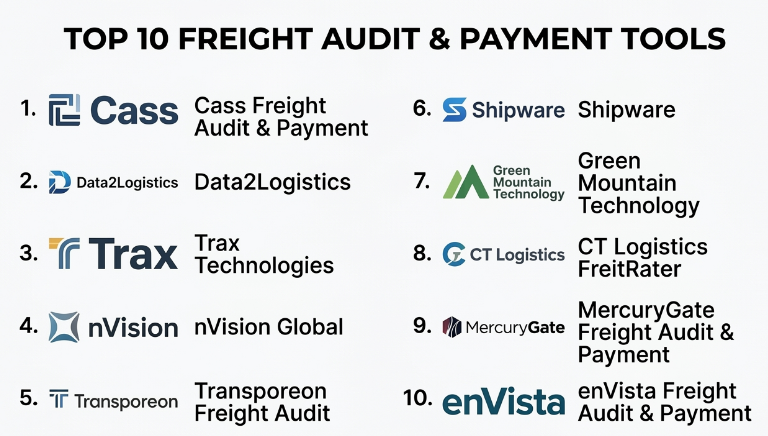
Top 10 Freight Audit & Payment Tools
#1 — Cass Freight Audit & Payment
Short description :
Cass Freight Audit & Payment is a widely recognized freight audit and payment solution used by shippers that need invoice validation, carrier payment, and transportation spend visibility. It supports complex freight environments where invoices must be checked against rates, contracts, shipment data, and business rules. The platform is useful for large manufacturers, retailers, distributors, and enterprises with high freight spend. Cass helps companies reduce overpayment risk, improve payment accuracy, and create better transportation cost reporting. It is a strong choice for organizations that want mature freight payment operations and detailed spend management.
Key Features
- Freight invoice audit and validation
- Carrier payment processing
- Contract and rate compliance checking
- Freight spend analytics
- Cost allocation and reporting
- Multi-mode freight support
- Exception and dispute management
Pros
- Strong freight audit and payment specialization
- Useful for large and complex transportation networks
- Helps finance and logistics teams improve cost visibility
Cons
- May be more than smaller shippers need
- Implementation may require data cleanup and carrier onboarding
- Best value comes with meaningful freight volume
Platforms / Deployment
Web / Enterprise environment.
Cloud / Managed service model: Varies / N/A.
Security & Compliance
Enterprise controls may be available depending on configuration.
SSO/SAML, MFA, encryption, audit logs, RBAC: Not publicly stated in detail.
SOC 2, ISO 27001, GDPR, HIPAA: Not publicly stated.
Integrations & Ecosystem
Cass fits into enterprise freight finance environments where shipment data, invoice data, carrier data, and payment workflows must connect.
- TMS platforms
- ERP and accounting systems
- Carrier invoice systems
- Procurement and contract data
- Payment processing workflows
- Spend analytics and reporting tools
Support & Community
Support is vendor-led and enterprise-focused. Implementation assistance, reporting support, carrier onboarding, and customer service may vary by contract and scope.
#2 — Data2Logistics
Short description :
Data2Logistics is a freight audit and payment provider focused on helping companies validate transportation invoices, process carrier payments, and analyze freight spend. It supports shippers that manage multiple carriers, freight modes, business units, and invoice formats. The platform is useful for organizations that want better accuracy, stronger financial controls, and more detailed transportation cost reporting. Data2Logistics can help teams identify invoice errors, duplicate charges, incorrect rates, and accessorial cost issues. It is a strong option for businesses that want a managed freight audit and payment approach.
Key Features
- Freight invoice audit
- Carrier payment services
- Rate and contract validation
- Duplicate invoice detection
- Freight spend reporting
- Exception and dispute workflows
- Multi-mode transportation support
Pros
- Strong freight audit and payment focus
- Useful for companies with complex carrier billing
- Helps logistics and finance teams work from cleaner cost data
Cons
- May require detailed carrier and rate setup
- Reporting value depends on data quality
- Public security and certification details may be limited
Platforms / Deployment
Web / Managed service environment.
Cloud / Managed deployment: Varies / N/A.
Security & Compliance
SSO/SAML, MFA, encryption, audit logs, RBAC: Not publicly stated in detail.
SOC 2, ISO 27001, GDPR, HIPAA: Not publicly stated.
Integrations & Ecosystem
Data2Logistics works well where invoice validation and payment must connect with transportation, finance, and procurement systems.
- TMS systems
- ERP and accounting platforms
- Carrier invoice feeds
- Freight contracts and rates
- Payment processing systems
- Analytics and reporting workflows
Support & Community
Support is vendor-led with implementation assistance, account support, and freight audit expertise. Community strength is mainly among logistics finance and transportation teams.
#3 — Trax Technologies
Short description :
Trax Technologies provides transportation spend management, freight audit, payment, and logistics analytics solutions for global shippers. It helps companies validate invoices, manage freight payment, analyze transportation cost, and improve logistics financial control. The platform is useful for enterprises with complex global freight networks, multiple modes, regions, carriers, and currencies. Trax is especially relevant when organizations need detailed visibility into freight spend and want to connect audit data with strategic transportation decisions. It is a strong choice for companies managing high-volume and multi-region logistics operations.
Key Features
- Freight audit and payment
- Transportation spend management
- Global freight invoice processing
- Multi-currency and multi-region support
- Carrier and lane cost analytics
- Contract compliance validation
- Transportation financial dashboards
Pros
- Strong global transportation spend management focus
- Useful for large multi-mode logistics operations
- Helps connect invoice audit with strategic cost analytics
Cons
- May be complex for smaller shippers
- Implementation may require global data alignment
- Best value comes with large freight spend and multiple carriers
Platforms / Deployment
Web / Enterprise environment.
Cloud deployment is commonly expected.
Hybrid: Varies / N/A.
Security & Compliance
Enterprise controls may be available depending on deployment.
SSO/SAML, MFA, encryption, audit logs, RBAC: Not publicly stated in detail.
SOC 2, ISO 27001, GDPR, HIPAA: Not publicly stated.
Integrations & Ecosystem
Trax fits into global supply chain finance environments where freight data must connect with transportation execution, procurement, payment, and analytics.
- TMS platforms
- ERP and finance systems
- Carrier invoice feeds
- Procurement and sourcing systems
- Freight contract data
- Business intelligence and analytics tools
Support & Community
Support is enterprise-focused with onboarding, data services, reporting support, and account management. Community strength is strongest among global logistics and transportation finance teams.
#4 — nVision Global
Short description :
nVision Global provides freight audit, freight payment, transportation management, and logistics visibility services for shippers across multiple industries. It helps companies validate freight invoices, process payments, manage carrier data, and analyze transportation cost. The platform is useful for businesses that want freight audit and payment connected with broader transportation visibility and logistics management. nVision Global supports companies that deal with multi-mode freight, complex billing, and global logistics spend. It is a practical choice for shippers that need both audit accuracy and transportation reporting.
Key Features
- Freight audit and invoice validation
- Freight payment processing
- Transportation spend reporting
- Carrier and shipment visibility
- Multi-mode freight support
- Exception and dispute management
- Cost allocation and analytics
Pros
- Supports freight audit and broader logistics visibility
- Useful for multi-mode freight operations
- Helps companies improve invoice accuracy and spend control
Cons
- Best fit depends on freight volume and system integration needs
- Advanced analytics may require data standardization
- Security and compliance details should be validated directly
Platforms / Deployment
Web / Enterprise environment.
Cloud / Managed service model: Varies / N/A.
Security & Compliance
SSO/SAML, MFA, encryption, audit logs, RBAC: Not publicly stated in detail.
SOC 2, ISO 27001, GDPR, HIPAA: Not publicly stated.
Integrations & Ecosystem
nVision Global fits into logistics operations where freight audit, payment, shipment data, and spend reporting must work together.
- TMS systems
- ERP and finance systems
- Carrier invoice data
- Shipment visibility workflows
- Freight contracts and rates
- Reporting and analytics tools
Support & Community
Support is vendor-led with customer service, implementation assistance, and freight audit support. Community strength is mainly among shippers and logistics finance teams.
#5 — Transporeon Freight Audit
Short description :
Transporeon Freight Audit supports freight invoice validation and payment workflows as part of a broader transportation management and carrier collaboration ecosystem. It is useful for companies that want freight audit connected with transportation procurement, execution, visibility, and carrier communication. The platform helps shippers compare invoices against agreed transport conditions, identify billing issues, and improve financial accuracy. Transporeon is especially relevant for European and global logistics networks with many carriers and freight movements. It is a strong option when freight audit needs to be closely connected with transportation execution data.
Key Features
- Freight invoice validation
- Rate and contract matching
- Carrier collaboration workflows
- Freight cost transparency
- Transportation execution alignment
- Exception and dispute support
- Spend and performance reporting
Pros
- Strong fit for transport-connected freight audit
- Useful when carrier collaboration is important
- Works well in broader transportation management ecosystems
Cons
- Best value may come when using other Transporeon modules
- May require carrier onboarding and data alignment
- Smaller businesses may not need full network capabilities
Platforms / Deployment
Web / Enterprise environment.
Cloud deployment is commonly expected.
Security & Compliance
Enterprise controls may be available depending on deployment.
SSO/SAML, MFA, encryption, audit logs, RBAC: Not publicly stated in detail.
SOC 2, ISO 27001, GDPR, HIPAA: Not publicly stated.
Integrations & Ecosystem
Transporeon Freight Audit fits into transportation environments where shipment execution, carrier collaboration, procurement, and freight billing need to connect.
- TMS workflows
- Carrier network data
- ERP and finance systems
- Freight procurement data
- Shipment execution data
- Analytics and reporting tools
Support & Community
Support is vendor-led with onboarding, carrier collaboration support, documentation, and enterprise customer services. Community strength is strong in transportation and logistics networks.
#6 — Shipware
Short description :
Shipware is a parcel and logistics spend management provider focused on helping companies reduce shipping costs, audit carrier invoices, and improve parcel contract performance. It is especially useful for eCommerce companies, retailers, distributors, and businesses with high parcel shipping volume. Shipware helps identify billing errors, service failures, surcharge issues, and savings opportunities. The platform and services are practical for businesses that want parcel audit, carrier contract optimization, and transportation cost recovery. It is a strong option for companies where parcel freight is a major cost area.
Key Features
- Parcel invoice audit
- Shipping cost analysis
- Carrier contract review support
- Surcharge and service failure detection
- Refund and recovery workflows
- Parcel spend reporting
- Cost-saving opportunity identification
Pros
- Strong focus on parcel shipping cost reduction
- Useful for eCommerce and high-volume parcel shippers
- Helps identify surcharge and billing issues
Cons
- Less focused on heavy global multi-mode freight than some enterprise tools
- Best value depends on parcel volume
- Managed service model may not fit every internal process
Platforms / Deployment
Web / Managed service environment.
Cloud / Service-based model: Varies / N/A.
Security & Compliance
SSO/SAML, MFA, encryption, audit logs, RBAC: Not publicly stated in detail.
SOC 2, ISO 27001, GDPR, HIPAA: Not publicly stated.
Integrations & Ecosystem
Shipware fits into parcel-heavy logistics environments where invoice data, carrier agreements, and shipping history must be analyzed.
- Parcel carrier billing data
- Shipping systems
- TMS or parcel management platforms
- ERP and accounting systems
- Contract and surcharge data
- Spend reporting workflows
Support & Community
Support is vendor-led and service-oriented. Customers may receive parcel audit, contract analysis, reporting, and advisory support depending on engagement scope.
#7 — Green Mountain Technology
Short description :
Green Mountain Technology focuses on parcel spend management, freight audit, carrier performance analytics, and parcel network optimization. It is useful for large parcel shippers that need deeper control over carrier invoices, accessorial charges, contract compliance, and shipping cost trends. The platform helps businesses identify overcharges, analyze service performance, and improve parcel transportation strategy. It is especially relevant for retailers, eCommerce companies, healthcare distributors, and high-volume parcel operations. Green Mountain Technology is a strong choice when parcel shipping is complex and cost-sensitive.
Key Features
- Parcel freight audit
- Carrier invoice validation
- Parcel spend analytics
- Contract compliance review
- Accessorial charge analysis
- Carrier performance visibility
- Network and cost optimization support
Pros
- Strong focus on parcel spend management
- Useful for high-volume parcel shippers
- Helps analyze cost, service, and carrier performance together
Cons
- Best suited for parcel-heavy environments
- Less focused on broad ocean, air, or heavy freight audit
- Value depends on shipment volume and contract complexity
Platforms / Deployment
Web / Enterprise environment.
Cloud / Managed service model: Varies / N/A.
Security & Compliance
SSO/SAML, MFA, encryption, audit logs, RBAC: Not publicly stated in detail.
SOC 2, ISO 27001, GDPR, HIPAA: Not publicly stated.
Integrations & Ecosystem
Green Mountain Technology fits into parcel logistics environments where invoice audit, carrier analytics, and cost optimization are important.
- Parcel carrier data
- Shipping platforms
- ERP and finance systems
- Contract and surcharge records
- Spend analytics systems
- Reporting dashboards
Support & Community
Support is vendor-led and focused on parcel logistics, freight audit, and transportation analytics. Advisory support may vary by customer scope.
#8 — CT Logistics FreitRater
Short description :
CT Logistics FreitRater supports freight audit, freight payment, rating, and transportation cost management for shippers. It helps companies validate invoices, calculate freight charges, manage carrier payments, and gain visibility into shipping costs. The platform is useful for businesses with complex carrier rates, multiple freight modes, and recurring invoice validation needs. FreitRater can help reduce manual invoice review and improve transportation financial control. It is a practical option for companies that want a specialized freight audit and rating solution.
Key Features
- Freight invoice audit
- Freight payment processing
- Rate calculation and validation
- Carrier contract checking
- Transportation spend reporting
- Exception handling
- Multi-mode freight support
Pros
- Specialized freight audit and rating focus
- Useful for companies with complex carrier rate structures
- Helps reduce manual billing review
Cons
- Interface and workflow experience should be evaluated during demo
- Integration needs may vary by customer systems
- Public security details may be limited
Platforms / Deployment
Web / Enterprise environment: Varies / N/A.
Cloud / Managed / On-premise: Varies / N/A.
Security & Compliance
SSO/SAML, MFA, encryption, audit logs, RBAC: Not publicly stated in detail.
SOC 2, ISO 27001, GDPR, HIPAA: Not publicly stated.
Integrations & Ecosystem
FreitRater fits into freight finance workflows where rating, invoice audit, payment, and reporting need to connect with business systems.
- TMS systems
- ERP and accounting platforms
- Carrier invoice feeds
- Freight rate tables
- Payment workflows
- Reporting and analytics tools
Support & Community
Support is vendor-led with freight audit, rating, and payment expertise. Documentation and implementation assistance may vary by customer needs.
#9 — MercuryGate Freight Audit & Payment
Short description :
MercuryGate offers transportation management capabilities that can support freight audit, invoice matching, carrier payment workflows, and transportation spend visibility. It is useful for companies that want freight audit connected with transportation planning, execution, carrier management, and shipment visibility. The platform helps logistics teams manage freight costs as part of the broader transportation lifecycle. It is especially relevant for shippers and 3PLs that already use MercuryGate TMS or need freight audit within a TMS environment. MercuryGate is a strong option when freight payment should be linked closely with transportation execution.
Key Features
- Freight invoice matching
- Carrier payment workflow support
- Transportation spend visibility
- Rate and contract validation support
- Shipment execution alignment
- Exception management
- Reporting and analytics
Pros
- Useful when freight audit must connect with TMS workflows
- Good fit for shippers and 3PLs using transportation management systems
- Helps connect planning, execution, and freight cost control
Cons
- Dedicated audit depth may vary by configuration
- May not replace specialized managed freight audit providers in all cases
- Best value comes when used within broader MercuryGate workflows
Platforms / Deployment
Web / Enterprise environment.
Cloud deployment is commonly expected.
Hybrid: Varies / N/A.
Security & Compliance
Enterprise controls may be available depending on configuration.
SSO/SAML, MFA, encryption, audit logs, RBAC: Not publicly stated in detail.
SOC 2, ISO 27001, GDPR, HIPAA: Not publicly stated.
Integrations & Ecosystem
MercuryGate fits into transportation environments where shipment planning, execution, carrier data, and freight invoice workflows must connect.
- MercuryGate TMS workflows
- ERP and finance systems
- Carrier invoice systems
- Freight contract data
- Shipment visibility workflows
- Reporting and analytics platforms
Support & Community
Support is vendor-led with transportation management documentation, implementation support, and customer services. Community strength is strongest among TMS users, shippers, and 3PLs.
#10 — enVista Freight Audit & Payment
Short description :
enVista Freight Audit & Payment helps businesses audit freight invoices, manage carrier payments, analyze transportation spend, and identify cost-saving opportunities. It is useful for retailers, manufacturers, distributors, and logistics teams that need better control over freight billing and payment accuracy. The solution can support multiple freight modes and help teams detect invoice errors, duplicate charges, incorrect accessorials, and contract mismatches. enVista is especially relevant for companies that also need supply chain consulting, transportation optimization, or broader logistics improvement support. It is a practical option for organizations that want freight audit combined with advisory and analytics capabilities.
Key Features
- Freight invoice auditing
- Carrier payment management
- Freight spend analytics
- Rate and contract validation
- Duplicate charge detection
- Exception and dispute workflows
- Transportation cost reporting
Pros
- Combines freight audit with logistics advisory capability
- Useful for shippers seeking cost visibility and improvement
- Can support broader transportation optimization work
Cons
- Best fit depends on engagement scope and freight volume
- Integration and reporting needs should be reviewed carefully
- Public security and compliance details may be limited
Platforms / Deployment
Web / Managed service environment.
Cloud / Managed deployment: Varies / N/A.
Security & Compliance
SSO/SAML, MFA, encryption, audit logs, RBAC: Not publicly stated in detail.
SOC 2, ISO 27001, GDPR, HIPAA: Not publicly stated.
Integrations & Ecosystem
enVista Freight Audit & Payment fits into transportation finance environments where invoice validation, payment, analytics, and cost improvement need to work together.
- TMS systems
- ERP and finance platforms
- Carrier invoice feeds
- Freight contract data
- Spend reporting systems
- Supply chain analytics workflows
Support & Community
Support is vendor-led and may include freight audit support, reporting assistance, advisory services, and transportation improvement guidance depending on customer scope.
Comparison Table
| Tool Name | Best For | Platform(s) Supported | Deployment | Standout Feature | Public Rating |
|---|---|---|---|---|---|
| Cass Freight Audit & Payment | Enterprise freight audit and carrier payment | Web / Enterprise | Cloud / Managed: Varies | Mature freight payment operations | N/A |
| Data2Logistics | Managed freight audit and payment | Web / Managed environment | Cloud / Managed: Varies | Invoice validation and payment services | N/A |
| Trax Technologies | Global transportation spend management | Web / Enterprise | Cloud / Hybrid: Varies | Multi-region freight spend analytics | N/A |
| nVision Global | Multi-mode freight audit and visibility | Web / Enterprise | Cloud / Managed: Varies | Freight audit plus logistics reporting | N/A |
| Transporeon Freight Audit | Transport-connected invoice validation | Web / Enterprise | Cloud | Audit connected with carrier collaboration | N/A |
| Shipware | Parcel audit and cost recovery | Web / Managed environment | Cloud / Service-based: Varies | Parcel surcharge and refund recovery | N/A |
| Green Mountain Technology | High-volume parcel spend management | Web / Enterprise | Cloud / Managed: Varies | Parcel cost and carrier performance analytics | N/A |
| CT Logistics FreitRater | Freight audit, payment, and rating | Web / Enterprise: Varies | Cloud / Managed / On-premise: Varies | Freight rating and invoice audit | N/A |
| MercuryGate Freight Audit & Payment | TMS-connected freight invoice workflows | Web / Enterprise | Cloud / Hybrid: Varies | Freight audit inside transportation execution | N/A |
| enVista Freight Audit & Payment | Freight audit with advisory support | Web / Managed environment | Cloud / Managed: Varies | Freight audit plus logistics improvement support | N/A |
Evaluation & Freight Audit & Payment Tools
The scoring below is comparative and based on practical freight audit and payment needs. It considers core features, ease of use, integrations, security signals, performance, support, and value. Scores should not be treated as final purchasing advice because the best fit depends on freight volume, mode mix, regions, carrier contracts, ERP/TMS environment, and internal finance process maturity.
| Tool Name | Core (25%) | Ease (15%) | Integrations (15%) | Security (10%) | Performance (10%) | Support (10%) | Value (15%) | Weighted Total (0–10) |
|---|---|---|---|---|---|---|---|---|
| Cass Freight Audit & Payment | 9 | 8 | 8 | 8 | 9 | 9 | 8 | 8.45 |
| Data2Logistics | 8 | 8 | 8 | 7 | 8 | 8 | 8 | 7.95 |
| Trax Technologies | 9 | 7 | 9 | 8 | 9 | 8 | 8 | 8.35 |
| nVision Global | 8 | 8 | 8 | 7 | 8 | 8 | 8 | 7.95 |
| Transporeon Freight Audit | 8 | 8 | 9 | 8 | 8 | 8 | 8 | 8.15 |
| Shipware | 8 | 9 | 7 | 7 | 8 | 8 | 9 | 8.10 |
| Green Mountain Technology | 8 | 8 | 7 | 7 | 8 | 8 | 8 | 7.75 |
| CT Logistics FreitRater | 8 | 7 | 8 | 7 | 8 | 8 | 8 | 7.70 |
| MercuryGate Freight Audit & Payment | 8 | 8 | 9 | 8 | 8 | 8 | 8 | 8.15 |
| enVista Freight Audit & Payment | 8 | 8 | 8 | 7 | 8 | 8 | 8 | 7.95 |
A higher score usually means stronger overall fit across broad freight audit and payment requirements. However, the right tool depends on the shipping profile. Parcel-heavy businesses may prefer Shipware or Green Mountain Technology. Global shippers may prefer Trax, Cass, or nVision Global. Companies already using transportation platforms may prefer MercuryGate or Transporeon because audit workflows can connect more closely with execution data.
Which Freight Audit & Payment Tool Should You Choose?
Solo / Freelancer
Solo consultants, logistics advisors, and freight cost analysts usually do not need a full freight audit platform for personal use. They may need carrier invoice samples, rate tables, cost models, and reporting templates to support client projects.
Good approach:
- Review carrier contracts and rate cards
- Compare invoices against shipment records
- Identify duplicate charges and accessorial patterns
- Build freight spend dashboards
- Recommend audit tools only when shipment volume justifies automation
For client projects, the right tool should depend on carrier mix, freight modes, invoice complexity, and payment process maturity.
SMB
Small and mid-sized businesses should first understand where freight cost leakage is happening. If most shipments are parcel, a parcel audit tool may be enough. If the company uses multiple LTL, truckload, and parcel carriers, a broader freight audit solution may be better.
Good options:
- Shipware for parcel audit and cost recovery
- Green Mountain Technology for parcel spend analytics
- CT Logistics FreitRater for freight rating and audit
- enVista Freight Audit & Payment for audit plus advisory support
- Data2Logistics for managed freight audit and payment
SMBs should focus on quick savings, clean invoice data, and simple reporting before moving into complex global spend analytics.
Mid-Market
Mid-market companies often manage multiple carriers, modes, facilities, and business units. They usually need stronger invoice validation, cost allocation, analytics, and integrations with TMS or ERP systems.
Good options:
- Data2Logistics for managed freight audit
- nVision Global for multi-mode freight audit and visibility
- enVista Freight Audit & Payment for audit and logistics improvement
- MercuryGate Freight Audit & Payment if TMS integration is important
- Transporeon Freight Audit for transport-connected audit workflows
Mid-market buyers should validate invoice formats, carrier onboarding, dispute workflows, payment approval rules, and reporting needs.
Enterprise
Large enterprises need scalable freight audit and payment systems that handle high invoice volume, multiple regions, multiple currencies, complex rate contracts, business-unit allocation, and strict financial controls.
Good options:
- Cass Freight Audit & Payment for enterprise freight payment operations
- Trax Technologies for global transportation spend management
- Data2Logistics for managed invoice audit and payment
- nVision Global for multi-mode audit and transportation visibility
- Transporeon Freight Audit for carrier-connected transport networks
- MercuryGate Freight Audit & Payment for TMS-centered freight execution
Enterprise buyers should involve logistics, finance, procurement, tax, IT, transportation, and carrier management teams before selecting a platform.
Budget vs Premium
Budget-focused teams should start with the freight mode that creates the most errors or spend. Parcel-heavy companies may find quick value through parcel audit. LTL and truckload shippers may need rate validation and accessorial review. Global shippers may require more advanced controls.
Budget-friendly path:
- Audit high-volume carriers first
- Check duplicate invoices
- Validate fuel and accessorial charges
- Compare invoices with shipment records
- Build simple freight spend reports
- Add automation after proving savings
Premium tools make sense when the business needs:
- Multi-mode freight audit
- Global invoice processing
- Multi-currency payment workflows
- Contract compliance validation
- Carrier dispute management
- Cost allocation by business unit
- ERP and TMS integration
- Freight accrual support
- Advanced spend analytics
- High-volume payment automation
The right budget depends on freight spend, invoice volume, billing error risk, carrier complexity, and internal finance workload.
Feature Depth vs Ease of Use
A freight audit tool must balance deep validation with practical usability. Finance teams need clean payment controls, while transportation teams need actionable cost insights.
Choose feature depth when:
- Freight contracts are complex
- Multiple freight modes are used
- Global shipments are involved
- Carrier invoice volume is high
- Accessorial charges are significant
- ERP and TMS integration is required
- Cost allocation is important
Choose ease of use when:
- Freight volume is moderate
- Internal teams need simple reporting
- Parcel audit is the first priority
- Finance approval workflows are basic
- Carrier contracts are not very complex
- Fast rollout matters more than deep customization
The best system should reduce manual work and improve financial accuracy without making the process harder for users.
Integrations & Scalability
Freight Audit & Payment Tools become more valuable when they connect with transportation, finance, and procurement systems. Without integration, teams may still depend on manual uploads and spreadsheet matching.
Important integration areas include:
- TMS platforms
- ERP systems
- Accounting software
- Procurement systems
- Carrier invoice feeds
- Parcel shipping systems
- Freight rate databases
- Payment platforms
- Data warehouses
- BI and reporting tools
- Contract management systems
- Tax and compliance systems
Scalability matters when the business manages many carriers, invoices, regions, currencies, business units, and freight modes.
Security & Compliance Needs
Freight audit platforms store sensitive carrier, shipment, invoice, payment, contract, and financial data. Security should be reviewed before implementation.
Buyers should ask about:
- Role-based access control
- SSO and MFA
- Encryption
- Audit logs
- Payment approval controls
- User activity tracking
- Secure carrier data exchange
- Data retention policies
- Backup and recovery
- Tax and financial audit support
- Integration security
- Support for internal security review
Never assume a tool has a specific security certification unless the vendor clearly confirms it.
Frequently Asked Questions
1. What is a Freight Audit & Payment Tool?
A Freight Audit & Payment Tool checks carrier invoices against shipment records, contracts, rates, and business rules. It helps companies avoid overpayments, manage disputes, process payments, and analyze transportation spend.
2. Why is freight audit important?
Freight invoices often include complex charges, surcharges, accessorials, taxes, and rate rules. Freight audit helps detect billing errors, duplicate invoices, incorrect rates, and unexpected charges before payment.
3. Who uses Freight Audit & Payment Tools?
Transportation managers, logistics teams, finance departments, procurement teams, supply chain leaders, retailers, manufacturers, distributors, 3PLs, and high-volume shippers use these tools.
4. What is the biggest mistake when choosing a freight audit tool?
The biggest mistake is choosing a tool without understanding invoice complexity, freight modes, carrier contracts, and integration needs. A parcel-heavy shipper and a global ocean freight shipper may need very different solutions.
5. Can freight audit tools reduce shipping cost?
Yes, they can reduce cost by identifying billing errors, duplicate charges, incorrect accessorials, missed service refunds, and contract mismatches. They also improve spend visibility for better carrier negotiations.
6. What freight modes can these tools support?
Many tools support parcel, LTL, truckload, ocean, air, rail, intermodal, and international freight. However, mode coverage varies by vendor, so buyers should confirm support for their exact shipping profile.
7. What is parcel audit?
Parcel audit reviews small-package carrier invoices for billing errors, service failures, surcharges, dimensional weight issues, address corrections, and refund opportunities. It is important for eCommerce and high-volume parcel shippers.
8. What is accessorial charge auditing?
Accessorial charge auditing checks extra fees such as detention, liftgate, residential delivery, reclassification, storage, demurrage, layover, fuel surcharge, and special handling. These charges can create major freight cost leakage.
9. Can freight audit tools integrate with ERP?
Yes, many tools integrate with ERP systems to support invoice approval, payment processing, cost allocation, accruals, and accounting workflows. Integration depth varies by vendor and implementation.
10. Can freight audit tools integrate with TMS?
Yes, TMS integration is common because shipment execution data helps validate carrier invoices. A strong connection between TMS and freight audit improves invoice accuracy and reporting.
Conclusion
Freight Audit & Payment Tools help companies improve invoice accuracy, reduce overpayments, manage carrier payments, control accessorial charges, and gain better transportation spend visibility. The right platform can create value for both logistics and finance teams by connecting shipment data, carrier invoices, contracts, payment workflows, and analytics. However, the best tool depends on freight volume, freight modes, parcel exposure, global complexity, carrier contracts, internal finance controls, and integration needs. Cass, Data2Logistics, Trax, and nVision Global are strong for broad freight audit and payment operations.
