Introduction
Yard Management Systems, also called YMS, are software platforms that help businesses manage trailer movements, dock appointments, gate check-ins, yard inventory, driver communication, dock scheduling, shipment visibility, and yard operations. In simple words, a YMS helps companies know which trailers, trucks, containers, and assets are inside the yard, where they are located, what they are waiting for, and when they should move to a dock or leave the facility.
A warehouse, distribution center, manufacturing plant, port facility, or retail logistics hub can lose a lot of time when yard operations are handled manually. Drivers may wait too long at the gate, trailers may be parked in the wrong location, dock doors may be underused, and warehouse teams may not know when inbound or outbound loads are ready. A good YMS reduces confusion by connecting gate, yard, dock, warehouse, transportation, and carrier activities.
These tools are used for gate management, trailer tracking, dock appointment scheduling, yard checks, yard jockey task assignment, shipment status updates, detention and demurrage reduction, driver communication, asset visibility, and operational reporting.
Buyers should evaluate:
- Gate check-in and check-out workflows
- Dock appointment scheduling
- Real-time trailer and yard asset visibility
- Yard jockey task management
- Integration with WMS, TMS, ERP, carrier portals, and telematics
- Mobile access for guards, drivers, and yard operators
- Exception alerts and detention tracking
- Reporting and yard performance analytics
- Multi-site yard management support
- Ease of use for warehouse and transportation teams
- Security, role-based access, and audit logs
- Scalability for high-volume yards and enterprise networks
Best for: Retailers, manufacturers, distributors, 3PL providers, food and beverage companies, automotive companies, ports, warehouses, fulfillment centers, logistics hubs, and companies with high trailer volume, dock congestion, or yard visibility challenges.
Not ideal for: Very small facilities with low truck volume, few trailers, simple dock operations, or limited yard space. In those cases, basic dock scheduling, WMS notes, spreadsheets, or manual gate logs may be enough.
Key Yard Management System Trends
- Real-time yard visibility is becoming essential. Companies want to know exactly where trailers, containers, tractors, and yard assets are located without depending on manual yard checks.
- Dock scheduling is now closely tied to yard management. Appointment planning, inbound visibility, dock door capacity, labor planning, and yard flow must work together.
- Driver self-service is improving gate efficiency. Mobile check-in, QR codes, digital forms, and automated instructions can reduce gate delays and manual guard work.
- Integration with TMS and WMS is a major requirement. Yard activity must connect with transportation planning and warehouse execution so inbound and outbound flows stay synchronized.
- Automation is entering yard operations. Some companies are using RFID, GPS, computer vision, license plate recognition, IoT sensors, and automated gate systems to improve yard accuracy.
- Detention and demurrage cost control is becoming a priority. YMS platforms help track dwell time, carrier wait time, and trailer aging so teams can reduce avoidable charges.
- Multi-site yard visibility is growing. Enterprises want one view of yard performance across plants, warehouses, DCs, and regional logistics hubs.
- Yard jockey productivity is being measured more closely. Task assignment, move completion time, trailer readiness, and dock turn time are becoming important metrics.
- Cloud-based YMS platforms are widely preferred. Cloud deployment helps companies support multiple sites, remote monitoring, mobile users, and faster updates.
- Security and access control are becoming more important. Yards often involve carriers, drivers, contractors, guards, and internal employees, so controlled access and audit trails matter.
How We Selected These Tools
The tools below were selected using practical logistics, warehouse, transportation, and yard operations evaluation criteria.
- Recognition in yard management, dock scheduling, transportation execution, warehouse execution, or logistics visibility
- Ability to manage gate activity, dock appointments, yard assets, trailer movement, and yard tasks
- Fit for warehouses, distribution centers, factories, 3PLs, ports, logistics hubs, and enterprise supply chains
- Integration potential with WMS, TMS, ERP, carrier portals, telematics, RFID, and automation systems
- Support for real-time visibility, alerts, dashboards, and operational reporting
- Scalability across single-site, multi-site, and enterprise yard networks
- Usability for guards, yard jockeys, transportation planners, warehouse managers, and carriers
- Mobile and self-service capabilities for field users and drivers
- Security, role-based access, auditability, and enterprise deployment readiness
- Vendor support, product maturity, documentation, and implementation ecosystem
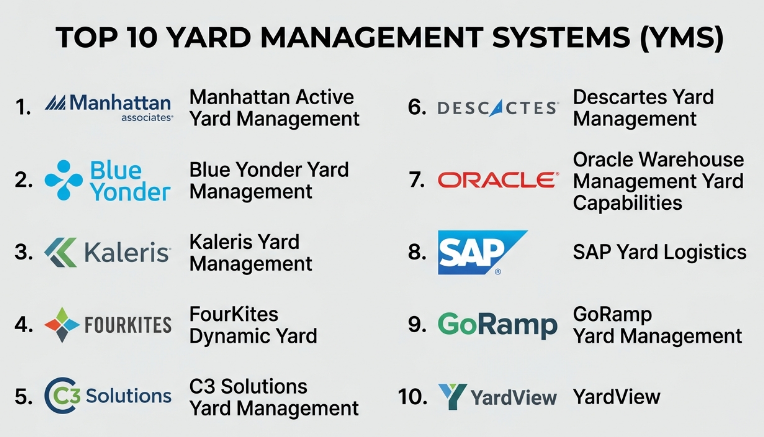
Top 10 Yard Management Systems YMS
#1 — Manhattan Active Yard Management
Short description :
Manhattan Active Yard Management is a yard management solution designed to help companies manage trailer movement, dock activity, gate operations, and yard visibility as part of a broader supply chain execution environment. It is especially useful for retailers, distributors, 3PLs, and high-volume fulfillment operations that already use Manhattan warehouse or transportation systems. The platform helps teams connect yard activity with warehouse execution, order flow, dock scheduling, and transportation operations. It supports better trailer visibility, yard task coordination, and operational control across complex facilities. Manhattan Active Yard Management is a strong fit for enterprises that want yard management tightly connected with warehouse and fulfillment execution.
Key Features
- Yard trailer and asset visibility
- Gate check-in and check-out workflows
- Dock door and appointment coordination
- Yard jockey task management
- Integration with warehouse execution workflows
- Real-time operational dashboards
- Multi-site yard operation support
Pros
- Strong fit for enterprise warehouse and distribution environments
- Works well with Manhattan supply chain ecosystem
- Useful for connecting yard, dock, warehouse, and transportation workflows
Cons
- May be more advanced than small yards need
- Best value often comes with broader Manhattan deployment
- Implementation may require process redesign and change management
Platforms / Deployment
Web / Mobile / Enterprise environment.
Cloud deployment is commonly expected.
Hybrid: Varies / N/A.
Security & Compliance
Enterprise controls may be available depending on deployment.
SSO/SAML, MFA, encryption, audit logs, RBAC: Not publicly stated in detail here.
SOC 2, ISO 27001, GDPR, HIPAA: Not publicly stated in this context.
Integrations & Ecosystem
Manhattan Active Yard Management fits into supply chain execution environments where yard data must connect with warehouse, order, transportation, labor, and fulfillment systems.
- Manhattan WMS and supply chain execution tools
- TMS and transportation workflows
- ERP and order systems
- Carrier and dock scheduling workflows
- Warehouse automation systems
- Reporting and analytics platforms
Support & Community
Support is enterprise-focused, with implementation services, documentation, training, and partner support. Community strength is strong in retail, distribution, logistics, and enterprise supply chain operations.
#2 — Blue Yonder Yard Management
Short description :
Blue Yonder Yard Management helps companies manage trailer visibility, dock scheduling, yard movements, gate activity, and supply chain execution. It is useful for organizations that need to coordinate yard operations with warehouse management, transportation planning, and fulfillment workflows. The platform is especially relevant for retailers, manufacturers, distributors, and logistics providers with complex yard and dock operations. Blue Yonder helps teams reduce trailer search time, improve dock utilization, and manage yard congestion more effectively. It is a strong choice for enterprises that want yard management as part of a broader supply chain planning and execution ecosystem.
Key Features
- Yard asset tracking
- Dock appointment and door coordination
- Gate activity management
- Yard move task assignment
- Exception alerts and visibility
- Integration with WMS and TMS workflows
- Multi-site operational reporting
Pros
- Strong fit for enterprise supply chain environments
- Useful when yard workflows must connect with warehouse and transportation systems
- Good for multi-site visibility and operational control
Cons
- May require detailed implementation planning
- Best value may depend on Blue Yonder ecosystem alignment
- Smaller operations may find it too complex
Platforms / Deployment
Web / Enterprise environment.
Cloud / Hybrid: Varies / N/A.
Security & Compliance
Enterprise access controls may be available depending on deployment.
SSO/SAML, MFA, encryption, audit logs, RBAC: Not publicly stated in detail here.
SOC 2, ISO 27001, GDPR, HIPAA: Not publicly stated in this context.
Integrations & Ecosystem
Blue Yonder Yard Management fits into logistics environments where yard, warehouse, transportation, inventory, and fulfillment data need to work together.
- Blue Yonder WMS and TMS workflows
- ERP and order systems
- Carrier and transportation data
- Dock scheduling workflows
- Yard automation systems
- Supply chain analytics tools
Support & Community
Support is vendor-led and enterprise-focused. Documentation, training, implementation partners, and customer support may vary by package, region, and deployment scope.
#3 — Kaleris Yard Management
Short description :
Kaleris Yard Management is designed for logistics-intensive operations that need better visibility, control, and coordination across yard, terminal, dock, and transportation workflows. It helps teams manage trailers, containers, appointments, gate operations, yard moves, and operational exceptions. The platform is useful for distribution centers, manufacturers, intermodal operations, ports, terminals, and large logistics facilities. Kaleris has strong relevance where yard operations are part of a larger transportation and terminal execution environment. It is a strong choice for organizations with complex freight movement, high asset volume, and multi-modal yard visibility needs.
Key Features
- Trailer and container visibility
- Gate and appointment workflows
- Yard move task management
- Dock and door coordination
- Terminal and logistics execution support
- Real-time operational dashboards
- Exception and dwell time tracking
Pros
- Strong fit for complex logistics and transportation environments
- Useful for trailer, container, and yard asset visibility
- Good for facilities with high freight and yard activity
Cons
- May be more than basic warehouse yards need
- Implementation scope can vary by operation type
- Integration requirements should be reviewed carefully
Platforms / Deployment
Web / Mobile / Enterprise environment.
Cloud / Hybrid / On-premise: Varies / N/A.
Security & Compliance
SSO/SAML, MFA, encryption, audit logs, RBAC: Not publicly stated in detail here.
SOC 2, ISO 27001, GDPR, HIPAA: Not publicly stated in this context.
Integrations & Ecosystem
Kaleris Yard Management fits into environments where yard operations connect with transportation, terminal, warehouse, and logistics execution systems.
- TMS and transportation systems
- WMS and dock operations
- Terminal operating systems
- Gate automation and access control
- Carrier and appointment workflows
- Reporting and analytics tools
Support & Community
Support is vendor-led with implementation assistance, documentation, training, and customer support. Community strength is strongest in logistics, terminal operations, ports, and transportation-heavy environments.
#4 — FourKites Dynamic Yard
Short description :
FourKites Dynamic Yard is a yard management and visibility solution focused on helping companies connect shipment tracking, appointment management, facility operations, and yard visibility. It is especially useful for organizations that already value real-time transportation visibility and want better control inside the facility yard. The platform helps teams understand inbound and outbound shipment status, manage dock appointments, reduce dwell time, and improve coordination with carriers. FourKites Dynamic Yard is suitable for manufacturers, retailers, distributors, food and beverage companies, and logistics teams that need yard visibility connected with shipment visibility. It is a strong option where transportation visibility and yard execution must work together.
Key Features
- Real-time yard visibility
- Dock appointment scheduling
- Shipment and carrier visibility
- Gate and facility workflow support
- Dwell time and detention tracking
- Carrier communication support
- Analytics and performance dashboards
Pros
- Strong connection between transportation visibility and yard operations
- Useful for reducing dwell time and improving appointment coordination
- Good fit for carrier-heavy operations
Cons
- Best value may come when paired with broader visibility workflows
- Deep warehouse execution features may require WMS integration
- Implementation depends on carrier and facility data quality
Platforms / Deployment
Web / Mobile environment.
Cloud deployment.
Security & Compliance
Enterprise controls may be available depending on configuration.
SSO/SAML, MFA, encryption, audit logs, RBAC: Not publicly stated in detail here.
SOC 2, ISO 27001, GDPR, HIPAA: Not publicly stated in this context.
Integrations & Ecosystem
FourKites Dynamic Yard fits into supply chain visibility environments where transportation, carriers, appointments, and yard operations need to be connected.
- Transportation visibility data
- TMS systems
- WMS and dock workflows
- Carrier communication systems
- Appointment scheduling tools
- Facility analytics dashboards
Support & Community
Support is vendor-led with onboarding, customer success, documentation, and implementation support. Community strength is strong in transportation visibility and logistics operations.
#5 — C3 Solutions Yard Management
Short description :
C3 Solutions Yard Management is a yard and dock management platform focused on appointment scheduling, gate management, trailer tracking, yard movements, and dock visibility. It is useful for warehouses, distribution centers, manufacturers, retailers, and logistics operations that want a practical YMS without necessarily replacing their WMS or TMS. The platform helps reduce manual gate logs, improve dock scheduling, and give teams better trailer visibility. C3 Solutions is especially useful for organizations that want a focused yard and dock solution that can be integrated with existing systems. It is a good choice for mid-market and enterprise facilities with recurring yard congestion or appointment problems.
Key Features
- Dock appointment scheduling
- Gate check-in and check-out
- Trailer and yard asset tracking
- Yard move management
- Carrier and driver communication
- Dwell time monitoring
- Reporting and operational dashboards
Pros
- Focused yard and dock management functionality
- Useful for improving appointment and gate workflows
- Good fit for facilities that need practical YMS capabilities
Cons
- May need integrations for deeper warehouse or transportation execution
- Advanced automation depends on selected setup
- Public security details may be limited
Platforms / Deployment
Web / Mobile environment.
Cloud deployment is commonly expected.
Hybrid: Varies / N/A.
Security & Compliance
SSO/SAML, MFA, encryption, audit logs, RBAC: Not publicly stated in detail here.
SOC 2, ISO 27001, GDPR, HIPAA: Not publicly stated in this context.
Integrations & Ecosystem
C3 Solutions Yard Management fits into logistics environments where yard activity must connect with dock scheduling, carrier workflows, and warehouse operations.
- WMS platforms
- TMS systems
- ERP and order systems
- Carrier appointment workflows
- Gate and dock operations
- Reporting and analytics tools
Support & Community
Support is vendor-led and focused on logistics and facility operations. Documentation, onboarding, and customer support may vary based on deployment scope and integrations.
#6 — Descartes Yard Management
Short description :
Descartes Yard Management supports yard visibility, trailer tracking, dock scheduling, and logistics execution as part of Descartes’ broader supply chain and logistics technology ecosystem. It is useful for companies that need better control over inbound and outbound yard movements, especially when yard activity must connect with transportation, customs, routing, and logistics visibility. The platform can help reduce delays, improve dock utilization, and support better carrier coordination. Descartes is especially relevant for logistics-heavy businesses that already use transportation or global trade solutions. It is a good fit for organizations that want yard operations connected with broader logistics execution.
Key Features
- Yard and trailer visibility
- Dock and appointment coordination
- Gate workflow support
- Carrier and transportation data connectivity
- Dwell time and exception monitoring
- Logistics execution integration
- Reporting and performance visibility
Pros
- Strong fit for logistics and transportation-heavy companies
- Useful when yard data must connect with broader supply chain execution
- Good for visibility and carrier coordination
Cons
- Yard depth may vary depending on selected solution package
- Best value may come inside Descartes ecosystem
- Integration scope should be reviewed carefully
Platforms / Deployment
Web / Enterprise environment.
Cloud deployment is commonly expected.
Hybrid: Varies / N/A.
Security & Compliance
Enterprise controls may be available depending on deployment.
SSO/SAML, MFA, encryption, audit logs, RBAC: Not publicly stated in detail here.
SOC 2, ISO 27001, GDPR, HIPAA: Not publicly stated in this context.
Integrations & Ecosystem
Descartes Yard Management fits into environments where yard operations are connected to logistics, transportation, carrier networks, and trade workflows.
- TMS and carrier systems
- WMS and dock operations
- ERP and order systems
- Logistics visibility workflows
- Carrier appointment processes
- Analytics and reporting tools
Support & Community
Support is vendor-led with documentation, implementation services, and customer support. Community strength is strongest in logistics, transportation, and global supply chain operations.
#7 — Oracle Warehouse Management Yard Capabilities
Short description :
Oracle Warehouse Management includes capabilities that can support yard, dock, inbound, outbound, and warehouse execution workflows in cloud-based supply chain environments. It is useful for organizations already using Oracle Cloud SCM, Oracle ERP, or Oracle warehouse operations. While dedicated YMS depth may depend on configuration and process design, Oracle can help connect yard activity with receiving, shipping, inventory, transportation, and enterprise workflows. It is especially suitable for companies that want yard operations connected to broader Oracle supply chain processes. Oracle is a strong fit for cloud-first enterprises that need warehouse and yard visibility in one business platform.
Key Features
- Inbound and outbound warehouse workflows
- Dock and receiving coordination
- Trailer and shipment status visibility
- Mobile warehouse execution support
- Inventory and order process integration
- Enterprise reporting and dashboards
- Oracle SCM and ERP alignment
Pros
- Strong fit for Oracle-centered enterprises
- Connects yard-related workflows with warehouse and business operations
- Good for companies using Oracle Cloud SCM
Cons
- Dedicated YMS depth may vary by configuration
- May require customization for advanced yard operations
- Best value comes when Oracle is already part of the supply chain stack
Platforms / Deployment
Web / Mobile / Enterprise environment.
Cloud deployment.
Security & Compliance
Enterprise security controls may be available depending on Oracle environment and configuration.
SSO/SAML, MFA, encryption, audit logs, RBAC: Not publicly stated in detail here.
SOC 2, ISO 27001, GDPR, HIPAA: Not publicly stated in this context.
Integrations & Ecosystem
Oracle Warehouse Management fits into Oracle enterprise environments where yard, warehouse, finance, order, and procurement processes must connect.
- Oracle SCM and ERP
- Order management systems
- Transportation workflows
- Procurement and receiving processes
- Warehouse automation systems
- Analytics and reporting tools
Support & Community
Oracle provides enterprise documentation, cloud support, implementation partners, training resources, and customer support. Support quality may vary by contract and implementation partner.
#8 — SAP Yard Logistics
Short description :
SAP Yard Logistics helps organizations manage yard operations, vehicle movements, dock appointments, check-in and check-out activities, loading and unloading coordination, and yard process visibility. It is designed for companies that want yard management connected with SAP ERP, SAP Extended Warehouse Management, transportation, and enterprise logistics processes. The platform is especially useful for manufacturing plants, warehouses, distribution centers, and logistics hubs that operate within SAP environments. SAP Yard Logistics helps standardize yard execution and connect it with broader supply chain operations. It is a strong choice for SAP-centered enterprises with complex yard and dock processes.
Key Features
- Yard check-in and check-out workflows
- Vehicle and trailer movement management
- Dock appointment and loading coordination
- Integration with SAP logistics processes
- Yard task visibility
- Gate and facility process support
- Reporting and operational tracking
Pros
- Strong fit for SAP-centered enterprises
- Connects yard workflows with warehouse, transportation, and ERP processes
- Useful for manufacturing and logistics facilities with complex yard operations
Cons
- Implementation can be complex
- Best value comes in SAP ecosystem environments
- Smaller yards may find it too heavy
Platforms / Deployment
Web / Enterprise environment.
Cloud / Hybrid / On-premise: Varies / N/A.
Security & Compliance
Enterprise security controls may be available depending on SAP environment and deployment.
SSO/SAML, MFA, encryption, audit logs, RBAC: Not publicly stated in detail here.
SOC 2, ISO 27001, GDPR, HIPAA: Not publicly stated in this context.
Integrations & Ecosystem
SAP Yard Logistics fits into SAP environments where yard operations must connect with warehouse, transportation, procurement, manufacturing, and enterprise logistics processes.
- SAP ERP and S/4HANA
- SAP Extended Warehouse Management
- Transportation and logistics systems
- Procurement and receiving workflows
- Dock and shipment processes
- Analytics and reporting tools
Support & Community
SAP has a large enterprise support ecosystem, documentation, training resources, implementation partners, and customer community. Support experience may vary by partner, region, and deployment size.
#9 — GoRamp Yard Management
Short description :
GoRamp Yard Management helps companies manage dock appointments, yard visibility, carrier communication, gate activity, and logistics coordination in a cloud-based environment. It is especially useful for manufacturers, retailers, logistics teams, and warehouses that want a practical platform for appointment scheduling and yard flow control. The platform helps reduce manual communication, improve carrier coordination, and provide better visibility into inbound and outbound movements. GoRamp is suitable for businesses looking for a modern and user-friendly yard and transportation coordination tool. It is a good option for mid-sized companies that need better logistics visibility without a very heavy enterprise deployment.
Key Features
- Dock appointment scheduling
- Yard and gate visibility
- Carrier communication
- Inbound and outbound coordination
- Real-time shipment and facility updates
- Reporting and operational dashboards
- Cloud-based collaboration workflows
Pros
- User-friendly for logistics and warehouse teams
- Useful for appointment scheduling and carrier coordination
- Good fit for mid-sized and growing operations
Cons
- May not offer the same depth as large enterprise YMS platforms
- Advanced automation may require additional integrations
- Best fit depends on facility complexity and carrier workflows
Platforms / Deployment
Web / Mobile environment.
Cloud deployment.
Security & Compliance
SSO/SAML, MFA, encryption, audit logs, RBAC: Not publicly stated in detail here.
SOC 2, ISO 27001, GDPR, HIPAA: Not publicly stated in this context.
Integrations & Ecosystem
GoRamp fits into logistics environments where carriers, appointments, warehouses, and transportation teams need smoother coordination.
- TMS and logistics workflows
- WMS and warehouse operations
- Carrier communication systems
- Appointment scheduling workflows
- ERP and order systems
- Reporting dashboards
Support & Community
Support is vendor-led with onboarding, documentation, and customer support. Community strength is mainly among logistics, manufacturing, and warehouse operations users.
#10 — YardView
Short description :
YardView is a yard management solution focused on trailer visibility, dock scheduling, gate activity, yard moves, and operational reporting. It is useful for warehouses, distribution centers, manufacturers, and logistics facilities that need a dedicated system to manage trailer and dock activity. YardView helps teams reduce manual yard checks, improve dock utilization, and track trailer dwell time more effectively. It is especially relevant for companies that need a focused YMS rather than a broad enterprise supply chain suite. YardView is a practical option for facilities that want structured yard control, better visibility, and improved daily execution.
Key Features
- Trailer and yard asset tracking
- Dock scheduling support
- Gate check-in and check-out workflows
- Yard move management
- Dwell time and detention tracking
- Operational dashboards
- Reporting and performance visibility
Pros
- Focused yard management functionality
- Useful for facilities with recurring trailer visibility problems
- Helps reduce manual yard tracking
Cons
- Integration depth should be validated by use case
- May need additional systems for full transportation or warehouse execution
- Public security details may be limited
Platforms / Deployment
Web / Enterprise environment: Varies / N/A.
Cloud / Hybrid / On-premise: Varies / N/A.
Security & Compliance
SSO/SAML, MFA, encryption, audit logs, RBAC: Not publicly stated in detail here.
SOC 2, ISO 27001, GDPR, HIPAA: Not publicly stated in this context.
Integrations & Ecosystem
YardView fits into yard operations where trailer data, dock scheduling, gate workflows, and warehouse activity need to be coordinated.
- WMS platforms
- TMS systems
- Carrier appointment workflows
- Gate and dock operations
- Yard move processes
- Reporting and analytics systems
Support & Community
Support is vendor-led and focused on yard operations and logistics teams. Documentation, onboarding, and support details may vary depending on deployment and customer needs.
Comparison Table
| Tool Name | Best For | Platform(s) Supported | Deployment | Standout Feature | Public Rating |
|---|---|---|---|---|---|
| Manhattan Active Yard Management | Enterprise warehouse and fulfillment yards | Web / Mobile / Enterprise | Cloud / Hybrid: Varies | Yard connected with warehouse execution | N/A |
| Blue Yonder Yard Management | Multi-site supply chain yard visibility | Web / Enterprise | Cloud / Hybrid: Varies | Yard visibility connected with WMS and TMS workflows | N/A |
| Kaleris Yard Management | Complex logistics, terminal, and yard operations | Web / Mobile / Enterprise | Cloud / Hybrid / On-premise: Varies | Trailer, container, and terminal yard visibility | N/A |
| FourKites Dynamic Yard | Transportation visibility connected with yard operations | Web / Mobile | Cloud | Shipment visibility plus yard execution | N/A |
| C3 Solutions Yard Management | Focused dock and yard management | Web / Mobile | Cloud / Varies | Appointment, gate, and trailer workflow control | N/A |
| Descartes Yard Management | Logistics and carrier-heavy operations | Web / Enterprise | Cloud / Varies | Yard visibility within logistics execution ecosystem | N/A |
| Oracle Warehouse Management Yard Capabilities | Oracle-centered warehouse operations | Web / Mobile / Enterprise | Cloud | Yard-related workflows connected with Oracle SCM | N/A |
| SAP Yard Logistics | SAP-centered yard and logistics processes | Web / Enterprise | Cloud / Hybrid / On-premise: Varies | Yard operations connected with SAP logistics | N/A |
| GoRamp Yard Management | Mid-sized logistics and appointment coordination | Web / Mobile | Cloud | User-friendly appointment and carrier coordination | N/A |
| YardView | Dedicated trailer and dock visibility | Web / Enterprise: Varies | Cloud / Hybrid / On-premise: Varies | Focused yard tracking and dock scheduling | N/A |
Evaluation & Yard Management Systems YMS
The scoring below is comparative and based on practical YMS needs such as core features, ease of use, integrations, security signals, performance, support, and value. Scores should not be treated as final purchasing advice because the best fit depends on yard size, trailer volume, dock complexity, carrier activity, existing WMS or TMS, and integration needs.
| Tool Name | Core (25%) | Ease (15%) | Integrations (15%) | Security (10%) | Performance (10%) | Support (10%) | Value (15%) | Weighted Total (0–10) |
|---|---|---|---|---|---|---|---|---|
| Manhattan Active Yard Management | 9 | 8 | 9 | 8 | 9 | 8 | 8 | 8.45 |
| Blue Yonder Yard Management | 9 | 7 | 9 | 8 | 9 | 8 | 7 | 8.15 |
| Kaleris Yard Management | 9 | 8 | 8 | 7 | 8 | 8 | 8 | 8.05 |
| FourKites Dynamic Yard | 8 | 8 | 8 | 7 | 8 | 8 | 8 | 7.85 |
| C3 Solutions Yard Management | 8 | 8 | 7 | 7 | 8 | 8 | 8 | 7.70 |
| Descartes Yard Management | 8 | 7 | 8 | 7 | 8 | 8 | 7 | 7.55 |
| Oracle Warehouse Management Yard Capabilities | 7 | 8 | 9 | 8 | 8 | 8 | 8 | 7.90 |
| SAP Yard Logistics | 8 | 7 | 9 | 8 | 8 | 8 | 7 | 7.85 |
| GoRamp Yard Management | 7 | 9 | 7 | 7 | 8 | 8 | 8 | 7.65 |
| YardView | 8 | 8 | 7 | 6 | 8 | 7 | 8 | 7.50 |
A higher score usually means stronger fit across broad yard management needs. However, the best system depends on the business problem. Manhattan, Blue Yonder, SAP, and Oracle are strong when yard operations must connect tightly with enterprise supply chain execution. FourKites is strong when transportation visibility and yard workflows need to work together. C3 Solutions, GoRamp, and YardView can be practical for focused yard and dock management needs.
Which Yard Management System Should You Choose?
Solo / Freelancer
Solo consultants, logistics advisors, and independent warehouse improvement experts usually do not need a full YMS for personal use. They may need yard audit templates, dock flow analysis, trailer dwell time studies, and process improvement frameworks.
Good approach:
- Map the current gate, yard, and dock process
- Measure trailer dwell time and dock utilization
- Identify manual handoff delays
- Review WMS and TMS integration gaps
- Recommend YMS only when volume and complexity justify it
For consulting projects, the right tool should depend on yard size, trailer volume, carrier mix, dock count, and system environment.
SMB
Small and mid-sized warehouses often need practical dock scheduling, trailer visibility, and carrier communication more than a heavy enterprise platform. They should focus on tools that are easy to implement and simple for guards, supervisors, and carriers to use.
Good options:
- GoRamp Yard Management for appointment and carrier coordination
- C3 Solutions Yard Management for focused dock and yard workflows
- YardView for trailer visibility and yard tracking
- FourKites Dynamic Yard if transportation visibility is also important
- Oracle or SAP yard-related capabilities if already using those ecosystems
SMBs should avoid overcomplicating the first rollout. Start with gate check-in, dock appointments, trailer visibility, and dwell time tracking.
Mid-Market
Mid-market companies often have multiple docks, growing carrier volume, regular yard congestion, detention costs, and stronger reporting needs. They may need better integration between yard, WMS, TMS, and carrier workflows.
Good options:
- FourKites Dynamic Yard for transportation and facility visibility
- C3 Solutions Yard Management for focused yard execution
- Kaleris Yard Management for complex yard and logistics operations
- Manhattan Active Yard Management for warehouse-connected yard execution
- Blue Yonder Yard Management for broader supply chain integration
Mid-market buyers should focus on integration quality, mobile usability, carrier adoption, and exception management.
Enterprise
Large retailers, manufacturers, 3PLs, port operators, and global supply chain organizations need scalable YMS platforms that support multiple sites, high trailer volume, complex appointments, enterprise reporting, and strong system integration.
Good options:
- Manhattan Active Yard Management for enterprise warehouse-connected yard control
- Blue Yonder Yard Management for multi-site supply chain visibility
- Kaleris Yard Management for complex logistics, terminal, and yard operations
- SAP Yard Logistics for SAP-centered enterprises
- Oracle Warehouse Management yard capabilities for Oracle-centered operations
- Descartes Yard Management for logistics and carrier-heavy networks
Enterprise buyers should involve warehouse operations, transportation, IT, security, carriers, site managers, and finance teams before final selection.
Budget vs Premium
Budget-focused teams should first identify the biggest yard problem. If the main issue is appointment chaos, start with dock scheduling. If the main issue is lost trailers, focus on yard visibility. If detention is the biggest problem, focus on dwell tracking and carrier communication.
Budget-friendly path:
- Digitize dock appointments
- Improve gate check-in
- Track trailer location manually or semi-automatically
- Measure dwell time
- Add mobile yard checks
- Integrate with WMS and TMS later
Premium YMS platforms make sense when the organization needs:
- Multi-site yard visibility
- Automated gate workflows
- Carrier self-service
- Dock scheduling optimization
- Yard jockey task dispatching
- WMS and TMS integration
- Detention and demurrage tracking
- Real-time trailer visibility
- Enterprise reporting
- Yard automation support
The right budget depends on detention cost, dock congestion, trailer volume, labor cost, and service-level pressure.
Feature Depth vs Ease of Use
A YMS must be easy for guards, drivers, yard jockeys, warehouse supervisors, and transportation teams. If users do not update the system properly, yard visibility becomes unreliable.
Choose feature depth when:
- Trailer volume is high
- Multiple yards or sites are involved
- Dock scheduling is complex
- Yard moves must be optimized
- Detention costs are high
- WMS and TMS integration is required
- Yard automation is planned
Choose ease of use when:
- The yard team is small
- Manual processes are still common
- Driver adoption is a concern
- The first goal is simple trailer visibility
- IT support is limited
- The operation needs quick rollout
The best YMS should improve daily yard decisions without creating unnecessary administrative work.
Integrations & Scalability
Yard Management Systems become more valuable when they connect with existing supply chain systems. Without integration, teams may still rely on manual updates and duplicate data entry.
Important integration areas include:
- WMS platforms
- TMS platforms
- ERP systems
- Dock scheduling tools
- Carrier portals
- Telematics systems
- Gate automation systems
- RFID and GPS systems
- License plate recognition systems
- Warehouse automation systems
- Labor management tools
- BI and reporting platforms
Scalability matters when the business operates multiple yards, many docks, high carrier traffic, and large trailer pools across regions.
Security & Compliance Needs
YMS platforms store carrier information, driver data, appointment details, shipment information, facility access records, trailer status, and operational timestamps. Security should be reviewed before rollout.
Buyers should ask about:
- Role-based access control
- SSO and MFA
- Encryption
- Audit logs
- Driver and carrier data protection
- Secure mobile access
- Gate access control
- Data retention policies
- Backup and recovery
- Secure integrations
- User activity tracking
- Support for internal security review
Never assume a platform has a specific security certification unless the vendor clearly confirms it.
Frequently Asked Questions
1. What is a Yard Management System?
A Yard Management System is software that helps companies manage trailers, trucks, containers, dock appointments, gate check-ins, yard moves, and yard visibility. It connects yard activity with warehouse and transportation operations.
2. How is YMS different from WMS?
A WMS manages warehouse inventory, picking, packing, receiving, and shipping inside the warehouse. A YMS manages activity outside the warehouse, such as trailers, docks, gates, yard moves, and carrier appointments.
3. How is YMS different from TMS?
A TMS manages transportation planning, carrier selection, freight cost, routing, and shipment execution. A YMS manages the physical movement and visibility of trucks, trailers, and containers at a facility.
4. Who uses Yard Management Systems?
YMS platforms are used by warehouse managers, yard supervisors, transportation planners, gate guards, dock coordinators, yard jockeys, carriers, 3PLs, manufacturers, retailers, and distribution centers.
5. What is the biggest mistake when choosing a YMS?
The biggest mistake is selecting a system without mapping the real gate, yard, dock, and warehouse workflows. A YMS must match how trailers actually move through the facility.
6. Can a YMS reduce detention charges?
Yes, a YMS can help reduce detention charges by tracking trailer dwell time, appointment timing, gate activity, dock delays, and carrier wait time. It gives teams better visibility before costs increase.
7. Can YMS improve dock utilization?
Yes, YMS platforms can improve dock utilization by coordinating appointments, matching trailers to dock doors, reducing idle dock time, and helping teams prioritize inbound and outbound loads.
8. Does YMS require RFID or GPS?
No, RFID or GPS is not always required. Some yards use manual mobile updates, barcode scans, gate entries, or system integrations. RFID, GPS, and automation can improve accuracy, but they are not mandatory for every operation.
9. Can drivers use YMS directly?
Many modern YMS platforms support driver or carrier self-service through mobile check-in, appointment portals, digital instructions, or automated gate processes. Buyers should confirm user experience before rollout.
10. What data does a YMS track?
A YMS may track trailer number, carrier, appointment time, gate time, parking location, dock assignment, shipment status, load status, yard move tasks, dwell time, driver details, and departure time.
Conclusion
Yard Management Systems help companies improve control over trailers, docks, gates, appointments, yard moves, carrier communication, and facility flow. A good YMS can reduce trailer search time, improve dock utilization, lower detention costs, reduce manual communication, and give warehouse and transportation teams better visibility into daily operations. However, the best system depends on facility size, trailer volume, dock complexity, carrier activity, existing WMS or TMS, and integration needs. Manhattan and Blue Yonder are strong for enterprise supply chain execution, Kaleris is valuable for complex logistics and terminal environments, FourKites is strong where transportation visibility and yard operations meet, and C3 Solutions, GoRamp, and YardView are practical for focused yard and dock control.
