Introduction
Factory Automation MES for Semiconductor refers to Manufacturing Execution System software designed to control, track, monitor, and optimize semiconductor manufacturing operations. In simple words, these tools help fabs, foundries, OSAT companies, and semiconductor manufacturers manage production flow, wafer movement, lot tracking, equipment integration, process execution, quality records, and factory visibility.
Semiconductor manufacturing is different from general manufacturing because it involves complex process routes, strict recipe control, cleanroom operations, wafer-level traceability, equipment automation, rework loops, metrology checks, hold-and-release workflows, engineering changes, and very high data volume. A semiconductor MES helps connect people, equipment, materials, processes, and production data in one controlled system.
These platforms are used for lot tracking, wafer tracking, equipment automation, dispatching, recipe management, process control, quality control, genealogy tracking, compliance documentation, production scheduling, operator guidance, and real-time factory visibility.
Buyers should evaluate:
- Semiconductor-specific MES functionality
- Lot, wafer, carrier, and batch tracking
- Equipment automation and factory integration
- Recipe and process control
- Dispatching and scheduling capabilities
- Quality, hold, rework, and nonconformance workflows
- Integration with EAP, APC, SPC, LIMS, ERP, PLM, and data platforms
- Scalability for high-volume manufacturing
- Reporting, dashboards, and analytics
- Security, audit logs, access control, and reliability
Best for: Semiconductor fabs, foundries, OSAT companies, integrated device manufacturers, advanced packaging facilities, MEMS manufacturers, compound semiconductor fabs, power semiconductor manufacturers, and manufacturing leaders who need strict production control.
Not ideal for: Very small electronics teams, basic assembly shops, or companies that do not need wafer-level traceability, equipment automation, process route control, or high-volume semiconductor production governance. In those cases, a general manufacturing management tool or lightweight production tracking system may be enough.
Key Factory Automation MES Semiconductor Trends
- Semiconductor MES is becoming more data-driven. Modern fabs need MES platforms that do more than track lots. They must feed analytics, yield systems, quality dashboards, and AI models.
- Equipment automation is now a core requirement. Semiconductor factories increasingly depend on automated tool communication, recipe download, data collection, alarm handling, and equipment status monitoring.
- Advanced packaging is changing MES needs. Chiplets, 2.5D/3D packaging, fan-out packaging, and heterogeneous integration require more flexible routing, genealogy, and traceability.
- Real-time dispatching is becoming more important. Fabs need intelligent lot prioritization based on tool availability, due dates, queue times, engineering holds, and process constraints.
- Recipe management and process control are critical. Wrong recipes, uncontrolled process changes, or poor version control can cause costly yield loss.
- MES integration with APC, SPC, and yield systems is increasing. Manufacturing teams need MES data to connect with process control, quality monitoring, and root cause analysis tools.
- Cloud and hybrid architectures are being evaluated carefully. Some semiconductor companies prefer cloud-based analytics, but core MES operations often require high reliability, low latency, and strong factory control.
- Cybersecurity and IP protection are major concerns. Semiconductor manufacturing data can include sensitive process, product, and customer information.
- Paperless factory operations are becoming standard. Operator instructions, checklists, approvals, holds, deviations, and quality records are increasingly managed digitally.
- Scalability matters more than ever. Semiconductor fabs generate huge amounts of data, so MES tools must support large-scale, continuous production environments.
How We Selected These Tools
The tools below were selected based on practical semiconductor factory automation and MES requirements.
- Relevance to semiconductor manufacturing, wafer fabs, foundries, OSAT, advanced packaging, or high-tech manufacturing
- Ability to support lot, wafer, carrier, batch, equipment, and process route tracking
- Fit for factory automation, equipment integration, recipe control, and production execution
- Support for quality workflows, holds, rework, genealogy, and traceability
- Integration potential with ERP, PLM, EAP, APC, SPC, LIMS, yield systems, and data platforms
- Scalability for high-volume and high-complexity manufacturing environments
- Enterprise readiness for multi-site manufacturing and global operations
- Reporting, dashboards, and manufacturing intelligence capability
- Security, access control, auditability, and operational reliability signals
- Practical fit for different buyer segments, from smaller specialty fabs to large enterprise fabs
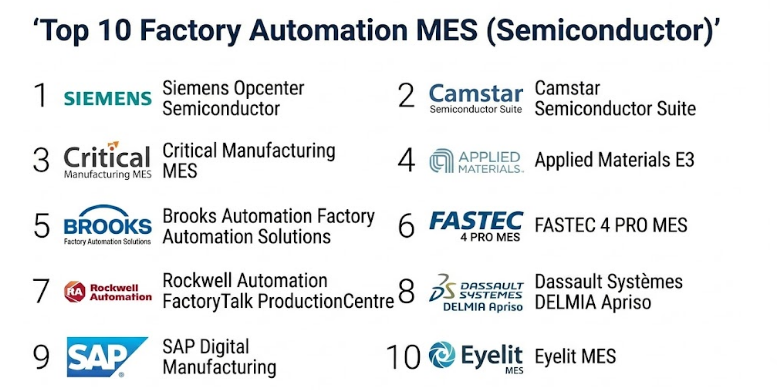
Top 10 Factory Automation MES Semiconductor Tools
#1 — Siemens Opcenter Semiconductor
Short description :
Siemens Opcenter Semiconductor is a manufacturing execution solution designed for semiconductor production environments. It supports lot tracking, wafer movement, production execution, quality control, process route management, and manufacturing visibility. The platform is useful for fabs, foundries, OSAT companies, and advanced manufacturing environments that need strict control over production steps. It helps teams connect factory operations, equipment data, quality workflows, and enterprise manufacturing systems. Siemens Opcenter Semiconductor is a strong choice for organizations that need enterprise-grade MES capabilities with semiconductor-specific manufacturing control.
Key Features
- Semiconductor manufacturing execution management
- Lot, wafer, and production tracking
- Process route and workflow control
- Equipment and shop-floor visibility
- Quality and nonconformance workflows
- Traceability and genealogy management
- Enterprise manufacturing integration
Pros
- Strong fit for semiconductor factory operations
- Useful for high-volume and complex manufacturing environments
- Supports broader manufacturing operations beyond simple tracking
Cons
- Implementation can be complex for large fabs
- May require integration planning with existing factory systems
- Smaller facilities may find it heavy if they need only basic tracking
Platforms / Deployment
Enterprise software environment.
Cloud / Self-hosted / Hybrid: Varies / N/A.
Security & Compliance
Enterprise access controls may be available depending on deployment.
SSO/SAML, MFA, encryption, audit logs, RBAC: Not publicly stated in detail.
SOC 2, ISO 27001, GDPR, HIPAA: Not publicly stated.
Integrations & Ecosystem
Siemens Opcenter Semiconductor fits into broader manufacturing and enterprise environments where MES must connect with factory automation, ERP, PLM, quality, and analytics systems.
- ERP and enterprise manufacturing systems
- Equipment automation and shop-floor systems
- Quality and traceability workflows
- Reporting and manufacturing analytics
- PLM and engineering data environments
Support & Community
Support is generally enterprise-focused, with implementation services, documentation, training, and technical support. Support scope may vary by region, deployment size, and contract.
#2 — Camstar Semiconductor Suite
Short description :
Camstar Semiconductor Suite, now associated with Siemens manufacturing software, is a well-known MES platform for semiconductor and high-tech manufacturing. It is used to manage production execution, lot movement, process control, quality records, and traceability. The platform is suitable for semiconductor fabs, electronics manufacturers, medical device manufacturers, and high-tech production environments where compliance and process control are important. For semiconductor teams, it provides structured control over manufacturing routes, work-in-process, and production events. It is a strong choice for organizations that need mature MES workflows and manufacturing traceability.
Key Features
- Manufacturing execution management
- Work-in-process tracking
- Process route control
- Quality and compliance workflows
- Electronic device history and production records
- Traceability and genealogy
- Reporting and production visibility
Pros
- Mature MES functionality
- Strong fit for high-tech and regulated manufacturing
- Useful for traceability-heavy operations
Cons
- May require expert implementation support
- Configuration can be complex for specialized semiconductor flows
- Public details may vary because product packaging has evolved
Platforms / Deployment
Enterprise software environment.
Cloud / Self-hosted / Hybrid: Varies / N/A.
Security & Compliance
Enterprise security controls may be available depending on deployment.
SSO/SAML, MFA, encryption, audit logs, RBAC: Not publicly stated in detail.
SOC 2, ISO 27001, GDPR, HIPAA: Not publicly stated.
Integrations & Ecosystem
Camstar-related MES environments are commonly used where manufacturing execution must connect with quality, enterprise systems, production equipment, and reporting tools.
- ERP and manufacturing systems
- Quality management workflows
- Production records and traceability
- Shop-floor data collection
- Reporting and analytics platforms
Support & Community
Support is typically enterprise-oriented. Documentation, implementation partners, and vendor support may vary based on deployment model and current product package.
#3 — Critical Manufacturing MES
Short description :
Critical Manufacturing MES is a modern manufacturing execution platform used in complex manufacturing environments including semiconductor, electronics, medical device, and high-tech production. It supports production control, equipment integration, automation, scheduling, materials tracking, quality workflows, and factory visibility. The platform is suitable for semiconductor manufacturers that want a flexible MES capable of supporting advanced factory automation and Industry 4.0-style operations. It is especially useful where teams need configurable workflows, real-time visibility, and strong integration with production systems. Critical Manufacturing MES is a strong option for manufacturers looking for a modern MES architecture.
Key Features
- Production execution management
- Equipment integration and automation support
- Lot and material tracking
- Scheduling and dispatching workflows
- Quality and nonconformance management
- Real-time dashboards and reporting
- Configurable workflows for complex manufacturing
Pros
- Modern MES architecture
- Strong fit for high-tech and semiconductor manufacturing
- Good support for automation and real-time visibility
Cons
- Implementation may require careful process mapping
- Advanced configuration may need trained internal or partner resources
- Smaller teams may need a phased rollout
Platforms / Deployment
Web-based / enterprise software environment.
Cloud / Self-hosted / Hybrid: Varies / N/A.
Security & Compliance
Enterprise access controls may be available depending on deployment.
SSO/SAML, MFA, encryption, audit logs, RBAC: Not publicly stated in detail.
SOC 2, ISO 27001, GDPR, HIPAA: Not publicly stated.
Integrations & Ecosystem
Critical Manufacturing MES is designed to connect with factory systems, automation layers, enterprise platforms, and analytics tools.
- ERP and PLM systems
- Equipment automation systems
- Scheduling and dispatching tools
- Quality systems and analytics
- Industrial IoT and factory data platforms
Support & Community
Support is vendor-led and enterprise-focused, with implementation support, documentation, training, and partner services. Community strength is mainly within manufacturing and high-tech customer environments.
#4 — Applied Materials E3
Short description :
Applied Materials E3 is a factory automation, equipment engineering, and process control platform used in semiconductor manufacturing environments. It supports equipment monitoring, automation, process stability, production intelligence, and factory performance improvement. While it is not only a traditional MES, it is highly relevant to semiconductor factory automation because equipment behavior directly affects yield, throughput, and quality. The platform is useful for fabs that need to connect equipment data, automation rules, process control, and manufacturing improvement workflows. It is best suited for environments where equipment intelligence is a major part of factory automation strategy.
Key Features
- Equipment automation support
- Equipment engineering data management
- Process control workflows
- Factory performance monitoring
- Equipment status and behavior analytics
- Manufacturing intelligence support
- Process stability improvement
Pros
- Strong relevance for equipment-heavy fabs
- Helps connect equipment behavior with production outcomes
- Useful for process control and automation strategies
Cons
- Not a complete MES replacement in every environment
- Best value depends on factory architecture and equipment landscape
- Implementation may require deep engineering involvement
Platforms / Deployment
Enterprise software environment.
Cloud / Self-hosted / Hybrid: Varies / N/A.
Security & Compliance
SSO/SAML, MFA, encryption, audit logs, RBAC: Not publicly stated in detail.
SOC 2, ISO 27001, GDPR, HIPAA: Not publicly stated.
Integrations & Ecosystem
Applied Materials E3 fits into factory automation ecosystems where equipment, process, and manufacturing data must be connected.
- Equipment data systems
- Factory automation layers
- Process control systems
- Manufacturing analytics
- Engineering dashboards
Support & Community
Support is typically enterprise and fab-focused. Implementation and support needs depend on equipment integration, production environment, and engineering requirements.
#5 — Brooks Automation Factory Automation Solutions
Short description :
Brooks Automation provides factory automation technologies and solutions relevant to semiconductor manufacturing, especially around material handling, automation control, and production equipment workflows. In semiconductor fabs, automation is not only software; it also includes movement of wafers, carriers, tools, and production materials. Brooks-related solutions are useful where equipment automation, material handling, and factory control must work together. These capabilities support MES environments by helping improve movement, visibility, and operational consistency. Brooks Automation is best viewed as part of the broader semiconductor factory automation ecosystem rather than a standalone MES-only platform.
Key Features
- Semiconductor factory automation support
- Material handling automation
- Equipment and carrier movement workflows
- Production automation systems
- Tool and factory interface support
- Operational visibility improvement
- Support for high-volume manufacturing environments
Pros
- Strong relevance in semiconductor automation environments
- Useful for fabs with complex material movement needs
- Supports automation-heavy production strategies
Cons
- Not a full MES platform by itself
- Best used with MES and factory control systems
- Scope depends on selected automation solution
Platforms / Deployment
Enterprise factory automation environment.
Cloud / Self-hosted / Hybrid: Varies / N/A.
Security & Compliance
SSO/SAML, MFA, encryption, audit logs, RBAC: Not publicly stated.
SOC 2, ISO 27001, GDPR, HIPAA: Not publicly stated.
Integrations & Ecosystem
Brooks Automation solutions typically fit into physical and digital factory automation environments.
- Semiconductor equipment systems
- Material handling systems
- MES and factory control environments
- Carrier and wafer movement workflows
- Automation control layers
Support & Community
Support is generally vendor-led and project-specific. Documentation, integration assistance, and technical support may vary depending on the selected automation solution.
#6 — FASTEC 4 PRO MES
Short description :
FASTEC 4 PRO is a manufacturing execution software platform used for production monitoring, machine data collection, manufacturing performance analysis, and operational improvement. While it is not only built for semiconductor manufacturing, it can support production environments that need machine connectivity, downtime tracking, performance visibility, and shop-floor transparency. It is more suitable for semiconductor-related manufacturing areas where general MES and production monitoring are needed rather than deep wafer fab control. FASTEC can be useful for specialty manufacturers, equipment-related production, packaging, or supporting operations. It is a practical option when the main need is production transparency and performance improvement.
Key Features
- Machine data collection
- Production monitoring
- Downtime and performance analysis
- OEE reporting
- Manufacturing dashboards
- Shop-floor transparency
- Production planning support
Pros
- Good for production performance visibility
- Useful for machine and shop-floor monitoring
- Practical for manufacturing teams improving OEE
Cons
- Not a semiconductor-specific wafer fab MES
- May need customization for semiconductor workflows
- Advanced wafer tracking and recipe control may be limited
Platforms / Deployment
Web / Windows / Enterprise environment: Varies / N/A.
Cloud / Self-hosted / Hybrid: Varies / N/A.
Security & Compliance
SSO/SAML, MFA, encryption, audit logs, RBAC: Not publicly stated in detail.
SOC 2, ISO 27001, GDPR, HIPAA: Not publicly stated.
Integrations & Ecosystem
FASTEC fits into manufacturing environments where production machines, operators, and performance metrics need to be connected.
- Machine data collection systems
- ERP and production planning workflows
- Reporting and dashboard tools
- Shop-floor terminals
- OEE and performance monitoring processes
Support & Community
Support is vendor-led, with documentation, onboarding, and implementation assistance depending on customer size and deployment scope.
#7 — Rockwell Automation FactoryTalk ProductionCentre
Short description :
FactoryTalk ProductionCentre is an MES platform from Rockwell Automation that supports manufacturing execution, quality, production tracking, and operational control. It is used across different industries and can support high-tech manufacturing environments where structured production workflows and plant-floor integration are important. For semiconductor-related facilities, it may be useful in areas requiring manufacturing execution, production visibility, quality workflows, and automation connectivity. It is not exclusively semiconductor-focused, but it can fit environments where Rockwell automation infrastructure already exists. FactoryTalk ProductionCentre is best for companies seeking MES with strong automation ecosystem alignment.
Key Features
- Manufacturing execution management
- Production tracking
- Quality management workflows
- Plant-floor integration
- Operator guidance
- Production reporting
- Automation ecosystem alignment
Pros
- Strong industrial automation ecosystem
- Useful for production tracking and quality workflows
- Good fit where Rockwell systems are already in use
Cons
- Not semiconductor-specific by default
- May require configuration for wafer fab workflows
- Advanced semiconductor automation may need additional systems
Platforms / Deployment
Enterprise software environment.
Cloud / Self-hosted / Hybrid: Varies / N/A.
Security & Compliance
Enterprise security features may be available depending on configuration.
SSO/SAML, MFA, encryption, audit logs, RBAC: Not publicly stated in detail.
SOC 2, ISO 27001, GDPR, HIPAA: Not publicly stated.
Integrations & Ecosystem
FactoryTalk ProductionCentre fits into industrial automation environments where MES must connect with control systems, plant-floor devices, and enterprise applications.
- Industrial automation systems
- ERP and production systems
- Quality workflows
- Plant-floor data collection
- Reporting and analytics tools
Support & Community
Support is enterprise-focused, with documentation, training, partner support, and vendor assistance. Community strength is connected to the broader Rockwell Automation ecosystem.
#8 — Dassault Systèmes DELMIA Apriso
Short description :
DELMIA Apriso is a manufacturing operations management and MES platform used by global manufacturers to manage production, quality, logistics, maintenance, and shop-floor execution. It is not only for semiconductor manufacturing, but it can support high-tech and complex manufacturing environments that need standardized operations across multiple sites. Semiconductor-related manufacturers may use it where production execution, quality traceability, and enterprise manufacturing governance are required. It is useful for organizations that want MES connected with broader manufacturing operations and digital continuity. DELMIA Apriso is a strong option for enterprises seeking multi-site manufacturing standardization.
Key Features
- Manufacturing operations management
- MES and production execution
- Quality management workflows
- Logistics and warehouse execution support
- Global operations standardization
- Traceability and compliance records
- Enterprise manufacturing visibility
Pros
- Strong enterprise manufacturing operations coverage
- Good fit for multi-site standardization
- Useful for connecting production, quality, and logistics
Cons
- Not semiconductor-specific out of the box
- Configuration may be required for fab workflows
- May be too broad for small specialty manufacturers
Platforms / Deployment
Enterprise software environment.
Cloud / Self-hosted / Hybrid: Varies / N/A.
Security & Compliance
Enterprise controls may be available depending on deployment.
SSO/SAML, MFA, encryption, audit logs, RBAC: Not publicly stated in detail.
SOC 2, ISO 27001, GDPR, HIPAA: Not publicly stated.
Integrations & Ecosystem
DELMIA Apriso fits into enterprise manufacturing environments where MES, quality, logistics, and operations need to be connected.
- ERP and enterprise systems
- Quality management workflows
- Warehouse and logistics systems
- Production reporting
- Manufacturing operations analytics
Support & Community
Support is typically enterprise-focused, with vendor documentation, implementation services, training, and partner ecosystem support.
#9 — SAP Digital Manufacturing
Short description :
SAP Digital Manufacturing is a cloud-based manufacturing execution and operations platform that helps manufacturers manage production execution, shop-floor visibility, quality, analytics, and integration with enterprise business systems. It is not semiconductor-specific by default, but it can support semiconductor-related manufacturing environments where SAP ERP integration, production visibility, and standardized operations are important. It is useful for organizations that want manufacturing execution connected closely with planning, procurement, quality, and business processes. For semiconductor companies, it may be more suitable for supporting operations, assembly, packaging, or broader manufacturing visibility than deep wafer fab automation alone. It is best for companies already invested in the SAP ecosystem.
Key Features
- Cloud manufacturing execution
- Production monitoring and analytics
- Shop-floor data collection
- Quality workflows
- Integration with enterprise business systems
- Standardized manufacturing processes
- Manufacturing performance dashboards
Pros
- Strong fit for SAP-centered enterprises
- Useful for connecting manufacturing with business processes
- Cloud-based manufacturing operations support
Cons
- Not semiconductor-specific by default
- Deep fab automation may require specialized systems
- Custom configuration may be needed for complex semiconductor workflows
Platforms / Deployment
Web-based platform.
Cloud deployment.
Hybrid integration options: Varies / N/A.
Security & Compliance
Enterprise security controls may be available.
SSO/SAML, MFA, encryption, audit logs, RBAC: Not publicly stated in detail here.
SOC 2, ISO 27001, GDPR, HIPAA: Not publicly stated in this context.
Integrations & Ecosystem
SAP Digital Manufacturing fits strongly into SAP-led manufacturing and enterprise environments.
- SAP ERP and planning systems
- Quality and production workflows
- Shop-floor systems
- Business reporting and analytics
- Enterprise integration tools
Support & Community
Support is enterprise-focused, with SAP documentation, implementation partners, training resources, and customer support options depending on contract and deployment.
#10 — Eyelit MES
Short description :
Eyelit MES is a manufacturing execution platform used in high-tech manufacturing environments, including semiconductor, electronics, medical device, and complex production settings. It supports production tracking, process control, quality workflows, traceability, and shop-floor execution. Eyelit is suitable for companies that need a focused MES platform with flexibility for specialized manufacturing processes. In semiconductor-related operations, it can help manage work-in-process, production routing, operator actions, and manufacturing records. It is a practical option for organizations seeking MES functionality for complex manufacturing without necessarily adopting the largest enterprise platform.
Key Features
- Manufacturing execution management
- Work-in-process tracking
- Process route control
- Quality and compliance workflows
- Traceability support
- Shop-floor data collection
- Production reporting
Pros
- Strong fit for high-tech manufacturing
- Useful for traceability and production execution
- Flexible for specialized manufacturing workflows
Cons
- Semiconductor-specific depth may vary by implementation
- Integration planning may be needed for factory automation
- Public details on security and certifications are limited
Platforms / Deployment
Enterprise software environment.
Cloud / Self-hosted / Hybrid: Varies / N/A.
Security & Compliance
SSO/SAML, MFA, encryption, audit logs, RBAC: Not publicly stated in detail.
SOC 2, ISO 27001, GDPR, HIPAA: Not publicly stated.
Integrations & Ecosystem
Eyelit MES can fit into complex manufacturing environments where production tracking, quality, and traceability need to connect with other factory systems.
- ERP and production planning systems
- Equipment and shop-floor data collection
- Quality workflows
- Reporting and analytics tools
- Integration availability: Varies / Not publicly stated
Support & Community
Support is generally vendor-led and customer-focused. Documentation, onboarding, and technical support may vary depending on deployment and implementation scope.
Comparison Table
| Tool Name | Best For | Platform(s) Supported | Deployment | Standout Feature | Public Rating |
|---|---|---|---|---|---|
| Siemens Opcenter Semiconductor | Semiconductor fabs and foundries | Enterprise environment | Cloud / Hybrid / Self-hosted: Varies | Semiconductor-specific MES control | N/A |
| Camstar Semiconductor Suite | High-tech and semiconductor production traceability | Enterprise environment | Cloud / Hybrid / Self-hosted: Varies | Mature MES and production records | N/A |
| Critical Manufacturing MES | Modern high-tech factory automation | Web / Enterprise environment | Cloud / Hybrid / Self-hosted: Varies | Configurable modern MES architecture | N/A |
| Applied Materials E3 | Equipment and process automation | Enterprise environment | Cloud / Hybrid / Self-hosted: Varies | Equipment intelligence and process control | N/A |
| Brooks Automation Factory Automation Solutions | Material handling and factory automation | Enterprise factory automation | Varies / N/A | Semiconductor material handling automation | N/A |
| FASTEC 4 PRO MES | Production monitoring and OEE visibility | Web / Windows / Enterprise: Varies | Cloud / Hybrid / Self-hosted: Varies | Machine data and performance tracking | N/A |
| Rockwell FactoryTalk ProductionCentre | Automation-aligned MES environments | Enterprise environment | Cloud / Hybrid / Self-hosted: Varies | Industrial automation ecosystem fit | N/A |
| Dassault Systèmes DELMIA Apriso | Multi-site manufacturing operations | Enterprise environment | Cloud / Hybrid / Self-hosted: Varies | Enterprise MOM and MES standardization | N/A |
| SAP Digital Manufacturing | SAP-centered manufacturing operations | Web | Cloud | ERP-connected manufacturing execution | N/A |
| Eyelit MES | High-tech production execution | Enterprise environment | Cloud / Hybrid / Self-hosted: Varies | Flexible MES for complex manufacturing | N/A |
Evaluation & Factory Automation MES Semiconductor Tools
The scoring below is comparative and based on practical semiconductor manufacturing requirements. It considers core MES features, ease of use, integration ecosystem, security signals, performance, support, and price/value. Scores should not be treated as final purchasing advice because the best fit depends on factory size, automation maturity, wafer flow complexity, existing systems, and implementation resources.
| Tool Name | Core (25%) | Ease (15%) | Integrations (15%) | Security (10%) | Performance (10%) | Support (10%) | Value (15%) | Weighted Total (0–10) |
|---|---|---|---|---|---|---|---|---|
| Siemens Opcenter Semiconductor | 9 | 7 | 9 | 8 | 9 | 8 | 7 | 8.20 |
| Camstar Semiconductor Suite | 8 | 7 | 8 | 8 | 8 | 8 | 7 | 7.75 |
| Critical Manufacturing MES | 9 | 8 | 8 | 8 | 8 | 8 | 8 | 8.25 |
| Applied Materials E3 | 8 | 7 | 8 | 7 | 9 | 8 | 7 | 7.70 |
| Brooks Automation Factory Automation Solutions | 7 | 7 | 8 | 6 | 8 | 8 | 7 | 7.25 |
| FASTEC 4 PRO MES | 7 | 8 | 7 | 6 | 8 | 7 | 8 | 7.35 |
| Rockwell FactoryTalk ProductionCentre | 8 | 7 | 8 | 8 | 8 | 8 | 7 | 7.70 |
| Dassault Systèmes DELMIA Apriso | 8 | 7 | 8 | 8 | 8 | 8 | 7 | 7.70 |
| SAP Digital Manufacturing | 7 | 8 | 9 | 8 | 8 | 8 | 7 | 7.85 |
| Eyelit MES | 8 | 8 | 7 | 7 | 8 | 7 | 8 | 7.65 |
A higher score means stronger overall fit across broad MES and factory automation needs. However, the best tool depends on your production environment. A wafer fab may prioritize semiconductor-specific routing and equipment automation, while an advanced packaging facility may prioritize traceability, genealogy, and quality workflows. A company already using SAP, Siemens, Rockwell, or Dassault systems may benefit from ecosystem alignment.
Which Factory Automation MES Semiconductor Tool Should You Choose?
Solo / Freelancer
Solo consultants or independent manufacturing advisors usually do not need a full MES platform for themselves. They may need to evaluate client workflows, map production processes, or help select MES systems.
Best approach:
- Use process mapping and requirement templates
- Review client MES maturity
- Recommend specialized MES platforms based on factory type
- Avoid overengineering small production environments
If a small client needs only production visibility, a lighter manufacturing monitoring system may be enough.
SMB
Small and mid-sized semiconductor-related manufacturers may not need the largest enterprise MES immediately. They should focus on production tracking, quality records, traceability, machine visibility, and simple integration with ERP or production planning systems.
Good options:
- Eyelit MES for flexible high-tech manufacturing execution
- FASTEC 4 PRO MES for production monitoring and OEE
- Critical Manufacturing MES for growing high-tech manufacturers
- SAP Digital Manufacturing if already using SAP systems
SMBs should avoid choosing a platform only because it looks powerful. Adoption, implementation effort, and practical daily use matter more.
Mid-Market
Mid-market semiconductor manufacturers often need better process control, equipment data collection, routing, quality workflows, and reporting. They may also need to support multiple production lines or facilities.
Good options:
- Critical Manufacturing MES for modern manufacturing execution
- Siemens Opcenter Semiconductor for semiconductor-specific operations
- Eyelit MES for high-tech production workflows
- Rockwell FactoryTalk ProductionCentre if automation alignment matters
- DELMIA Apriso for broader manufacturing operations
Mid-market buyers should check how well the MES supports their exact process routes, rework loops, quality checkpoints, and equipment integration needs.
Enterprise
Large fabs, foundries, OSAT companies, and IDMs need scalable, reliable, and deeply integrated MES platforms. These organizations often require 24/7 operations, high data volume, recipe control, equipment automation, dispatching, genealogy, and global reporting.
Good options:
- Siemens Opcenter Semiconductor for semiconductor-specific MES
- Critical Manufacturing MES for modern high-tech factory automation
- Camstar Semiconductor Suite for mature production traceability
- Applied Materials E3 for equipment and process automation
- DELMIA Apriso for enterprise manufacturing operations
- SAP Digital Manufacturing for SAP-centered global manufacturing
Enterprise buyers should involve manufacturing, automation, IT, security, process engineering, quality, and operations leadership in the selection process.
Budget vs Premium
Budget-focused teams should start with clear priorities. If the main pain point is downtime tracking or production visibility, a lighter MES or production monitoring platform may be enough.
Premium platforms make sense when the factory needs:
- Wafer-level traceability
- Advanced equipment automation
- Recipe and process control
- Multi-site manufacturing governance
- Real-time dispatching
- Enterprise integration
- Complex quality and rework workflows
- High-volume production reliability
Premium MES investment should be tied to measurable improvements in throughput, quality, traceability, and factory control.
Feature Depth vs Ease of Use
Feature-rich MES platforms are powerful, but they can also be complex. A simpler tool may be better if the factory does not need advanced automation or semiconductor-specific routing.
Choose feature depth when:
- Production routes are complex
- Equipment automation is required
- Process control must be strict
- Traceability is critical
- Multiple sites must follow standard workflows
- Quality requirements are high
Choose ease of use when:
- The factory is small
- Operators need simple screens
- The main need is visibility and tracking
- IT resources are limited
- The team wants a phased rollout
The best MES should balance deep functionality with practical usability.
Integrations & Scalability
Factory automation MES systems must connect with many other systems. Poor integration can create manual work, data gaps, and operational risk.
Important integration areas include:
- ERP systems
- PLM systems
- EAP systems
- APC systems
- SPC systems
- LIMS platforms
- Equipment interfaces
- Recipe management systems
- Quality management systems
- Yield management software
- Data lakes and analytics tools
- Barcode, RFID, and material handling systems
Scalability matters because semiconductor production can involve thousands of lots, wafers, recipes, tools, process steps, and events. Buyers should test performance with realistic production data.
Security & Compliance Needs
Semiconductor MES platforms store highly sensitive manufacturing, process, customer, and product data. Security should be evaluated early.
Buyers should review:
- Role-based access control
- SSO and MFA
- Encryption
- Audit logs
- Recipe access control
- Change management history
- Data backup and recovery
- User activity tracking
- Secure equipment communication
- Support for internal security review
Never assume a tool has a specific certification unless the vendor clearly confirms it.
Frequently Asked Questions
1. What is Factory Automation MES for Semiconductor?
Factory Automation MES for Semiconductor is software that manages semiconductor production execution, wafer movement, lot tracking, equipment integration, process routes, quality checks, and factory data. It helps fabs control production from start to finish.
2. How is semiconductor MES different from general MES?
Semiconductor MES must handle wafer-level tracking, complex process routes, recipe control, cleanroom workflows, rework loops, equipment automation, metrology steps, and high-volume process data. General MES tools may not support these needs deeply without customization.
3. Who uses semiconductor MES software?
Semiconductor fabs, foundries, OSAT companies, IDMs, advanced packaging facilities, MEMS manufacturers, compound semiconductor fabs, process engineers, production managers, quality teams, and automation engineers use MES software.
4. What is the biggest mistake when choosing MES software?
The biggest mistake is selecting a platform without mapping real production workflows. Semiconductor manufacturing has complex routes, holds, rework, tool constraints, and quality checks. The MES must match real factory operations.
5. Can MES improve yield?
Yes, MES can support yield improvement by improving traceability, process control, recipe accuracy, quality records, and production visibility. However, deep yield analysis may also require separate yield management, SPC, APC, and analytics tools.
6. Does MES replace ERP?
No. ERP manages business processes such as finance, procurement, planning, and inventory at a business level. MES manages real-time production execution on the factory floor. Both systems often need to integrate.
7. What systems should semiconductor MES integrate with?
Important integrations include ERP, PLM, EAP, APC, SPC, LIMS, QMS, yield management software, equipment systems, material handling systems, data lakes, scheduling tools, and reporting platforms.
8. Is cloud MES suitable for semiconductor fabs?
Cloud MES may be suitable for some manufacturing environments, but core semiconductor production often requires careful evaluation of latency, reliability, data security, integration, and factory continuity. Many companies evaluate hybrid models.
9. How long does MES implementation take?
Implementation depends on factory complexity, number of tools, process routes, integrations, data migration, validation needs, and user training. A small facility may implement faster, while a large fab may need a phased rollout.
10. What is equipment automation in semiconductor MES?
Equipment automation means connecting MES or factory systems with production tools so they can exchange information such as lot status, recipe selection, equipment state, process data, alarms, and completion results.
Conclusion
Factory Automation MES for Semiconductor is essential for organizations that need strong control over wafer movement, lot tracking, equipment integration, process execution, recipe control, quality workflows, and factory visibility. The right MES can help reduce manual errors, improve traceability, support better production decisions, and create a stronger foundation for yield improvement. However, the best platform depends on factory type, production scale, automation maturity, integration needs, and internal implementation capability. A large wafer fab may need deep semiconductor-specific MES and equipment automation, while a smaller high-tech manufacturer may need flexible production tracking and quality workflows.
