Introduction
Lab Safety Management Tools are software platforms that help laboratories manage safety, chemical inventory, SDS records, training, inspections, incidents, audits, equipment safety, and compliance documentation in one organized system. In simple words, these tools help labs move away from scattered spreadsheets, paper checklists, manual logs, and disconnected safety records.
Laboratories deal with chemicals, biological samples, instruments, hazardous materials, controlled substances, waste handling, training requirements, and inspection needs. Without a proper system, it becomes difficult to know who is trained, which chemicals are stored, where safety documents are kept, whether corrective actions are closed, and whether the lab is ready for an audit.
Lab safety software is useful for many real-world needs such as chemical inventory tracking, SDS management, safety inspection planning, incident reporting, corrective action tracking, training compliance, equipment safety checks, audit preparation, and multi-site lab governance.
Buyers should evaluate:
- Chemical inventory and SDS management
- Inspection and audit workflows
- Training and competency tracking
- Incident reporting and corrective actions
- Ease of use for lab staff
- Mobile access for inspections
- Reporting dashboards and analytics
- Integration with LIMS, ELN, HR, ERP, and identity systems
- Role-based access and audit logs
- Scalability for multiple labs or locations
Best for: Lab managers, EHS teams, research institutions, universities, pharma companies, biotech firms, healthcare labs, testing labs, chemical manufacturers, and industrial research teams.
Not ideal for: Very small labs with simple workflows, low-risk materials, and limited compliance needs. Such teams may use spreadsheets, shared folders, or lightweight inventory tools until their safety requirements become more complex.
Key Lab Safety Management Tools Trends
- Chemical inventory is becoming more digital and traceable. Labs want container-level tracking, barcode scanning, expiration alerts, storage location visibility, and better control over hazardous materials.
- SDS access is becoming faster and more searchable. Instead of storing safety data sheets in folders, teams now expect searchable SDS libraries with quick access to hazard, PPE, and emergency information.
- Mobile inspections are becoming common. Safety teams need to perform inspections directly in the lab using phones or tablets, capture notes, assign actions, and track closure.
- Training automation is now a major need. Labs want systems that automatically assign training based on role, lab location, chemical exposure, equipment access, or research activity.
- Corrective action tracking is becoming more important. It is no longer enough to report an issue; labs need ownership, deadlines, status tracking, reminders, and audit history.
- AI-assisted safety support is slowly growing. AI can help summarize incident reports, flag missing records, improve search, suggest safety documentation, and support risk reviews.
- Integration with lab systems is becoming essential. Lab safety tools are expected to connect with ELN, LIMS, HR systems, procurement tools, SSO providers, and business reporting platforms.
- Cloud platforms are widely preferred. Most teams prefer cloud-based safety tools because they reduce IT maintenance, improve access, and support multi-location visibility.
- Enterprise governance is increasing. Large organizations want standard safety policies, centralized reporting, location-level controls, and consistent audit preparation across many labs.
- Buyers are looking for practical usability. A powerful system is not useful if scientists and technicians avoid using it. Ease of use is now just as important as feature depth.
How We Selected These Tools
The tools below were selected using a practical evaluation approach focused on real laboratory safety needs.
- Market recognition in lab safety, EHS, chemical inventory, research operations, or laboratory management
- Feature depth across SDS, chemical inventory, inspections, training, incidents, and compliance
- Suitability for laboratories rather than only general workplace safety
- Fit for academic, pharma, biotech, healthcare, industrial, and testing environments
- Support for multi-user, multi-lab, or multi-site operations
- Ability to improve documentation, audit readiness, and safety visibility
- Integration potential with other lab and business systems
- Practical usability for lab managers, EHS professionals, and technical teams
- Security and access control signals where clearly available
- Overall value for different buyer segments, from small labs to large enterprises
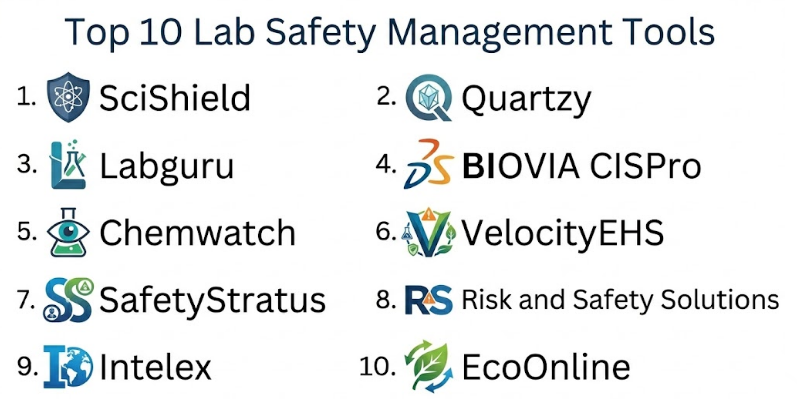
Top 10 Lab Safety Management Tools
#1 — SciShield
Short description :
SciShield is a lab safety and research compliance management platform designed mainly for universities, research institutions, biotech organizations, and multi-lab environments. It helps teams manage lab profiles, hazards, inspections, training, personnel records, equipment, and compliance workflows in one structured system. The platform is useful for organizations where many labs operate under different principal investigators, departments, or research groups. SciShield helps safety teams understand what hazards exist in each lab, who works there, what training is required, and what safety actions are pending. It is a strong choice for institutions that need a lab-specific safety system instead of a general-purpose EHS tool.
Key Features
- Lab profile and hazard registration
- Safety inspection management
- Corrective action tracking
- Training assignment and completion records
- Personnel and research group visibility
- Equipment and asset safety records
- Compliance reporting and documentation
Pros
- Strong fit for academic and research lab environments
- Helps centralize safety information across many labs
- Useful for managing people, hazards, equipment, and training together
Cons
- May be more complex than needed for very small labs
- Configuration and adoption may require planning
- Pricing details are usually not simple for public comparison
Platforms / Deployment
Web-based platform.
Cloud deployment is commonly expected.
Mobile support: Varies / N/A.
Security & Compliance
SSO/SAML, MFA, encryption, audit logs, RBAC: Not publicly stated in detail.
SOC 2, ISO 27001, GDPR, HIPAA: Not publicly stated.
Integrations & Ecosystem
SciShield is usually used as part of a larger institutional safety and research operations environment. It may connect with internal user records, training systems, safety workflows, and reporting processes depending on the organization.
- Identity and user management workflows
- Training and personnel data connections
- Lab profile and hazard records
- Reporting and export support
- API availability: Not publicly stated
Support & Community
Support is generally focused on institutional customers, research organizations, and safety teams. Documentation, onboarding, and implementation support may vary based on contract and deployment scope.
#2 — Quartzy
Short description :
Quartzy is a lab management and procurement platform that helps research teams organize inventory, supplies, ordering, and lab purchasing workflows. While it is not a full EHS platform, it supports lab safety by improving visibility into chemicals, reagents, consumables, and other materials used in the lab. Many safety issues happen because teams do not know what is stored, where it is stored, who ordered it, or whether materials are expired. Quartzy is useful for small and mid-sized labs that need better inventory discipline without a heavy enterprise system. It is especially suitable for academic labs, biotech startups, and research groups that want a simple operational tool.
Key Features
- Lab inventory management
- Supply and reagent tracking
- Purchase request workflows
- Team-based inventory visibility
- Vendor and ordering support
- Searchable item records
- Basic organization for materials and consumables
Pros
- Easy for lab teams to adopt
- Helps reduce duplicate ordering and inventory confusion
- Good fit for small and mid-sized research labs
Cons
- Not a complete EHS or safety compliance platform
- Advanced inspection and incident workflows may be limited
- May not meet complex enterprise safety governance needs
Platforms / Deployment
Web-based platform.
Cloud deployment.
Mobile support: Varies / N/A.
Security & Compliance
SSO/SAML, MFA, encryption, audit logs, RBAC: Not publicly stated in detail.
SOC 2, ISO 27001, GDPR, HIPAA: Not publicly stated.
Integrations & Ecosystem
Quartzy fits well with lab procurement and inventory workflows. It can support better coordination between researchers, lab managers, and purchasing teams.
- Procurement workflow support
- Vendor and supply ecosystem
- Inventory export and reporting
- Team-based lab organization
- API availability: Not publicly stated
Support & Community
Quartzy provides support for lab users, buyers, and operational teams. Its community is strongest among academic research labs, biotech startups, and small-to-mid-sized lab teams.
#3 — Labguru
Short description :
Labguru is a laboratory management platform that combines electronic lab notebook, inventory, equipment, sample, and workflow management features. Its safety value comes from helping labs maintain better traceability, organize materials, manage equipment, and document processes more clearly. Labguru is suitable for biotech, pharma, academic research, and life science teams that want a connected lab operating environment. It is not only a safety system, but it can support safer operations by improving control over samples, protocols, materials, and lab activities. It works well for labs that want operational visibility along with research documentation.
Key Features
- Electronic lab notebook functionality
- Inventory and sample management
- Equipment tracking
- Protocol and workflow management
- Team collaboration features
- Research documentation
- Reporting and data organization
Pros
- Combines research and lab operations in one system
- Useful for traceability and documentation
- Good fit for life science and biotech environments
Cons
- Not a dedicated EHS platform
- Safety-specific inspection and incident workflows may need separate tools
- May require training for teams moving from paper or spreadsheets
Platforms / Deployment
Web-based platform.
Cloud deployment.
Mobile support: Varies / N/A.
Security & Compliance
Role-based access and controlled user permissions are commonly expected in platforms of this type.
SSO/SAML, MFA, audit logs, SOC 2, ISO 27001, GDPR, HIPAA: Not publicly stated in detail.
Integrations & Ecosystem
Labguru can fit into a broader digital lab ecosystem where ELN, inventory, sample management, and research records need to work together.
- ELN and research workflows
- Inventory and sample tracking
- Equipment and protocol management
- Data export and reporting
- Integration availability: Varies / Not publicly stated
Support & Community
Support typically includes onboarding and documentation for lab teams. Community strength is more product-user focused than open community driven. Support tiers vary by plan and customer type.
#4 — BIOVIA CISPro
Short description :
BIOVIA CISPro is a chemical inventory management solution used by organizations that need strong control over chemicals, containers, storage locations, and safety-related chemical data. It is suitable for pharma, research, chemical, industrial, and enterprise lab environments where chemical tracking is a serious operational and compliance requirement. The platform helps teams manage chemical inventory visibility, reduce unnecessary purchases, improve storage control, and support safety reviews. It is especially useful when a lab has many chemicals across multiple rooms, buildings, or sites. BIOVIA CISPro is a strong option for organizations that need chemical management depth rather than only general lab checklists.
Key Features
- Chemical inventory management
- Container-level tracking
- Location and storage visibility
- Barcode-based inventory workflows
- Chemical usage and stock monitoring
- Reporting and audit support
- Enterprise chemical data management
Pros
- Strong chemical inventory focus
- Suitable for large and complex lab environments
- Helps improve inventory accuracy and chemical control
Cons
- May be too specialized for labs needing broad safety management
- Implementation can require process planning
- Cost may be higher for smaller teams
Platforms / Deployment
Web-based / enterprise deployment options may vary.
Cloud / Hybrid / Self-hosted: Varies / N/A.
Security & Compliance
Enterprise access controls may be available depending on deployment.
SSO/SAML, MFA, encryption, audit logs, RBAC: Not publicly stated in detail.
SOC 2, ISO 27001, GDPR, HIPAA: Not publicly stated.
Integrations & Ecosystem
BIOVIA CISPro can be part of a larger scientific and enterprise technology ecosystem. It is often relevant where chemical inventory data must connect with procurement, compliance, reporting, and laboratory systems.
- Chemical inventory records
- Barcode and labeling workflows
- Enterprise reporting support
- Possible integration with scientific systems
- API availability: Varies / Not publicly stated
Support & Community
Support is generally enterprise-oriented. Documentation, onboarding, and implementation services may depend on contract size, deployment complexity, and customer requirements.
#5 — Chemwatch
Short description :
Chemwatch is a chemical safety and SDS management platform focused on helping organizations manage chemical hazards, safety data sheets, risk assessments, labels, and regulatory information. It is useful for laboratories, universities, industrial sites, healthcare environments, and chemical-heavy workplaces that need reliable access to chemical safety information. Chemwatch helps teams understand hazards, manage SDS libraries, support labeling, and improve chemical risk visibility. It is especially useful for organizations where chemical safety documentation is a major part of compliance. Chemwatch is a strong choice when SDS management and chemical risk information are central needs.
Key Features
- SDS management
- Chemical hazard information
- Chemical risk assessment support
- Labeling support
- Chemical inventory-related workflows
- Regulatory information support
- Reporting and safety documentation
Pros
- Strong focus on chemical safety information
- Useful for SDS-heavy environments
- Suitable for organizations with broad chemical handling needs
Cons
- May not cover all lab operational workflows
- User experience may vary by module and setup
- May need integration with other lab management systems
Platforms / Deployment
Web-based platform.
Cloud deployment is commonly expected.
Mobile support: Varies / N/A.
Security & Compliance
SSO/SAML, MFA, encryption, audit logs, RBAC: Not publicly stated in detail.
SOC 2, ISO 27001, GDPR, HIPAA: Not publicly stated.
Integrations & Ecosystem
Chemwatch is typically used as a chemical safety information and SDS management layer. It can support safety programs where chemical data needs to be accessible across teams and locations.
- SDS library management
- Chemical labeling workflows
- Chemical risk documentation
- Reporting and compliance exports
- Integration availability: Varies / Not publicly stated
Support & Community
Support is usually provided through vendor documentation, training, and customer service channels. Community visibility is more vendor-led than open public community based.
#6 — VelocityEHS
Short description :
VelocityEHS is an EHS and ESG software platform that includes capabilities relevant to lab safety, especially chemical management, SDS management, incident reporting, audits, inspections, training, and compliance workflows. It is suitable for organizations that need more than lab-specific safety and want a broader enterprise safety platform. Labs inside manufacturing, healthcare, pharma, education, and industrial companies may use VelocityEHS as part of a larger safety program. The platform is useful when safety teams want consistency across labs, offices, plants, and field locations. It is best for organizations looking for broader EHS governance rather than only lab inventory tracking.
Key Features
- SDS and chemical management
- Incident reporting
- Audits and inspections
- Corrective action tracking
- Training management
- Risk and compliance workflows
- Enterprise reporting dashboards
Pros
- Broad EHS feature coverage
- Useful for organizations with labs plus other safety needs
- Supports enterprise safety governance
Cons
- May feel broad for teams needing only lab-specific workflows
- Implementation may require coordination across departments
- Pricing may not fit small labs
Platforms / Deployment
Web-based platform.
Cloud deployment.
Mobile support: Varies / N/A.
Security & Compliance
Enterprise security controls may be available.
SSO/SAML, MFA, encryption, audit logs, RBAC: Not publicly stated in detail.
SOC 2, ISO 27001, GDPR, HIPAA: Not publicly stated.
Integrations & Ecosystem
VelocityEHS fits into broader EHS, HR, training, compliance, and enterprise reporting environments. It may be used by safety leaders who need standardization across many locations.
- HR and training workflow alignment
- Safety reporting and dashboards
- SDS and chemical information workflows
- Audit and incident management
- Integration availability: Varies / Not publicly stated
Support & Community
Support generally includes vendor-led onboarding, documentation, and customer service. Enterprise support tiers may vary based on product package and contract.
#7 — SafetyStratus
Short description :
SafetyStratus is a safety and compliance management platform that offers modules for inspections, audits, incidents, training, chemical inventory, equipment, and broader safety workflows. It is useful for organizations that want a configurable safety platform with lab-relevant capabilities. Universities, research facilities, healthcare organizations, and enterprise safety teams may use it to manage safety operations across departments and locations. SafetyStratus helps teams digitize inspections, assign corrective actions, track hazards, and maintain documentation. It is a good option for teams that need both lab safety and general EHS workflow support.
Key Features
- Inspection and audit management
- Incident reporting
- Chemical inventory support
- Training tracking
- Equipment and asset safety workflows
- Corrective action management
- Reporting and analytics
Pros
- Flexible safety workflow coverage
- Useful for both lab and general safety programs
- Supports structured inspections and follow-up actions
Cons
- May require configuration to match lab-specific processes
- Some advanced needs may depend on selected modules
- Smaller labs may find it more system than they need
Platforms / Deployment
Web-based platform.
Cloud deployment.
Mobile support: Varies / N/A.
Security & Compliance
SSO/SAML, MFA, encryption, audit logs, RBAC: Not publicly stated in detail.
SOC 2, ISO 27001, GDPR, HIPAA: Not publicly stated.
Integrations & Ecosystem
SafetyStratus can support safety teams that need a connected platform for inspections, incidents, training, and compliance records. Integration needs may vary by organization.
- Inspection and audit workflows
- Training and personnel tracking
- Incident and corrective action records
- Chemical inventory workflows
- API availability: Not publicly stated
Support & Community
Support is generally vendor-led with onboarding and documentation. Community strength is more customer-focused than open public community based.
#8 — Risk and Safety Solutions
Short description :
Risk and Safety Solutions provides software for safety, risk, inspection, and compliance workflows, with strong relevance for university and research environments. It supports safety teams that need to manage inspections, incidents, hazards, training, and risk documentation across different departments and facilities. The platform is useful for institutions where laboratory safety is part of a wider risk management program. It can help teams standardize processes, improve visibility, and manage corrective actions more consistently. Risk and Safety Solutions is well suited for organizations that need structured safety governance across academic or research operations.
Key Features
- Inspection management
- Incident and hazard reporting
- Corrective action tracking
- Risk and safety workflow support
- Training-related workflows
- Reporting and dashboard capabilities
- Multi-department safety visibility
Pros
- Strong fit for institutional and research safety programs
- Helps standardize inspections and corrective actions
- Useful for multi-department risk visibility
Cons
- May not be the best fit for very small private labs
- Some lab-specific features may depend on configuration
- Public details on integrations and security may be limited
Platforms / Deployment
Web-based platform.
Cloud / Hybrid / Self-hosted: Varies / N/A.
Security & Compliance
SSO/SAML, MFA, encryption, audit logs, RBAC: Not publicly stated in detail.
SOC 2, ISO 27001, GDPR, HIPAA: Not publicly stated.
Integrations & Ecosystem
Risk and Safety Solutions can work well where safety data needs to connect with institutional processes, reporting, training, and risk programs.
- Inspection workflows
- Incident and hazard reporting
- Corrective action tracking
- Risk management documentation
- Integration availability: Varies / Not publicly stated
Support & Community
Support and documentation are typically focused on institutional users and safety teams. Community visibility is more limited compared with broader enterprise software platforms.
#9 — Intelex
Short description :
Intelex is a broad EHS and quality management platform used by organizations that need structured safety, environmental, quality, compliance, and risk workflows. It is not only a lab safety system, but it can support lab safety programs through incident reporting, audits, inspections, document control, training, and corrective actions. Intelex is best for larger organizations where labs are part of a wider operational risk and compliance structure. It helps teams standardize safety processes across multiple sites, departments, and business units. For labs inside large enterprises, Intelex can provide governance and reporting depth.
Key Features
- EHS management workflows
- Incident and near-miss reporting
- Audit and inspection management
- Corrective and preventive action tracking
- Training and compliance records
- Document control support
- Enterprise reporting and analytics
Pros
- Strong enterprise EHS and compliance coverage
- Useful for multi-site organizations
- Good fit when lab safety is part of a larger risk program
Cons
- Not lab-specific by default
- May need configuration for laboratory workflows
- Can be too heavy for smaller teams
Platforms / Deployment
Web-based platform.
Cloud deployment is commonly expected.
Hybrid options: Varies / N/A.
Security & Compliance
Enterprise access controls may be available.
SSO/SAML, MFA, encryption, audit logs, RBAC: Not publicly stated in detail.
SOC 2, ISO 27001, GDPR, HIPAA: Not publicly stated.
Integrations & Ecosystem
Intelex is designed for enterprise EHS and quality ecosystems. It can support integrations with business systems, reporting tools, HR processes, and operational workflows depending on customer needs.
- HR and training process alignment
- Audit and compliance reporting
- Incident and CAPA workflows
- Enterprise analytics
- API availability: Varies / Not publicly stated
Support & Community
Support is generally enterprise-focused, with onboarding, implementation services, documentation, and account support depending on the customer package.
#10 — EcoOnline
Short description :
EcoOnline is an EHS, chemical safety, and workplace safety platform that can support lab environments needing SDS management, chemical risk assessment, incident reporting, audits, inspections, and compliance workflows. It is useful for organizations that handle chemicals across labs, production sites, warehouses, and field environments. The platform helps teams centralize chemical safety information and broader safety processes. For laboratories, EcoOnline can be valuable when chemical control and safety documentation are key requirements. It is best for teams wanting a broader safety platform with chemical safety capabilities.
Key Features
- Chemical safety management
- SDS management
- Risk assessment workflows
- Incident reporting
- Audits and inspections
- Compliance documentation
- Safety reporting and dashboards
Pros
- Strong chemical safety orientation
- Useful for organizations with labs and other operational sites
- Supports broader EHS workflows beyond the lab
Cons
- May not offer deep lab-specific research workflows
- Configuration may be required for specialized lab processes
- Some details may vary by region and product package
Platforms / Deployment
Web-based platform.
Cloud deployment.
Mobile support: Varies / N/A.
Security & Compliance
SSO/SAML, MFA, encryption, audit logs, RBAC: Not publicly stated in detail.
SOC 2, ISO 27001, GDPR, HIPAA: Not publicly stated.
Integrations & Ecosystem
EcoOnline can support chemical safety, workplace safety, and compliance workflows across different departments. It is useful when chemical safety data needs to be shared across labs, safety teams, and management.
- SDS and chemical safety workflows
- Incident and inspection records
- Risk assessment documentation
- Reporting and dashboards
- Integration availability: Varies / Not publicly stated
Support & Community
Support is typically vendor-led with documentation, onboarding, and customer service. Support details may vary by region, product package, and organization size.
Comparison Table
| Tool Name | Best For | Platform(s) Supported | Deployment | Standout Feature | Public Rating |
|---|---|---|---|---|---|
| SciShield | Academic and research lab safety | Web | Cloud | Lab profiles and hazard-based safety workflows | N/A |
| Quartzy | Small and mid-sized lab inventory and procurement | Web | Cloud | Simple lab inventory and purchasing workflows | N/A |
| Labguru | Research teams needing ELN plus lab operations | Web | Cloud | Connected ELN, inventory, and equipment management | N/A |
| BIOVIA CISPro | Enterprise chemical inventory management | Web / Varies | Cloud / Hybrid / Self-hosted: Varies | Container-level chemical inventory control | N/A |
| Chemwatch | SDS and chemical safety management | Web | Cloud | Chemical safety and SDS information management | N/A |
| VelocityEHS | Enterprise EHS with lab safety needs | Web | Cloud | Broad EHS, SDS, training, and incident workflows | N/A |
| SafetyStratus | Configurable safety and inspection workflows | Web | Cloud | Modular safety, inspection, and corrective action management | N/A |
| Risk and Safety Solutions | Institutional safety and risk programs | Web | Varies / N/A | Research and institutional safety workflow support | N/A |
| Intelex | Large enterprise EHS governance | Web | Cloud / Varies | Enterprise EHS and compliance management | N/A |
| EcoOnline | Chemical safety and broader workplace safety | Web | Cloud | Chemical risk and SDS-centered safety workflows | N/A |
Evaluation & Lab Safety Management Tools
The scoring below is comparative and based on practical buyer needs such as feature depth, usability, integration potential, safety workflow maturity, and suitability for lab environments. Scores should not be treated as absolute product rankings. The best tool depends on lab size, compliance needs, budget, existing systems, and implementation capacity.
| Tool Name | Core (25%) | Ease (15%) | Integrations (15%) | Security (10%) | Performance (10%) | Support (10%) | Value (15%) | Weighted Total (0–10) |
|---|---|---|---|---|---|---|---|---|
| SciShield | 9 | 8 | 7 | 7 | 8 | 8 | 8 | 8.05 |
| Quartzy | 7 | 9 | 6 | 6 | 8 | 8 | 9 | 7.65 |
| Labguru | 8 | 8 | 7 | 7 | 8 | 8 | 8 | 7.75 |
| BIOVIA CISPro | 9 | 7 | 8 | 7 | 8 | 8 | 7 | 7.90 |
| Chemwatch | 8 | 7 | 7 | 7 | 8 | 8 | 8 | 7.60 |
| VelocityEHS | 9 | 7 | 8 | 8 | 8 | 8 | 7 | 8.00 |
| SafetyStratus | 8 | 8 | 7 | 7 | 8 | 8 | 8 | 7.75 |
| Risk and Safety Solutions | 8 | 7 | 7 | 7 | 8 | 7 | 8 | 7.50 |
| Intelex | 9 | 7 | 8 | 8 | 8 | 8 | 7 | 8.00 |
| EcoOnline | 8 | 7 | 7 | 7 | 8 | 8 | 8 | 7.60 |
These scores are meant to help buyers compare tools quickly. A higher score does not automatically mean the tool is best for every lab. For example, a small research lab may get more value from Quartzy than from a large enterprise EHS platform. A pharma enterprise may need deeper governance from Intelex, VelocityEHS, or BIOVIA CISPro. Always validate the tool using your own workflows, users, compliance requirements, and integration needs.
Which Lab Safety Management Tools Should You Choose?
Solo / Freelancer
Solo researchers, independent consultants, and very small labs should keep the system simple. A heavy EHS platform may create more work than value if there are only a few users and limited safety complexity.
Good options:
- Quartzy for inventory and purchasing visibility
- Labguru if research documentation and inventory need to work together
- Chemwatch if SDS and chemical safety information are the main need
The main goal should be clarity, not complexity. Start with the tool that solves your most painful issue, such as tracking chemicals, organizing SDS documents, or maintaining basic safety records.
SMB
Small and mid-sized labs need better structure than spreadsheets, but they may not need a full enterprise EHS suite. They should look for tools that are easy to roll out, affordable, and useful for daily users.
Good options:
- Quartzy for inventory-first teams
- Labguru for research operations and documentation
- SafetyStratus for inspection and safety workflow management
- Chemwatch for SDS and chemical risk needs
SMBs should focus on adoption. If scientists and technicians find the tool difficult, the system will not stay accurate.
Mid-Market
Mid-market organizations often need more formal safety workflows, multiple user roles, inspection records, corrective actions, training tracking, and better reporting.
Good options:
- SciShield for research-heavy organizations
- SafetyStratus for modular safety workflows
- VelocityEHS for broader EHS needs
- EcoOnline for chemical safety and EHS workflows
- BIOVIA CISPro for chemical inventory depth
Mid-market buyers should evaluate integrations, reporting, training workflows, and support quality before choosing.
Enterprise
Large enterprises need standard processes, strong governance, multi-site reporting, role-based access, audit trails, and scalable workflows. They often need lab safety to connect with broader EHS, quality, HR, procurement, and compliance programs.
Good options:
- VelocityEHS for broad EHS management
- Intelex for enterprise EHS and compliance governance
- BIOVIA CISPro for chemical inventory control
- EcoOnline for chemical safety and workplace safety
- SciShield for enterprise research or academic lab environments
Enterprise buyers should run a structured pilot, involve IT/security early, and test real workflows before contract finalization.
Budget vs Premium
Budget-conscious teams should avoid buying a platform with too many unused modules. Quartzy, Labguru, or a focused SDS/chemical safety tool may be enough for smaller teams.
Premium buyers should consider enterprise platforms when they need:
- Multi-site governance
- Advanced reporting
- Formal audit workflows
- Strong access controls
- Training and compliance management
- Integration with business systems
The right choice depends on the cost of safety failure, compliance exposure, and operational complexity.
Feature Depth vs Ease of Use
Feature-rich platforms can handle complex workflows, but they may require more training and setup. Easy tools may be adopted quickly, but they may not cover all compliance needs.
Choose feature depth when:
- You manage many labs or locations
- You need formal audits and corrective actions
- Compliance requirements are strict
- Chemical inventory is large or risky
Choose ease of use when:
- Your team is small
- Adoption is the biggest challenge
- You mainly need inventory, SDS, or simple inspection records
- You do not have dedicated EHS administrators
Integrations & Scalability
Labs should avoid choosing software that becomes isolated. Safety data may need to connect with LIMS, ELN, HR, ERP, procurement, SSO, training platforms, and reporting tools.
Prioritize integrations when:
- You have multiple lab systems
- User access must be automated
- Training must connect with HR records
- Chemical purchasing must connect with procurement
- Safety metrics must feed leadership dashboards
Scalability matters if your organization is growing, adding sites, handling more chemicals, or moving toward formal compliance programs.
Security & Compliance Needs
Security and compliance should be reviewed early, especially for pharma, biotech, healthcare, government, and enterprise labs. Buyers should ask vendors about access controls, encryption, audit logs, data retention, backups, SSO, MFA, and compliance documentation.
Strong security matters when:
- Sensitive research data is involved
- Multiple departments use the same platform
- External auditors review safety records
- User permissions must be controlled carefully
- The system stores incident, personnel, chemical, or regulated data
Never assume a platform has a certification or compliance feature unless the vendor clearly confirms it.
Frequently Asked Questions
1. What is a Lab Safety Management Tool?
A Lab Safety Management Tool is software that helps laboratories manage safety records, chemical inventory, SDS documents, training, inspections, incidents, audits, and corrective actions. It gives lab managers and EHS teams a centralized way to track safety responsibilities and reduce manual paperwork.
2. How much do Lab Safety Management Tools cost?
Pricing varies based on users, modules, locations, inventory size, support level, and deployment needs. Some tools are suitable for small labs, while enterprise platforms usually require custom pricing. If pricing is not clearly published, buyers should request a detailed quote.
3. Are these tools only for large laboratories?
No. Small labs can also benefit from safety tools, especially for chemical inventory, SDS management, and training records. However, very small low-risk labs may not need a full enterprise system and can start with a simpler tool.
4. What is the biggest mistake buyers make?
The biggest mistake is choosing software only by feature list without testing real lab workflows. A tool must be easy for scientists, technicians, safety officers, and managers to use. If daily users avoid the platform, the data becomes incomplete.
5. Do Lab Safety Management Tools replace EHS teams?
No. These tools support EHS teams, but they do not replace human judgment, safety culture, inspections, training, and leadership responsibility. Software helps organize and track safety work, but people still need to act on the information.
6. Can these tools manage SDS documents?
Many lab safety and chemical safety platforms include SDS management or support SDS workflows. Tools such as Chemwatch, VelocityEHS, EcoOnline, and some chemical inventory platforms are especially relevant for SDS-heavy environments.
7. Can Lab Safety Management Tools integrate with LIMS or ELN systems?
Some tools may integrate with LIMS, ELN, HR, procurement, SSO, ERP, or reporting systems, but integration depth varies widely. Buyers should ask about APIs, supported connectors, data import/export, and identity management before purchase.
8. How long does implementation take?
Implementation depends on lab size, number of users, data quality, inventory volume, training requirements, and workflow complexity. A small lab may go live faster, while a multi-site enterprise may need phased rollout, data migration, user training, and governance planning.
9. Are cloud-based lab safety tools secure?
Cloud-based tools can be secure, but buyers should verify the vendor’s security controls. Important areas include encryption, access control, audit logs, SSO, MFA, backup policies, and compliance documentation. Do not assume security certifications unless clearly confirmed.
10. What are alternatives to Lab Safety Management Tools?
Alternatives include spreadsheets, shared drives, paper inspection forms, generic task management tools, ELN systems, LIMS platforms, procurement systems, or general EHS software. These may work for basic needs but often become difficult to manage as lab complexity grows.
11. Which tool is best for chemical inventory?
BIOVIA CISPro is strong for enterprise chemical inventory, while Quartzy can work well for smaller lab inventory and supply workflows. Chemwatch, EcoOnline, and VelocityEHS are also useful when chemical safety and SDS management are major needs.
Conclusion
Lab Safety Management Tools help laboratories become safer, better organized, and more prepared for inspections, audits, and daily operational risks. The right platform can reduce manual work, improve chemical visibility, strengthen training records, simplify SDS access, and help teams manage inspections and corrective actions more consistently. However, there is no single best tool for every lab. A small academic lab may need simple inventory and procurement support, while a pharma enterprise may need advanced chemical tracking, audit controls, integrations, and enterprise EHS governance.
