Introduction
Utility Billing Software helps utility companies manage customer accounts, meter readings, rate plans, billing cycles, invoices, payments, collections, service requests, and reporting. In simple English, it helps water, electricity, gas, waste, telecom, and municipal utility providers bill customers accurately and manage customer service from one system.
This software is important because utility billing is not just about sending invoices. Utilities must handle complex rates, meter data, taxes, late fees, deposits, service changes, customer communication, payment plans, regulatory reporting, and audit trails. Manual billing or spreadsheet-based billing can quickly create errors, delays, customer complaints, and revenue leakage.
Common use cases include:
- Water, electricity, gas, waste, and sewer billing
- Meter reading import and usage-based billing
- Customer account and service management
- Online payments and customer portals
- Rate plan and tariff management
- Late fee, deposit, and collections management
- Reporting for finance, operations, and compliance teams
Buyers should evaluate:
- Utility type support
- Meter reading and AMI integration
- Rate and tariff configuration
- Customer portal quality
- Payment processing options
- Reporting and audit trails
- Integration with accounting, ERP, GIS, CRM, and meter systems
- Security and role-based access
- Ease of use for billing and customer service teams
- Vendor support and implementation experience
Best for: Municipal utilities, water districts, electric cooperatives, gas providers, waste management firms, utility billing departments, finance teams, customer service teams, and organizations managing recurring usage-based billing.
Not ideal for: Very small businesses with only a few fixed monthly customers, companies that do not bill by usage or service cycles, or teams that only need basic invoicing without meter, tariff, or customer service workflows.
Key Utility Billing Software Trends
- Customer self-service portals are becoming essential because customers expect online bills, payments, usage history, and service requests.
- Smart meter and AMI integration is increasingly important for utilities that want faster readings, fewer errors, and better usage visibility.
- Flexible rate management is a major need because utilities may handle tiered rates, seasonal rates, demand charges, taxes, surcharges, and special programs.
- Cloud-based billing systems are growing because utilities want easier updates, remote access, and lower infrastructure maintenance.
- Mobile workforce support is useful for meter readers, field service teams, inspections, and service order management.
- Payment automation helps reduce manual collections, missed payments, and administrative workload.
- Data analytics and reporting are becoming important for revenue forecasting, customer trends, usage patterns, and operational planning.
- Integration with GIS and asset systems is valuable for utilities that need billing data connected with service locations and infrastructure.
- Security and audit trails are increasingly important because billing data includes customer, financial, and service information.
- Modular platforms are popular because some utilities need only billing, while others need customer management, field service, payment processing, and analytics together.
How We Selected These Tools
The tools below were selected using practical buyer-focused evaluation logic:
- Recognized presence in utility billing, municipal software, customer information systems, or utility management.
- Ability to support utility billing workflows such as meter readings, rates, invoices, payments, and customer accounts.
- Suitability for different utilities, including water, electric, gas, waste, sewer, municipal, and cooperative providers.
- Strength of billing configuration, customer portal, payment workflows, and reporting.
- Integration potential with meter systems, AMI, accounting, ERP, GIS, CRM, and payment processors.
- Usability for billing clerks, finance teams, field staff, and customer service teams.
- Support for audit trails, permissions, and operational controls.
- Vendor maturity, onboarding support, documentation, and implementation experience.
- Scalability for small municipalities, mid-sized utilities, and large enterprise utilities.
- Balanced inclusion of municipal platforms, utility-focused CIS systems, cloud billing tools, and broader ERP-style solutions.
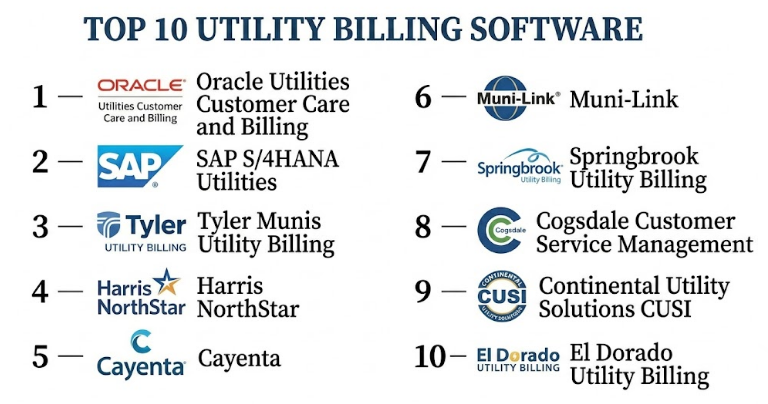
Top 10 Utility Billing Software
#1 — Oracle Utilities Customer Care and Billing
Short description :
Oracle Utilities Customer Care and Billing is an enterprise-grade utility customer information and billing platform. It is designed for large utilities that need advanced customer management, complex rate handling, billing, payments, service orders, and operational workflows. The platform is suitable for electric, gas, water, and multi-service utilities with high transaction volumes. It supports sophisticated billing environments where reliability, scalability, and integration are critical. It is best for large utilities that need deep functionality and enterprise-grade control.
Key Features
- Customer information and account management
- Complex utility billing and rate configuration
- Meter data and usage-based billing support
- Service order and customer care workflows
- Payment and collections support
- Enterprise reporting and analytics
- Integration with broader Oracle utilities ecosystem
Pros
- Strong fit for large and complex utility providers.
- Supports advanced billing and customer care workflows.
- Scalable for high-volume utility operations.
Cons
- Implementation can be complex and resource-intensive.
- May be too advanced for small utilities.
- Requires strong internal process and technical planning.
Platforms / Deployment
Web
Cloud / Enterprise deployment options may vary
Security & Compliance
Enterprise security capabilities such as role-based access, audit trails, encryption, and identity controls may be available depending on deployment. Specific certifications should be verified directly with the vendor.
Integrations & Ecosystem
Oracle Utilities Customer Care and Billing works best when billing must connect with enterprise utility systems and operational platforms.
- Meter data management systems
- ERP and finance systems
- Customer service systems
- Payment processing workflows
- Reporting and analytics tools
- Oracle utilities ecosystem
Support & Community
Enterprise support, documentation, implementation partners, training, and consulting services are available. Community strength is strong among large utility and enterprise Oracle users.
#2 — SAP S/4HANA Utilities
Short description :
SAP S/4HANA Utilities supports utility companies with billing, customer management, finance, meter-to-cash workflows, and enterprise resource planning. It is designed for large utilities that need billing tightly connected with finance, operations, asset management, and enterprise processes. The platform can support electricity, gas, water, and multi-utility business models. It is especially useful for utilities already invested in SAP systems. It is best for enterprise utilities seeking end-to-end business process integration.
Key Features
- Utility billing and customer account management
- Meter-to-cash process support
- Rate and tariff management
- Integration with finance and ERP workflows
- Customer service and account lifecycle support
- Reporting and analytics
- Enterprise process automation
Pros
- Strong fit for SAP-based utility organizations.
- Excellent integration with enterprise finance and operations.
- Suitable for large, complex, multi-utility environments.
Cons
- Can be complex to implement and maintain.
- Requires SAP expertise and planning.
- May be too heavy for small utilities.
Platforms / Deployment
Web
Cloud / On-premise / Hybrid options may vary
Security & Compliance
SAP enterprise security controls may apply depending on configuration and deployment. Specific certifications and compliance details should be verified directly.
Integrations & Ecosystem
SAP S/4HANA Utilities is useful when billing must be deeply connected with finance, procurement, asset management, customer processes, and enterprise reporting.
- SAP finance and ERP modules
- Meter and customer systems
- Asset and work management tools
- Analytics and reporting systems
- Payment and banking workflows
Support & Community
SAP provides enterprise support, documentation, partner services, training, and a large ecosystem. Community strength is strong among enterprise utilities and SAP professionals.
#3 — Tyler Munis Utility Billing
Short description :
Tyler Munis Utility Billing is part of Tyler Technologies’ municipal software ecosystem. It is designed for cities, towns, counties, and public-sector utilities that need billing connected with finance, customer service, payments, and local government workflows. The platform supports utility billing for services such as water, sewer, waste, and other municipal services. It is useful for local governments that want billing to work closely with accounting and public administration systems. It is best for municipalities using or considering Tyler’s broader ERP ecosystem.
Key Features
- Utility billing for municipal services
- Customer account management
- Meter reading and usage billing support
- Rate, fee, and service charge configuration
- Payment and collections workflows
- Reporting and finance integration
- Public-sector ERP connectivity
Pros
- Strong fit for municipalities and local governments.
- Good integration with Tyler’s public-sector software ecosystem.
- Useful for finance and utility billing teams working together.
Cons
- Best value depends on Tyler ecosystem fit.
- May not be ideal for large investor-owned utilities.
- Implementation depends on municipal process readiness.
Platforms / Deployment
Web
Cloud / Hosted / On-premise options may vary
Security & Compliance
Role-based access and public-sector software controls may be available. Specific certifications are Not publicly stated here.
Integrations & Ecosystem
Tyler Munis Utility Billing works well when utility billing must connect with municipal finance, customer service, and local government operations.
- Municipal ERP systems
- Payment processing
- Meter reading systems
- Finance and accounting workflows
- Reporting and public administration tools
Support & Community
Vendor support, documentation, training, and implementation services are available. Community strength is strong among municipalities and public-sector users.
#4 — Harris NorthStar
Short description :
Harris NorthStar is a customer information and billing solution for utilities. It supports customer account management, billing, meter data, payments, service orders, and operational workflows. The platform is suitable for water, electric, gas, and multi-service utilities that need structured customer and billing management. It is especially useful for utilities looking for a dedicated CIS and billing solution rather than a generic invoicing tool. It is best for mid-sized and larger utilities that need utility-specific depth.
Key Features
- Utility customer information management
- Billing and rate management
- Meter reading and usage-based billing support
- Service order workflows
- Payment and collections management
- Reporting and analytics
- Multi-service utility support
Pros
- Built specifically for utility customer and billing needs.
- Good fit for mid-sized and larger utilities.
- Supports operational billing and customer service workflows.
Cons
- May require implementation planning and configuration.
- Smaller utilities may need a simpler solution.
- Public pricing and detailed security details may be limited.
Platforms / Deployment
Web / Desktop options may vary
Cloud / Hosted / On-premise options may vary
Security & Compliance
Enterprise access controls and audit-related features may be available. Specific certifications are Not publicly stated here.
Integrations & Ecosystem
NorthStar is useful when customer information, billing, and utility operations need to work together.
- Meter systems
- Payment processors
- Accounting and ERP systems
- Service order workflows
- Reporting and analytics tools
- Customer communication systems
Support & Community
Vendor support, implementation assistance, training, and documentation are available. Community strength is strongest among utility CIS and billing teams.
#5 — Cayenta
Short description :
Cayenta provides utility billing, customer information, ERP, and financial management software for municipalities, public utilities, and related service providers. It is suitable for utilities that want customer billing connected with finance, work management, and operational systems. The platform can support electric, water, wastewater, waste, and other municipal services depending on configuration. Cayenta is useful for utilities needing a broad operational and financial platform. It is best for public utilities and municipalities looking for utility-specific business management capabilities.
Key Features
- Utility billing and customer information management
- Rate and service management
- Meter reading and account workflows
- Finance and ERP integration
- Work and service management support
- Reporting and analytics
- Multi-utility service support
Pros
- Strong public utility and municipal focus.
- Useful when billing must connect with finance and operations.
- Supports broad utility business workflows.
Cons
- May be more than small utilities need.
- Implementation can require process and data preparation.
- Detailed pricing and deployment specifics may vary.
Platforms / Deployment
Web / Desktop options may vary
Cloud / Hosted / On-premise options may vary
Security & Compliance
Enterprise controls may be available depending on deployment. Specific certifications are Not publicly stated here.
Integrations & Ecosystem
Cayenta is useful when utility billing needs to connect with accounting, service management, and municipal operations.
- ERP and financial systems
- Meter and usage data
- Payment processing
- Work management workflows
- Customer service systems
- Reporting tools
Support & Community
Vendor support, implementation services, training, and documentation are available. Community strength is strongest among public utilities and municipal organizations.
#6 — Muni-Link
Short description :
Muni-Link is a cloud-based utility billing software designed for municipalities, water authorities, and local utility providers. It helps teams manage customer accounts, billing, payments, meter readings, service orders, and reporting. The platform is especially useful for small and mid-sized municipal utilities that want a modern billing system without a heavy enterprise implementation. Muni-Link is designed to be practical for billing offices and customer service teams. It is best for local governments and utility districts seeking cloud-based simplicity.
Key Features
- Cloud-based utility billing
- Customer account management
- Meter reading and usage billing support
- Online payment and customer portal options
- Service order and work tracking
- Reporting and billing analytics
- Municipal utility workflow support
Pros
- Practical for small and mid-sized utilities.
- Cloud-based approach can reduce IT burden.
- Useful for municipal billing and customer service teams.
Cons
- May not fit very large enterprise utilities.
- Advanced custom workflows should be validated.
- Integration depth may vary by utility environment.
Platforms / Deployment
Web
Cloud
Security & Compliance
Cloud access controls may be available. Specific certifications are Not publicly stated here.
Integrations & Ecosystem
Muni-Link is useful when local utilities need billing connected with meters, payments, customer portals, and municipal workflows.
- Meter reading systems
- Payment processors
- Customer portals
- Reporting tools
- Service order workflows
- Accounting exports
Support & Community
Vendor support, onboarding, training, and documentation are available. Community strength is strongest among municipalities, water authorities, and local utility offices.
#7 — Springbrook Utility Billing
Short description :
Springbrook Utility Billing is part of a cloud-based ERP and finance platform for local governments and public-sector organizations. It helps municipalities manage utility accounts, meter readings, bills, payments, service orders, and reporting. The platform is useful for cities, towns, and special districts that want utility billing connected with public finance and accounting. Springbrook is especially relevant for local governments that need practical billing workflows without large enterprise complexity. It is best for small to mid-sized public-sector utilities.
Key Features
- Utility billing and customer account management
- Meter reading and usage-based billing
- Rate and fee configuration
- Payment and collections support
- Service order workflows
- Financial reporting and accounting integration
- Public-sector ERP alignment
Pros
- Good fit for local governments and public utilities.
- Cloud-based approach supports easier access.
- Useful when billing and finance must work together.
Cons
- May not be suitable for very large multi-region utilities.
- Advanced utility-specific needs should be validated.
- Best value depends on broader Springbrook ecosystem fit.
Platforms / Deployment
Web
Cloud
Security & Compliance
Role-based access and cloud controls may be available. Specific certifications are Not publicly stated here.
Integrations & Ecosystem
Springbrook Utility Billing works well when municipal billing needs to connect with public finance, accounting, and customer service workflows.
- Public-sector ERP modules
- Payment processing
- Meter data imports
- Accounting and reporting
- Customer service workflows
- Service order management
Support & Community
Vendor support, implementation help, training, and documentation are available. Community strength is strongest among public-sector finance and utility billing teams.
#8 — Cogsdale Customer Service Management
Short description :
Cogsdale Customer Service Management is a utility customer information and billing solution often associated with Microsoft Dynamics environments. It helps utilities manage customer accounts, billing, service orders, payments, and operational workflows. The platform is suitable for municipal and utility organizations that want customer service and billing connected with finance and ERP processes. It can support water, electric, gas, and other utility services depending on setup. Cogsdale is best for utilities that want billing functionality aligned with a business application ecosystem.
Key Features
- Customer information and billing management
- Utility account and service management
- Meter reading and billing workflows
- Payment and collections support
- Service order and customer service tools
- ERP and finance alignment
- Reporting and operational visibility
Pros
- Useful for utilities wanting customer service and billing together.
- Good fit for Microsoft-oriented environments.
- Supports practical utility account and service workflows.
Cons
- Ecosystem fit should be validated before selection.
- Implementation may require business process planning.
- Not ideal for simple invoicing-only needs.
Platforms / Deployment
Web / Microsoft ecosystem options may vary
Cloud / Hosted / On-premise options may vary
Security & Compliance
Security controls may depend on the Microsoft environment and deployment model. Specific certifications are Not publicly stated here.
Integrations & Ecosystem
Cogsdale is useful when utility billing must connect with ERP, finance, customer service, and Microsoft-based business systems.
- Microsoft Dynamics ecosystem
- Finance and accounting workflows
- Meter reading systems
- Payment systems
- Service order management
- Reporting tools
Support & Community
Vendor support, documentation, and implementation guidance are available. Community strength is strongest among utility teams using Microsoft-oriented business systems.
#9 — Continental Utility Solutions CUSI
Short description :
Continental Utility Solutions, often known as CUSI, provides utility billing software for municipalities, water districts, electric utilities, gas utilities, and other service providers. It supports customer management, billing, meter readings, payments, service orders, and reporting. CUSI is useful for small and mid-sized utilities that need a dedicated billing system without overly complex enterprise software. It is especially practical for utility offices that need reliable billing and customer account workflows. It is best for utilities looking for focused billing functionality.
Key Features
- Utility billing and customer account management
- Meter reading and usage billing support
- Rate and fee management
- Payment processing workflows
- Service order tracking
- Reporting and billing history
- Multi-utility support depending on setup
Pros
- Focused utility billing functionality.
- Practical for small and mid-sized utilities.
- Useful for local utility offices and service providers.
Cons
- May not offer the same enterprise depth as large CIS platforms.
- Advanced integrations should be validated.
- User experience and deployment options may vary by setup.
Platforms / Deployment
Windows / Web options may vary
Cloud / Hosted / On-premise options may vary
Security & Compliance
Access controls and user permissions may be available. Specific certifications are Not publicly stated here.
Integrations & Ecosystem
CUSI is useful when utilities need billing connected with meter readings, payments, reporting, and customer service workflows.
- Meter reading systems
- Payment processing
- Accounting exports
- Customer account workflows
- Service order tracking
- Reporting tools
Support & Community
Vendor support, training, onboarding, and documentation are available. Community strength is strongest among local utilities and billing departments.
#10 — El Dorado Utility Billing
Short description :
El Dorado Utility Billing is software designed to help municipalities and utility providers manage customer accounts, meter readings, billing, payments, and reporting. It is relevant for small and mid-sized utility operations that need practical billing features without a large enterprise platform. The software can support utility services such as water, sewer, trash, and other local services depending on configuration. It is useful for billing clerks and municipal teams that need straightforward account and invoice management. It is best for local providers looking for focused utility billing tools.
Key Features
- Customer account management
- Utility billing and invoice generation
- Meter reading and usage tracking
- Payment and balance management
- Rate and fee configuration
- Reporting and account history
- Local utility billing workflows
Pros
- Practical for small and local utility providers.
- Focused billing workflows can be easier to manage.
- Useful for municipalities and small service districts.
Cons
- May not support large enterprise utility complexity.
- Integration depth should be validated.
- Advanced analytics and modern portal features may vary.
Platforms / Deployment
Windows / Web options may vary
Cloud / Hosted / On-premise options may vary
Security & Compliance
Not publicly stated.
Integrations & Ecosystem
El Dorado Utility Billing is useful when local utility teams need basic-to-moderate billing workflows connected with customer accounts and meter data.
- Meter reading imports
- Payment workflows
- Customer account records
- Billing reports
- Accounting exports where available
- Local government workflows
Support & Community
Vendor support and documentation may be available. Community strength is strongest among small utility and municipal billing users.
Comparison Table
| Tool Name | Best For | Platform(s) Supported | Deployment | Standout Feature | Public Rating |
|---|---|---|---|---|---|
| Oracle Utilities Customer Care and Billing | Large enterprise utilities | Web | Cloud / Enterprise options vary | Deep customer care and billing functionality | N/A |
| SAP S/4HANA Utilities | SAP-based enterprise utilities | Web | Cloud / On-premise / Hybrid | Billing connected with enterprise ERP workflows | N/A |
| Tyler Munis Utility Billing | Municipal utilities and local governments | Web | Cloud / Hosted / On-premise options vary | Utility billing connected with public-sector ERP | N/A |
| Harris NorthStar | Mid-sized and large utilities | Web / Desktop options vary | Cloud / Hosted / On-premise options vary | Dedicated utility CIS and billing workflows | N/A |
| Cayenta | Public utilities and municipalities | Web / Desktop options vary | Cloud / Hosted / On-premise options vary | Billing, finance, and utility operations together | N/A |
| Muni-Link | Small and mid-sized municipal utilities | Web | Cloud | Cloud-based municipal utility billing | N/A |
| Springbrook Utility Billing | Local government utility billing teams | Web | Cloud | Public-sector billing connected with finance | N/A |
| Cogsdale Customer Service Management | Microsoft-oriented utility organizations | Web / Microsoft ecosystem options vary | Cloud / Hosted / On-premise options vary | Utility billing aligned with customer service workflows | N/A |
| Continental Utility Solutions CUSI | Small and mid-sized utility providers | Windows / Web options vary | Cloud / Hosted / On-premise options vary | Focused utility billing for local providers | N/A |
| El Dorado Utility Billing | Small municipalities and service districts | Windows / Web options vary | Cloud / Hosted / On-premise options vary | Straightforward local utility billing workflows | N/A |
Evaluation & Utility Billing Software
| Tool Name | Core (25%) | Ease (15%) | Integrations (15%) | Security (10%) | Performance (10%) | Support (10%) | Value (15%) | Weighted Total (0–10) |
|---|---|---|---|---|---|---|---|---|
| Oracle Utilities Customer Care and Billing | 10 | 6 | 9 | 9 | 9 | 8 | 7 | 8.45 |
| SAP S/4HANA Utilities | 9 | 6 | 10 | 9 | 9 | 8 | 7 | 8.40 |
| Tyler Munis Utility Billing | 8 | 8 | 8 | 8 | 8 | 8 | 8 | 8.00 |
| Harris NorthStar | 9 | 7 | 8 | 8 | 8 | 8 | 7 | 7.95 |
| Cayenta | 8 | 7 | 8 | 8 | 8 | 8 | 7 | 7.70 |
| Muni-Link | 7 | 9 | 7 | 7 | 8 | 8 | 9 | 7.85 |
| Springbrook Utility Billing | 7 | 8 | 8 | 7 | 8 | 8 | 8 | 7.70 |
| Cogsdale Customer Service Management | 8 | 7 | 8 | 7 | 8 | 7 | 7 | 7.45 |
| Continental Utility Solutions CUSI | 7 | 8 | 7 | 6 | 7 | 7 | 8 | 7.15 |
| El Dorado Utility Billing | 6 | 8 | 6 | 5 | 7 | 7 | 8 | 6.70 |
These scores are comparative and should be used for shortlisting, not as final purchasing advice. Large enterprise platforms score higher for depth, scalability, and integrations, but they may be too complex for small utilities. Smaller municipal billing tools may score better for ease and value, but they may not support advanced enterprise workflows. Buyers should test real billing cycles, meter imports, rate calculations, payment workflows, reports, and integrations before choosing.
Which Utility Billing Software Should You Choose?
Solo / Freelancer
Solo consultants working with utility providers usually do not need their own billing platform unless they manage billing operations for clients. They should focus on understanding commonly used systems such as Tyler Munis, Muni-Link, Springbrook, Harris NorthStar, and Oracle Utilities.
Consultants helping small utilities may prefer tools with simpler workflows, clear reporting, and easier billing setup. Consultants supporting large utilities should understand enterprise CIS, ERP, meter, and payment integrations.
SMB
Small and mid-sized utilities should focus on ease of use, billing accuracy, payment workflows, customer service, and support quality. Muni-Link, Springbrook Utility Billing, CUSI, and El Dorado Utility Billing can be practical options depending on service type and budget.
SMBs should avoid buying a system that is too complex for their team. The best solution is usually the one that helps billing staff work faster, reduce errors, and support customers without needing heavy technical resources.
Mid-Market
Mid-market utilities often need more advanced billing, better reporting, customer portals, meter integrations, and finance connectivity. Harris NorthStar, Cayenta, Tyler Munis Utility Billing, Springbrook, and Cogsdale can be strong options.
A mid-sized municipality may prefer Tyler or Springbrook if public-sector finance integration is important. A growing utility with dedicated customer service and billing teams may prefer Harris NorthStar or Cayenta.
Enterprise
Large utilities should prioritize scalability, complex tariffs, multi-service billing, security, integrations, audit trails, customer service workflows, and enterprise reporting. Oracle Utilities Customer Care and Billing, SAP S/4HANA Utilities, Harris NorthStar, and Cayenta are stronger enterprise candidates.
Enterprise buyers should test high-volume billing, complex rate structures, smart meter data, payment processing, outage/service workflows, and integration with ERP, GIS, MDM, CRM, and analytics systems.
Budget vs Premium
Budget-conscious utilities may prefer Muni-Link, CUSI, El Dorado Utility Billing, or Springbrook depending on feature needs and public-sector fit. These tools can be practical for smaller organizations that need reliable billing without large enterprise overhead.
Premium buyers with complex operations may prefer Oracle Utilities, SAP S/4HANA Utilities, Harris NorthStar, Cayenta, or Tyler Munis. Premium systems usually provide deeper functionality but require stronger implementation planning.
Feature Depth vs Ease of Use
For feature depth, Oracle Utilities, SAP S/4HANA Utilities, Harris NorthStar, and Cayenta are stronger because they support larger, more complex utility operations.
For ease of use and practical municipal billing, Muni-Link, Springbrook, CUSI, and El Dorado Utility Billing may be more approachable. The right choice depends on team size, complexity, and service volume.
Integrations & Scalability
Utilities should test integrations before final selection. Common integrations include meter reading systems, AMI, payment processors, accounting systems, ERP, GIS, CRM, customer portals, and reporting tools.
Large utilities may need Oracle or SAP because of enterprise integration depth. Municipal utilities may prefer Tyler, Springbrook, Muni-Link, or Cayenta if public-sector finance and billing workflows are the priority.
Security & Compliance Needs
Utility billing software contains customer names, addresses, service details, payment records, balances, and usage data. Buyers should ask vendors about SSO, MFA, RBAC, encryption, audit logs, backups, data residency, access reviews, and payment security responsibilities.
For utilities with regulatory or public-sector obligations, audit trails, role-based permissions, and reporting controls should be tested carefully during evaluation.
Frequently Asked Questions
1. What is Utility Billing Software?
Utility Billing Software helps utility providers manage customer accounts, meter readings, usage calculations, invoices, payments, collections, service orders, and reporting. It is used by water, electric, gas, sewer, waste, and municipal service providers.
2. How is Utility Billing Software different from normal invoicing software?
Normal invoicing software usually handles simple invoices. Utility Billing Software handles meter readings, usage-based charges, rates, tariffs, deposits, service locations, billing cycles, taxes, customer portals, and utility-specific reporting.
3. How much does Utility Billing Software cost?
Pricing varies by number of customers, users, modules, utility services, deployment model, integrations, payment features, and support needs. Enterprise systems usually use custom pricing, while smaller municipal tools may offer simpler packages.
4. Can small utilities use Utility Billing Software?
Yes. Small utilities can benefit from billing software because it reduces manual errors and improves customer service. Tools like Muni-Link, Springbrook, CUSI, and El Dorado Utility Billing may be practical for smaller providers.
5. What is the biggest mistake buyers make?
The biggest mistake is choosing software before documenting billing rules, rate structures, meter workflows, payment processes, and reporting needs. If the billing process is unclear, even good software can be difficult to implement.
6. Can Utility Billing Software integrate with smart meters?
Many platforms can integrate with meter reading systems, AMI, or meter data management tools, but compatibility varies. Buyers should test meter import formats, validation rules, exception handling, and usage calculations before purchase.
7. Does Utility Billing Software include customer portals?
Many modern platforms offer customer portals for online payments, bill history, usage viewing, account updates, and service requests. The depth and user experience of portals vary by vendor and package.
8. Is cloud-based Utility Billing Software safe?
Cloud-based billing software can be safe when proper controls are in place. Buyers should verify encryption, access controls, audit logs, backups, payment security, data residency, and vendor security practices.
9. Which software is best for municipal utilities?
Municipal utilities may evaluate Tyler Munis Utility Billing, Muni-Link, Springbrook Utility Billing, Cayenta, CUSI, or El Dorado Utility Billing. The best choice depends on utility size, public finance needs, meter workflows, and support expectations.
10. Which software is best for large utilities?
Large utilities may evaluate Oracle Utilities Customer Care and Billing, SAP S/4HANA Utilities, Harris NorthStar, or Cayenta. The best choice depends on billing complexity, customer volume, integration needs, and enterprise architecture.
Conclusion
Utility Billing Software is essential for organizations that manage recurring customer billing, meter readings, service accounts, payments, and utility-specific reporting. The right platform can reduce billing errors, improve collections, support customer service, and give finance teams better visibility into revenue. However, the best solution depends on utility size, service type, billing complexity, integration needs, customer volume, and internal team skills.
