Introduction
Water Quality Monitoring Software helps organizations collect, manage, analyze, visualize, and report water quality data. In simple English, it gives teams one place to track parameters such as pH, turbidity, dissolved oxygen, conductivity, temperature, chlorine, salinity, nutrients, heavy metals, biological indicators, and other water-related measurements.
This software is used by water utilities, wastewater treatment plants, environmental agencies, laboratories, industrial facilities, mining companies, agriculture teams, researchers, and consultants. Instead of keeping water data in spreadsheets, emails, or separate field devices, these platforms help teams build dashboards, generate reports, detect unusual changes, manage sampling programs, and respond faster to water quality issues.
Real-world use cases include:
- Drinking water quality monitoring
- Wastewater treatment performance tracking
- River, lake, and groundwater monitoring
- Industrial discharge compliance
- Stormwater and flood-related water quality tracking
- Laboratory and field sample data management
- Sensor-based real-time monitoring
Buyers should evaluate:
- Supported water quality parameters
- Sensor and device compatibility
- Laboratory data import support
- Real-time dashboards and alerts
- Reporting and compliance workflows
- GIS and map-based visualization
- API and integration options
- Data validation and audit history
- Security and user permissions
- Ease of use for field, lab, and office teams
Best for: Water utilities, environmental consultants, municipalities, wastewater plants, industrial facilities, laboratories, mining companies, agriculture operations, government agencies, research teams, and sustainability teams.
Not ideal for: Very small teams that only need occasional manual readings, users who only need a simple consumer water test app, or organizations without long-term monitoring, compliance, reporting, or sensor-data requirements.
Key Water Quality Monitoring Software Trends
- Real-time water monitoring is becoming more common through IoT sensors, telemetry systems, and connected monitoring stations.
- Cloud dashboards are helping distributed teams access water quality data from treatment plants, rivers, reservoirs, wells, and field locations.
- AI-assisted anomaly detection is improving the ability to identify unusual water quality changes before they become serious incidents.
- GIS-based visualization is important for watershed monitoring, groundwater studies, river networks, and regional water programs.
- Laboratory and field data integration is becoming essential because many teams collect data from both sensors and lab samples.
- Compliance-ready reporting is a key need for utilities, industries, and government agencies.
- Data validation and QA workflows are becoming more important because poor-quality readings can lead to wrong decisions.
- API and interoperability are important for connecting water data with SCADA, GIS, BI, ERP, and environmental platforms.
- Mobile field data collection helps reduce delays and errors during sampling, inspections, and site visits.
- Predictive analytics is gaining value for utilities and industrial sites that want to reduce risk, downtime, and compliance failures.
How We Selected These Tools
The tools below were selected using a practical buyer-focused approach:
- Recognized use in water quality, environmental data management, hydrology, utilities, or monitoring workflows.
- Ability to support water quality data collection, analysis, reporting, or visualization.
- Suitability for different users, including utilities, consultants, laboratories, government agencies, industries, and researchers.
- Support for field data, lab data, sensor data, telemetry, or environmental compliance workflows.
- Reporting, dashboard, alerting, and data validation capabilities.
- GIS, mapping, and location-based monitoring support where relevant.
- Integration potential with sensors, SCADA, APIs, databases, business systems, or BI tools.
- Practical usability for technical and non-technical teams.
- Support, documentation, implementation help, and vendor maturity.
- Balanced inclusion of enterprise, technical, field-focused, utility-focused, and environmental data platforms.
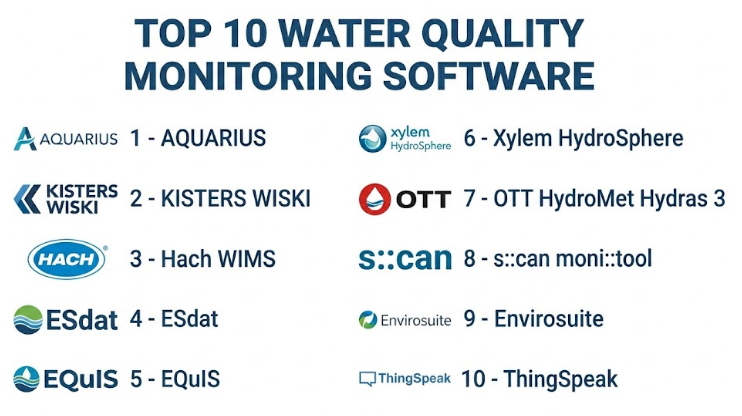
Top 10 Water Quality Monitoring Software
#1 — AQUARIUS
Short description :
AQUARIUS is a water data management platform used by water agencies, environmental organizations, utilities, and hydrology teams. It helps users collect, manage, quality-control, analyze, and publish water data from different sources. The platform is especially useful for river monitoring, groundwater programs, water quality tracking, hydrometric data, and environmental reporting. It is designed for teams that need trusted scientific water data rather than simple dashboard-only monitoring. AQUARIUS is a strong fit for organizations managing long-term water monitoring networks.
Key Features
- Water quality and hydrometric data management
- Time-series data collection and analysis
- Data validation and quality control workflows
- Rating curves and hydrology-focused tools
- Dashboards, reports, and data publishing
- Sensor and monitoring network support
- Useful for agencies, utilities, and water resource teams
Pros
- Strong fit for professional water data management.
- Good for long-term monitoring and scientific data quality.
- Suitable for government agencies and large water programs.
Cons
- May require technical setup and training.
- More advanced than basic water quality dashboard tools.
- Pricing and implementation details are usually project-specific.
Platforms / Deployment
Web / Cloud / Enterprise deployment options may vary.
Security & Compliance
Enterprise access controls and data management controls may be available depending on deployment. Specific certifications are Not publicly stated.
Integrations & Ecosystem
AQUARIUS is useful when water quality data must connect with field sensors, hydrology systems, reporting workflows, and public data programs.
- Monitoring stations and telemetry systems
- Hydrology and water resource workflows
- Data exports and reporting tools
- APIs and enterprise data connections where configured
- Agency and utility data management programs
Support & Community
Vendor documentation, onboarding, technical support, and implementation services are available. Community strength is strongest among water agencies, hydrologists, and environmental data professionals.
#2 — KISTERS WISKI
Short description :
KISTERS WISKI is a professional environmental data management system used for hydrology, water quality, meteorology, groundwater, and environmental monitoring. It helps organizations manage large volumes of time-series and environmental data from many locations. WISKI is suitable for government agencies, water utilities, environmental regulators, flood monitoring teams, and research organizations. It is especially strong for structured water monitoring networks and long-term environmental datasets. It is best for teams that need serious data management and analysis, not only basic reporting.
Key Features
- Water quality and hydrological data management
- Time-series database and analysis tools
- Data validation and quality assurance workflows
- Monitoring station and telemetry data handling
- Maps, charts, and reporting capabilities
- Support for groundwater, rivers, reservoirs, and weather data
- Enterprise-level environmental data workflows
Pros
- Strong for complex water and environmental monitoring networks.
- Good fit for agencies and utilities with large datasets.
- Supports scientific data validation and long-term analysis.
Cons
- Can be complex for small teams.
- Implementation and configuration may require expert support.
- Not ideal for simple one-site monitoring use cases.
Platforms / Deployment
Windows / Web modules may vary
Cloud / Self-hosted / Hybrid options may vary by deployment.
Security & Compliance
Enterprise security controls may be available depending on implementation. Specific certifications are Not publicly stated.
Integrations & Ecosystem
WISKI is strong where water quality data must connect with broader hydrology, meteorology, and environmental systems.
- Telemetry and monitoring networks
- GIS and mapping workflows
- Databases and environmental systems
- Reporting and publishing workflows
- APIs and enterprise integration options where configured
Support & Community
Vendor support, implementation services, training, and documentation are available. Community strength is strongest among technical water data and environmental monitoring teams.
#3 — Hach WIMS
Short description :
Hach WIMS is water information management software used by water and wastewater utilities to manage operational and compliance data. It helps teams collect, organize, analyze, and report water quality and treatment data from lab results, instruments, and manual entries. The platform is especially useful for drinking water plants, wastewater treatment plants, and utility operations. It helps reduce spreadsheet dependency and supports better compliance reporting. Hach WIMS is a practical choice for utility teams that need structured water data management.
Key Features
- Water and wastewater data management
- Lab data, field data, and manual data entry support
- Compliance reporting workflows
- Dashboards and operational reporting
- Trend analysis and calculations
- Plant performance data management
- Utility-focused data organization
Pros
- Strong fit for water and wastewater utilities.
- Helps centralize compliance and operational data.
- Useful for teams moving away from spreadsheets.
Cons
- Best suited for utility environments.
- Advanced customization may require setup support.
- Not a broad environmental monitoring platform for all use cases.
Platforms / Deployment
Windows / Web options may vary
Cloud / On-premise / Hybrid options may vary.
Security & Compliance
Access controls and audit-supporting workflows may be available depending on deployment. Specific certifications are Not publicly stated.
Integrations & Ecosystem
Hach WIMS works well when water utility data needs to connect with instruments, lab results, and operational reporting.
- Hach instruments and systems
- Laboratory data workflows
- SCADA or operational data sources where configured
- Compliance reporting
- Data exports and reports
Support & Community
Vendor documentation, customer support, onboarding, and utility-focused implementation help are available. Community strength is strongest among water and wastewater professionals.
#4 — ESdat
Short description :
ESdat is environmental data management software used for groundwater, surface water, soil, laboratory, and field monitoring data. It is especially useful for environmental consultants, contaminated land teams, mining companies, government agencies, and technical monitoring programs. The platform helps users manage lab results, compare data against standards, create charts and maps, and prepare reports. ESdat is highly relevant for water quality because many projects require groundwater and surface water sample management. It is best for technical environmental data teams.
Key Features
- Groundwater and surface water data management
- Laboratory data import and validation
- Field data and sampling program support
- Standards comparison and exceedance tracking
- Charts, maps, and reporting tools
- Environmental investigation workflows
- Data exports for reports and analysis
Pros
- Strong for technical water quality and environmental datasets.
- Useful for consultants and groundwater monitoring programs.
- Good support for lab data and standards comparison.
Cons
- Less focused on real-time sensor operations.
- May require environmental data knowledge.
- Not a general business dashboard tool.
Platforms / Deployment
Web / Windows options may vary
Cloud / Hybrid options may vary.
Security & Compliance
Not publicly stated.
Integrations & Ecosystem
ESdat is useful when water quality data comes from labs, field teams, sampling events, and environmental investigations.
- Laboratory result imports
- GIS and mapping workflows
- Environmental standards databases
- Reporting and charting tools
- Data export workflows
Support & Community
Vendor support, documentation, and training resources are available. Community strength is strongest among environmental consultants, hydrogeologists, and technical environmental teams.
#5 — EQuIS
Short description :
EQuIS is an environmental data management platform used for water quality, groundwater, surface water, soil, air, chemistry, and field data. It is widely used by consultants, industrial organizations, government agencies, and environmental programs that need strong data governance. EQuIS helps manage laboratory data, field data, reporting, data validation, and regulatory-style environmental datasets. For water quality teams, it is valuable when data accuracy, defensibility, and long-term storage matter. It is best for organizations with serious environmental data management needs.
Key Features
- Environmental and water quality data management
- Laboratory and field data workflows
- Data validation and quality assurance
- Reporting, dashboards, and exports
- Support for groundwater, surface water, and chemistry data
- Enterprise database structure
- Long-term environmental record management
Pros
- Strong for defensible environmental data management.
- Useful for consultants, industries, and agencies.
- Good fit for complex water quality and lab datasets.
Cons
- Can be technical and implementation-heavy.
- May be more than small teams need.
- Setup and governance require planning.
Platforms / Deployment
Web / Desktop components may vary
Cloud / Self-hosted / Hybrid options may vary.
Security & Compliance
Enterprise controls may be available depending on deployment. Specific certifications are Not publicly stated.
Integrations & Ecosystem
EQuIS works well when water quality data must support long-term environmental programs and defensible reporting.
- Laboratory information workflows
- Field data collection tools
- GIS and reporting systems
- Databases and data exports
- Enterprise environmental programs
Support & Community
Vendor support, training, documentation, and professional services are available. Community strength is strong among environmental data managers and consultants.
#6 — Xylem HydroSphere
Short description :
Xylem HydroSphere is a cloud-based platform designed to support monitoring and management of water data from connected systems and devices. It is relevant for utilities, environmental teams, and organizations using Xylem or compatible monitoring technologies. The platform helps users view water-related data, manage assets, improve visibility, and support operational decisions. For water quality monitoring, it can be useful where connected sensors and water infrastructure data need to be centralized. It is best for teams already working with connected water systems.
Key Features
- Cloud-based water data visibility
- Connected monitoring and device support
- Dashboards and operational insights
- Water infrastructure monitoring workflows
- Remote access to water data
- Alerting and condition visibility
- Useful for utilities and water operations
Pros
- Strong fit for connected water infrastructure.
- Useful for utilities and operational water teams.
- Works well with broader Xylem water technology ecosystem.
Cons
- Best value may depend on hardware and ecosystem fit.
- Specific water quality capabilities may vary by setup.
- Not ideal for users needing only lab sample management.
Platforms / Deployment
Web
Cloud
Security & Compliance
Enterprise cloud security controls may be available. Specific certifications are Not publicly stated here.
Integrations & Ecosystem
HydroSphere is useful where water quality and operational data must connect with sensors, devices, and utility workflows.
- Xylem technology ecosystem
- Remote monitoring devices
- Utility data workflows
- Dashboards and alerts
- Connected water infrastructure systems
Support & Community
Vendor support, technical resources, and implementation guidance are available. Community strength is strongest among water utilities and organizations using Xylem solutions.
#7 — OTT HydroMet Hydras 3
Short description :
OTT HydroMet Hydras 3 is software used for managing hydrological and meteorological monitoring data. It is relevant for water quality programs where monitoring stations, data loggers, and environmental measurement devices are used. The platform helps collect, process, visualize, and manage monitoring data from field instruments. It is useful for agencies, hydrologists, environmental teams, and water resource managers. Hydras 3 is more technical and monitoring-station-focused than broad compliance workflow software.
Key Features
- Monitoring station data management
- Hydrological and environmental data handling
- Data visualization and analysis
- Support for connected field instruments
- Time-series monitoring workflows
- Reporting and export options
- Useful for water resource and environmental monitoring teams
Pros
- Strong for field station and hydrological monitoring data.
- Useful for technical users managing monitoring networks.
- Good fit for environmental and water resource programs.
Cons
- May not include broad enterprise compliance workflows.
- Best for teams using compatible monitoring equipment.
- May require technical knowledge for setup and use.
Platforms / Deployment
Windows
Deployment varies by setup.
Security & Compliance
Not publicly stated.
Integrations & Ecosystem
Hydras 3 is useful where water monitoring data comes from field devices and stations.
- OTT HydroMet devices
- Data loggers and monitoring stations
- Hydrological workflows
- Data exports and reporting
- Environmental field monitoring systems
Support & Community
Vendor documentation and support are available. Community strength is strongest among hydrology, meteorology, and water monitoring professionals.
#8 — s::can moni::tool
Short description :
s::can moni::tool is software used with s::can online water quality monitoring systems and sensors. It is designed for real-time monitoring of drinking water, wastewater, surface water, and industrial water applications. The platform helps users visualize sensor data, manage measurements, and detect changes in water quality. It is especially useful for organizations using online sensors for continuous water monitoring. It is more device-ecosystem-focused than a general environmental data platform.
Key Features
- Online water quality monitoring support
- Real-time visualization of sensor data
- Drinking water, wastewater, and surface water use cases
- Sensor and analyzer connectivity
- Event and change detection support
- Data logging and reporting support
- Useful for continuous water monitoring programs
Pros
- Strong for real-time sensor-based water monitoring.
- Useful for drinking water and wastewater applications.
- Good fit for organizations using s::can instruments.
Cons
- Best value is tied to s::can hardware ecosystem.
- Not a broad enterprise EHS platform.
- Advanced integration needs should be validated before purchase.
Platforms / Deployment
Web / Device-connected environment may vary
Cloud / Local deployment options may vary.
Security & Compliance
Not publicly stated.
Integrations & Ecosystem
s::can moni::tool is useful when continuous water quality data must be captured from online sensors.
- s::can sensors and analyzers
- Real-time water monitoring stations
- Data logging workflows
- Alert and visualization systems
- Water treatment and environmental monitoring use cases
Support & Community
Vendor support, device documentation, and technical guidance are available. Community strength is strongest among users of s::can monitoring systems.
#9 — Envirosuite
Short description :
Envirosuite is an environmental intelligence platform that supports monitoring and management of environmental conditions, including water-related use cases depending on configuration. It is used by industries, utilities, wastewater facilities, infrastructure operators, and environmental teams that need operational environmental insights. The platform can help connect monitoring data with alerts, dashboards, predictive insights, and stakeholder communication. For water quality, it is especially relevant when water conditions are part of a broader environmental impact program. It is best for organizations managing complex operational environments.
Key Features
- Environmental intelligence dashboards
- Water, air, odor, noise, weather, and operational data support depending on use case
- Alerts and incident response workflows
- Predictive and analytics-driven insights
- Useful for wastewater and industrial environments
- Stakeholder and community communication support
- Operational decision support
Pros
- Strong for complex environmental operations.
- Useful when water quality connects with other environmental risks.
- Good fit for industrial and infrastructure teams.
Cons
- May be more advanced than simple water testing needs.
- Water-specific capabilities should be validated by use case.
- Pricing and package details are usually not publicly simple.
Platforms / Deployment
Web
Cloud
Security & Compliance
Enterprise controls may be available. Specific certifications are Not publicly stated.
Integrations & Ecosystem
Envirosuite is useful when water monitoring must be part of a broader environmental intelligence program.
- Environmental sensors and data sources
- Weather and operational data
- Incident workflows
- Dashboards and alerts
- Industrial and utility systems
Support & Community
Vendor support, implementation guidance, and technical resources are available. Community strength is strongest in industrial, airport, port, wastewater, and infrastructure environments.
#10 — ThingSpeak
Short description :
ThingSpeak is an IoT analytics platform that can be used for custom water quality monitoring projects. It is popular with engineers, researchers, students, makers, and small teams building sensor-based monitoring systems. Users can collect sensor readings such as pH, turbidity, temperature, conductivity, and other parameters from connected devices. It is not a ready-made enterprise water compliance platform, but it is useful for prototyping, research, and lightweight IoT monitoring. ThingSpeak is best for technical users who want flexibility.
Key Features
- IoT data collection and visualization
- Sensor data logging for custom projects
- Charts and basic analytics
- API-based data ingestion
- Suitable for pH, turbidity, temperature, and custom sensor projects
- Useful for research and prototypes
- Integration with technical computing workflows
Pros
- Good for low-cost IoT water monitoring prototypes.
- Flexible for technical users and researchers.
- Useful for learning, testing, and custom dashboards.
Cons
- Not a full water utility compliance platform.
- Requires technical setup and device configuration.
- Limited fit for enterprise governance needs.
Platforms / Deployment
Web / API
Cloud
Security & Compliance
Basic account-level security is expected. Enterprise compliance certifications are Not publicly stated here.
Integrations & Ecosystem
ThingSpeak is useful when teams build custom sensor-based water quality monitoring systems.
- IoT devices and microcontrollers
- API-based data ingestion
- Custom dashboards and charts
- Research and academic projects
- Technical analytics workflows
Support & Community
Documentation and technical learning resources are available. Community strength is good among engineers, educators, students, and IoT developers.
Comparison Table
| Tool Name | Best For | Platform(s) Supported | Deployment | Standout Feature | Public Rating |
|---|---|---|---|---|---|
| AQUARIUS | Water agencies and hydrology teams | Web, varies by deployment | Cloud / Enterprise options vary | Professional water data management | N/A |
| KISTERS WISKI | Large environmental monitoring networks | Windows / Web modules vary | Cloud / Self-hosted / Hybrid | Time-series water and environmental data management | N/A |
| Hach WIMS | Water and wastewater utilities | Windows / Web options vary | Cloud / On-premise / Hybrid | Utility-focused compliance and operational data | N/A |
| ESdat | Consultants and groundwater monitoring teams | Web / Windows options vary | Cloud / Hybrid | Lab, field, and environmental standards workflows | N/A |
| EQuIS | Enterprise environmental data management | Web / Desktop components vary | Cloud / Self-hosted / Hybrid | Defensible environmental and water quality data management | N/A |
| Xylem HydroSphere | Connected water infrastructure teams | Web | Cloud | Connected water system visibility | N/A |
| OTT HydroMet Hydras 3 | Hydrology and field station monitoring | Windows | Varies / N/A | Monitoring station data management | N/A |
| s::can moni::tool | Continuous online water quality monitoring | Web / Device-connected setup varies | Cloud / Local options vary | Real-time sensor-based water monitoring | N/A |
| Envirosuite | Industrial and utility environmental operations | Web | Cloud | Environmental intelligence for complex operations | N/A |
| ThingSpeak | IoT prototypes and research projects | Web / API | Cloud | Flexible custom sensor data monitoring | N/A |
Evaluation & Water Quality Monitoring Software
| Tool Name | Core (25%) | Ease (15%) | Integrations (15%) | Security (10%) | Performance (10%) | Support (10%) | Value (15%) | Weighted Total (0–10) |
|---|---|---|---|---|---|---|---|---|
| AQUARIUS | 9 | 7 | 8 | 7 | 9 | 8 | 7 | 7.95 |
| KISTERS WISKI | 9 | 6 | 8 | 7 | 9 | 8 | 7 | 7.80 |
| Hach WIMS | 8 | 8 | 7 | 7 | 8 | 8 | 8 | 7.75 |
| ESdat | 8 | 7 | 7 | 6 | 8 | 7 | 8 | 7.35 |
| EQuIS | 9 | 6 | 8 | 7 | 8 | 8 | 7 | 7.65 |
| Xylem HydroSphere | 8 | 8 | 7 | 7 | 8 | 8 | 7 | 7.65 |
| OTT HydroMet Hydras 3 | 7 | 6 | 7 | 5 | 8 | 7 | 7 | 6.80 |
| s::can moni::tool | 8 | 7 | 7 | 5 | 8 | 7 | 7 | 7.10 |
| Envirosuite | 8 | 7 | 8 | 7 | 8 | 8 | 7 | 7.60 |
| ThingSpeak | 6 | 8 | 8 | 5 | 7 | 7 | 9 | 7.05 |
These scores are comparative and should be used as a shortlisting guide, not as a final decision. A utility, consultant, researcher, and industrial plant may each need a different type of water quality platform. A high score in enterprise data management does not always mean the tool is best for simple field monitoring. Buyers should validate sensor compatibility, reporting needs, security requirements, data quality workflows, and total cost before choosing.
Which Water Quality Monitoring Software
Solo / Freelancer
Solo consultants and independent professionals should focus on practical data collection, lab result handling, and reporting. ESdat is a strong choice for groundwater, surface water, lab data, and environmental standards comparison. ThingSpeak can be useful for custom IoT projects, prototypes, or educational monitoring.
If the work involves utility operations or treatment plant reporting, Hach WIMS may be more relevant. Freelancers should avoid heavy enterprise platforms unless client projects specifically require them.
SMB
Small and mid-sized organizations usually need a balance of usability, reporting, and cost. Hach WIMS is useful for water and wastewater utilities. ESdat is strong for technical environmental monitoring. Xylem HydroSphere may be useful for teams using connected water infrastructure.
SMBs should avoid buying more software than they need. The first step should be to define whether the main problem is compliance reporting, sensor monitoring, lab data management, or operational visibility.
Mid-Market
Mid-market teams often need multi-site monitoring, better reporting, and more reliable data governance. AQUARIUS, Hach WIMS, EQuIS, ESdat, and Xylem HydroSphere can all fit depending on the use case.
A mid-market utility may prefer Hach WIMS or Xylem HydroSphere. An environmental consulting or industrial team may prefer ESdat or EQuIS. A water agency managing hydrology and monitoring networks may prefer AQUARIUS or KISTERS WISKI.
Enterprise
Enterprise buyers should prioritize scalability, data governance, role-based access, audit trails, integrations, long-term storage, and reporting reliability. AQUARIUS, KISTERS WISKI, EQuIS, Hach WIMS, and Envirosuite are stronger candidates for large programs.
Large utilities, government agencies, industrial groups, and environmental regulators should also evaluate implementation support, data migration effort, and integration with SCADA, GIS, BI, laboratory systems, and enterprise reporting tools.
Budget vs Premium
Budget-conscious teams may consider ThingSpeak for technical prototypes or ESdat for focused environmental data workflows. However, low-cost options may require more manual setup or technical knowledge.
Premium buyers with complex compliance, large monitoring networks, or enterprise data governance needs should evaluate AQUARIUS, KISTERS WISKI, EQuIS, Hach WIMS, or Envirosuite. Premium tools usually provide stronger workflows, support, and scalability.
Feature Depth vs Ease of Use
For feature depth, AQUARIUS, KISTERS WISKI, EQuIS, and Hach WIMS are stronger because they support structured water data management and professional reporting.
For ease of use, Hach WIMS, Xylem HydroSphere, and ThingSpeak may feel more approachable depending on the user type. Technical environmental teams may find ESdat easier because it matches their data workflow closely.
Integrations & Scalability
Organizations with SCADA, telemetry, lab systems, GIS, BI tools, and enterprise databases should prioritize integration testing. AQUARIUS, KISTERS WISKI, EQuIS, and Hach WIMS are stronger for structured integration-heavy environments.
For IoT sensor projects, ThingSpeak can be useful. For device-driven online water monitoring, s::can moni::tool and Xylem HydroSphere may be better depending on hardware fit.
Security & Compliance Needs
Security-focused buyers should ask each vendor about SSO, MFA, RBAC, encryption, audit logs, backups, data ownership, and data residency. Water utilities and government agencies should also review procurement, compliance, and operational risk requirements.
For high-stakes water quality decisions, security is only one part of the evaluation. Buyers should also validate data accuracy, calibration processes, QA workflows, audit history, and reporting reliability.
Frequently Asked Questions
1. What is Water Quality Monitoring Software?
Water Quality Monitoring Software helps teams collect, store, analyze, and report water quality data. It can manage sensor readings, lab results, field samples, compliance reports, dashboards, alerts, and long-term environmental records.
2. What water quality parameters can these tools track?
The supported parameters depend on the platform and sensors used. Common examples include pH, turbidity, dissolved oxygen, conductivity, temperature, chlorine, salinity, ammonia, nitrate, phosphate, heavy metals, and biological indicators.
3. How much does Water Quality Monitoring Software cost?
Pricing varies based on users, sites, sensors, modules, data volume, deployment model, and support level. Enterprise platforms often use custom pricing, while simpler or developer-focused tools may have more accessible plans.
4. Can these platforms connect with water sensors?
Yes, many platforms can connect with sensors, telemetry devices, monitoring stations, or IoT systems. However, compatibility must be validated carefully because some platforms work best with specific hardware ecosystems.
5. Can Water Quality Monitoring Software handle laboratory data?
Yes, platforms like ESdat, EQuIS, Hach WIMS, and AQUARIUS can support lab data workflows depending on setup. Buyers should check whether the software can import lab files, validate results, and compare data against standards.
6. What is the biggest mistake buyers make?
The biggest mistake is choosing software before defining the monitoring workflow. A drinking water plant, groundwater consultant, research project, and industrial discharge program all need different features, reports, and integrations.
7. Is cloud deployment safe for water quality data?
Cloud deployment can be safe when proper controls are in place. Buyers should verify security details such as encryption, role-based access, MFA, audit logs, backups, data residency, and vendor compliance documentation.
8. Can these tools support compliance reporting?
Yes, many water quality platforms support compliance reporting, but the depth varies. Utility-focused and environmental data platforms usually provide stronger compliance workflows than lightweight IoT dashboards.
9. Which software is best for water utilities?
Water utilities may consider Hach WIMS, AQUARIUS, Xylem HydroSphere, KISTERS WISKI, or EQuIS depending on whether they need treatment plant reporting, monitoring network management, connected infrastructure visibility, or long-term data governance.
10. Which software is best for environmental consultants?
Environmental consultants often need lab data imports, field data management, standards comparison, and defensible reports. ESdat and EQuIS are strong candidates, while AQUARIUS or KISTERS WISKI may fit larger water resource projects.
Conclusion
Water Quality Monitoring Software is important for organizations that need reliable water data, better compliance reporting, stronger operational visibility, and faster response to water quality changes. The right platform depends on the buyer’s real use case. A water utility may need Hach WIMS, AQUARIUS, or Xylem HydroSphere. An environmental consultant may prefer ESdat or EQuIS. A government agency or hydrology team may need AQUARIUS or KISTERS WISKI. A technical team building custom sensor projects may find ThingSpeak useful. An industrial or wastewater operation may consider Envirosuite or device-connected monitoring platforms.
