Introduction
Air Quality Monitoring Software helps organizations collect, analyze, visualize, and report air pollution data from sensors, monitoring stations, APIs, satellites, and environmental networks. In simple words, it helps teams understand what is happening in the air around cities, factories, schools, construction sites, roads, ports, industrial zones, and public spaces.
This software is useful because air quality directly affects public health, workplace safety, regulatory compliance, climate planning, and community trust. Businesses and governments can no longer depend only on manual readings or scattered sensor data. They need dashboards, alerts, historical trends, maps, reports, and reliable data pipelines.
Common use cases include:
- Monitoring PM2.5, PM10, NO2, CO, CO2, ozone, VOCs, and other pollutants
- Tracking industrial emissions near factories or construction zones
- Supporting city-level air quality planning
- Sending alerts when pollution levels cross safe limits
- Monitoring indoor air quality in offices, schools, hospitals, and public buildings
- Creating environmental reports for compliance and community communication
Buyers should evaluate:
- Sensor and hardware compatibility
- Real-time dashboard quality
- Pollutant coverage
- Alerting and threshold management
- Data accuracy and calibration support
- Mapping and location intelligence
- Reporting and export options
- API and integration flexibility
- Security and user permissions
- Vendor support and implementation help
Best for: Environmental teams, city governments, smart city planners, industrial companies, construction firms, schools, healthcare facilities, sustainability teams, consultants, and organizations managing air quality across multiple locations.
Not ideal for: Teams that only need a one-time air quality reading, small users who only need a basic consumer air purifier app, or organizations without any need for reporting, alerts, or long-term data tracking.
Key Air Quality Monitoring Software Trends
- Real-time air quality visibility is becoming more important for cities, workplaces, industrial sites, and public spaces.
- Low-cost sensor networks are helping organizations monitor more locations instead of depending only on a few fixed stations.
- AI-based prediction and anomaly detection are improving early warning systems for pollution spikes and unusual readings.
- Indoor air quality monitoring is gaining more attention in offices, schools, hospitals, airports, and commercial buildings.
- Public-facing dashboards are becoming useful for transparency, citizen awareness, and community trust.
- API-first platforms are helping air quality data connect with smart city systems, ESG tools, BI dashboards, and emergency systems.
- Mobile access is important for field teams, consultants, and facility managers who need quick status checks.
- Calibration and data validation are becoming key buying criteria because poor sensor data can mislead decisions.
- GIS and map-based visualization are important for city planning, traffic analysis, industrial monitoring, and environmental consulting.
- Compliance-ready reporting is valuable for regulated industries, government agencies, and environmental consultants.
How We Selected These Tools
The tools below were selected using practical buyer-focused evaluation logic:
- Recognized presence in air quality monitoring, environmental sensing, smart city monitoring, or indoor air quality software.
- Ability to collect, display, analyze, or report real air quality data.
- Support for important pollutants such as particulate matter, gases, VOCs, CO2, ozone, or environmental conditions.
- Suitability for different user types, including cities, enterprises, consultants, schools, industrial teams, and public health organizations.
- Dashboard quality, reporting flexibility, alerts, mapping, and trend analysis.
- Sensor ecosystem, hardware compatibility, and field deployment readiness.
- Integration potential through APIs, exports, dashboards, or connected environmental systems.
- Practical usability for technical and non-technical teams.
- Support, documentation, onboarding, and vendor maturity.
- Balance between enterprise-grade platforms, IoT sensor platforms, public data platforms, and indoor air quality tools.
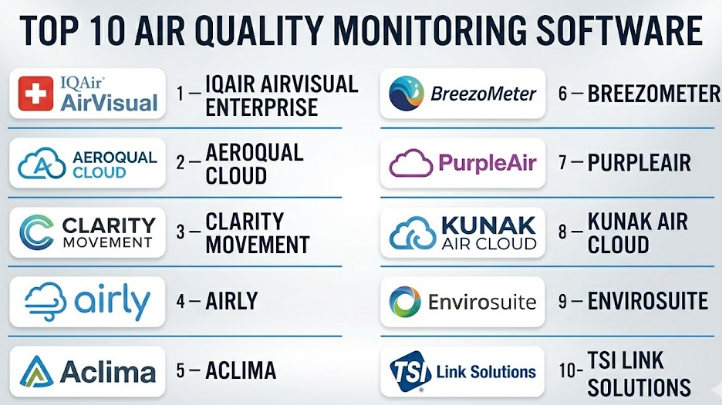
Top 10 Air Quality Monitoring Software
#1 — IQAir AirVisual Enterprise
Short description :
IQAir AirVisual Enterprise is an air quality monitoring and reporting platform used for real-time air quality visibility. It is suitable for organizations that want to track indoor or outdoor air quality through dashboards, connected monitors, and historical data. The platform is useful for schools, businesses, cities, public buildings, and environmental teams. It helps users understand air quality conditions, communicate risk, and take action when pollution levels rise. It is especially useful for teams that want a more accessible and visual monitoring experience.
Key Features
- Real-time air quality dashboards
- Indoor and outdoor air quality tracking
- PM2.5, CO2, temperature, humidity, and other sensor support depending on device
- Historical data and trend visibility
- Air quality alerts and notifications
- Public and private monitoring use cases
- Visual reports for non-technical users
Pros
- Easy to understand for business and public-facing users.
- Strong brand recognition in air quality monitoring.
- Useful for indoor air quality and community awareness.
Cons
- Advanced enterprise customization may depend on selected plan.
- Pollutant coverage depends on connected devices.
- Not ideal for highly complex industrial compliance workflows.
Platforms / Deployment
Web / iOS / Android
Cloud
Security & Compliance
Basic account security and cloud access controls are expected. Specific enterprise certifications such as SOC 2, ISO 27001, or HIPAA are Not publicly stated.
Integrations & Ecosystem
IQAir works well when organizations need simple air quality visibility, dashboards, and monitor-based data collection.
- IQAir monitoring devices
- Web dashboard access
- Mobile app ecosystem
- Data reporting and visualization
- Public air quality communication workflows
Support & Community
Documentation, product support, and customer resources are available. Community awareness is strong because IQAir is widely recognized among air quality users.
#2 — Aeroqual Cloud
Short description :
Aeroqual Cloud is designed for air quality monitoring programs that use Aeroqual monitoring hardware and connected software. It is suitable for environmental consultants, industrial teams, construction sites, government agencies, and organizations that need reliable field monitoring. The platform helps users view data, manage monitoring projects, receive alerts, and produce reports. Aeroqual is useful where air quality monitoring needs to be more technical and project-based. It is stronger for professional monitoring than simple consumer-level air quality tracking.
Key Features
- Cloud-based air quality data management
- Support for Aeroqual monitoring stations and sensors
- Real-time dashboards and pollutant trends
- Alerts for threshold exceedances
- Data export and reporting
- Project-based monitoring workflows
- Outdoor and industrial monitoring use cases
Pros
- Strong fit for professional air quality monitoring projects.
- Good hardware and software ecosystem.
- Useful for consultants, construction, and industrial monitoring.
Cons
- Best value comes when using Aeroqual hardware.
- May require technical setup and calibration planning.
- Less suitable for users needing only basic indoor visibility.
Platforms / Deployment
Web
Cloud
Security & Compliance
Role-based access and cloud security controls may be available depending on configuration. Specific certifications are Not publicly stated.
Integrations & Ecosystem
Aeroqual Cloud is closely connected with Aeroqual’s monitoring devices and project-based environmental workflows.
- Aeroqual hardware ecosystem
- Data exports
- Reporting workflows
- Field monitoring devices
- Environmental consulting workflows
Support & Community
Vendor support, documentation, and implementation guidance are available. Community strength is strongest among environmental consultants and technical monitoring teams.
#3 — Clarity Movement
Short description :
Clarity Movement provides air quality monitoring software and sensor network solutions for cities, governments, campuses, communities, and organizations that need distributed air monitoring. It focuses on scalable sensor networks, air pollution visibility, mapping, and data analytics. The platform is useful for smart city programs, public health planning, environmental justice projects, and community monitoring. Clarity is especially strong when many monitoring points are needed across a geographic area. It is more suitable for program-level monitoring than individual consumer use.
Key Features
- Distributed air quality sensor network management
- Real-time dashboards and maps
- PM2.5, NO2, ozone, and other pollutant support depending on sensor setup
- Air quality analytics and reporting
- Community and city-scale monitoring
- Alerts and trend analysis
- Data services and monitoring program support
Pros
- Strong fit for cities and community air monitoring.
- Useful for scalable sensor network deployments.
- Good for public health and environmental justice use cases.
Cons
- May require project planning and deployment support.
- Best suited for organizations, not casual individual users.
- Pricing and package details are typically project-based.
Platforms / Deployment
Web
Cloud
Security & Compliance
Enterprise access controls may be available. Specific certifications are Not publicly stated.
Integrations & Ecosystem
Clarity works well where air quality data must connect with maps, public dashboards, analytics, and city planning systems.
- Sensor network ecosystem
- Environmental data APIs
- Mapping and visualization workflows
- City and community monitoring programs
- Data analytics and reporting
Support & Community
Vendor-led support, project guidance, documentation, and deployment services are available. Community relevance is strong in smart city and public-sector monitoring programs.
#4 — Airly
Short description :
Airly provides air quality monitoring software, sensors, and data tools for cities, businesses, schools, and communities. It helps users track air pollution levels, view maps, understand trends, and communicate local air quality conditions. Airly is especially useful for public-facing air quality visibility and smart city initiatives. The platform supports environmental awareness, alerts, and location-based monitoring. It is a good choice for organizations that want a visual and accessible air quality monitoring experience.
Key Features
- Air quality maps and dashboards
- Sensor-based monitoring network support
- Pollution trend analysis
- Forecasting and alerts
- Public-facing air quality communication
- API and data access options
- Useful for cities, schools, and communities
Pros
- Strong visual experience for public and organizational users.
- Useful for city-scale and community air quality awareness.
- Good fit for education, public health, and local monitoring.
Cons
- Advanced enterprise compliance workflows may be limited.
- Sensor availability and coverage may vary by region.
- Detailed security certifications are not clearly public.
Platforms / Deployment
Web / iOS / Android
Cloud
Security & Compliance
Standard cloud application security is expected. Specific certifications such as SOC 2, ISO 27001, or HIPAA are Not publicly stated.
Integrations & Ecosystem
Airly is useful when air quality data needs to be shared visually and connected with public or organizational dashboards.
- Airly sensor ecosystem
- API access
- Public maps
- Mobile app access
- Reporting and alerting workflows
Support & Community
Support and documentation are available through the vendor. Community visibility is strong in air quality awareness and city monitoring use cases.
#5 — Aclima
Short description :
Aclima provides air quality and environmental intelligence solutions focused on hyperlocal air pollution mapping and emissions insights. It is suitable for governments, enterprises, public health teams, and organizations that need street-level or community-level air quality data. Aclima is especially relevant for environmental justice, city planning, emissions reduction, and local pollution exposure analysis. Its strength is detailed environmental intelligence rather than basic sensor dashboards. It is better suited for large projects and data-driven public or enterprise programs.
Key Features
- Hyperlocal air quality mapping
- Pollution exposure analysis
- Environmental intelligence dashboards
- Community and city-scale monitoring
- Data-driven planning support
- Emissions and pollution insights
- Useful for public health and environmental justice projects
Pros
- Strong for hyperlocal pollution intelligence.
- Useful for city planning and community impact analysis.
- Good fit for public-sector and large-scale environmental projects.
Cons
- Not designed as a simple plug-and-play indoor monitor app.
- Project scope and pricing may be enterprise or government-focused.
- Implementation may require planning and stakeholder coordination.
Platforms / Deployment
Web
Cloud
Security & Compliance
Enterprise security capabilities may be available depending on engagement. Specific certifications are Not publicly stated.
Integrations & Ecosystem
Aclima is valuable when air quality data needs to support planning, policy, public health, and emissions intelligence.
- Environmental intelligence workflows
- Geospatial analysis
- Public-sector data programs
- Enterprise sustainability workflows
- Reporting and decision-support systems
Support & Community
Support is typically project-led and vendor-guided. Community relevance is strongest among cities, environmental justice programs, researchers, and policy teams.
#6 — BreezoMeter
Short description :
BreezoMeter provides air quality, pollen, wildfire, and environmental data services through APIs and digital experiences. It is useful for companies that want to embed air quality information into apps, websites, health platforms, weather products, insurance tools, or smart home systems. BreezoMeter is more API and data-service focused than a traditional environmental compliance platform. It is best for product teams and digital businesses that need location-based air quality intelligence inside their own user experience.
Key Features
- Air quality data APIs
- Pollen and environmental data services
- Location-based pollution insights
- Wildfire and smoke-related data support
- Health-focused air quality recommendations
- Digital product integration
- Useful for apps, platforms, and connected services
Pros
- Strong for embedding air quality data into products.
- Useful for health, weather, smart home, and digital services.
- API-first model supports flexible product integration.
Cons
- Not a full compliance or field sensor management platform.
- Best for software teams, not teams needing only a dashboard.
- Data coverage and commercial access should be validated by use case.
Platforms / Deployment
API / Web-based services
Cloud
Security & Compliance
Not publicly stated.
Integrations & Ecosystem
BreezoMeter is strongest for digital product integration and API-based environmental intelligence.
- Air quality APIs
- Mobile and web app integration
- Health and weather applications
- Smart home and IoT ecosystems
- Location-based user experiences
Support & Community
Developer documentation and commercial support may be available. Community strength is strongest among product teams using air quality data services.
#7 — PurpleAir
Short description :
PurpleAir is known for its network of air quality sensors and public air quality map. It is useful for communities, schools, homeowners, researchers, and organizations that want practical air quality visibility using distributed sensors. PurpleAir is especially popular for particulate matter monitoring and community-level awareness. It is not a full enterprise EHS platform, but it is very useful for accessible sensor data, public maps, and local monitoring projects. It is best for visibility and awareness rather than formal compliance-only workflows.
Key Features
- Sensor-based air quality monitoring
- Public air quality map
- PM2.5 and particulate matter visibility
- Community monitoring network
- Real-time and historical data access
- Useful for wildfire smoke and local pollution tracking
- API/data access options may be available depending on usage
Pros
- Accessible and community-friendly.
- Useful for local air quality visibility.
- Strong public map and sensor network awareness.
Cons
- Not a formal enterprise compliance management system.
- Data interpretation may require calibration and context.
- Pollutant coverage depends on device type.
Platforms / Deployment
Web
Cloud / Sensor network
Security & Compliance
Not publicly stated.
Integrations & Ecosystem
PurpleAir is useful when organizations or communities need accessible particulate matter monitoring and public visibility.
- PurpleAir sensors
- Public map ecosystem
- Data export or API-style access depending on use case
- Community monitoring projects
- Research and awareness workflows
Support & Community
Documentation and support resources are available. Community strength is strong among citizen science, wildfire smoke monitoring, and local air quality users.
#8 — Kunak AIR Cloud
Short description :
Kunak AIR Cloud is an air quality monitoring platform connected with Kunak monitoring stations and environmental sensors. It is designed for smart cities, industrial monitoring, ports, construction sites, environmental consultants, and public agencies. The platform helps teams monitor pollutants, manage devices, analyze data, and generate reports. Kunak is useful when organizations need professional-grade sensor networks and cloud-based environmental intelligence. It is a strong option for structured outdoor air monitoring programs.
Key Features
- Cloud-based air quality monitoring dashboard
- Device and sensor network management
- Pollutant tracking depending on sensor setup
- Alerts and threshold monitoring
- Data validation and analysis tools
- Reporting and export capabilities
- Useful for smart cities, ports, and industrial sites
Pros
- Good fit for professional outdoor air monitoring.
- Strong connection between hardware and cloud software.
- Useful for industrial, urban, and infrastructure monitoring.
Cons
- Best suited for Kunak ecosystem deployments.
- Requires planning for sensor placement and calibration.
- May be more advanced than basic indoor monitoring needs.
Platforms / Deployment
Web
Cloud
Security & Compliance
Not publicly stated.
Integrations & Ecosystem
Kunak AIR Cloud is useful when organizations need a complete monitoring stack from devices to dashboards.
- Kunak monitoring stations
- Sensor network management
- Data exports
- Environmental reporting workflows
- Smart city and industrial systems
Support & Community
Vendor support, documentation, and deployment guidance are available. Community strength is stronger among environmental professionals and monitoring program teams.
#9 — Envirosuite
Short description :
Envirosuite provides environmental intelligence software used for air quality, odor, noise, dust, weather, water, and operational environmental management. It is relevant for airports, ports, mining, wastewater facilities, heavy industry, and communities affected by environmental impacts. The platform helps organizations predict, monitor, and manage environmental conditions. It is especially useful when air quality is connected with odor, dust, weather, and operational decision-making. It is more advanced than simple sensor dashboards.
Key Features
- Air quality, odor, dust, and noise monitoring support
- Environmental intelligence dashboards
- Predictive analytics and operational insights
- Weather and dispersion-related analysis
- Alerts and incident response support
- Community and compliance reporting workflows
- Industrial and infrastructure-focused use cases
Pros
- Strong fit for complex operational environments.
- Useful for air quality plus odor, dust, and noise.
- Good for industries needing proactive environmental management.
Cons
- May be too specialized for small basic monitoring needs.
- Implementation can require operational and environmental expertise.
- Pricing and modules are typically not simple public information.
Platforms / Deployment
Web
Cloud
Security & Compliance
Enterprise controls may be available. Specific certifications are Not publicly stated.
Integrations & Ecosystem
Envirosuite works well when environmental monitoring data must support real operational decisions.
- Sensor and monitoring data sources
- Weather and environmental models
- Incident and alert workflows
- Industrial operation systems
- Reporting and stakeholder communication
Support & Community
Vendor support, implementation guidance, and technical resources are available. Community strength is strongest in industrial, infrastructure, and environmental operations.
#10 — TSI Link Solutions
Short description :
TSI Link Solutions supports connected monitoring and data access for TSI instruments, including air quality and indoor environmental monitoring use cases. It is useful for facility teams, industrial hygienists, environmental health teams, and professionals using TSI devices. The software helps users view, manage, and share measurement data from compatible instruments. It is best for teams already using TSI equipment or needing instrument-connected monitoring workflows. It is more device-focused than broad ESG or EHS platforms.
Key Features
- Connected monitoring for compatible TSI instruments
- Indoor air quality and environmental data visibility
- Remote data access depending on device and setup
- Reporting and sharing support
- Useful for facility and professional measurement teams
- Instrument-based workflow support
- Data collection and monitoring assistance
Pros
- Strong fit for users of TSI monitoring instruments.
- Useful for indoor air quality and professional measurement workflows.
- Practical for facility, lab, and environmental health teams.
Cons
- Best value is tied to TSI hardware ecosystem.
- Not a full enterprise environmental compliance platform.
- Integration depth may vary by device and setup.
Platforms / Deployment
Web / Cloud
Device compatibility varies.
Security & Compliance
Not publicly stated.
Integrations & Ecosystem
TSI Link Solutions is useful when air quality data needs to be captured and managed from professional instruments.
- TSI instruments
- Cloud-based data access
- Reporting workflows
- Facility monitoring use cases
- Professional measurement workflows
Support & Community
Vendor documentation, product support, and technical guidance are available. Community strength is mainly among professional measurement and facility monitoring users.
Comparison Table
| Tool Name | Best For | Platform(s) Supported | Deployment | Standout Feature | Public Rating |
|---|---|---|---|---|---|
| IQAir AirVisual Enterprise | Indoor and outdoor air quality visibility | Web / iOS / Android | Cloud | Simple dashboards and monitor-based air quality tracking | N/A |
| Aeroqual Cloud | Professional monitoring projects | Web | Cloud | Air quality monitoring connected with professional hardware | N/A |
| Clarity Movement | City and community sensor networks | Web | Cloud | Scalable distributed air quality monitoring | N/A |
| Airly | Smart cities, schools, and public awareness | Web / iOS / Android | Cloud | Visual maps and accessible air quality communication | N/A |
| Aclima | Hyperlocal air pollution intelligence | Web | Cloud | Street-level and community-level environmental insights | N/A |
| BreezoMeter | Product teams needing air quality APIs | API / Web services | Cloud | Air quality data integration into apps and digital products | N/A |
| PurpleAir | Community and local PM monitoring | Web | Cloud / Sensor network | Public sensor map and accessible particulate monitoring | N/A |
| Kunak AIR Cloud | Smart cities and industrial monitoring | Web | Cloud | Professional sensor network and device management | N/A |
| Envirosuite | Industrial environmental intelligence | Web | Cloud | Air, odor, dust, noise, and weather-based insights | N/A |
| TSI Link Solutions | TSI instrument users and facility teams | Web / Device-based | Cloud | Connected data access for professional instruments | N/A |
Evaluation & Air Quality Monitoring Software
| Tool Name | Core (25%) | Ease (15%) | Integrations (15%) | Security (10%) | Performance (10%) | Support (10%) | Value (15%) | Weighted Total (0–10) |
|---|---|---|---|---|---|---|---|---|
| IQAir AirVisual Enterprise | 8 | 9 | 7 | 6 | 8 | 8 | 8 | 7.75 |
| Aeroqual Cloud | 9 | 7 | 7 | 6 | 9 | 8 | 7 | 7.75 |
| Clarity Movement | 9 | 8 | 8 | 7 | 8 | 8 | 7 | 8.00 |
| Airly | 8 | 9 | 8 | 6 | 8 | 7 | 8 | 7.80 |
| Aclima | 9 | 7 | 8 | 7 | 9 | 8 | 7 | 8.00 |
| BreezoMeter | 8 | 8 | 9 | 6 | 8 | 7 | 8 | 7.85 |
| PurpleAir | 7 | 9 | 7 | 5 | 7 | 7 | 9 | 7.35 |
| Kunak AIR Cloud | 9 | 7 | 7 | 6 | 9 | 8 | 7 | 7.75 |
| Envirosuite | 9 | 7 | 8 | 7 | 9 | 8 | 7 | 8.00 |
| TSI Link Solutions | 7 | 8 | 6 | 6 | 8 | 8 | 7 | 7.15 |
These scores are comparative and should be used for shortlisting, not as a final buying decision. A city monitoring team, an industrial facility, and an indoor air quality team may need very different platforms. The best score for one use case may not be the best score for another. Always validate device compatibility, reporting needs, integration options, security controls, support quality, and total cost before choosing.
Which Air Quality Monitoring Software
Solo / Freelancer
Independent environmental consultants, researchers, and small air quality professionals should focus on practical deployment, data access, and easy reporting. PurpleAir can be useful for community-level particulate monitoring. Aeroqual Cloud, Kunak AIR Cloud, or TSI Link Solutions may be better for professional measurement projects.
If the main need is app-based air quality visibility, IQAir AirVisual Enterprise or Airly may be easier to use. Solo users should avoid very large enterprise systems unless they are working on a government or industrial project.
SMB
Small and mid-sized businesses usually need simple dashboards, alerts, and reports without heavy implementation. IQAir AirVisual Enterprise, Airly, and TSI Link Solutions may be useful for indoor or facility-level monitoring. Aeroqual Cloud can be stronger for construction, industrial, or professional outdoor monitoring.
SMBs should choose based on whether they need indoor comfort monitoring, outdoor pollution tracking, compliance support, or sensor network management.
Mid-Market
Mid-market organizations may need multiple site monitoring, better reporting, and stronger data consistency. Clarity Movement, Aeroqual Cloud, Kunak AIR Cloud, and Envirosuite are strong options depending on project type.
For cities and campuses, Clarity or Airly may fit well. For industrial and operational sites, Envirosuite, Aeroqual, or Kunak may be stronger. For product teams, BreezoMeter may be better because it focuses on API-driven air quality data.
Enterprise
Enterprises should prioritize scalability, security, integrations, governance, and advanced analytics. Envirosuite, Aclima, Clarity Movement, Aeroqual Cloud, and Kunak AIR Cloud are stronger candidates for large monitoring programs.
Organizations should also consider whether they need hyperlocal intelligence, public dashboards, compliance reports, sensor hardware management, or integration with ESG and sustainability platforms.
Budget vs Premium
Budget-focused buyers may consider PurpleAir, IQAir, or Airly for accessible monitoring and visibility. These can be suitable for community projects, schools, facilities, or smaller monitoring programs.
Premium buyers with industrial, government, or large-scale requirements should evaluate Clarity Movement, Aclima, Envirosuite, Aeroqual Cloud, or Kunak AIR Cloud. Premium tools usually provide better program support, stronger analytics, and more professional monitoring workflows.
Feature Depth vs Ease of Use
For ease of use, IQAir, Airly, and PurpleAir are strong choices. They are more visual and easier for non-technical users to understand.
For feature depth, Envirosuite, Aclima, Clarity Movement, Aeroqual Cloud, and Kunak AIR Cloud are stronger. They are better for structured monitoring programs, city-scale deployments, industrial environments, and advanced environmental intelligence.
Integrations & Scalability
For API-based integration, BreezoMeter is a strong option for product teams. For sensor network scalability, Clarity Movement, Kunak AIR Cloud, and Aeroqual Cloud are strong candidates.
For industrial environmental operations, Envirosuite may provide better value because it connects air quality with odor, dust, noise, weather, and operational context. Buyers should validate APIs, data exports, hardware compatibility, and dashboard access before final selection.
Security & Compliance Needs
Security-conscious buyers should ask vendors about SSO, MFA, RBAC, audit logs, encryption, data ownership, data residency, and backup policies. Public-sector and enterprise buyers should also check procurement, privacy, and compliance requirements.
For high-risk environments, the platform should provide reliable user permissions, validated data workflows, and audit-friendly reporting. If security details are not publicly clear, buyers should request documentation during vendor evaluation.
Frequently Asked Questions
1. What is Air Quality Monitoring Software?
Air Quality Monitoring Software helps collect and analyze air pollution data from sensors, devices, APIs, and monitoring stations. It shows real-time air quality levels, trends, alerts, maps, and reports so teams can make better environmental decisions.
2. What pollutants can these tools monitor?
The pollutants depend on the connected sensors or data source. Common measurements include PM2.5, PM10, CO2, CO, NO2, ozone, VOCs, temperature, humidity, pressure, and sometimes odor, dust, or smoke-related indicators.
3. How much does Air Quality Monitoring Software cost?
Pricing varies by vendor, sensors, users, locations, APIs, data volume, and support level. Some platforms are affordable for small projects, while city-scale or industrial deployments may require custom pricing.
4. Is air quality software useful for indoor monitoring?
Yes. Indoor air quality monitoring is useful for offices, schools, hospitals, airports, labs, and commercial buildings. It helps track comfort, ventilation quality, CO2 levels, particulate matter, and possible air quality risks.
5. Can air quality platforms send alerts?
Yes. Many platforms support alerts when pollutant levels cross defined thresholds. Alerts may be delivered through dashboards, email, mobile notifications, or configured workflows depending on the software.
6. What is the biggest mistake buyers make?
The biggest mistake is choosing software before defining the monitoring goal. A city air quality project, an indoor office project, and an industrial dust monitoring project all need different devices, dashboards, and reporting workflows.
7. Can these tools integrate with other systems?
Many platforms offer APIs, exports, dashboards, or integration options. Product-focused tools like BreezoMeter are especially API-driven, while sensor platforms may integrate with analytics, GIS, smart city systems, or environmental reporting tools.
8. Are low-cost air quality sensors reliable?
Low-cost sensors can be useful for visibility and trend monitoring, but accuracy depends on calibration, placement, weather conditions, maintenance, and data validation. For compliance or high-stakes use, professional-grade monitoring may be required.
9. Which software is best for cities?
Cities should consider platforms like Clarity Movement, Airly, Aclima, Kunak AIR Cloud, or Envirosuite depending on the project. The best choice depends on whether the city needs public dashboards, hyperlocal mapping, sensors, analytics, or operational alerts.
10. Which software is best for industrial sites?
Industrial sites may benefit from Aeroqual Cloud, Kunak AIR Cloud, Envirosuite, or TSI Link Solutions. These tools are more suitable when monitoring requires professional devices, alerts, reporting, and operational environmental awareness.
Conclusion
Air Quality Monitoring Software is now an important tool for organizations that need better visibility into pollution, indoor air quality, community exposure, industrial emissions, and environmental performance. The best platform depends on the use case. A school or office may need a simple dashboard and indoor monitoring. A city may need a scalable sensor network and public air quality map. An industrial site may need professional sensors, alerts, and operational intelligence. A software product team may need APIs instead of dashboards.
