Introduction
Event Venue Management Tools help venue owners, event managers, hospitality teams, sales teams, operations teams, and facility managers manage bookings, inquiries, contracts, calendars, floor plans, catering, staffing, payments, communication, and event execution from one organized platform. In simple words, these tools help venues handle the full event lifecycle, from the first inquiry to final billing and post-event reporting.
Event venues often manage many moving parts. A single event may include client inquiries, availability checks, proposal creation, room layout, guest count, food and beverage planning, equipment needs, staff scheduling, contracts, invoices, deposits, vendor coordination, and event-day operations. Without proper software, teams may depend on spreadsheets, shared calendars, emails, paper contracts, and manual follow-ups, which can lead to double bookings, missed details, poor client experience, and revenue leakage.
Common use cases include venue booking, event calendar management, lead tracking, proposal generation, contract management, banquet event orders, floor plan design, catering coordination, payment tracking, resource scheduling, staff planning, vendor coordination, event reporting, and customer communication.
Buyers should evaluate booking workflows, calendar visibility, CRM features, proposal and contract tools, floor plan management, catering support, payment tracking, automation, reporting, integrations, mobile access, permissions, security, scalability, and ease of use.
Best for: event venues, hotels, banquet halls, conference centers, convention centers, wedding venues, coworking event spaces, stadiums, universities, cultural centers, restaurants with private rooms, corporate event teams, and venue operators managing frequent bookings.
Not ideal for: very small venues with only occasional bookings, teams that only need a basic shared calendar, or organizations that do not need proposal management, contracts, payments, floor plans, or event operations tracking.
Key Trends in Event Venue Management Tools
- Centralized booking calendars are becoming essential, helping venue teams avoid double bookings, missed holds, and unclear room availability.
- Digital proposal and contract workflows are replacing manual documents, allowing sales teams to create quotes, send agreements, collect approvals, and manage deposits faster.
- CRM features are becoming more important, because venues need to track leads, inquiries, follow-ups, event history, client preferences, and lost opportunities.
- Floor plan and seating tools are becoming more connected, helping teams visualize layouts, capacity, tables, booths, stages, exits, equipment, and service flow.
- Food and beverage planning is becoming more integrated, especially for hotels, banquet halls, wedding venues, and conference centers that need menus, packages, BEOs, and catering details.
- Automation is reducing repetitive follow-ups, including inquiry responses, quote reminders, deposit reminders, contract status updates, and event timeline notifications.
- Hybrid and corporate events are influencing venue workflows, with more demand for AV details, streaming support, room technology, breakout spaces, and flexible layouts.
- Revenue analytics are becoming more valuable, helping venues track booking conversion, room utilization, average event value, lost business, payment status, and seasonal demand.
- Integration with payment, accounting, CRM, and marketing systems is expected, because venue data often connects with financial reporting, lead generation, and customer communication.
- Security and permission controls matter more, especially when teams manage client contracts, payment data, guest details, vendor documents, and confidential event information.
How We Selected These Tools
The tools below were selected using practical event venue and hospitality operations evaluation logic.
- Market recognition: Tools known in venue management, event booking, hospitality sales, catering management, event CRM, and event operations were prioritized.
- Feature completeness: Booking calendars, proposals, contracts, CRM, payments, floor plans, catering, reporting, and communication workflows were reviewed.
- Venue workflow fit: Tools that support inquiry-to-event workflows, room bookings, event holds, client details, and event execution were given stronger consideration.
- Sales and CRM strength: Lead tracking, follow-ups, pipeline visibility, proposal generation, and conversion reporting were considered important.
- Event operations support: Floor plans, BEOs, room setup, staff notes, catering details, equipment, and event timelines were evaluated.
- Ease of use: Venue sales and operations teams need software that is practical during busy event cycles.
- Integration ecosystem: Payment processors, accounting, calendars, marketing tools, CRM systems, ticketing tools, and event platforms were considered.
- Security and governance: User roles, client data controls, contract access, payment handling, and admin permissions were reviewed.
- Scalability: Tools suitable for small venues, hotels, conference centers, enterprise hospitality groups, and large event facilities were included.
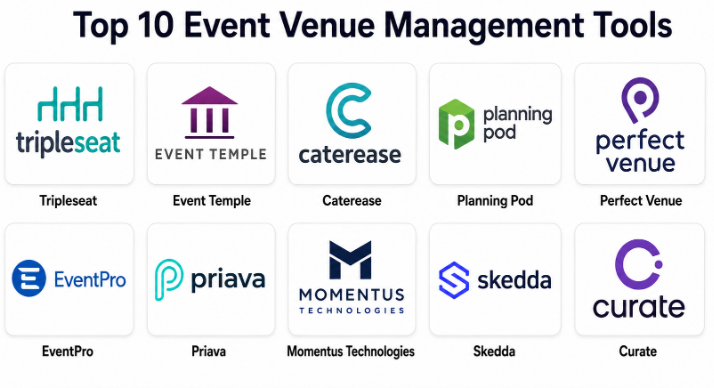
Top 10 Event Venue Management Tools
#1 — Tripleseat
Short description :
Tripleseat is an event sales and venue management platform designed for restaurants, hotels, private dining spaces, event venues, and hospitality businesses. It helps teams manage leads, bookings, proposals, contracts, payments, banquet event orders, guest details, and event communication. Tripleseat is especially useful for venues that handle private events, weddings, corporate gatherings, catering, and group bookings. It supports sales teams and event managers by keeping inquiries, documents, and event details organized. It is best for hospitality-focused venues that need strong event sales and booking workflows.
Key Features
- Lead and inquiry management.
- Booking calendar.
- Proposal and contract workflows.
- Event documents and BEO support.
- Payment and deposit tracking.
- Client communication.
- Reporting and sales pipeline visibility.
Pros
- Strong fit for restaurants, hotels, and private event venues.
- Useful for managing proposals, contracts, and event details.
- Helps reduce manual follow-ups and scattered communication.
Cons
- May be more than very small venues need.
- Setup requires clear event packages and workflow structure.
- Best value depends on active sales pipeline usage.
Platforms / Deployment
Web / Mobile access may vary
Cloud
Security & Compliance
Supports user permissions, client records, event documents, payment-related workflows, and administrative controls depending on plan. Specific compliance details should be validated directly with the vendor.
Integrations & Ecosystem
Tripleseat connects event sales with hospitality operations.
- Payment workflows.
- Calendar systems.
- CRM-style sales tracking.
- Catering and BEO workflows.
- Client communication.
- Reporting dashboards.
Support & Community
Tripleseat provides onboarding, documentation, customer support, and hospitality event management resources.
#2 — Event Temple
Short description :
Event Temple is a venue management and hospitality sales platform built for hotels, venues, event spaces, and hospitality groups. It helps teams manage inquiries, leads, bookings, contracts, proposals, room blocks, tasks, email communication, and reporting. Event Temple is useful for venues that need a strong sales CRM combined with event booking and operational details. It supports teams handling corporate events, weddings, meetings, and group bookings. It is best for hotels and venues that want event sales, CRM, and booking workflows in one platform.
Key Features
- Event CRM and lead tracking.
- Booking calendar.
- Proposal and contract management.
- Task and follow-up automation.
- Room block support may vary.
- Email communication workflows.
- Sales and booking reports.
Pros
- Strong CRM-style workflow for venue sales teams.
- Useful for hotels and event venues.
- Good for tracking inquiries, pipeline, and follow-ups.
Cons
- May require setup effort for templates and sales stages.
- Smaller venues may not need full CRM depth.
- Advanced catering or floor plan workflows should be validated.
Platforms / Deployment
Web
Cloud
Security & Compliance
Supports user roles, client data controls, contract records, communication history, and administrative settings depending on plan. Specific compliance details should be validated directly with the vendor.
Integrations & Ecosystem
Event Temple connects venue sales with operational booking workflows.
- Email systems.
- Calendar workflows.
- Proposal templates.
- Contract workflows.
- Sales pipeline reporting.
- Hospitality operations.
Support & Community
Event Temple provides onboarding, documentation, customer support, and sales workflow guidance for venues and hospitality teams.
#3 — Caterease
Short description :
Caterease is event planning and catering management software used by caterers, banquet halls, hotels, event venues, and hospitality teams. It helps manage event bookings, menus, proposals, contracts, invoices, BEOs, room layouts, staffing details, and client communication. Caterease is especially useful when food and beverage planning is central to venue operations. It helps teams organize event details and produce professional event documents. It is best for catering-heavy venues, banquet operations, and hospitality teams that need detailed event planning and food service workflows.
Key Features
- Event booking management.
- Menu and catering planning.
- Proposal and contract tools.
- Banquet event order generation.
- Invoicing and payment tracking.
- Staff and resource planning.
- Event document templates.
Pros
- Strong catering and banquet workflow support.
- Useful for detailed event documents and BEOs.
- Good fit for venues with food and beverage operations.
Cons
- Interface and workflow should be tested for modern team preferences.
- May be more detailed than simple venue booking tools.
- Best value depends on catering complexity.
Platforms / Deployment
Windows / Web options may vary
Desktop / Cloud options vary
Security & Compliance
Security depends on deployment model, user controls, local or cloud setup, and administrative configuration. Specific compliance details should be validated directly with the vendor.
Integrations & Ecosystem
Caterease connects event planning with catering and banquet operations.
- Menu planning.
- BEO workflows.
- Proposal documents.
- Invoice workflows.
- Staffing and resource planning.
- Event reporting.
Support & Community
Caterease provides customer support, documentation, training resources, and event catering workflow guidance.
#4 — Planning Pod
Short description :
Planning Pod is event management and venue management software for event venues, planners, caterers, and event professionals. It helps teams manage bookings, event calendars, proposals, contracts, invoices, floor plans, task lists, timelines, forms, and client communication. Planning Pod is useful for wedding venues, banquet halls, corporate event spaces, nonprofits, schools, and independent event planners. It provides a broad set of tools for planning and executing events from one platform. It is best for venues and event teams that need practical event planning, booking, and client collaboration tools.
Key Features
- Booking calendar.
- Event planning dashboard.
- Proposal and contract management.
- Invoice and payment tracking.
- Floor plan tools.
- Task lists and timelines.
- Client collaboration portals.
Pros
- Broad event planning feature set.
- Useful for venues, planners, and event teams.
- Good balance of booking, planning, and operations tools.
Cons
- Teams may need time to learn all features.
- Advanced hotel-specific workflows may be limited.
- Best value depends on using multiple modules.
Platforms / Deployment
Web
Cloud
Security & Compliance
Supports user permissions, client data controls, event documents, payment-related workflows, and administrative settings depending on plan.
Integrations & Ecosystem
Planning Pod connects event planning with venue operations.
- Event calendars.
- Floor plans.
- Proposals and contracts.
- Invoice workflows.
- Client collaboration.
- Task and timeline management.
Support & Community
Planning Pod provides documentation, support resources, onboarding guidance, and event planning templates.
#5 — Perfect Venue
Short description :
Perfect Venue is event management software designed for restaurants, private dining spaces, bars, hospitality groups, and event venues. It helps teams manage inquiries, bookings, proposals, contracts, payments, event details, and customer communication. Perfect Venue is useful for venues that need a simple and modern way to handle private events and group bookings. It focuses on making event sales and booking workflows easier for hospitality teams. It is best for restaurants and small to mid-sized venues that need clean event booking and client management.
Key Features
- Inquiry and lead management.
- Event booking calendar.
- Proposal and contract workflows.
- Payment collection support.
- Event detail tracking.
- Client communication.
- Sales reporting.
Pros
- Easy for hospitality teams to use.
- Good fit for restaurants and private dining.
- Helps streamline event inquiries and booking workflows.
Cons
- May not fit large convention center complexity.
- Advanced floor plan or production workflows should be validated.
- Best value depends on private event volume.
Platforms / Deployment
Web
Cloud
Security & Compliance
Supports user permissions, client records, event documents, payment-related workflows, and administrative controls depending on plan.
Integrations & Ecosystem
Perfect Venue connects private event sales with daily venue workflows.
- Booking calendars.
- Proposal templates.
- Contract workflows.
- Payment workflows.
- Client communication.
- Event sales reports.
Support & Community
Perfect Venue provides onboarding, support resources, documentation, and hospitality event workflow guidance.
#6 — EventPro
Short description :
EventPro is event management software designed for venues, event planners, conference centers, convention facilities, caterers, and organizations managing complex events. It helps teams manage bookings, event details, resources, contracts, invoices, schedules, tasks, contacts, and event operations. EventPro is useful for venues that need structured event management across departments and resources. It can support detailed event planning and operational coordination. It is best for venues that need more traditional event operations management with deeper event detail tracking.
Key Features
- Event booking management.
- Contact and client management.
- Resource scheduling.
- Contracts and invoices.
- Task and timeline tracking.
- Event documents.
- Reporting tools.
Pros
- Strong event operations feature set.
- Useful for venues with complex resource needs.
- Good for detailed event planning and administration.
Cons
- User experience should be tested for team fit.
- Setup may require configuration and training.
- Smaller venues may not need full operational depth.
Platforms / Deployment
Windows / Web options may vary
Desktop / Cloud options vary
Security & Compliance
Security depends on deployment model, user permissions, hosting setup, and administrative configuration. Specific compliance details should be validated directly with the vendor.
Integrations & Ecosystem
EventPro connects event operations with venue workflows.
- Resource scheduling.
- Contract documents.
- Invoicing.
- Event timelines.
- Contact management.
- Operational reporting.
Support & Community
EventPro provides documentation, customer support, training resources, and event management implementation guidance.
#7 — Priava
Short description :
Priava is venue and event management software designed for venues, universities, conference centers, cultural institutions, and event spaces. It helps teams manage room bookings, event inquiries, calendars, resources, clients, invoices, contracts, and event operations. Priava is useful for organizations that manage many spaces, rooms, halls, and event requests. It supports venue availability, event details, and operational coordination. It is best for venues and institutions that need room booking, resource management, and event scheduling in one platform.
Key Features
- Venue and room booking.
- Event calendar management.
- Resource scheduling.
- Client and contact records.
- Contracts and invoicing support.
- Event task tracking.
- Reporting and availability visibility.
Pros
- Strong for multi-room venue management.
- Useful for universities and institutional event spaces.
- Helps avoid booking conflicts and resource confusion.
Cons
- May require configuration for complex workflows.
- Smaller venues may prefer simpler tools.
- Advanced sales CRM depth should be validated.
Platforms / Deployment
Web
Cloud
Security & Compliance
Supports user permissions, event data controls, booking records, and administrative settings depending on plan. Specific compliance details should be validated directly with the vendor.
Integrations & Ecosystem
Priava connects venue booking with event operations.
- Room calendars.
- Resource scheduling.
- Client records.
- Invoicing workflows.
- Event documents.
- Availability reporting.
Support & Community
Priava provides onboarding, customer support, documentation, and venue management guidance.
#8 — Momentus Technologies
Short description :
Momentus Technologies provides venue and event management solutions for large venues, convention centers, stadiums, arenas, performing arts centers, and complex event facilities. It supports event booking, sales, operations, resource management, financial workflows, event calendars, and reporting. Momentus is especially useful for large venues that manage complex events with many departments, spaces, vendors, and operational requirements. It is best for enterprise venues and major event facilities that need robust venue operations management.
Key Features
- Enterprise venue booking.
- Event sales and CRM workflows.
- Resource and space management.
- Event operations planning.
- Financial and reporting workflows.
- Calendar and availability management.
- Multi-department coordination.
Pros
- Strong for large venues and complex facilities.
- Useful for convention centers, stadiums, and arenas.
- Supports enterprise-level event operations.
Cons
- May be too complex for small venues.
- Implementation requires planning and stakeholder alignment.
- Pricing and setup should be reviewed carefully.
Platforms / Deployment
Web / Mobile options may vary
Cloud / Enterprise options vary
Security & Compliance
Supports enterprise permissions, role-based access, event data controls, financial workflow controls, and administrative governance depending on configuration.
Integrations & Ecosystem
Momentus connects venue management with enterprise event operations.
- Venue sales.
- Space booking.
- Resource scheduling.
- Event operations.
- Financial systems.
- Reporting dashboards.
Support & Community
Momentus provides enterprise support, implementation resources, documentation, and venue operations guidance.
#9 — Skedda
Short description :
Skedda is a space booking and scheduling platform used by venues, coworking spaces, universities, offices, studios, sports facilities, and shared spaces. It helps teams manage room bookings, availability, booking rules, approvals, payments, user access, and space utilization. While it is broader than event venue management alone, it is highly useful for venues that need clean booking workflows for rooms and shared spaces. It is best for smaller and mid-sized venues that need simple, self-service space booking and scheduling.
Key Features
- Room and space booking.
- Availability calendar.
- Booking rules and approvals.
- User access controls.
- Payment support may vary.
- Space utilization reporting.
- Self-service booking workflows.
Pros
- Easy to use for space booking.
- Good for shared spaces and smaller venues.
- Helps reduce manual scheduling requests.
Cons
- Not a full event sales CRM.
- Advanced catering and BEO workflows may be limited.
- Best suited for booking-led operations.
Platforms / Deployment
Web / Mobile-friendly experience
Cloud
Security & Compliance
Supports user permissions, booking access controls, administrative settings, and space-level rules depending on plan.
Integrations & Ecosystem
Skedda connects booking workflows with space operations.
- Calendar systems.
- Payment workflows may vary.
- User access controls.
- Room booking pages.
- Approval workflows.
- Utilization reporting.
Support & Community
Skedda provides documentation, onboarding support, customer resources, and space booking guidance.
#10 — Curate
Short description :
Curate is event management software focused on event professionals, especially planners, caterers, florists, rental companies, and event service providers. It helps teams manage proposals, orders, inventory, timelines, recipes, pricing, and event details. While it is not only venue software, it can be useful for venues that offer event services, rentals, catering, or detailed production planning. Curate supports event documentation and operational planning where many service details must be coordinated. It is best for event businesses and venues that need proposal and production workflow support.
Key Features
- Event proposal management.
- Order and service detail tracking.
- Inventory support may vary.
- Timeline and production planning.
- Pricing workflows.
- Client communication.
- Event document generation.
Pros
- Useful for event service providers and production-heavy teams.
- Strong proposal and planning workflow support.
- Good for venues with add-on services or rentals.
Cons
- Not a full venue booking platform for all use cases.
- May need another system for room availability and CRM.
- Best value depends on service planning complexity.
Platforms / Deployment
Web
Cloud
Security & Compliance
Supports user permissions, client records, proposal documents, pricing information, and administrative controls depending on plan.
Integrations & Ecosystem
Curate connects event service planning with proposal workflows.
- Event proposals.
- Pricing and orders.
- Production timelines.
- Client documents.
- Rental and service details.
- Event planning workflows.
Support & Community
Curate provides onboarding, documentation, customer support, and event business workflow guidance.
Comparison Table
| Tool Name | Best For | Platform(s) Supported | Deployment | Standout Feature | Public Rating |
|---|---|---|---|---|---|
| Tripleseat | Restaurants, hotels, and private events | Web / Mobile varies | Cloud | Event sales, contracts, payments, and BEO workflows | N/A |
| Event Temple | Hotel and venue sales teams | Web | Cloud | CRM-focused event booking and follow-up management | N/A |
| Caterease | Catering-heavy venues and banquet operations | Windows / Web varies | Desktop / Cloud varies | Catering, menus, BEOs, and event documents | N/A |
| Planning Pod | Event planners and venue teams | Web | Cloud | Booking, contracts, floor plans, and planning tools | N/A |
| Perfect Venue | Restaurants and private dining venues | Web | Cloud | Simple private event booking and client management | N/A |
| EventPro | Detailed event operations management | Windows / Web varies | Desktop / Cloud varies | Resource scheduling and operational event tracking | N/A |
| Priava | Multi-room venues and institutions | Web | Cloud | Room booking, resources, and venue availability | N/A |
| Momentus Technologies | Large venues and convention facilities | Web / Mobile varies | Cloud / Enterprise varies | Enterprise venue and event operations management | N/A |
| Skedda | Shared spaces and room booking | Web / Mobile-friendly | Cloud | Self-service space booking and scheduling rules | N/A |
| Curate | Event service and production teams | Web | Cloud | Proposals, pricing, and event production workflows | N/A |
Evaluation & Event Venue Management Tools
| Tool Name | Core (25%) | Ease (15%) | Integrations (15%) | Security (10%) | Performance (10%) | Support (10%) | Value (15%) | Weighted Total (0–10) |
|---|---|---|---|---|---|---|---|---|
| Tripleseat | 9 | 8 | 8 | 8 | 8 | 9 | 8 | 8.35 |
| Event Temple | 9 | 8 | 8 | 8 | 8 | 8 | 8 | 8.25 |
| Caterease | 9 | 7 | 7 | 8 | 8 | 8 | 8 | 7.95 |
| Planning Pod | 8 | 8 | 8 | 8 | 8 | 8 | 8 | 8.00 |
| Perfect Venue | 8 | 9 | 7 | 8 | 8 | 8 | 8 | 8.00 |
| EventPro | 8 | 7 | 7 | 8 | 8 | 8 | 7 | 7.60 |
| Priava | 8 | 8 | 8 | 8 | 8 | 8 | 7 | 7.85 |
| Momentus Technologies | 10 | 6 | 9 | 9 | 9 | 9 | 7 | 8.45 |
| Skedda | 7 | 9 | 8 | 8 | 8 | 8 | 9 | 8.00 |
| Curate | 7 | 8 | 7 | 8 | 8 | 8 | 8 | 7.65 |
These scores are comparative and should be used as a practical guide, not a fixed ranking. Tripleseat and Event Temple are strong for hospitality event sales and venue booking. Caterease is stronger when catering and banquet event orders are central. Planning Pod is useful for broad event planning workflows. Momentus Technologies is best for large venues and complex event facilities. Skedda is practical for room and space booking, while Curate is useful for event service and production-heavy teams.
Which Event Venue Management Tools
Solo / Freelancer
Solo event planners, small venue consultants, or independent venue managers usually need simple tools for bookings, proposals, invoices, timelines, and client communication. Planning Pod, Skedda, Perfect Venue, and Curate can be practical depending on the workflow.
A solo user should avoid heavy enterprise venue software unless managing a complex facility. The focus should be easy booking, clear client documents, payment tracking, and simple event-day coordination.
SMB
Small and mid-sized venues should focus on inquiry tracking, booking calendars, proposal templates, contracts, deposits, floor plans, and communication. Tripleseat, Perfect Venue, Planning Pod, Event Temple, and Skedda are strong options.
Restaurants and private dining venues may prefer Tripleseat or Perfect Venue. Small halls and community venues may prefer Planning Pod or Skedda depending on whether they need full event planning or simple space booking.
Mid-Market
Mid-market venues usually need stronger CRM, sales pipeline reporting, booking rules, payments, BEOs, resource planning, client communication, and event operations tracking. Tripleseat, Event Temple, Caterease, Priava, and Planning Pod are strong candidates.
At this stage, teams should define booking stages, proposal templates, contract approval rules, deposit policies, event document standards, resource categories, and handoff steps between sales and operations.
Enterprise
Enterprise venues should prioritize scalability, multi-space scheduling, department coordination, role-based permissions, financial workflows, resource planning, reporting, contract controls, and integrations. Momentus Technologies, Tripleseat, Event Temple, Priava, and EventPro may be relevant depending on venue size.
Large venues should involve sales, catering, operations, finance, AV teams, facilities, security, event services, and executive leadership before selecting a platform.
Budget vs Premium
Budget-conscious teams may prefer Skedda, Planning Pod, Perfect Venue, or lightweight event booking tools if their needs are simple.
Premium platforms such as Momentus Technologies, Tripleseat, Event Temple, Caterease, and Priava are better when venues need sales CRM, contracts, BEOs, resource scheduling, complex room availability, enterprise reporting, and multi-department workflows.
Feature Depth vs Ease of Use
If ease of use matters most, Perfect Venue, Skedda, Planning Pod, and Tripleseat are practical choices for teams that need faster adoption.
If feature depth matters more, Momentus Technologies, Caterease, EventPro, Priava, and Event Temple provide stronger support for complex operations, resource planning, banquet details, room booking, and sales pipeline management.
Integrations & Scalability
Event venue management tools should integrate with payment systems, accounting software, calendars, email, CRM tools, ticketing platforms, marketing systems, room booking tools, catering systems, POS platforms, and reporting dashboards.
For hospitality and private dining, Tripleseat and Perfect Venue are strong. For hotels and event sales teams, Event Temple is practical. For catering-heavy venues, Caterease is useful. For large venues and convention centers, Momentus Technologies and Priava are more relevant. For simple space booking, Skedda is a strong option.
Security & Compliance Needs
Event venue management tools may store client contact details, contracts, payment records, guest counts, event notes, pricing, invoices, vendor details, floor plans, and internal operations information.
Buyers should validate role-based access, client data controls, contract permissions, payment security, audit logs, admin settings, user permissions, document retention, and integration security before rollout.
Frequently Asked Questions
1. What is Event Venue Management Software?
Event Venue Management Software helps venues manage inquiries, bookings, calendars, proposals, contracts, payments, event details, resources, communication, and reporting from one system.
2. How is venue management software different from event planning software?
Venue management software focuses on space availability, bookings, contracts, room setup, resources, sales, payments, and venue operations. Event planning software focuses more on tasks, timelines, vendors, guest details, and planning activities for individual events.
3. What pricing models are common for Event Venue Management Tools?
Pricing may depend on users, venues, rooms, events, bookings, modules, payment features, support level, or enterprise contracts. Large venue systems often use custom pricing because operational needs vary widely.
4. What are common mistakes when choosing venue management software?
Common mistakes include choosing a tool without testing the booking calendar, ignoring proposal workflows, not involving operations teams, skipping payment requirements, and selecting a system that does not support room holds or event details properly.
5. Which tool is best for restaurants and private dining?
Tripleseat and Perfect Venue are strong options for restaurants, bars, and private dining spaces. They help manage inquiries, event bookings, proposals, contracts, payments, and client communication.
6. Which tool is best for hotels and hospitality venues?
Event Temple, Tripleseat, Caterease, and EventPro can be useful for hotels and hospitality venues. The best choice depends on whether the priority is sales CRM, catering, contracts, BEOs, or room booking.
7. Which tool is best for catering-heavy venues?
Caterease is strong for catering-heavy venues because it supports menus, BEOs, event documents, invoices, and detailed food and beverage planning. Tripleseat and Planning Pod may also be useful depending on the venue workflow.
8. Which tool is best for large convention centers and arenas?
Momentus Technologies, Priava, and EventPro are more suitable for large event facilities that need resource scheduling, space management, department coordination, event operations, and enterprise reporting.
9. Can venue management tools prevent double bookings?
Yes, most venue management tools include booking calendars and room availability views that help reduce double bookings. Buyers should test holds, tentative bookings, confirmed bookings, room conflicts, and approval workflows before rollout.
10. Can these tools create proposals and contracts?
Yes, many venue management tools can create proposals, quotes, contracts, agreements, and event documents. Template quality, approval workflows, electronic signatures, and payment links vary by tool.
Conclusion
Event Venue Management Tools help venues manage bookings, sales, contracts, payments, event details, resources, and operations with better clarity and less manual work. The best tool depends on venue type, event volume, sales process, catering needs, room complexity, and team size. Tripleseat and Perfect Venue are strong for restaurants, private dining spaces, and hospitality event sales. Event Temple is useful for hotels and venues that need CRM-style booking management. Caterease is strong for catering-heavy and banquet operations. Planning Pod is practical for event planners and venues that need broad planning tools. Priava and EventPro are useful for venues with room booking and resource scheduling needs, while Momentus Technologies is better for large convention centers, arenas, and enterprise venues.
