Introduction
Route Dispatch & Scheduling Software helps businesses plan routes, assign jobs, dispatch drivers or field workers, track service progress, and improve delivery or field operation efficiency. In simple words, these tools help companies decide who should go where, when they should go, which route they should take, and how managers can track the work in real time.
This software matters because manual dispatching can quickly become confusing when teams manage many vehicles, drivers, technicians, delivery stops, customer appointments, service windows, and urgent changes. Poor routing can lead to late arrivals, high fuel cost, missed jobs, overtime, customer complaints, and low team productivity.
Common use cases include delivery route planning, field technician dispatch, courier scheduling, home service routing, fleet dispatch, last-mile delivery, pickup and drop-off planning, waste collection routes, sales visit planning, medical sample collection, maintenance scheduling, and multi-stop route optimization.
Buyers should evaluate route optimization, dispatch board usability, mobile driver app, live tracking, proof of delivery, customer notifications, scheduling rules, time windows, capacity planning, vehicle constraints, integrations, reporting, security, scalability, and pricing.
Best for: logistics teams, delivery companies, courier businesses, field service teams, home service companies, distributors, fleet managers, route planners, operations managers, retail delivery teams, waste management companies, healthcare logistics teams, and businesses managing mobile teams.
Not ideal for: very small teams with only one or two daily stops, businesses that only need simple calendar scheduling, or organizations where routing is predictable and already handled well through basic maps and manual planning.
Key Trends in Route Dispatch & Scheduling Software
- AI-based route optimization is becoming more practical, helping dispatchers reduce travel time, fuel usage, idle time, and missed time windows.
- Real-time dispatch visibility is now expected, allowing managers to see driver locations, job status, route delays, and schedule changes from one dashboard.
- Customer notifications are becoming a major feature, with automated updates for estimated arrival time, driver status, delays, and completed deliveries.
- Mobile driver apps are now essential, helping drivers view routes, capture proof of delivery, update job status, collect signatures, and communicate with dispatchers.
- Dynamic rerouting is gaining importance, especially when traffic, cancellations, urgent jobs, vehicle issues, or customer changes affect daily plans.
- Capacity-aware scheduling is becoming more useful, allowing teams to plan routes based on vehicle size, technician skills, delivery volume, work duration, and service priority.
- Proof of delivery is becoming standard, including photos, signatures, barcode scans, timestamps, GPS proof, and customer confirmation.
- Integration with CRM, ERP, order management, and field service systems is now expected, because dispatch data must connect with customer, inventory, billing, and service records.
- Sustainability and fuel optimization are becoming part of routing decisions, especially for companies trying to reduce travel distance and vehicle emissions.
- Route analytics are becoming more important, helping managers measure driver performance, route efficiency, on-time delivery, failed stops, and operational cost.
How We Selected These Tools
The tools below were selected using practical business-focused evaluation logic.
- Market recognition: Tools known in route optimization, dispatching, fleet scheduling, delivery management, and field operations were prioritized.
- Feature completeness: Route planning, dispatching, mobile apps, live tracking, proof of delivery, customer notifications, and reporting were reviewed.
- Ease of use: Dispatchers and drivers should be able to use the system without heavy training.
- Optimization depth: Multi-stop routing, time windows, capacity rules, driver skills, vehicle constraints, and dynamic changes were considered important.
- Mobile capability: Driver apps, offline support, GPS tracking, photo capture, signatures, and job status updates were evaluated.
- Customer fit: The list includes tools for SMB delivery teams, field service teams, courier businesses, enterprise fleets, and last-mile operations.
- Integration ecosystem: CRM, ERP, accounting, eCommerce, order management, fleet telematics, and field service integrations were considered.
- Security and governance: User roles, permissions, GPS data privacy, audit logs, and admin controls were reviewed.
- Scalability: Tools suitable for small local teams, growing regional operations, and enterprise route networks were included.
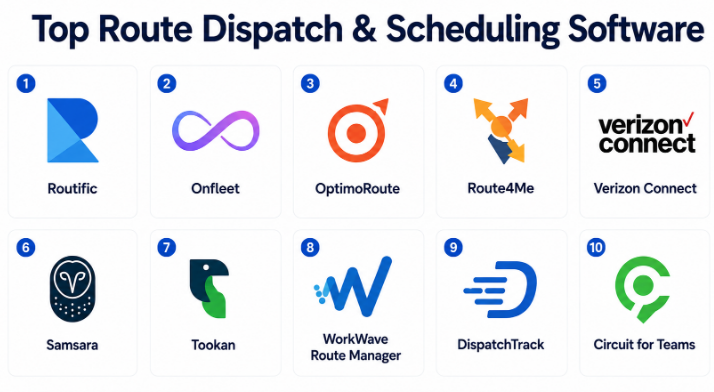
Top 10 Route Dispatch & Scheduling Software
#1 — Routific
Short description :
Routific is a route optimization and delivery planning platform designed for businesses that need to plan efficient routes for multiple drivers and many stops. It helps dispatchers create optimized routes, assign deliveries, track progress, and improve on-time performance. Routific is useful for local delivery businesses, food distribution, retail delivery, healthcare logistics, courier teams, and small to mid-sized fleets. It focuses on reducing planning time and improving route efficiency. It is best for teams that need practical multi-stop route optimization without unnecessary complexity.
Key Features
- Multi-stop route optimization.
- Driver route assignment.
- Delivery time window support.
- Live route progress tracking.
- Customer notifications.
- Proof of delivery features may vary by plan.
- Route analytics and planning dashboard.
Pros
- Strong for delivery route optimization.
- Easy for dispatchers to plan routes quickly.
- Good fit for small and mid-sized delivery operations.
Cons
- May not cover deep enterprise fleet management needs.
- Advanced telematics integrations may require validation.
- Best value depends on delivery volume and route complexity.
Platforms / Deployment
Web / Mobile driver workflows may vary
Cloud
Security & Compliance
Supports business account controls, route data management, and user access features depending on plan. Specific security details should be validated directly with the vendor.
Integrations & Ecosystem
Routific connects route planning with delivery operations.
- Order management workflows.
- Delivery tracking.
- Customer notifications.
- Spreadsheet imports.
- Driver mobile workflows.
- Reporting dashboards.
Support & Community
Routific provides documentation, onboarding guidance, and customer support. It is practical for businesses that want quick and effective delivery route planning.
#2 — Onfleet
Short description :
Onfleet is a last-mile delivery management platform that helps businesses dispatch drivers, optimize routes, track deliveries, communicate with customers, and capture proof of delivery. It is widely used by delivery companies, retailers, food and beverage businesses, pharmacies, courier teams, and logistics operations. Onfleet provides a strong dispatcher dashboard, driver app, customer notifications, analytics, and API support. It is best for companies that need real-time last-mile delivery dispatch and customer visibility.
Key Features
- Dispatch dashboard.
- Route optimization.
- Driver mobile app.
- Real-time tracking.
- Customer notifications.
- Proof of delivery with photos and signatures.
- API and analytics support.
Pros
- Strong for last-mile delivery operations.
- Good driver and customer tracking experience.
- Useful for real-time dispatch and delivery visibility.
Cons
- May be more delivery-focused than field service-focused.
- Pricing should be reviewed for high-volume operations.
- Complex enterprise workflows may require API setup.
Platforms / Deployment
Web / iOS / Android
Cloud
Security & Compliance
Supports business security controls, user roles, delivery records, and operational tracking features depending on plan. Specific compliance details should be validated directly with the vendor.
Integrations & Ecosystem
Onfleet connects delivery operations with business systems.
- eCommerce workflows.
- Order management systems.
- Delivery APIs.
- Customer notifications.
- Analytics tools.
- Driver mobile workflows.
Support & Community
Onfleet provides documentation, API resources, onboarding support, and customer service. It is suitable for delivery businesses that need strong last-mile visibility.
#3 — OptimoRoute
Short description :
OptimoRoute is a route planning and field service scheduling platform designed to optimize routes, schedules, driver assignments, and delivery or service visits. It is useful for delivery teams, technicians, inspectors, logistics teams, and service businesses that need to balance route efficiency with appointment windows and workload. OptimoRoute supports route optimization, live tracking, customer updates, proof of delivery, and workload planning. It is best for teams that need both route planning and schedule optimization for mobile workers.
Key Features
- Route optimization.
- Scheduling and dispatch planning.
- Time window management.
- Workload balancing.
- Live tracking.
- Customer notifications.
- Proof of delivery features.
Pros
- Good balance of routing and scheduling.
- Useful for both delivery and service teams.
- Helps improve route efficiency and appointment reliability.
Cons
- Setup requires accurate job and driver data.
- Advanced enterprise workflows should be tested.
- Not a full fleet maintenance platform.
Platforms / Deployment
Web / iOS / Android
Cloud
Security & Compliance
Supports account controls, operational records, and route data management depending on plan. Specific security details should be validated directly with the vendor.
Integrations & Ecosystem
OptimoRoute supports route planning and operational workflows.
- Order imports.
- Driver mobile apps.
- Customer notifications.
- Delivery tracking.
- Field service workflows.
- Reporting and analytics.
Support & Community
OptimoRoute provides documentation, onboarding help, and customer support. It is practical for teams that need route and schedule planning together.
#4 — Route4Me
Short description :
Route4Me is a route planning and optimization platform that helps businesses plan multi-stop routes, manage drivers, track route progress, and improve delivery or service efficiency. It is useful for couriers, distributors, sales teams, field service teams, logistics businesses, and fleet operations. Route4Me supports route optimization, route monitoring, driver apps, geofencing, territory planning, and operational reporting. It is best for businesses that need flexible routing tools across different field and delivery use cases.
Key Features
- Multi-stop route optimization.
- Driver route management.
- Mobile driver app.
- Territory and route planning.
- GPS tracking and geofencing features may vary.
- Route analytics.
- API and integration options.
Pros
- Flexible for many routing use cases.
- Good for multi-stop delivery and field visits.
- Useful for sales routes, service routes, and delivery routes.
Cons
- Feature depth may require careful plan selection.
- Interface and workflow should be tested by dispatchers.
- Advanced integrations may need technical setup.
Platforms / Deployment
Web / iOS / Android
Cloud
Security & Compliance
Supports user access controls, route activity records, and administrative features depending on plan. Specific security details should be validated directly with the vendor.
Integrations & Ecosystem
Route4Me connects routing with field and logistics operations.
- CRM workflows.
- Delivery operations.
- Mobile driver apps.
- API workflows.
- Territory planning.
- Reporting systems.
Support & Community
Route4Me provides documentation, support, and developer resources. It is suitable for teams needing flexible route optimization and tracking.
#5 — Verizon Connect
Short description :
Verizon Connect is a fleet management and field service platform that includes dispatch, scheduling, GPS tracking, route planning, vehicle monitoring, driver behavior insights, and fleet analytics. It is useful for companies managing vehicles, drivers, mobile workers, and service routes. Verizon Connect is especially relevant for businesses that need dispatching combined with fleet visibility and telematics. It supports industries such as transportation, construction, field service, utilities, government, and logistics. It is best for organizations that need route dispatch connected with fleet tracking and vehicle operations.
Key Features
- GPS fleet tracking.
- Dispatch and scheduling.
- Route planning.
- Driver behavior monitoring.
- Vehicle status visibility.
- Fleet analytics.
- Mobile workforce management features.
Pros
- Strong fleet tracking and dispatch visibility.
- Useful for vehicle-heavy operations.
- Helps improve driver accountability and fleet performance.
Cons
- May be too fleet-focused for simple route planning needs.
- Hardware or telematics setup may be required.
- Pricing and contracts should be reviewed carefully.
Platforms / Deployment
Web / iOS / Android / Vehicle telematics devices
Cloud
Security & Compliance
Supports fleet data controls, user permissions, vehicle tracking records, and admin management depending on plan. Specific compliance details should be validated directly with the vendor.
Integrations & Ecosystem
Verizon Connect connects route dispatch with fleet operations.
- Vehicle telematics.
- GPS tracking.
- Fleet maintenance workflows.
- Driver mobile workflows.
- Dispatch dashboards.
- Reporting and analytics.
Support & Community
Verizon Connect provides enterprise support, onboarding resources, documentation, and fleet technology guidance. It is best for organizations managing vehicle-based operations.
#6 — Samsara
Short description :
Samsara is a connected operations platform that supports fleet tracking, driver management, route visibility, dispatch workflows, safety monitoring, equipment tracking, and operational analytics. It is commonly used by transportation, logistics, construction, field service, manufacturing, public sector, and industrial teams. Samsara is especially useful when route dispatch needs to connect with vehicle telematics, dash cams, driver safety, and equipment visibility. It is best for organizations that need dispatch and routing insights as part of a broader fleet and operations platform.
Key Features
- GPS fleet tracking.
- Route visibility and dispatch support.
- Driver safety monitoring.
- Vehicle diagnostics.
- Equipment tracking.
- Mobile driver workflows.
- Operational dashboards and analytics.
Pros
- Strong connected operations and fleet visibility.
- Useful for safety, compliance, and dispatch oversight.
- Good fit for larger fleet and logistics operations.
Cons
- May be more than simple delivery teams need.
- Hardware and implementation planning may be required.
- Best value depends on fleet size and operational complexity.
Platforms / Deployment
Web / iOS / Android / Vehicle devices
Cloud
Security & Compliance
Supports enterprise security controls, user permissions, fleet data management, and operational governance depending on plan and configuration.
Integrations & Ecosystem
Samsara connects dispatch, fleet, safety, and operational systems.
- Vehicle telematics.
- Dash cams.
- Driver apps.
- Maintenance workflows.
- Fleet operations.
- Analytics dashboards.
Support & Community
Samsara provides onboarding, documentation, customer support, and implementation resources. It is best for organizations that need fleet intelligence beyond basic routing.
#7 — Tookan
Short description :
Tookan is a delivery and field workforce management platform that helps businesses manage tasks, dispatch agents, optimize routes, track workers, and update customers. It is useful for courier services, food delivery, grocery delivery, home services, logistics startups, and on-demand service businesses. Tookan provides a dispatcher dashboard, agent app, customer notifications, task assignment, route optimization, and analytics. It is best for businesses that need a flexible platform for delivery and on-demand dispatch workflows.
Key Features
- Task dispatching.
- Route optimization.
- Agent mobile app.
- Real-time tracking.
- Customer notifications.
- Proof of delivery.
- Analytics and reporting.
Pros
- Good for on-demand delivery and service models.
- Useful dispatcher and agent workflow.
- Flexible for different task-based operations.
Cons
- May require configuration for specialized industries.
- Complex enterprise routing should be tested carefully.
- Best fit depends on task volume and operational workflow.
Platforms / Deployment
Web / iOS / Android
Cloud
Security & Compliance
Supports user permissions, task records, and operational data controls depending on plan. Specific security details should be validated directly with the vendor.
Integrations & Ecosystem
Tookan connects dispatch workflows with delivery and service operations.
- Delivery apps.
- Order management workflows.
- Customer notifications.
- Driver tracking.
- Payment or business workflows may vary.
- Analytics dashboards.
Support & Community
Tookan provides documentation, support, and onboarding guidance. It is practical for businesses managing on-demand delivery or mobile workforce tasks.
#8 — WorkWave Route Manager
Short description :
WorkWave Route Manager is route planning and optimization software designed for field service, delivery, distribution, pest control, lawn care, cleaning, and recurring route businesses. It helps organizations plan routes, schedule stops, manage drivers, improve productivity, and reduce travel time. WorkWave is especially relevant for companies with repeat routes and service territories. It supports route optimization, dispatch visibility, customer communication, and reporting. It is best for businesses that need route planning for recurring field service or delivery operations.
Key Features
- Route optimization.
- Recurring route planning.
- Dispatch and schedule management.
- Driver and stop management.
- Customer communication workflows.
- Route performance reporting.
- Territory and service area planning.
Pros
- Strong for recurring routes and field service operations.
- Useful for service-based businesses with territories.
- Helps reduce travel time and improve route density.
Cons
- May not be ideal for simple one-off routing.
- Industry fit should be validated before purchase.
- Advanced integrations may require setup support.
Platforms / Deployment
Web / Mobile options may vary
Cloud
Security & Compliance
Supports business access controls and route data management depending on plan. Specific security details should be validated directly with the vendor.
Integrations & Ecosystem
WorkWave Route Manager connects routing with service operations.
- Field service workflows.
- Customer management systems.
- Driver workflows.
- Reporting dashboards.
- Territory planning.
- Dispatch processes.
Support & Community
WorkWave provides onboarding, documentation, support, and industry-specific guidance. It is useful for route-based service businesses.
#9 — DispatchTrack
Short description :
DispatchTrack is a delivery management and route optimization platform focused on last-mile delivery, customer experience, appointment scheduling, and delivery visibility. It is useful for retailers, furniture delivery companies, appliance delivery teams, distributors, logistics providers, and service delivery businesses. DispatchTrack helps teams plan delivery routes, communicate with customers, track drivers, capture proof of delivery, and monitor route performance. It is best for companies that need customer-facing delivery scheduling and last-mile execution.
Key Features
- Route optimization.
- Delivery scheduling.
- Real-time driver tracking.
- Customer notifications.
- Proof of delivery.
- ETA management.
- Delivery analytics.
Pros
- Strong for last-mile delivery and customer updates.
- Useful for scheduled delivery businesses.
- Helps improve delivery visibility and on-time performance.
Cons
- May be more delivery-focused than field service-focused.
- Implementation depends on delivery process complexity.
- Integration needs should be tested carefully.
Platforms / Deployment
Web / iOS / Android
Cloud
Security & Compliance
Supports user access controls, delivery records, and operational data security features depending on plan. Specific compliance details should be validated directly with the vendor.
Integrations & Ecosystem
DispatchTrack connects delivery operations with customer and logistics workflows.
- Order management.
- Driver mobile apps.
- Customer notifications.
- Proof of delivery workflows.
- Delivery analytics.
- Retail and logistics systems.
Support & Community
DispatchTrack provides documentation, onboarding resources, and customer support. It is suitable for teams that need last-mile delivery execution and visibility.
#10 — Circuit for Teams
Short description :
Circuit for Teams is a route planning and delivery management tool designed for small and growing delivery teams. It helps businesses plan optimized routes, assign drivers, track delivery progress, and send customer notifications. Circuit is useful for local delivery companies, small courier teams, meal delivery, retail delivery, and businesses that need simple multi-driver route planning. It focuses on ease of use and fast route planning rather than heavy enterprise fleet management. It is best for teams that want a simple and practical route dispatch tool.
Key Features
- Route optimization.
- Multi-driver route planning.
- Driver mobile app.
- Delivery tracking.
- Customer notifications.
- Proof of delivery features may vary.
- Route progress dashboard.
Pros
- Easy for small delivery teams to use.
- Fast route planning and assignment.
- Good fit for local delivery operations.
Cons
- May not support complex enterprise dispatch workflows.
- Advanced fleet and telematics features may be limited.
- Best suited for delivery routing rather than full field service.
Platforms / Deployment
Web / iOS / Android
Cloud
Security & Compliance
Supports business account controls and delivery data management depending on plan. Specific security details should be validated directly with the vendor.
Integrations & Ecosystem
Circuit for Teams supports practical delivery routing workflows.
- Driver mobile routes.
- Delivery tracking.
- Customer notifications.
- Stop management.
- Route planning dashboards.
- Local delivery operations.
Support & Community
Circuit provides documentation, onboarding resources, and customer support. It is practical for smaller teams that want route planning without heavy complexity.
Comparison Table
| Tool Name | Best For | Platform(s) Supported | Deployment | Standout Feature | Public Rating |
|---|---|---|---|---|---|
| Routific | Multi-stop delivery route planning | Web / Mobile varies | Cloud | Practical route optimization for delivery teams | N/A |
| Onfleet | Last-mile delivery dispatch | Web / iOS / Android | Cloud | Real-time delivery tracking and proof of delivery | N/A |
| OptimoRoute | Route and schedule optimization | Web / iOS / Android | Cloud | Balances routes, schedules, and workloads | N/A |
| Route4Me | Flexible route planning use cases | Web / iOS / Android | Cloud | Multi-stop route optimization and territory planning | N/A |
| Verizon Connect | Fleet dispatch and vehicle tracking | Web / iOS / Android / Vehicle devices | Cloud | Route dispatch connected with fleet telematics | N/A |
| Samsara | Connected fleet and operations visibility | Web / iOS / Android / Vehicle devices | Cloud | Fleet tracking, safety, and operational analytics | N/A |
| Tookan | On-demand delivery and workforce dispatch | Web / iOS / Android | Cloud | Task dispatching with agent tracking | N/A |
| WorkWave Route Manager | Recurring service and delivery routes | Web / Mobile varies | Cloud | Recurring route planning for service businesses | N/A |
| DispatchTrack | Customer-facing last-mile delivery | Web / iOS / Android | Cloud | Delivery scheduling, ETA, and customer notifications | N/A |
| Circuit for Teams | Small delivery teams | Web / iOS / Android | Cloud | Simple multi-driver route planning | N/A |
Evaluation & Route Dispatch & Scheduling Software
| Tool Name | Core (25%) | Ease (15%) | Integrations (15%) | Security (10%) | Performance (10%) | Support (10%) | Value (15%) | Weighted Total (0–10) |
|---|---|---|---|---|---|---|---|---|
| Routific | 9 | 9 | 8 | 8 | 8 | 8 | 8 | 8.35 |
| Onfleet | 9 | 8 | 9 | 8 | 9 | 8 | 8 | 8.45 |
| OptimoRoute | 9 | 8 | 8 | 8 | 8 | 8 | 8 | 8.25 |
| Route4Me | 9 | 8 | 8 | 8 | 8 | 8 | 8 | 8.25 |
| Verizon Connect | 9 | 7 | 9 | 9 | 9 | 9 | 7 | 8.35 |
| Samsara | 9 | 7 | 9 | 9 | 9 | 9 | 7 | 8.35 |
| Tookan | 8 | 8 | 8 | 8 | 8 | 8 | 8 | 8.00 |
| WorkWave Route Manager | 8 | 8 | 8 | 8 | 8 | 8 | 8 | 8.00 |
| DispatchTrack | 9 | 8 | 8 | 8 | 8 | 8 | 8 | 8.25 |
| Circuit for Teams | 8 | 9 | 7 | 8 | 8 | 8 | 9 | 8.10 |
These scores are comparative and should be used as a practical guide, not a fixed ranking. Onfleet, DispatchTrack, and Routific are strong for last-mile delivery and route planning. OptimoRoute and Route4Me are flexible for route scheduling and multi-stop operations. Verizon Connect and Samsara are stronger when route dispatch must connect with fleet tracking, telematics, and vehicle operations. Circuit for Teams is practical for smaller delivery teams.
Which Route Dispatch & Scheduling Software
Solo / Freelancer
Solo operators usually need simple routing rather than a full dispatch platform. Circuit for Teams, Route4Me, or basic route planning tools may be enough if the work involves daily stops, deliveries, or customer visits.
A solo courier, service provider, or salesperson should focus on easy route planning, mobile navigation, customer details, proof of completion, and low cost. Heavy fleet platforms are usually unnecessary for one-person operations.
SMB
Small and medium businesses should focus on simple route planning, driver assignment, customer notifications, proof of delivery, and live status visibility. Routific, Circuit for Teams, Onfleet, OptimoRoute, and Tookan are strong options.
SMBs should avoid overcomplicating the system. Start with the daily operational problem: late deliveries, poor route planning, manual driver calls, missing proof of delivery, or poor customer updates.
Mid-Market
Mid-market organizations usually need multi-driver route planning, dispatch boards, schedule optimization, customer notifications, proof of delivery, route analytics, and integrations with order systems. Onfleet, OptimoRoute, Route4Me, DispatchTrack, and WorkWave Route Manager are strong candidates.
At this stage, buyers should evaluate time windows, route density, driver capacity, customer communication, delivery exceptions, and real-time dispatch changes.
Enterprise
Enterprises should prioritize scalability, fleet visibility, telematics, safety, compliance, route analytics, ERP integration, customer notifications, and multi-location dispatch management. Samsara, Verizon Connect, DispatchTrack, Onfleet, and Route4Me may be relevant depending on operations.
Large organizations should involve logistics, IT, fleet managers, customer service, operations, finance, and security teams before selecting a platform.
Budget vs Premium
Budget-conscious teams may prefer Circuit for Teams, Routific, Route4Me, or OptimoRoute depending on delivery volume and route complexity.
Premium tools such as Samsara, Verizon Connect, DispatchTrack, and enterprise-grade Onfleet are better when organizations need telematics, fleet safety, advanced analytics, customer experience workflows, and large-scale dispatch control.
Feature Depth vs Ease of Use
If ease of use matters most, Circuit for Teams, Routific, OptimoRoute, and Tookan are practical choices because dispatchers can plan and assign routes quickly.
If feature depth matters more, Samsara, Verizon Connect, Onfleet, DispatchTrack, and Route4Me provide stronger tracking, analytics, fleet visibility, customer communication, and operational controls.
Integrations & Scalability
Route dispatch software should connect with order management systems, CRM platforms, ERP tools, eCommerce platforms, fleet telematics, accounting systems, customer communication tools, and reporting dashboards.
For delivery-first teams, Onfleet, DispatchTrack, Routific, and Circuit are useful. For fleet-heavy operations, Samsara and Verizon Connect are stronger. For mixed route planning and field scheduling, OptimoRoute, Route4Me, and WorkWave Route Manager are practical.
Security & Compliance Needs
Route dispatch software may store customer addresses, driver locations, delivery photos, signatures, vehicle data, proof of delivery records, customer contact details, and operational logs.
Buyers should validate role-based access, GPS data privacy, encryption, driver permissions, audit logs, proof-of-delivery storage, customer data handling, mobile device controls, and admin permissions before rollout.
Frequently Asked Questions
1. What is Route Dispatch & Scheduling Software?
Route Dispatch & Scheduling Software helps businesses plan routes, assign drivers or field workers, manage schedules, track progress, and improve delivery or service efficiency. It is commonly used by logistics, courier, delivery, and field service teams.
2. How is route dispatch software different from simple map navigation?
Map navigation helps one driver get from one place to another. Route dispatch software helps managers plan many stops, assign multiple drivers, optimize routes, track job status, notify customers, and monitor performance across the whole operation.
3. What pricing models are common for route dispatch tools?
Pricing may be based on drivers, vehicles, stops, routes, users, tasks, deliveries, features, or enterprise contracts. Fleet-focused platforms may also include hardware, telematics devices, installation, or support costs.
4. What are common mistakes when choosing route dispatch software?
Common mistakes include ignoring driver usability, not testing route accuracy, underestimating integration needs, skipping customer notification workflows, and choosing a tool without checking proof-of-delivery requirements. Another mistake is buying fleet software when simple route planning is enough.
5. Which tool is best for small delivery teams?
Circuit for Teams, Routific, OptimoRoute, Route4Me, and Tookan can be practical for small delivery teams. The best choice depends on number of drivers, stops per day, customer notification needs, and proof-of-delivery requirements.
6. Which tool is best for last-mile delivery?
Onfleet, DispatchTrack, Routific, OptimoRoute, and Circuit for Teams are strong options for last-mile delivery. Onfleet and DispatchTrack are especially useful when customer tracking, proof of delivery, and delivery status visibility are important.
7. Which tool is best for fleet-heavy operations?
Samsara and Verizon Connect are strong options for fleet-heavy operations because they connect dispatch visibility with GPS tracking, vehicle telematics, driver behavior, safety monitoring, and fleet analytics.
8. Can route dispatch software reduce fuel costs?
Yes, route dispatch software can reduce fuel costs by optimizing routes, reducing unnecessary mileage, improving stop order, avoiding inefficient routes, and helping managers reduce idle time. Actual savings depend on route volume and driver adoption.
9. Can these tools send customer ETA notifications?
Yes, many route dispatch tools can send customer notifications with estimated arrival times, delay updates, delivery confirmations, and completion messages. This is especially important for delivery and appointment-based service businesses.
10. Do these tools support proof of delivery?
Many route dispatch platforms support proof of delivery through photos, signatures, barcode scans, timestamps, GPS location, and completion notes. Buyers should test proof-of-delivery workflows before choosing a tool.
Conclusion
Route Dispatch & Scheduling Software helps businesses plan smarter routes, reduce manual dispatch work, improve driver productivity, and create a better customer experience. The best tool depends on the type of operation. Routific and Circuit for Teams are practical for small and growing delivery teams. Onfleet and DispatchTrack are strong for last-mile delivery with real-time customer visibility. OptimoRoute and Route4Me are useful for flexible route and schedule planning. Tookan supports on-demand delivery and task dispatch. WorkWave Route Manager is strong for recurring service routes.
