Introduction
Identity Resolution Platforms help businesses connect customer data from different systems and recognize when multiple records, devices, emails, phone numbers, cookies, app IDs, transactions, or interactions belong to the same person, household, account, or company. In simple English, these tools help create a more complete and accurate view of the customer.
A customer may visit a website on mobile, later buy from a desktop, open emails using another address, contact support, visit a store, and interact with ads across different platforms. Without identity resolution, the business may treat the same customer as many different people. This creates poor reporting, duplicate profiles, weak personalization, wasted ad spend, and inaccurate customer insights.
Identity resolution matters because companies depend more on first-party data, privacy-aware marketing, customer data platforms, clean rooms, personalization, fraud prevention, and customer experience analytics. It helps teams unify data while applying governance and consent rules.
Real-world use cases include customer profile unification, marketing personalization, cross-device recognition, household matching, account-based marketing, fraud detection, loyalty analytics, customer journey mapping, audience activation, and clean room collaboration.
Buyers should evaluate match accuracy, deterministic and probabilistic matching, privacy controls, data onboarding, integrations, governance, consent handling, scalability, identity graph quality, activation options, reporting, and security posture.
Best for: Marketing teams, data teams, customer experience teams, ecommerce brands, publishers, retailers, financial services, SaaS companies, agencies, B2B revenue teams, and enterprises managing customer data across many systems.
Not ideal for: Very small businesses with limited customer data, teams without clear privacy policies, or companies that only need basic CRM deduplication instead of cross-channel identity unification.
Key Trends in Identity Resolution Platforms
- First-party identity is becoming more important: Companies are investing in their own customer data because third-party identifiers are less reliable than before.
- Privacy-safe identity workflows are now expected: Buyers want consent-aware data usage, governance, encryption, data minimization, and clear permission controls.
- Clean rooms and identity resolution are becoming connected: Identity matching often supports privacy-safe collaboration between advertisers, publishers, retailers, and data partners.
- Real-time profile updates are more valuable: Teams want identity graphs and customer profiles to update quickly as people interact across apps, websites, stores, and support channels.
- B2B identity resolution is growing: Companies need to connect people, accounts, domains, companies, buying committees, and CRM records for account-based marketing.
- Retail media is increasing demand: Retailers and brands need accurate identity matching to measure media impact, loyalty behavior, and customer overlap.
- AI and machine learning are improving matching logic: Some platforms use machine learning to improve entity matching, householding, deduplication, and confidence scoring.
- Data governance is now a core buying factor: Identity resolution must work with data lineage, consent rules, data residency, audit logs, and role-based access.
- Interoperability matters more: Companies want identity data to connect with CDPs, CRMs, marketing automation tools, data warehouses, analytics platforms, and ad platforms.
- Accuracy must be balanced with trust: Over-aggressive matching can create privacy risks and poor customer experiences, while weak matching can reduce marketing and analytics value.
How We Selected These Tools
The following platforms were selected based on practical use cases across customer data, marketing identity, B2B data, ecommerce, media, advertising, and enterprise data management.
- Market recognition: Tools with strong visibility in identity resolution, customer data platforms, data onboarding, marketing identity, and enterprise data management were prioritized.
- Feature completeness: Platforms were evaluated for profile unification, identity graphs, matching logic, activation, governance, and integrations.
- Use-case coverage: The list includes tools for B2C marketing, B2B revenue teams, ecommerce, retail media, publishing, enterprise data teams, and customer experience teams.
- Integration ecosystem: Stronger tools connect with CRM, CDP, data warehouses, marketing automation, ad platforms, analytics tools, clean rooms, and BI systems.
- Privacy and governance: Preference was given to platforms that support permissioning, consent-aware workflows, access controls, and controlled data usage.
- Scalability: Tools were considered stronger when they can handle large customer datasets, multiple identifiers, real-time updates, and multi-channel activation.
- Practical usability: Platforms were evaluated for business usability, technical flexibility, onboarding support, and reporting clarity.
- Data quality support: Tools with deduplication, enrichment, identity graphing, profile stitching, and confidence scoring were considered valuable.
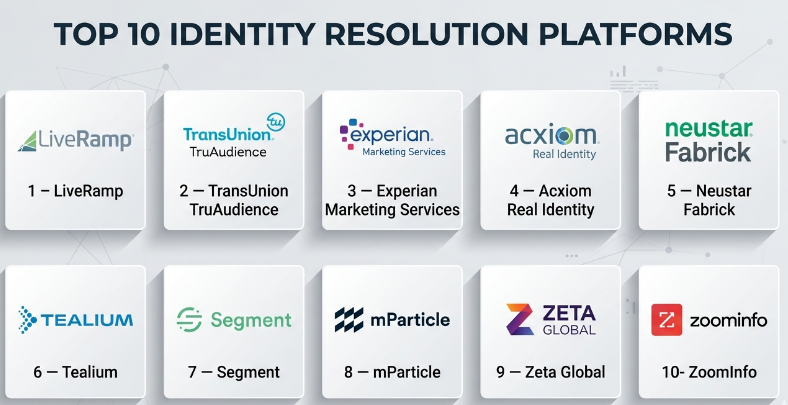
Top 10 Identity Resolution Platforms
#1 — LiveRamp
Short description :
LiveRamp is a widely recognized identity resolution and data collaboration platform used by brands, agencies, publishers, retailers, and media companies. It helps organizations connect customer data, match audiences, activate segments, and measure campaigns across privacy-aware environments. LiveRamp is especially strong in advertising identity, data onboarding, and partner collaboration. It is suitable for enterprises that need identity resolution connected with media activation and clean room workflows. The platform is best for organizations with mature customer data and strong marketing partnership needs.
Key Features
- Identity resolution and customer matching
- Data onboarding and audience activation
- Identity graph capabilities
- Privacy-aware data collaboration
- Clean room and partner measurement support
- Media and advertising ecosystem connectivity
- Audience segmentation and activation workflows
Pros
- Strong identity and advertising ecosystem.
- Useful for enterprise media activation and measurement.
- Good fit for brands, publishers, retailers, and agencies.
Cons
- May be too advanced for small businesses.
- Pricing and packaging may require vendor discussion.
- Best results depend on strong data quality and governance.
Platforms / Deployment
Web-based platform.
Cloud / managed deployment options may vary.
Security & Compliance
LiveRamp is commonly used in privacy-sensitive identity and advertising workflows. Specific certifications, access controls, and compliance requirements should be validated directly during procurement.
SOC 2, ISO 27001, HIPAA: Not publicly stated here.
Integrations & Ecosystem
LiveRamp fits into marketing, media, clean room, data onboarding, and audience activation workflows. It is most valuable when identity resolution must connect with advertising partners and customer data systems.
- Ad platforms
- Data clean rooms
- Publisher partnerships
- Retail media networks
- Customer data platforms
- Measurement workflows
Support & Community
LiveRamp provides enterprise support, onboarding, implementation guidance, and partner ecosystem resources. It has strong recognition among enterprise marketers, publishers, agencies, and data collaboration teams.
#2 — TransUnion TruAudience
Short description :
TransUnion TruAudience is an identity and audience platform used for marketing, media measurement, customer recognition, and data-driven advertising. It helps businesses connect identity signals, improve audience targeting, and measure marketing outcomes. The platform is suitable for enterprises, agencies, publishers, and advertisers that need people-based identity resolution and audience intelligence. It is especially relevant for companies that need identity connected with media planning and measurement. TruAudience is best for organizations that want identity resolution backed by a large consumer data ecosystem.
Key Features
- Identity resolution
- Audience segmentation
- People-based marketing support
- Campaign measurement workflows
- Data enrichment options
- Media and advertising ecosystem support
- Customer recognition capabilities
Pros
- Strong fit for enterprise media and audience use cases.
- Useful for people-based marketing and measurement.
- Can support targeting, analytics, and campaign planning.
Cons
- May not be ideal for small businesses.
- Full capabilities may require enterprise contracts.
- Buyers should carefully validate data governance and compliance fit.
Platforms / Deployment
Web-based platform.
Cloud / managed deployment options may vary.
Security & Compliance
Security and compliance details should be confirmed directly with the vendor. Identity and consumer data workflows require strong governance review.
SOC 2, ISO 27001, HIPAA: Not publicly stated here.
Integrations & Ecosystem
TruAudience is commonly used across media, marketing, and audience intelligence workflows where identity signals need to connect with campaign planning and measurement.
- Media platforms
- Audience planning tools
- Measurement workflows
- Data collaboration processes
- Advertising platforms
- Enterprise analytics systems
Support & Community
Support is generally enterprise-oriented, with onboarding and professional guidance depending on contract. Community visibility is strongest among media, agency, and enterprise advertising teams.
#3 — Experian Marketing Services
Short description :
Experian Marketing Services provides identity resolution, data quality, audience insights, and marketing data solutions. It helps organizations connect customer records, improve data accuracy, enrich profiles, and support more relevant marketing. The platform is suitable for brands, agencies, financial services, retailers, publishers, and enterprises that need identity and data quality at scale. Experian is especially relevant where customer data accuracy, householding, segmentation, and audience activation are important. It is best for organizations that need identity resolution combined with broader consumer data and marketing services.
Key Features
- Identity resolution and customer matching
- Data quality and enrichment
- Audience segmentation
- Household and individual-level insights
- Marketing activation support
- Customer profile enhancement
- Campaign measurement support
Pros
- Strong data quality and enrichment capabilities.
- Useful for enterprises with large customer datasets.
- Good fit for customer recognition and segmentation.
Cons
- May require vendor-led implementation.
- Pricing and capabilities may vary widely.
- Buyers should validate privacy and consent workflows carefully.
Platforms / Deployment
Web-based / managed service options may vary.
Cloud / managed deployment.
Security & Compliance
Security and compliance details should be validated directly. Identity, enrichment, and consumer data workflows require careful legal and privacy review.
SOC 2, ISO 27001, HIPAA: Not publicly stated here.
Integrations & Ecosystem
Experian Marketing Services can support customer data, marketing activation, segmentation, and data quality workflows across enterprise systems.
- CRM systems
- Marketing platforms
- Audience activation channels
- Data quality workflows
- Analytics systems
- Campaign reporting
Support & Community
Experian provides enterprise support, consulting, data services, and implementation guidance. Its recognition is strong among enterprise data, marketing, and financial services users.
#4 — Acxiom Real Identity
Short description :
Acxiom Real Identity helps organizations resolve, manage, and connect customer identities across channels. It supports identity recognition, data onboarding, profile unification, customer intelligence, and marketing activation. The platform is suitable for large brands, agencies, retailers, financial services, and enterprises that need identity resolution across fragmented customer data. Acxiom is especially relevant when businesses need identity services connected with customer data management and marketing execution. It is best for organizations with complex customer data environments and multi-channel engagement needs.
Key Features
- Identity resolution and recognition
- Customer profile unification
- Data onboarding support
- Audience and activation workflows
- Data quality and enrichment
- Cross-channel customer matching
- Enterprise identity graph support
Pros
- Strong enterprise identity resolution experience.
- Useful for large, complex customer data environments.
- Supports data onboarding and activation use cases.
Cons
- May be more service-led than simple SaaS tools.
- Not ideal for small companies with basic CRM needs.
- Implementation may require data governance and technical planning.
Platforms / Deployment
Web-based / managed service options may vary.
Cloud / managed deployment.
Security & Compliance
Security and compliance details should be validated directly with the vendor. Identity resolution requires strong governance and consent review.
SOC 2, ISO 27001, HIPAA: Not publicly stated here.
Integrations & Ecosystem
Acxiom fits into enterprise customer intelligence, marketing data, and activation workflows where large-scale identity resolution is needed.
- CRM systems
- Customer data platforms
- Marketing clouds
- Audience activation channels
- Data onboarding workflows
- Analytics platforms
Support & Community
Acxiom provides enterprise support, implementation guidance, and professional services. It is well known among enterprise marketers, agencies, and data management teams.
#5 — Neustar Fabrick
Short description :
Neustar Fabrick is an identity and data collaboration platform designed to help brands connect customer identity, enrich audience understanding, and support marketing activation. It helps businesses resolve customer identities across channels and improve audience targeting. It is suitable for advertisers, agencies, publishers, and enterprise brands that need identity-based marketing and measurement. Neustar’s identity capabilities are useful for connecting fragmented customer signals into more actionable insights. It is best for organizations focused on media, marketing, and customer intelligence use cases.
Key Features
- Identity resolution
- Audience enrichment
- Customer recognition
- Data collaboration workflows
- Media activation support
- Measurement and analytics use cases
- Cross-channel identity matching
Pros
- Strong for marketing identity and audience use cases.
- Useful for media activation and customer intelligence.
- Good fit for enterprise brands and agencies.
Cons
- May be too complex for small teams.
- Packaging and capabilities should be validated directly.
- Data governance review is important before implementation.
Platforms / Deployment
Web-based / managed service options may vary.
Cloud / managed deployment.
Security & Compliance
Security and privacy details should be verified directly. Identity-based workflows require clear review of consent, access, and data usage.
SOC 2, ISO 27001, HIPAA: Not publicly stated here.
Integrations & Ecosystem
Neustar Fabrick fits into advertising, customer intelligence, data collaboration, and media measurement workflows.
- Advertising platforms
- Customer data systems
- Measurement workflows
- Audience activation
- Data collaboration environments
- Analytics dashboards
Support & Community
Support is generally enterprise-oriented with onboarding and implementation guidance. Community visibility is strongest among media, advertising, and marketing analytics professionals.
#6 — Tealium
Short description :
Tealium is a customer data platform and data collection platform that includes identity resolution capabilities for unifying customer profiles across touchpoints. It helps businesses collect event data, manage consent signals, build customer profiles, and activate data across marketing and analytics tools. Tealium is suitable for enterprises that need real-time customer data infrastructure with identity stitching. It is especially useful for companies with complex websites, apps, marketing tags, and customer journeys. Tealium is best when identity resolution needs to work together with event collection and activation.
Key Features
- Customer profile stitching
- Real-time customer data platform workflows
- Event data collection
- Consent and preference support
- Audience segmentation
- Data activation integrations
- Server-side and client-side data workflows
Pros
- Strong for real-time customer data workflows.
- Useful for companies with complex digital journeys.
- Broad integration ecosystem for activation.
Cons
- Requires planning around data layer and event taxonomy.
- May be complex for small teams.
- Full value depends on implementation maturity.
Platforms / Deployment
Web-based platform.
Cloud deployment.
Security & Compliance
Enterprise security and governance features may be available depending on plan and configuration. Buyers should validate controls directly.
SOC 2, ISO 27001, HIPAA: Not publicly stated here.
Integrations & Ecosystem
Tealium connects identity resolution with customer data collection, consent signals, segmentation, and activation across digital ecosystems.
- CRM systems
- Marketing automation tools
- Analytics platforms
- Advertising platforms
- Data warehouses
- Tag and event data workflows
Support & Community
Tealium provides documentation, enterprise support, onboarding, and partner services. It has strong visibility among enterprise CDP, data collection, and marketing operations teams.
#7 — Segment
Short description :
Segment is a customer data platform that helps companies collect, unify, and route customer data across business systems. Its identity resolution capabilities help connect user events, traits, devices, anonymous visitors, known users, and customer profiles. Segment is suitable for SaaS companies, ecommerce businesses, apps, marketplaces, and digital-first companies that need reliable customer data infrastructure. It is especially useful for product, marketing, data, and engineering teams that want to standardize customer data pipelines. Segment is best when identity resolution is part of a broader CDP and event data strategy.
Key Features
- Customer identity stitching
- Event collection and routing
- Unified customer profiles
- Data governance workflows
- Audience segmentation
- Warehouse and destination integrations
- Real-time customer data activation
Pros
- Strong developer and data infrastructure fit.
- Useful for product-led and digital businesses.
- Broad ecosystem of data destinations and sources.
Cons
- Requires proper event tracking design.
- Identity rules must be planned carefully.
- May become costly or complex at high scale.
Platforms / Deployment
Web-based platform.
Cloud deployment.
Security & Compliance
Enterprise security features may be available depending on plan. Buyers should validate SSO, permissions, data residency, encryption, and compliance needs directly.
SOC 2, ISO 27001, HIPAA: Not publicly stated here.
Integrations & Ecosystem
Segment is strong where customer data needs to move reliably between apps, websites, warehouses, marketing tools, and analytics systems.
- Product analytics tools
- Data warehouses
- CRM platforms
- Marketing automation tools
- Advertising destinations
- Customer support systems
Support & Community
Segment has strong documentation, developer resources, community adoption, and enterprise support options. It is widely recognized among product, data, and engineering teams.
#8 — mParticle
Short description :
mParticle is a customer data platform with identity resolution, real-time data collection, audience segmentation, and data activation capabilities. It is suitable for mobile apps, ecommerce brands, media companies, subscription businesses, and enterprises that need customer data infrastructure across many channels. mParticle helps teams unify user identities, manage customer profiles, and send accurate data to marketing and analytics tools. It is especially relevant for businesses with strong app, web, and cross-device customer journeys. The platform is best when identity resolution must work with real-time customer data activation.
Key Features
- Identity resolution and profile unification
- Real-time customer data collection
- Audience segmentation
- Mobile and web event tracking
- Data governance controls
- Activation across marketing and analytics tools
- Customer journey data infrastructure
Pros
- Strong fit for mobile and digital businesses.
- Useful for real-time customer data activation.
- Good support for complex customer journeys.
Cons
- Requires technical setup and event planning.
- May be more than small businesses need.
- Best results depend on clean data architecture.
Platforms / Deployment
Web-based platform.
Cloud deployment.
Security & Compliance
Enterprise governance and security features may be available depending on plan. Buyers should validate requirements directly.
SOC 2, ISO 27001, HIPAA: Not publicly stated here.
Integrations & Ecosystem
mParticle fits into app, web, marketing, analytics, and customer experience stacks where customer data needs to be unified and activated.
- Mobile apps
- Websites
- Analytics platforms
- CRM systems
- Marketing automation tools
- Data warehouses
Support & Community
mParticle provides documentation, onboarding, support, and enterprise services. It is recognized among mobile-first, app-first, and customer data infrastructure teams.
#9 — Zeta Global
Short description :
Zeta Global provides marketing technology, customer intelligence, identity data, and activation capabilities for enterprises. Its identity resolution capabilities help brands connect customer signals, build audience understanding, and support personalized marketing. The platform is suitable for large brands that need identity, data enrichment, segmentation, campaign execution, and measurement in one environment. It is especially relevant for marketers who want identity resolution connected with activation and customer engagement. Zeta is best for organizations that prefer an integrated marketing platform rather than a standalone identity graph only.
Key Features
- Identity resolution and customer intelligence
- Audience segmentation
- Data enrichment
- Marketing activation
- Campaign orchestration
- Customer profile development
- Measurement and analytics workflows
Pros
- Combines identity with marketing activation.
- Useful for enterprise customer engagement.
- Supports audience intelligence and personalization.
Cons
- May not be ideal for teams needing only identity matching.
- Enterprise scope may be too broad for smaller companies.
- Buyers should validate data governance and transparency needs.
Platforms / Deployment
Web-based platform.
Cloud deployment.
Security & Compliance
Security and compliance controls should be validated directly with the vendor. Identity and activation workflows require careful privacy review.
SOC 2, ISO 27001, HIPAA: Not publicly stated here.
Integrations & Ecosystem
Zeta fits into customer intelligence, campaign activation, and marketing engagement workflows.
- Campaign management
- Customer engagement channels
- Audience segmentation
- Data enrichment workflows
- Analytics dashboards
- Marketing measurement
Support & Community
Zeta provides enterprise support, onboarding, services, and campaign guidance. Its community visibility is strongest among enterprise marketers and customer engagement teams.
#10 — ZoomInfo
Short description :
ZoomInfo is a B2B data and go-to-market intelligence platform that supports identity resolution for business contacts, accounts, buying committees, and company-level data. It helps sales, marketing, and revenue teams identify target accounts, enrich CRM records, improve contact data, and connect buyer signals. ZoomInfo is especially useful for B2B companies that need account-based marketing, prospecting, enrichment, and revenue intelligence. It is not a general consumer identity platform, but it is strong for B2B identity and account data use cases. It is best for teams focused on business-to-business sales and marketing.
Key Features
- B2B contact and account intelligence
- CRM enrichment
- Account matching and segmentation
- Buyer intent and company signals
- Go-to-market data workflows
- Sales and marketing activation
- Data quality improvement
Pros
- Strong fit for B2B sales and marketing teams.
- Useful for account-based marketing and CRM enrichment.
- Helps improve business contact and company data quality.
Cons
- Not designed for B2C identity resolution.
- Data accuracy should be reviewed and maintained.
- Privacy and usage rules must be carefully followed.
Platforms / Deployment
Web-based platform.
Cloud deployment.
Security & Compliance
Security and compliance details should be validated directly. B2B data usage requires careful governance, consent review, and regional privacy consideration.
SOC 2, ISO 27001, HIPAA: Not publicly stated here.
Integrations & Ecosystem
ZoomInfo fits into B2B go-to-market stacks where account data, contact data, CRM enrichment, and sales engagement are important.
- CRM systems
- Sales engagement platforms
- Marketing automation tools
- Account-based marketing workflows
- Revenue intelligence tools
- Data enrichment processes
Support & Community
ZoomInfo provides documentation, onboarding, customer support, and training resources. It has strong recognition among B2B sales, marketing, and revenue operations teams.
Comparison Table Top 10
| Tool Name | Best For | Platform Supported | Deployment | Standout Feature | Public Rating |
|---|---|---|---|---|---|
| LiveRamp | Enterprise identity and media activation | Web | Cloud / Managed | Identity graph and partner activation ecosystem | N/A |
| TransUnion TruAudience | People-based marketing and audience intelligence | Web | Cloud / Managed | Identity-backed audience and measurement workflows | N/A |
| Experian Marketing Services | Customer data quality and enrichment | Web / Managed | Cloud / Managed | Identity resolution with data enrichment | N/A |
| Acxiom Real Identity | Enterprise customer identity management | Web / Managed | Cloud / Managed | Large-scale identity recognition and onboarding | N/A |
| Neustar Fabrick | Media identity and audience collaboration | Web / Managed | Cloud / Managed | Cross-channel identity and data collaboration | N/A |
| Tealium | Real-time customer data and identity stitching | Web | Cloud | Identity resolution inside customer data workflows | N/A |
| Segment | Customer data infrastructure and profile unification | Web | Cloud | Event-based identity stitching and data routing | N/A |
| mParticle | Mobile and digital customer identity | Web | Cloud | Real-time profile unification and activation | N/A |
| Zeta Global | Identity-driven customer engagement | Web | Cloud | Identity plus marketing activation | N/A |
| ZoomInfo | B2B account and contact identity | Web | Cloud | B2B data enrichment and account matching | N/A |
Evaluation & Identity Resolution Platforms
| Tool Name | Core 25% | Ease 15% | Integrations 15% | Security 10% | Performance 10% | Support 10% | Value 15% | Weighted Total 0–10 |
|---|---|---|---|---|---|---|---|---|
| LiveRamp | 9 | 7 | 9 | 8 | 8 | 8 | 7 | 8.10 |
| TransUnion TruAudience | 8 | 7 | 8 | 8 | 8 | 8 | 7 | 7.80 |
| Experian Marketing Services | 8 | 7 | 8 | 8 | 8 | 8 | 7 | 7.80 |
| Acxiom Real Identity | 8 | 7 | 8 | 8 | 8 | 8 | 7 | 7.80 |
| Neustar Fabrick | 8 | 7 | 8 | 7 | 8 | 7 | 7 | 7.55 |
| Tealium | 8 | 7 | 9 | 8 | 8 | 8 | 8 | 8.05 |
| Segment | 8 | 8 | 9 | 8 | 8 | 8 | 8 | 8.20 |
| mParticle | 8 | 8 | 8 | 8 | 8 | 8 | 8 | 8.00 |
| Zeta Global | 8 | 7 | 8 | 7 | 8 | 7 | 7 | 7.55 |
| ZoomInfo | 8 | 8 | 8 | 7 | 8 | 8 | 8 | 7.90 |
These scores are comparative and should be used as a shortlist guide, not as a final buying decision. A media-heavy enterprise may value LiveRamp, TransUnion TruAudience, Acxiom, or Experian more highly. A product-led digital company may prefer Segment, Tealium, or mParticle. A B2B revenue team may find ZoomInfo more practical. Always validate identity accuracy, consent workflows, integrations, pricing, and security before selection.
Which Identity Resolution Platforms
Solo / Freelancer
Solo consultants and freelancers usually do not need a full enterprise identity resolution platform. For small client work, basic CRM deduplication, email matching, and clean customer records may be enough.
However, consultants working with larger brands should understand identity resolution concepts because clients may need help with CDPs, customer data strategy, clean rooms, and audience activation. Segment, Tealium, or ZoomInfo may be easier to understand depending on whether the work is digital product data or B2B data.
SMB
Small and mid-sized businesses should avoid buying complex identity platforms before solving basic data problems. They should first clean CRM records, standardize customer fields, define consent rules, and improve event tracking.
For SMBs with digital products, Segment or mParticle may be useful if they need customer data infrastructure. For B2B SMBs, ZoomInfo can help with account and contact data enrichment. For ecommerce and marketing-heavy SMBs, a CDP with identity stitching may be more practical than a large enterprise identity graph.
Mid-Market
Mid-market companies often need stronger identity resolution because customer journeys become more complex. They may have multiple websites, apps, stores, campaigns, CRM records, email systems, support tools, and customer databases.
Segment, Tealium, mParticle, ZoomInfo, and Zeta Global may be practical depending on business model. Companies working with media partners, publishers, retailers, or advertising networks may also evaluate LiveRamp or similar identity collaboration platforms.
Enterprise
Enterprise organizations need scalable identity resolution, governance, security, auditability, partner activation, and integration depth. They may also need householding, cross-device matching, consent management, account-level identity, and clean room collaboration.
LiveRamp, TransUnion TruAudience, Experian Marketing Services, Acxiom Real Identity, Neustar Fabrick, Tealium, Segment, and mParticle are stronger enterprise candidates depending on use case. Large organizations may use multiple tools because B2C identity, B2B identity, media activation, and internal customer data infrastructure are different needs.
Budget vs Premium
Budget-focused teams should start by improving data hygiene before buying identity tools. Duplicate records, inconsistent fields, missing consent, poor event tracking, and weak CRM discipline will reduce the value of any platform.
Premium tools are useful when identity resolution directly supports revenue, personalization, media efficiency, partner collaboration, fraud reduction, or customer experience. The right investment should improve match quality, reduce wasted spend, and create more trustworthy customer data.
Feature Depth vs Ease of Use
LiveRamp, Experian, Acxiom, TransUnion TruAudience, and Neustar Fabrick offer deeper identity and media ecosystem capabilities, but they may require enterprise implementation and governance.
Segment, Tealium, and mParticle may be easier for digital product and customer data teams because identity resolution is connected with event data and activation workflows. ZoomInfo is easier to apply for B2B sales and marketing teams because its value is directly tied to account and contact intelligence.
Integrations & Scalability
Identity resolution platforms should connect with the systems where customer data is created and used. Important integrations include CRM, CDP, email platforms, ad platforms, ecommerce systems, mobile apps, websites, data warehouses, BI tools, support tools, clean rooms, and marketing automation platforms.
Scalability matters when data volume grows across regions, brands, channels, and customer segments. Buyers should check whether the platform can support real-time updates, batch processing, multiple identifiers, custom match rules, confidence scores, and governance workflows.
Security & Compliance Needs
Identity resolution involves sensitive customer, account, device, behavioral, and transaction data. Security and compliance review should be done before implementation.
Buyers should evaluate SSO, SAML, MFA, RBAC, encryption, audit logs, consent handling, data retention, data residency, permission controls, identity graph governance, and data usage policies. If certifications are not clearly published, request formal vendor documentation.
Frequently Asked Questions FAQs
1. What are Identity Resolution Platforms?
Identity Resolution Platforms help businesses connect customer records and identifiers across different systems. They can match emails, phone numbers, device IDs, cookies, CRM records, app events, transaction data, and account records. The goal is to create a more accurate customer or account view.
2. Why is identity resolution important?
Identity resolution helps reduce duplicate profiles, improve personalization, measure journeys more accurately, and connect customer activity across channels. Without it, businesses may treat the same person as multiple users. This can lead to poor reporting, irrelevant messaging, and wasted marketing spend.
3. What is deterministic matching?
Deterministic matching uses direct identifiers such as email address, phone number, login ID, customer ID, or account ID to connect records. It is usually more accurate because it relies on confirmed signals. However, it requires clean and available identifiers.
4. What is probabilistic matching?
Probabilistic matching uses patterns and signals such as device behavior, location, browser data, timing, and other attributes to estimate whether records belong together. It can increase reach, but it also introduces uncertainty. Buyers should check how confidence scores and privacy controls are handled.
5. What is an identity graph?
An identity graph is a structured map of identifiers and relationships linked to people, households, accounts, devices, or companies. It helps businesses understand how different data points connect. Identity graphs can be first-party, third-party, private, or vendor-managed depending on platform design.
6. How much do Identity Resolution Platforms cost?
Pricing varies widely based on data volume, number of records, matching complexity, integrations, activation channels, support, and vendor model. Enterprise platforms often use custom pricing. Buyers should ask about onboarding costs, data processing fees, match rates, usage limits, and activation fees.
7. Are Identity Resolution Platforms safe for privacy?
They can be privacy-aware if configured properly, but identity resolution always requires careful governance. Teams must define consent rules, access controls, retention policies, and approved use cases. Buyers should validate how the platform handles encryption, permissions, audit logs, and data usage restrictions.
8. Can identity resolution improve marketing personalization?
Yes, identity resolution can help create more complete customer profiles, which improves segmentation, personalization, suppression, frequency control, and journey messaging. However, personalization must respect consent and customer expectations. Better matching should not be used to create intrusive experiences.
9. Can Identity Resolution Platforms support B2B marketing?
Yes. B2B identity resolution connects contacts, accounts, domains, buying committees, CRM records, and intent signals. Tools like ZoomInfo and some CDPs can help B2B teams improve account-based marketing, enrichment, segmentation, and revenue operations.
10. What are common mistakes in identity resolution?
Common mistakes include over-matching records, ignoring consent, relying on poor data quality, failing to define match rules, and using identity data without governance. Another mistake is buying an identity platform before cleaning CRM, event, and customer data.
Conclusion
Identity Resolution Platforms are important because customer data is often fragmented across websites, apps, stores, CRMs, ad platforms, support systems, transactions, and partner environments. Without identity resolution, businesses struggle to understand customer journeys, personalize experiences, measure campaigns, reduce duplicates, and build reliable customer intelligence. A strong identity resolution platform helps connect these signals into a more useful and governed customer or account view.
