Introduction
Competitive Intelligence Platforms help businesses monitor competitors, market movement, pricing changes, website updates, product launches, messaging, advertising activity, customer reviews, funding signals, job postings, content strategy, and sales positioning. In simple words, these platforms help teams understand what competitors are doing and how the market is changing.
Competitive intelligence is important because companies do not operate in isolation. Buyers compare products, competitors change pricing, new features launch, brands reposition themselves, and customer expectations shift quickly. Without a structured competitive intelligence system, teams often depend on scattered spreadsheets, manual research, social media checks, and informal sales feedback. This creates blind spots.
A good competitive intelligence platform helps centralize competitor data, collect market signals, organize battlecards, alert teams about important changes, and support smarter decisions across sales, marketing, product, strategy, and leadership.
Real-world use cases include:
- Tracking competitor website and pricing changes
- Creating sales battlecards and objection-handling notes
- Monitoring competitor product launches and feature updates
- Analyzing competitor ads, content, SEO, and messaging
- Collecting customer review and sentiment insights
- Tracking market trends, funding, hiring, and partnerships
- Supporting product positioning and go-to-market strategy
- Sharing competitive updates with sales and leadership teams
Buyers should evaluate:
- Competitor monitoring depth
- Battlecard and sales enablement features
- Website, pricing, content, and product change alerts
- Market and news signal tracking
- Review and sentiment monitoring
- Integrations with CRM and sales tools
- Collaboration and knowledge sharing
- AI summaries and insight generation
- Data source coverage
- Reporting and executive dashboards
- User permissions and governance
- Pricing, scalability, and support quality
Best for: SaaS companies, product marketers, sales teams, strategy teams, founders, revenue leaders, enterprise product teams, agencies, ecommerce brands, and businesses competing in fast-moving markets.
Not ideal for: very small companies with only one or two competitors, businesses with no defined market strategy, or teams that are not ready to act on competitive insights. Competitive intelligence only creates value when insights are shared, discussed, and used in real business decisions.
Key Trends in Competitive Intelligence Platforms
- AI summaries are becoming common: Platforms increasingly summarize competitor updates, news, product changes, reviews, and sales signals into easier-to-read insights.
- Sales battlecards are becoming more dynamic: Sales teams want competitor battlecards that update automatically instead of static documents that become outdated.
- Real-time alerts matter more: Companies want to know quickly when competitors change pricing, launch features, publish major content, or shift messaging.
- Product marketing teams are leading CI programs: Competitive intelligence is becoming a core product marketing responsibility because positioning, messaging, and sales enablement depend on it.
- Customer review intelligence is growing: Teams are using reviews to identify competitor weaknesses, customer complaints, feature gaps, and market opportunities.
- Competitive intelligence is becoming cross-functional: Sales, marketing, product, customer success, leadership, and strategy teams all need different views of competitor activity.
- Website and messaging tracking is more important: Competitor homepages, landing pages, pricing pages, product pages, and comparison pages reveal positioning changes.
- Market intelligence is merging with competitive intelligence: Teams want competitor signals along with industry trends, funding news, hiring movement, partnerships, and analyst commentary.
- CRM and sales workflow integrations are expected: Competitive insights are more useful when they appear inside sales tools, enablement systems, and deal workflows.
- Signal quality matters more than data volume: Teams do not need endless alerts. They need meaningful, filtered insights that help them make better decisions.
How We Selected These Tools Methodology
The tools below were selected based on competitive intelligence relevance, market recognition, feature depth, monitoring capability, sales enablement value, collaboration features, and practical usefulness across business sizes.
- Competitor monitoring: Tools were reviewed for website tracking, news monitoring, product updates, pricing changes, and market signal coverage.
- Sales enablement: Battlecards, objection handling, competitive talk tracks, and CRM integrations were considered.
- Product marketing fit: Positioning, messaging, feature comparison, launch monitoring, and competitor profile management were evaluated.
- Data source coverage: News, web pages, reviews, social content, ads, SEO, traffic, company data, and funding signals were considered where relevant.
- Alert quality: Real-time alerts, digest emails, signal filtering, and update prioritization were reviewed.
- Collaboration: Team workspaces, notes, comments, ownership, permissions, and sharing workflows were considered.
- Analytics and reporting: Dashboards, trend tracking, competitor comparisons, executive summaries, and reporting exports were evaluated.
- AI and automation: Summaries, automated insights, content classification, and recommendation workflows were considered.
- Scalability: Tools for startups, mid-market teams, enterprises, agencies, and research teams were included.
- Practical buyer fit: The goal is not one universal winner, but a useful comparison based on business model and competitive intelligence maturity.
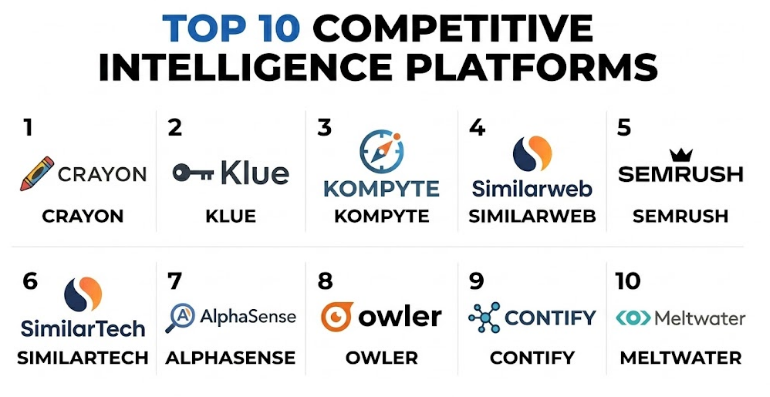
Top 10 Competitive Intelligence Platforms
#1 — Crayon
Short description :
Crayon is a competitive intelligence platform designed to help businesses monitor competitor activity, capture market signals, create battlecards, and support sales and marketing teams. It tracks competitor website changes, messaging shifts, product updates, content, news, and other market signals. Crayon is especially useful for B2B SaaS and technology companies that need structured competitive intelligence workflows. It helps product marketing and sales enablement teams keep competitive assets updated. Crayon is a strong option for companies that want continuous competitor monitoring and sales-ready intelligence.
Key Features
- Competitor website and content monitoring
- Market and news signal tracking
- Sales battlecards
- Competitive alerts and digests
- Competitor profile management
- Team collaboration workflows
- CRM and sales enablement integrations
Pros
- Strong fit for B2B competitive intelligence
- Useful battlecard and sales enablement workflows
- Helps centralize competitor signals
Cons
- May be more than very small teams need
- Signal quality depends on setup and competitor tracking rules
- Teams still need internal ownership to turn data into action
Platforms / Deployment
Web
Cloud deployment
Security & Compliance
Crayon may process competitor profiles, sales enablement content, user activity, notes, internal strategy data, and integration data. Specific certifications such as SOC 2, ISO 27001, GDPR, or other compliance details should be verified directly.
Not publicly stated.
Integrations & Ecosystem
Crayon fits product marketing and sales workflows where competitive insights need to reach revenue teams.
- CRM systems
- Sales enablement tools
- Slack-style team notifications
- Email digests
- Battlecard workflows
- Market monitoring sources
Support & Community
Crayon provides competitive intelligence support resources and onboarding. It is best for teams that want a structured CI program with sales enablement impact.
#2 — Klue
Short description :
Klue is a competitive enablement platform focused on helping companies collect competitive intelligence, organize insights, build battlecards, and equip sales teams with practical competitive guidance. It is especially strong for B2B revenue teams that need competitor talk tracks, objection handling, and deal support. Klue helps product marketing teams gather signals, validate insights, and distribute competitive content to sales teams. It can support competitive research, battlecard management, and field intelligence collection. Klue is a strong option for companies that want competitive intelligence tied closely to sales execution.
Key Features
- Competitive battlecards
- Sales enablement workflows
- Competitor profile management
- Field intelligence collection
- Market signal tracking
- Team collaboration
- CRM and sales tool integrations
Pros
- Strong for competitive sales enablement
- Useful for battlecards and objection handling
- Helps product marketing and sales align
Cons
- Less useful if the company has no active sales team
- Requires ongoing content ownership
- Best value depends on sales adoption
Platforms / Deployment
Web
Cloud deployment
Security & Compliance
Klue may process competitive content, internal notes, sales enablement data, deal context, and user activity. Specific security and compliance details should be verified directly.
Not publicly stated.
Integrations & Ecosystem
Klue fits competitive enablement programs connected with sales teams.
- CRM systems
- Sales enablement platforms
- Team communication tools
- Battlecard delivery
- Field feedback workflows
- Competitive content libraries
Support & Community
Klue provides support and resources for competitive enablement teams. It is best for B2B companies that need competitive intelligence inside sales conversations.
#3 — Kompyte
Short description :
Kompyte is a competitive intelligence platform that helps businesses track competitor updates, monitor digital activity, and create sales battlecards. It is useful for marketing, sales, and product teams that want alerts about competitor website changes, content updates, product messaging, and campaign activity. Kompyte helps teams organize competitor insights and share them with sales teams in a usable format. It is especially relevant for companies that want automated competitor monitoring with sales enablement support. Kompyte is a practical option for teams building a competitive intelligence function.
Key Features
- Competitor monitoring
- Website and content change tracking
- Competitive alerts
- Sales battlecards
- Competitor profile organization
- Digital activity monitoring
- Team collaboration workflows
Pros
- Useful for automated competitor tracking
- Good for sales battlecards and marketing insights
- Helps reduce manual competitor research
Cons
- Alert quality depends on competitor setup
- May need filtering to avoid information overload
- Advanced use requires internal CI ownership
Platforms / Deployment
Web
Cloud deployment
Security & Compliance
Kompyte may process competitor tracking data, internal notes, battlecards, team activity, and integration data. Specific security and compliance details should be verified directly.
Not publicly stated.
Integrations & Ecosystem
Kompyte fits businesses that want competitor monitoring and sales enablement together.
- CRM tools
- Team communication workflows
- Competitive battlecards
- Website monitoring sources
- Content tracking
- Sales enablement workflows
Support & Community
Kompyte provides support for competitive intelligence and sales enablement workflows. It is best for teams that need competitor monitoring plus practical sales assets.
#4 — Similarweb
Short description :
Similarweb is a digital intelligence platform used to analyze website traffic, digital market trends, audience behavior, competitor performance, marketing channels, and online growth signals. It is useful for marketing teams, strategy teams, ecommerce teams, investors, agencies, and competitive intelligence professionals. Similarweb helps businesses understand where competitor traffic comes from, which channels perform, and how digital audiences behave. It is especially valuable for market sizing, traffic benchmarking, and digital strategy. Similarweb is a strong option when competitive intelligence depends on online performance and market visibility.
Key Features
- Website traffic intelligence
- Competitor traffic benchmarking
- Audience and channel analysis
- Market trend insights
- Referral and search traffic data
- App and digital performance insights depending on setup
- Reporting and dashboard workflows
Pros
- Strong digital market intelligence
- Useful for competitor traffic and channel analysis
- Good for strategy, marketing, and research teams
Cons
- Data should be treated as directional, not exact
- Not mainly a battlecard platform
- Pricing and data depth should be reviewed carefully
Platforms / Deployment
Web
Cloud deployment
Security & Compliance
Similarweb may process user accounts, analytics data, market intelligence queries, reports, and business research workflows. Specific certifications and compliance details should be verified directly.
Not publicly stated.
Integrations & Ecosystem
Similarweb fits digital intelligence and market research workflows.
- Marketing analytics
- SEO and traffic research
- Digital benchmarking
- Market research
- Investor research
- Competitive dashboards
Support & Community
Similarweb provides business and research support resources. It is best for teams that need digital market intelligence and competitor traffic insights.
#5 — Semrush
Short description :
Semrush is a digital marketing and competitive research platform used for SEO, PPC, content marketing, competitor analysis, market research, and online visibility tracking. It helps businesses analyze competitor keywords, backlinks, ads, content strategy, traffic signals, and search performance. Semrush is especially useful for marketing teams that want competitive intelligence around search, content, and digital advertising. It is not only a CI platform, but it is powerful for understanding how competitors win visibility online. Semrush is a strong option for SEO-led and digital marketing-led competitive research.
Key Features
- SEO competitor research
- Keyword and backlink analysis
- Paid search competitor insights
- Content and topic research
- Traffic and market analysis tools
- Rank tracking
- Reporting and dashboards
Pros
- Strong for SEO and digital marketing intelligence
- Useful for content and search competitor research
- Broad marketing toolkit beyond CI
Cons
- Not a dedicated sales battlecard platform
- Data can be overwhelming for non-marketing teams
- Some metrics are estimates and should be interpreted carefully
Platforms / Deployment
Web
Cloud deployment
Security & Compliance
Semrush may process user accounts, website projects, keyword data, competitive research data, and reporting workflows. Specific certifications and compliance details should be verified directly.
Not publicly stated.
Integrations & Ecosystem
Semrush fits digital marketing and SEO-led competitive intelligence.
- SEO tools
- PPC research
- Content marketing workflows
- Website audits
- Rank tracking
- Reporting dashboards
Support & Community
Semrush has a large marketing user community and extensive educational resources. It is best for teams that need competitor intelligence around search and digital visibility.
#6 — SimilarTech
Short description :
SimilarTech is a technology intelligence platform that helps businesses identify the technologies used by websites, track technology adoption, and analyze market trends across web technologies. It is useful for sales, marketing, lead generation, competitive research, and market intelligence teams. SimilarTech helps companies understand which tools, platforms, analytics systems, ecommerce technologies, and software categories competitors or prospects use. It is especially useful for technology vendors and agencies that sell to companies based on their tech stack. SimilarTech is a strong option for technology-focused competitive intelligence.
Key Features
- Website technology tracking
- Tech stack intelligence
- Market share and adoption insights
- Lead generation based on technology usage
- Competitor technology monitoring
- Category and trend analysis
- Data exports and reporting
Pros
- Strong for technology adoption intelligence
- Useful for sales and market research teams
- Helps identify competitor and prospect tech stacks
Cons
- Not a full competitive battlecard solution
- Best fit is technology and web stack intelligence
- Data accuracy should be validated for critical decisions
Platforms / Deployment
Web
Cloud deployment
Security & Compliance
SimilarTech may process web technology data, user accounts, company lists, reports, and export workflows. Specific compliance and security details should be verified directly.
Not publicly stated.
Integrations & Ecosystem
SimilarTech fits technology market intelligence workflows.
- Lead generation systems
- Sales research
- Market analysis
- Website technology monitoring
- Competitive tech stack tracking
- Data exports
Support & Community
SimilarTech provides support for technology intelligence and prospecting workflows. It is best for companies that need web technology and market adoption insights.
#7 — AlphaSense
Short description :
AlphaSense is a market intelligence and research platform used by enterprise teams, financial professionals, strategy teams, product teams, and corporate researchers to search across business content, filings, expert insights, news, and market signals. It is useful for competitive intelligence when teams need deeper business research beyond website monitoring. AlphaSense helps users find themes, track companies, analyze market movement, and summarize business information. It is especially valuable for enterprise strategy, investor relations, corporate development, and market research teams. AlphaSense is a strong option when CI requires deep research and external business intelligence.
Key Features
- Market and company research
- Business content search
- News and document intelligence
- AI-assisted summaries
- Company and topic monitoring
- Research workflow support
- Alerts and reporting
Pros
- Strong for deep business and market research
- Useful for enterprise strategy and research teams
- Helps summarize large volumes of information
Cons
- May be too advanced for small teams
- Not mainly a sales battlecard tool
- Best value depends on research maturity
Platforms / Deployment
Web
Cloud deployment
Security & Compliance
AlphaSense may process user research activity, saved searches, documents, company watchlists, and business intelligence workflows. Specific certifications and compliance details should be verified directly.
Not publicly stated.
Integrations & Ecosystem
AlphaSense fits market research and strategy intelligence workflows.
- Company research
- Market monitoring
- News alerts
- Document search
- Executive research
- Strategy reporting
Support & Community
AlphaSense provides enterprise research support and onboarding resources. It is best for teams that need deeper business intelligence and market research.
#8 — Owler
Short description :
Owler is a business information and competitive intelligence platform that helps users track companies, competitors, news, funding updates, leadership changes, and market movement. It is useful for sales, marketing, strategy, and business development teams that need company-level competitor updates. Owler helps teams monitor competitor activity and receive alerts about important business changes. It is especially practical for teams that want simple company tracking without a heavy enterprise research platform. Owler is a good option for lightweight competitive and company intelligence.
Key Features
- Company profiles
- Competitor tracking
- News and update alerts
- Funding and leadership signal tracking
- Company comparison information
- Market and business updates
- Sales and research workflows
Pros
- Easy company-level competitor monitoring
- Useful for sales and business research
- Good for lightweight CI programs
Cons
- Not as deep as enterprise research platforms
- Data should be validated for critical use
- Limited battlecard and enablement depth
Platforms / Deployment
Web
Cloud deployment
Security & Compliance
Owler may process user account data, company watchlists, research activity, and business alerts. Specific security and compliance details should be verified directly.
Not publicly stated.
Integrations & Ecosystem
Owler fits company monitoring and simple competitive research workflows.
- Company profiles
- Competitor alerts
- Sales research
- Business development workflows
- News monitoring
- Market updates
Support & Community
Owler provides business information resources and company tracking features. It is best for teams that need simple competitor and company alerts.
#9 — Contify
Short description :
Contify is a market and competitive intelligence platform that helps businesses monitor competitors, industry news, market trends, customers, and strategic signals from multiple sources. It supports intelligence collection, filtering, tagging, dashboards, and insight distribution. Contify is especially useful for strategy, market intelligence, product marketing, and corporate intelligence teams that need curated intelligence rather than raw alerts. It helps reduce noise by organizing signals into meaningful intelligence topics. Contify is a strong option for companies that need structured market and competitor monitoring.
Key Features
- Competitive and market intelligence monitoring
- News and signal aggregation
- Custom dashboards
- Tagging and classification
- Alerting and newsletters
- Source filtering
- Insight distribution workflows
Pros
- Strong for curated market intelligence
- Useful for strategy and corporate intelligence teams
- Helps reduce alert noise through filtering
Cons
- Requires thoughtful topic and source setup
- Not mainly a sales battlecard platform
- Best value depends on ongoing intelligence management
Platforms / Deployment
Web
Cloud deployment
Security & Compliance
Contify may process company watchlists, intelligence topics, user activity, research notes, and alert workflows. Specific certifications and compliance details should be verified directly.
Not publicly stated.
Integrations & Ecosystem
Contify fits market and competitive intelligence programs.
- News monitoring
- Competitor tracking
- Executive dashboards
- Email newsletters
- Market trend tracking
- Intelligence libraries
Support & Community
Contify provides support for market intelligence workflows. It is best for teams that need curated intelligence across competitors and industries.
#10 — Meltwater
Short description :
Meltwater is a media intelligence and social listening platform used by brands, PR teams, communications teams, marketing teams, and competitive intelligence professionals. It helps businesses monitor news, media coverage, social conversations, brand mentions, competitor mentions, sentiment, and industry trends. Meltwater is useful for competitive intelligence when companies need to understand public perception, media visibility, and market conversation around competitors. It is especially relevant for PR, brand, communications, and social intelligence use cases. Meltwater is a strong option for teams that need media and social intelligence as part of CI.
Key Features
- Media monitoring
- Social listening
- Brand and competitor mention tracking
- Sentiment analysis
- News and PR intelligence
- Reporting dashboards
- Alerting and insights workflows
Pros
- Strong for media and social intelligence
- Useful for PR and brand teams
- Helps track competitor visibility and public sentiment
Cons
- Not mainly a product or pricing CI platform
- Can be more than small teams need
- Requires clear monitoring topics to reduce noise
Platforms / Deployment
Web
Cloud deployment
Security & Compliance
Meltwater may process user accounts, media monitoring queries, social content, reports, and alert workflows. Specific security and compliance details should be verified directly.
Not publicly stated.
Integrations & Ecosystem
Meltwater fits media, PR, and social competitive intelligence workflows.
- Media monitoring
- Social listening
- PR reporting
- Brand tracking
- Competitor mention analysis
- Sentiment dashboards
Support & Community
Meltwater provides support for media intelligence and social listening programs. It is best for teams that need competitor visibility across media and social channels.
Comparison Table Top 10
| Tool Name | Best For | Platform(s) Supported | Deployment | Standout Feature | Public Rating |
|---|---|---|---|---|---|
| Crayon | B2B competitive intelligence and battlecards | Web | Cloud | Competitor monitoring plus sales battlecards | N/A |
| Klue | Competitive sales enablement | Web | Cloud | Battlecards and field intelligence workflows | N/A |
| Kompyte | Competitor tracking and sales assets | Web | Cloud | Automated competitor alerts and battlecards | N/A |
| Similarweb | Digital market and traffic intelligence | Web | Cloud | Website traffic and market benchmarking | N/A |
| Semrush | SEO and digital marketing competitor research | Web | Cloud | Search, content, and paid traffic intelligence | N/A |
| SimilarTech | Technology stack intelligence | Web | Cloud | Website technology adoption tracking | N/A |
| AlphaSense | Enterprise market and business research | Web | Cloud | Deep business research and AI summaries | N/A |
| Owler | Lightweight company and competitor alerts | Web | Cloud | Company news and competitor updates | N/A |
| Contify | Curated market and competitor intelligence | Web | Cloud | Filtered intelligence dashboards and alerts | N/A |
| Meltwater | Media and social competitive intelligence | Web | Cloud | Media monitoring and social listening | N/A |
Evaluation & Competitive Intelligence Platforms
| Tool Name | Core 25% | Ease 15% | Integrations 15% | Security 10% | Performance 10% | Support 10% | Value 15% | Weighted Total 0–10 |
|---|---|---|---|---|---|---|---|---|
| Crayon | 9.0 | 8.0 | 8.6 | 8.3 | 8.7 | 8.4 | 8.0 | 8.47 |
| Klue | 8.8 | 8.2 | 8.5 | 8.3 | 8.6 | 8.5 | 8.0 | 8.45 |
| Kompyte | 8.5 | 8.2 | 8.2 | 8.0 | 8.4 | 8.2 | 8.1 | 8.29 |
| Similarweb | 9.0 | 7.8 | 8.5 | 8.4 | 8.8 | 8.4 | 7.8 | 8.43 |
| Semrush | 8.8 | 8.2 | 8.4 | 8.3 | 8.8 | 8.4 | 8.3 | 8.50 |
| SimilarTech | 8.0 | 8.0 | 7.8 | 8.0 | 8.2 | 8.0 | 8.0 | 8.00 |
| AlphaSense | 9.2 | 7.6 | 8.5 | 8.7 | 8.8 | 8.6 | 7.6 | 8.49 |
| Owler | 7.8 | 8.6 | 7.5 | 8.0 | 8.0 | 7.8 | 8.4 | 8.01 |
| Contify | 8.7 | 8.0 | 8.2 | 8.3 | 8.5 | 8.4 | 8.0 | 8.32 |
| Meltwater | 8.6 | 7.8 | 8.4 | 8.4 | 8.6 | 8.4 | 7.8 | 8.31 |
These scores are comparative and should be used as a starting point. B2B sales and product marketing teams may rate Crayon, Klue, or Kompyte higher because battlecards and field enablement matter. Digital marketing teams may prefer Semrush or Similarweb. Strategy and research teams may prefer AlphaSense or Contify. PR and communications teams may prefer Meltwater. Teams needing lightweight company alerts may prefer Owler.
Which Competitive Intelligence Platform Should You Choose?
Solo / Small Business
A small business should start simple. If the goal is to track competitor websites, messaging, SEO, and traffic, Semrush, Similarweb, or Owler can be practical starting points.
Small teams should avoid overbuilding competitive intelligence. Start by tracking three to five direct competitors, pricing pages, product updates, review sites, ads, and messaging changes.
Startup
Startups need competitive intelligence that supports positioning, sales conversations, product roadmap decisions, and market messaging. Crayon, Klue, Kompyte, Semrush, and Similarweb are useful options to compare.
The priority should be clarity. Teams should know who they compete with, where they win, where they lose, and how to explain the difference to buyers.
Mid-Market Company
Mid-market companies usually need structured competitor profiles, sales battlecards, alerts, product updates, and market reporting. Crayon, Klue, Kompyte, Contify, and Similarweb are strong options.
At this stage, competitive intelligence should be shared across product marketing, sales, customer success, leadership, and product teams.
Enterprise
Enterprise companies need broad intelligence coverage, governance, advanced reporting, integrations, security controls, and cross-team workflows. AlphaSense, Crayon, Klue, Contify, Meltwater, and Similarweb are strong options to evaluate.
Enterprise buyers should involve product marketing, strategy, sales enablement, research, legal, communications, and leadership teams.
Sales Team
Sales teams need fast, practical, easy-to-use competitive content. Klue, Crayon, and Kompyte are strong options because they help convert research into battlecards, talk tracks, and objection-handling content.
Sales-focused CI should be short, clear, and actionable. Reps do not need long research reports during live deals.
Marketing Team
Marketing teams often need SEO, content, advertising, messaging, and website intelligence. Semrush, Similarweb, Meltwater, and Crayon are useful depending on marketing goals.
Marketing should use competitive intelligence to improve positioning, campaign messaging, content gaps, and category differentiation.
Product Team
Product teams need insight into competitor features, roadmap signals, customer complaints, product reviews, pricing changes, and launch activity. Crayon, Kompyte, Contify, and AlphaSense can be useful.
Product teams should combine competitor data with customer feedback, win-loss analysis, and usage data before making roadmap decisions.
Budget vs Premium
Budget-focused teams should start with manual competitor tracking supported by lightweight tools. A simple company alert system and SEO competitor tool may be enough early on.
Premium platforms become valuable when the company has many competitors, active sales teams, multiple markets, frequent product changes, and a need to distribute intelligence across teams.
Feature Depth vs Ease of Use
Owler is easy for simple company tracking. Semrush is strong for SEO and digital marketing intelligence. Similarweb is stronger for traffic and market benchmarking. Crayon, Klue, and Kompyte are better for competitive enablement and battlecards. AlphaSense and Contify are stronger for strategic research and market intelligence. Meltwater is best for media and social visibility.
The best choice depends on whether the main need is sales battlecards, digital marketing research, market intelligence, media monitoring, or technology tracking.
Integrations & Scalability
Competitive intelligence platforms may need to connect with CRM systems, sales enablement platforms, Slack-style communication tools, email digests, BI tools, knowledge bases, content repositories, and research workflows.
Scalability means tracking more competitors, more markets, more signals, more users, more battlecards, more alerts, and more reporting needs without creating noise.
Security & Compliance Needs
Competitive intelligence platforms may store internal strategy notes, sales battlecards, competitor analysis, customer feedback, deal insights, and market research. Buyers should review user permissions, access controls, audit logs, data retention, integration security, and sharing controls.
Teams should also train users to avoid uploading confidential third-party data, private customer information, or legally sensitive content into CI systems without approval.
Frequently Asked Questions FAQs
1. What is a Competitive Intelligence Platform?
A Competitive Intelligence Platform helps businesses collect, organize, monitor, and share information about competitors, markets, products, pricing, messaging, customers, and industry movement.
2. Why do businesses need competitive intelligence?
Businesses need competitive intelligence to understand market changes, improve positioning, support sales teams, guide product strategy, monitor competitors, and make better business decisions.
3. Which platform is best for sales battlecards?
Crayon, Klue, and Kompyte are strong options for sales battlecards and competitive enablement. They help sales teams understand competitor differences and handle objections more confidently.
4. Which platform is best for SEO competitor research?
Semrush is a strong option for SEO competitor research. It helps teams analyze keywords, backlinks, rankings, content gaps, and paid search activity.
5. Which platform is best for digital traffic intelligence?
Similarweb is useful for competitor traffic benchmarking, audience analysis, traffic source insights, and digital market trends.
6. Which platform is best for enterprise research?
AlphaSense and Contify are strong options for enterprise research and market intelligence. They help teams track companies, industry movement, news, and strategic signals.
7. Which platform is best for media and PR intelligence?
Meltwater is useful for media monitoring, social listening, sentiment analysis, brand mentions, and competitor visibility across public channels.
8. What are common competitive intelligence mistakes?
Common mistakes include tracking too many competitors, collecting data without analysis, sending too many alerts, not updating battlecards, ignoring sales feedback, and failing to connect insights to decisions.
9. Can competitive intelligence tools replace human research?
No. They can collect and organize signals, but human judgment is still needed to interpret meaning, validate accuracy, and turn insights into strategy.
10. How often should competitive intelligence be updated?
Important competitor changes should be monitored continuously, but formal summaries can be shared weekly, monthly, or around major product launches, campaigns, or sales enablement updates.
Conclusion
Competitive Intelligence Platforms help businesses understand competitors, track market changes, support sales teams, improve positioning, and make better strategic decisions. The right platform depends on the team’s goals and maturity. Crayon, Klue, and Kompyte are strong for B2B competitive enablement and battlecards. Similarweb is useful for traffic and digital market intelligence. Semrush is strong for SEO and digital marketing competitor research. SimilarTech helps with technology stack intelligence. AlphaSense is powerful for enterprise research and business intelligence. Owler is useful for lightweight company tracking. Contify supports curated market intelligence. Meltwater is strong for media and social monitoring.
