Introduction
Product Feed Management Tools help ecommerce brands, retailers, agencies, and marketplace sellers create, clean, optimize, and distribute product feeds across shopping channels, marketplaces, comparison engines, social commerce platforms, affiliate networks, and advertising platforms. In simple words, these tools make sure product data is formatted correctly for every channel where products are promoted or sold.
A product feed usually includes product titles, descriptions, SKUs, prices, availability, categories, images, shipping details, variants, GTINs, brands, product types, custom labels, sale prices, and tracking parameters. Each channel may require a different format, field structure, category mapping, image rule, or approval standard. Managing all this manually can create feed errors, rejected products, poor ad performance, and wasted ad spend.
Real-world use cases include:
- Sending optimized product feeds to shopping ads
- Publishing product catalogs to marketplaces
- Fixing missing product attributes and feed errors
- Creating channel-specific titles and descriptions
- Managing product feeds for social commerce
- Improving product visibility in comparison engines
- Segmenting products by margin, category, price, or campaign
- Automating product data updates across channels
Buyers should evaluate:
- Supported shopping channels and marketplaces
- Feed optimization and rule-building features
- Category and attribute mapping
- Product data validation
- Bulk editing and automation
- Custom labels and campaign segmentation
- Variant and inventory handling
- Error detection and feed diagnostics
- Ecommerce platform integrations
- API and data source support
- Reporting and performance analytics
- Pricing, scalability, and support quality
Best for: ecommerce brands, retailers, agencies, DTC companies, marketplace sellers, performance marketers, product data teams, and businesses that advertise or sell products across multiple channels.
Not ideal for: very small stores with a few products on one platform, businesses that do not use shopping ads or marketplaces, or sellers whose ecommerce platform already handles simple feed requirements well. Product feed tools become more valuable when product catalogs, channels, campaigns, or feed rules become complex.
Key Trends in Product Feed Management Tools
- Feed quality directly affects ad performance: Better titles, categories, images, pricing, and attributes can improve product visibility, click quality, and conversion potential.
- Multi-channel product distribution is becoming standard: Brands now manage feeds for shopping ads, marketplaces, social commerce, affiliate networks, comparison engines, and retail media channels.
- Automation is replacing manual feed editing: Rule-based optimization helps teams update thousands of products without editing each listing manually.
- AI-assisted feed optimization is growing: Some teams use AI to improve product titles, descriptions, categorization, attribute completion, and campaign segmentation.
- Retail media is increasing feed complexity: Brands need clean product data for retailer ad networks, marketplace ads, and commerce media platforms.
- Custom labels are becoming more strategic: Marketers use product margin, seasonality, stock level, bestseller status, price bands, and lifecycle stage to segment campaigns.
- Channel-specific optimization matters: A product title that works for one marketplace may not perform well in a shopping ad or social commerce feed.
- Inventory and pricing accuracy are critical: Incorrect prices or out-of-stock products can cause wasted ad spend, disapproved listings, and poor customer experience.
- Feed diagnostics are more important: Teams need quick visibility into rejected items, missing fields, broken images, invalid categories, and policy-related errors.
- Product feed management is becoming part of commerce operations: Feed quality now connects ecommerce, marketing, merchandising, product data, and performance advertising teams.
How We Selected These Tools Methodology
The tools below were selected based on product feed management relevance, market recognition, ecommerce fit, feed optimization capability, integration depth, automation features, and practical value across business sizes.
- Feed creation and optimization: Tools were reviewed for product feed building, field mapping, bulk editing, custom rules, and feed transformation.
- Channel support: Shopping platforms, marketplaces, social commerce channels, comparison engines, and advertising destinations were considered.
- Data quality controls: Validation rules, error detection, diagnostics, missing attribute checks, and approval readiness were evaluated.
- Automation capability: Rule-based updates, scheduled feed refreshes, dynamic labels, and product segmentation were considered.
- Ecommerce integrations: Shopify, WooCommerce, Magento, BigCommerce, custom stores, APIs, files, and product databases were reviewed.
- Campaign support: Custom labels, product grouping, margin-based segmentation, and advertising-focused optimization were considered.
- Scalability: Tools for small stores, growing brands, agencies, and enterprise ecommerce teams were included.
- Ease of use: Feed editor experience, dashboard clarity, onboarding, and marketer-friendly workflows were reviewed.
- Reporting and diagnostics: Error reporting, product status visibility, and channel feedback handling were considered.
- Practical buyer fit: The goal is not one universal winner, but a useful comparison based on feed complexity and selling channels.
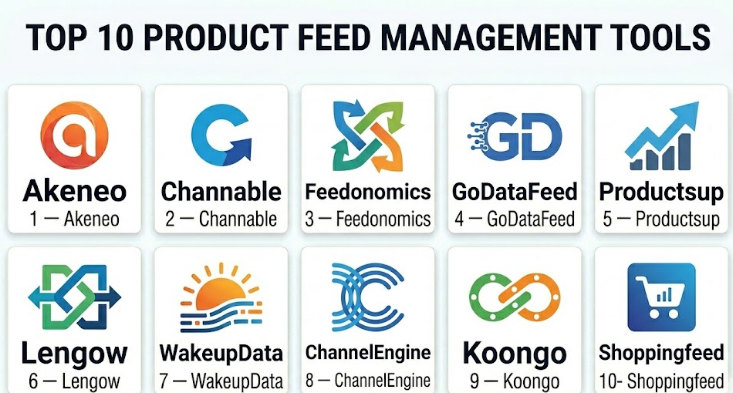
Top 10 Product Feed Management Tools
#1 — DataFeedWatch
Short description :
DataFeedWatch is a product feed management tool designed to help ecommerce sellers optimize and distribute product feeds across shopping channels, marketplaces, and advertising platforms. It allows teams to create feed rules, map product attributes, improve titles, exclude poor-performing products, and manage channel-specific feed requirements. It is especially useful for ecommerce brands and agencies that need better control over product feeds without relying only on native ecommerce platform exports. DataFeedWatch is strong for shopping ads, comparison engines, and multi-channel product feed optimization. It is a practical choice for teams that want powerful feed rules with a marketer-friendly interface.
Key Features
- Product feed creation and optimization
- Channel-specific feed templates
- Rule-based attribute mapping
- Product title and description optimization
- Custom labels and segmentation
- Feed diagnostics and error management
- Ecommerce platform integrations
Pros
- Strong for shopping feed optimization
- Useful for agencies and ecommerce marketers
- Good rule-building capability for product segmentation
Cons
- Requires feed strategy for best results
- Advanced use cases may need setup time
- Very small stores may not need the full feature set
Platforms / Deployment
Web
Cloud deployment
Security & Compliance
DataFeedWatch may process product data, store connections, feed files, campaign attributes, and channel-related information. Specific certifications such as SOC 2, ISO 27001, GDPR, or other compliance details should be verified directly.
Not publicly stated.
Integrations & Ecosystem
DataFeedWatch fits ecommerce teams managing feeds across multiple advertising and commerce destinations.
- Ecommerce platforms
- Shopping ad channels
- Comparison shopping engines
- Marketplace feeds
- Social commerce catalogs
- Agency campaign workflows
Support & Community
DataFeedWatch provides product feed support and learning resources. It is best for teams that want hands-on feed optimization and campaign-focused product segmentation.
#2 — Channable
Short description :
Channable is a feed management and ecommerce automation platform that helps businesses manage product feeds, marketplace listings, PPC campaigns, and order connections across multiple channels. It is useful for ecommerce brands, retailers, and agencies that need one system for feed optimization and channel distribution. Channable supports rule-based feed editing, category mapping, marketplace listing creation, and campaign automation depending on setup. It is especially valuable for businesses expanding across marketplaces and advertising platforms. Channable is a strong option when feed management and marketplace automation need to work together.
Key Features
- Product feed management
- Rule-based product data optimization
- Marketplace listing automation
- Category and attribute mapping
- PPC campaign automation support
- Order connection workflows depending on setup
- Multi-channel product distribution
Pros
- Strong feed and marketplace automation combination
- Useful for agencies and multi-channel retailers
- Good rule-based product data control
Cons
- Advanced marketplace workflows require careful setup
- May be more complex than simple feed-only tools
- Pricing should be evaluated by channels and usage
Platforms / Deployment
Web
Cloud deployment
Security & Compliance
Channable may process product catalogs, channel data, marketplace listings, order data, and advertising feed information. Specific certifications and compliance details should be verified directly.
Not publicly stated.
Integrations & Ecosystem
Channable fits businesses that need product feed and channel automation.
- Ecommerce platforms
- Marketplaces
- Shopping ad platforms
- PPC tools
- Product feed exports
- Order connection workflows
Support & Community
Channable provides support and onboarding resources for ecommerce teams and agencies. It is best for businesses managing many channels and feed automation rules.
#3 — Feedonomics
Short description :
Feedonomics is an enterprise-focused product feed management and data feed optimization platform used by brands, retailers, marketplaces, and agencies. It helps businesses optimize product data, distribute feeds across many channels, manage marketplace listings, and support complex commerce data workflows. Feedonomics is especially useful for large catalogs, enterprise ecommerce programs, and teams that need managed feed operations. It can support product data transformation, channel mapping, diagnostics, and marketplace feed requirements. Feedonomics is a strong option for enterprise brands needing scalable feed management and expert support.
Key Features
- Enterprise product feed optimization
- Marketplace and advertising feed distribution
- Data transformation and mapping
- Feed diagnostics and issue resolution
- Large catalog support
- Marketplace listing support
- Managed service and technical support options
Pros
- Strong for enterprise feed operations
- Useful for large and complex product catalogs
- Good fit for brands needing managed feed expertise
Cons
- May be too advanced for small businesses
- Pricing and service scope should be reviewed carefully
- Implementation requires product data coordination
Platforms / Deployment
Web
Cloud deployment
Security & Compliance
Feedonomics may process large product catalogs, marketplace data, feed credentials, product attributes, and channel performance data. Specific certifications and compliance details should be verified directly.
Not publicly stated.
Integrations & Ecosystem
Feedonomics fits enterprise ecommerce and marketplace feed workflows.
- Ecommerce systems
- Marketplaces
- Shopping ad platforms
- Retail media channels
- Product data sources
- Agency and enterprise workflows
Support & Community
Feedonomics is known for feed management expertise and enterprise support. It is best for larger businesses needing advanced optimization and managed assistance.
#4 — GoDataFeed
Short description :
GoDataFeed is a product feed management platform that helps ecommerce sellers connect, optimize, and distribute product feeds to shopping channels, marketplaces, and advertising platforms. It supports feed transformation, channel templates, product data mapping, and diagnostics. GoDataFeed is useful for retailers and agencies that need to improve feed quality and reduce product listing errors. It can help sellers manage multiple feeds from a central dashboard. GoDataFeed is a practical choice for ecommerce teams that want structured feed optimization and multi-channel distribution.
Key Features
- Product feed creation and management
- Channel feed templates
- Attribute mapping and transformation
- Product data validation
- Feed diagnostics
- Multi-channel feed distribution
- Ecommerce platform integrations
Pros
- Useful for multi-channel feed workflows
- Helps reduce product feed errors
- Practical for ecommerce teams and agencies
Cons
- Advanced optimization requires proper rule setup
- Not a complete ecommerce operations platform
- Users should validate supported channels before purchase
Platforms / Deployment
Web
Cloud deployment
Security & Compliance
GoDataFeed may process store data, product feeds, channel exports, product attributes, and campaign-related data. Specific certifications and compliance details should be verified directly.
Not publicly stated.
Integrations & Ecosystem
GoDataFeed fits ecommerce businesses that distribute product feeds across multiple channels.
- Ecommerce platforms
- Shopping ad channels
- Marketplaces
- Product feed exports
- Comparison engines
- Campaign workflows
Support & Community
GoDataFeed provides support resources for feed setup and optimization. It is best for teams needing reliable product feed management without enterprise-level complexity.
#5 — Productsup
Short description :
Productsup is a product-to-consumer platform that helps businesses manage product content, feed syndication, marketplace integrations, and product data distribution across digital commerce channels. It is useful for brands, retailers, manufacturers, and enterprise teams that need to optimize product data at scale. Productsup supports feed transformation, channel-specific data requirements, marketplace distribution, and product content workflows. It is especially relevant for companies with complex global commerce operations. Productsup is a strong option for enterprise product data syndication and channel management.
Key Features
- Product feed syndication
- Product data transformation
- Channel-specific feed management
- Marketplace integration support
- Product content distribution
- Data quality and validation workflows
- Enterprise scalability
Pros
- Strong for enterprise product data distribution
- Useful for global commerce and marketplace workflows
- Good product content transformation capability
Cons
- May be too advanced for small sellers
- Implementation can require data and channel planning
- Pricing and scope should be reviewed carefully
Platforms / Deployment
Web
Cloud deployment
Security & Compliance
Productsup may process product data, channel requirements, marketplace feeds, media assets, and distribution workflows. Specific certifications and compliance details should be verified directly.
Not publicly stated.
Integrations & Ecosystem
Productsup fits enterprise product data syndication and channel operations.
- Ecommerce platforms
- Marketplaces
- Retail media channels
- Product content systems
- Feed exports
- Digital commerce channels
Support & Community
Productsup provides enterprise support and product data expertise. It is best for larger organizations with complex product-to-channel operations.
#6 — Lengow
Short description :
Lengow is an ecommerce feed management and marketplace automation platform designed to help retailers and brands distribute product catalogs across marketplaces, comparison shopping engines, social networks, and advertising platforms. It supports feed optimization, marketplace publication, channel rules, product data mapping, and order management depending on setup. Lengow is especially useful for businesses expanding across European and international commerce channels. It helps sellers manage product data and channel complexity from one platform. Lengow is a strong choice for retailers needing feed management and marketplace expansion support.
Key Features
- Product feed management
- Marketplace distribution
- Comparison shopping engine feeds
- Channel-specific rules
- Product data optimization
- Order management workflows depending on setup
- Multi-country commerce support
Pros
- Strong for marketplace and feed expansion
- Useful for European and international selling
- Good multi-channel product data workflows
Cons
- Setup requires clear channel strategy
- Advanced features may need onboarding
- Businesses should validate channel coverage by region
Platforms / Deployment
Web
Cloud deployment
Security & Compliance
Lengow may process product catalogs, marketplace data, orders, channel credentials, and feed data. Specific security and compliance details should be verified directly.
Not publicly stated.
Integrations & Ecosystem
Lengow fits retailers expanding across marketplaces and shopping channels.
- Ecommerce platforms
- Marketplaces
- Social commerce platforms
- Comparison shopping engines
- Advertising channels
- Order workflows
Support & Community
Lengow provides ecommerce and marketplace-focused support. It is best for retailers that need broader channel expansion with feed optimization.
#7 — WakeupData
Short description :
WakeupData is a product feed management and optimization tool that helps ecommerce businesses improve product data quality and distribute feeds to shopping channels, marketplaces, and advertising platforms. It supports feed transformation, enrichment, rule-based optimization, and channel mapping. WakeupData is useful for marketers and ecommerce teams that want stronger control over product feeds and campaign segmentation. It can help improve product titles, categorize items, exclude low-value products, and prepare feeds for different platforms. WakeupData is a strong option for performance-focused ecommerce feed optimization.
Key Features
- Product feed optimization
- Rule-based feed editing
- Product data enrichment
- Channel mapping and exports
- Custom labels and segmentation
- Feed diagnostics
- Ecommerce integration support
Pros
- Good for performance marketing feed workflows
- Useful rule-based optimization
- Helps improve product feed quality
Cons
- Requires feed optimization knowledge
- Smaller stores may not need advanced features
- Channel support should be validated before purchase
Platforms / Deployment
Web
Cloud deployment
Security & Compliance
WakeupData may process product data, ecommerce feeds, channel exports, and campaign-related product attributes. Specific compliance details should be verified directly.
Not publicly stated.
Integrations & Ecosystem
WakeupData fits ecommerce marketers and agencies managing product feeds.
- Ecommerce platforms
- Shopping ad channels
- Marketplaces
- Product feed exports
- Custom feed workflows
- Campaign optimization systems
Support & Community
WakeupData provides feed management support and resources. It is best for teams that want control over feed optimization and product segmentation.
#8 — ChannelEngine
Short description :
ChannelEngine is a marketplace integration and feed management platform that helps brands and retailers sell products across marketplaces and online channels. It supports product feed distribution, marketplace listing, order synchronization, inventory updates, pricing workflows, and channel expansion. ChannelEngine is especially useful for businesses that want to manage marketplace selling from a central platform. While it is broader than feed management alone, product feed quality is a key part of its marketplace operations. ChannelEngine is a strong option for businesses focused on marketplace growth and operational control.
Key Features
- Marketplace product feed distribution
- Product listing management
- Inventory and order synchronization
- Pricing and channel rules
- Product data mapping
- Marketplace integration support
- Sales and marketplace reporting
Pros
- Strong marketplace expansion support
- Combines feed management with order operations
- Useful for brands selling across many marketplaces
Cons
- More marketplace-focused than ad-feed focused
- Implementation requires product and order workflow planning
- May be too broad for simple feed optimization needs
Platforms / Deployment
Web
Cloud deployment
Security & Compliance
ChannelEngine may process product feeds, marketplace credentials, order data, customer information, inventory data, and channel rules. Specific certifications and compliance details should be verified directly.
Not publicly stated.
Integrations & Ecosystem
ChannelEngine fits brands expanding marketplace sales operations.
- Marketplaces
- Ecommerce platforms
- ERP systems
- Product feed systems
- Inventory tools
- Order management workflows
Support & Community
ChannelEngine provides marketplace-focused support and onboarding. It is best for businesses where feed management is connected to marketplace selling.
#9 — Koongo
Short description :
Koongo is a product feed and marketplace integration tool that helps ecommerce sellers connect their stores to marketplaces, comparison engines, affiliate networks, and shopping channels. It supports product feed export, channel templates, order sync depending on setup, and product data mapping. Koongo is especially useful for small and mid-sized sellers that need a practical feed connector for multiple channels. It can help reduce manual feed uploads and improve product distribution. Koongo is a good option for sellers looking for straightforward feed and marketplace connections.
Key Features
- Product feed exports
- Channel templates
- Marketplace connection support
- Product data mapping
- Feed automation and scheduled updates
- Order synchronization depending on channel
- Ecommerce platform integration
Pros
- Practical for small and mid-sized sellers
- Useful for marketplace and comparison feed connections
- Helps reduce manual product data uploads
Cons
- Advanced optimization may be limited compared with enterprise tools
- Channel support should be checked before selection
- Complex catalog workflows may require more advanced systems
Platforms / Deployment
Web
Cloud deployment
Security & Compliance
Koongo may process product data, channel exports, marketplace data, order information, and store connections. Specific security and compliance details should be verified directly.
Not publicly stated.
Integrations & Ecosystem
Koongo fits sellers that need feed automation across commerce channels.
- Ecommerce platforms
- Marketplaces
- Comparison engines
- Affiliate channels
- Product feed templates
- Order sync workflows
Support & Community
Koongo provides seller-focused support and feed connection resources. It is best for businesses that need straightforward product feed distribution.
#10 — Shoppingfeed
Short description :
Shoppingfeed is a feed management and marketplace automation platform that helps ecommerce sellers publish products across marketplaces, shopping channels, and advertising destinations. It supports product feed optimization, channel mapping, order synchronization, inventory updates, and marketplace listing workflows. Shoppingfeed is useful for retailers that want to centralize product data distribution and marketplace operations. It is especially practical for sellers expanding beyond one ecommerce store into multiple external sales channels. Shoppingfeed is a strong option for sellers that need feed and marketplace management together.
Key Features
- Product feed management
- Marketplace publication
- Channel mapping and data rules
- Order synchronization
- Inventory updates
- Product listing automation
- Reporting and marketplace workflow support
Pros
- Good combination of feed and marketplace management
- Useful for multi-channel ecommerce sellers
- Helps centralize product distribution workflows
Cons
- More than basic feed optimization may require onboarding
- Channel coverage should be reviewed by region
- May not be necessary for single-channel sellers
Platforms / Deployment
Web
Cloud deployment
Security & Compliance
Shoppingfeed may process product data, order information, marketplace connections, inventory data, and channel exports. Specific certifications and compliance details should be verified directly.
Not publicly stated.
Integrations & Ecosystem
Shoppingfeed fits ecommerce teams that need feed distribution and marketplace operations.
- Ecommerce platforms
- Marketplaces
- Shopping channels
- Product feed exports
- Inventory systems
- Order workflows
Support & Community
Shoppingfeed provides support for ecommerce sellers and marketplace operations. It is best for sellers needing both feed optimization and multi-channel selling workflows.
Comparison Table Top 10
| Tool Name | Best For | Platform(s) Supported | Deployment | Standout Feature | Public Rating |
|---|---|---|---|---|---|
| DataFeedWatch | Ecommerce feed optimization and shopping ads | Web | Cloud | Rule-based feed optimization for many channels | N/A |
| Channable | Feed management plus marketplace automation | Web | Cloud | Feed rules, marketplaces, and PPC automation | N/A |
| Feedonomics | Enterprise product feed optimization | Web | Cloud | Managed enterprise feed operations | N/A |
| GoDataFeed | Multi-channel product feed distribution | Web | Cloud | Feed templates and diagnostics | N/A |
| Productsup | Enterprise product data syndication | Web | Cloud | Product-to-channel data transformation | N/A |
| Lengow | Marketplace and shopping channel expansion | Web | Cloud | International feed and marketplace distribution | N/A |
| WakeupData | Performance-focused feed optimization | Web | Cloud | Product enrichment and campaign segmentation | N/A |
| ChannelEngine | Marketplace feed and order operations | Web | Cloud | Marketplace product feeds plus order sync | N/A |
| Koongo | Small and mid-sized feed connections | Web | Cloud | Practical marketplace and comparison feed exports | N/A |
| Shoppingfeed | Feed and marketplace management together | Web | Cloud | Product publication, inventory, and order sync | N/A |
Evaluation & Product Feed Management Tools
| Tool Name | Core 25% | Ease 15% | Integrations 15% | Security 10% | Performance 10% | Support 10% | Value 15% | Weighted Total 0–10 |
|---|---|---|---|---|---|---|---|---|
| DataFeedWatch | 8.8 | 8.6 | 8.6 | 8.0 | 8.6 | 8.2 | 8.4 | 8.49 |
| Channable | 9.0 | 8.2 | 8.8 | 8.2 | 8.7 | 8.3 | 8.2 | 8.54 |
| Feedonomics | 9.3 | 7.5 | 9.2 | 8.5 | 8.9 | 8.8 | 7.6 | 8.55 |
| GoDataFeed | 8.4 | 8.4 | 8.4 | 8.0 | 8.4 | 8.0 | 8.3 | 8.30 |
| Productsup | 9.2 | 7.6 | 9.1 | 8.5 | 8.8 | 8.5 | 7.7 | 8.47 |
| Lengow | 8.8 | 8.0 | 8.8 | 8.2 | 8.6 | 8.3 | 8.0 | 8.39 |
| WakeupData | 8.4 | 8.4 | 8.3 | 8.0 | 8.4 | 8.0 | 8.4 | 8.31 |
| ChannelEngine | 8.7 | 7.8 | 8.8 | 8.3 | 8.7 | 8.3 | 8.0 | 8.37 |
| Koongo | 8.0 | 8.5 | 8.0 | 7.8 | 8.2 | 7.8 | 8.5 | 8.12 |
| Shoppingfeed | 8.4 | 8.2 | 8.4 | 8.0 | 8.4 | 8.0 | 8.2 | 8.25 |
These scores are comparative and should be used as a starting point. A small ecommerce seller may rate Koongo, GoDataFeed, or DataFeedWatch higher because ease and value matter. A performance marketing team may prefer DataFeedWatch, WakeupData, or Channable. A marketplace-focused seller may prefer ChannelEngine, Lengow, or Shoppingfeed. Enterprise brands may rate Feedonomics or Productsup higher because scalability and managed feed operations matter.
Which Product Feed Management Tool Should You Choose?
Solo / Small Seller
A solo seller or small ecommerce business should start with a simple feed tool only when native ecommerce exports are not enough. If products are being rejected, attributes are missing, or shopping ads are underperforming, a feed tool can help.
Koongo, GoDataFeed, DataFeedWatch, and WakeupData are practical options to compare for smaller teams.
Small Ecommerce Brand
Small ecommerce brands should focus on clean product data, correct channel formatting, custom labels, and campaign segmentation. DataFeedWatch, GoDataFeed, Channable, and WakeupData can be useful.
The goal should be to improve product approval rates, reduce feed errors, and make campaigns easier to manage.
Mid-Market Retailer
Mid-market retailers often need feed rules, marketplace feeds, advertising feeds, product segmentation, and order workflows. Channable, Lengow, Shoppingfeed, ChannelEngine, and DataFeedWatch are strong options to evaluate.
At this stage, teams should define product categories, channel requirements, update frequency, inventory sync rules, and feed ownership.
Enterprise Brand
Enterprise brands need scalable feed transformation, large catalog support, managed workflows, channel governance, retail media readiness, and strong support. Feedonomics, Productsup, Channable, Lengow, and ChannelEngine are strong options.
Enterprise buyers should involve ecommerce, marketing, IT, product data, marketplace operations, analytics, and agency teams before selecting a platform.
Agency
Agencies managing multiple clients need flexible feed rules, easy account management, reporting, templates, diagnostics, and support for many channels. DataFeedWatch, Channable, GoDataFeed, WakeupData, and Feedonomics are good options to compare.
Agencies should evaluate how easily teams can duplicate rules, manage multiple accounts, troubleshoot errors, and produce client-ready reports.
Budget vs Premium
Budget-focused sellers should first fix basic product data issues inside the ecommerce platform. Missing GTINs, poor titles, weak images, and incorrect categories can hurt performance even before adding a feed tool.
Premium feed platforms are worth considering when the business has many SKUs, many channels, high ad spend, marketplace expansion, frequent feed errors, or complex product segmentation.
Feature Depth vs Ease of Use
Koongo and GoDataFeed are practical for straightforward feed distribution. DataFeedWatch and WakeupData are strong for feed optimization and performance campaigns. Channable adds marketplace and PPC automation. Lengow, Shoppingfeed, and ChannelEngine are useful for marketplace expansion. Feedonomics and Productsup are stronger for enterprise-scale feed operations.
The best choice depends on whether your main need is ad feed optimization, marketplace listing, product data transformation, order sync, or large catalog governance.
Integrations & Scalability
Product feed tools may need to connect with ecommerce platforms, marketplaces, shopping ads, social commerce catalogs, affiliate networks, comparison engines, product information management systems, ERP tools, inventory platforms, and analytics systems.
Scalability means handling more SKUs, more variants, more regions, more channels, more rules, more feed errors, more campaigns, and more frequent product updates without manual chaos.
Security & Compliance Needs
Product feed management tools may process product data, pricing, inventory, campaign labels, marketplace credentials, order data, and channel exports. Buyers should review user permissions, data access, integration security, API controls, audit logs, and privacy practices.
Businesses should also control who can edit feed rules because one wrong rule can affect thousands of products across ads and marketplaces.
Frequently Asked Questions FAQs
1. What is a Product Feed Management Tool?
A Product Feed Management Tool helps businesses create, optimize, and send product data feeds to shopping ads, marketplaces, comparison engines, social commerce platforms, and other sales channels.
2. Why is product feed management important?
Product feed quality affects product approvals, ad visibility, click quality, marketplace listings, and conversion. Poor feeds can lead to rejected products, wasted ad spend, and lost sales.
3. What is included in a product feed?
A product feed usually includes titles, descriptions, images, prices, availability, product IDs, brands, categories, variants, shipping details, sale prices, custom labels, and tracking fields.
4. Which tool is best for small ecommerce stores?
Koongo, GoDataFeed, DataFeedWatch, and WakeupData are useful options for smaller ecommerce stores. The best choice depends on channels, catalog size, and feed rule complexity.
5. Which tool is best for agencies?
DataFeedWatch, Channable, GoDataFeed, WakeupData, and Feedonomics are strong options for agencies managing multiple product feeds and shopping campaigns.
6. Which tool is best for enterprise product feeds?
Feedonomics, Productsup, Channable, Lengow, and ChannelEngine are strong options for enterprise feed operations, large catalogs, and complex channel requirements.
7. Can product feed tools improve shopping ad performance?
Yes. Better product titles, categories, custom labels, product grouping, and feed segmentation can help improve campaign control and product visibility. However, feed optimization should be combined with good pricing, images, landing pages, and bidding strategy.
8. What are common product feed errors?
Common errors include missing GTINs, invalid categories, broken image links, mismatched prices, out-of-stock products, incorrect variants, unsupported characters, and missing required attributes.
9. Can product feed tools manage marketplace listings?
Some tools support marketplace listing and order workflows. Channable, Lengow, ChannelEngine, Shoppingfeed, and Productsup are more marketplace-oriented than basic feed-only tools.
10. How often should product feeds update?
Feed update frequency depends on product catalog changes. Stores with changing inventory, prices, and promotions may need frequent updates. Static catalogs may not need updates as often.
Conclusion
Product Feed Management Tools help ecommerce businesses turn raw product data into clean, optimized, channel-ready feeds for shopping ads, marketplaces, comparison engines, social commerce platforms, and affiliate channels. The right tool can reduce feed errors, improve product visibility, support better campaign segmentation, and make multi-channel selling easier. DataFeedWatch is strong for feed optimization and campaign segmentation. Channable is useful for feed management, marketplace automation, and PPC workflows. Feedonomics and Productsup are strong for enterprise feed operations. GoDataFeed and WakeupData are practical for ecommerce feed optimization. Lengow, ChannelEngine, Shoppingfeed, and Koongo are useful for marketplace and channel expansion.
