Introduction
Therapy Practice Management Tools are software platforms that help therapists, counselors, psychologists, behavioral health clinics, and wellness practices manage daily operations in one place. In simple English, these tools support appointment booking, client records, intake forms, clinical notes, billing, telehealth, reminders, payments, and reporting.
In therapy practices need more than a digital calendar. Clients expect online booking, secure communication, virtual care, fast payments, and smooth onboarding. At the same time, providers must protect sensitive health data, reduce admin work, and maintain accurate documentation.
Common use cases include managing client appointments, writing therapy notes, sending intake forms, handling insurance claims, offering telehealth sessions, tracking payments, and improving client communication.
Buyers should evaluate:
- Ease of use
- Clinical documentation
- Scheduling and reminders
- Billing and claims tools
- Telehealth support
- Client portal experience
- Security and compliance
- Integrations
- Reporting
- Pricing flexibility
Best for: solo therapists, group practices, behavioral health clinics, counseling centers, psychologists, psychiatrists, speech therapists, occupational therapists, and growing wellness practices.
Not ideal for: teams that only need a simple calendar, organizations already using a full hospital EHR, or clinics that require highly custom enterprise workflows beyond therapy-focused care.
Key Trends in Therapy Practice Management Tools
- AI-assisted documentation is becoming more common, especially for note drafting, summary support, and admin task reduction.
- Telehealth is now a core feature, not just an add-on, especially for hybrid therapy practices.
- Client portals are improving, giving clients easier access to forms, appointments, invoices, messages, and documents.
- Insurance billing automation is becoming more important for practices that want fewer claim errors and faster reimbursements.
- Mobile-first access matters because therapists and clients often interact outside traditional office settings.
- Security expectations are higher, especially around HIPAA, audit logs, MFA, encrypted communication, and role-based access.
- Integrated payments are now expected for private-pay practices.
- Interoperability is improving, but many therapy platforms still have limited deep integration with larger healthcare systems.
- Subscription pricing remains common, usually based on provider count, features, or practice size.
- All-in-one platforms are growing, as practices want fewer disconnected tools for scheduling, billing, notes, and telehealth.
How We Selected These Tools
The tools below were selected using practical buyer-focused evaluation logic:
- Market recognition in therapy, behavioral health, or allied health practice management
- Feature completeness across scheduling, notes, billing, intake, telehealth, and client communication
- Fit for solo providers, small clinics, group practices, and larger behavioral health teams
- Strength of workflow design for therapy-specific documentation
- Availability of client portal, reminders, payments, and billing tools
- Security and compliance posture where publicly clear
- Integration options with payments, calendars, claims, telehealth, and reporting tools
- Ease of onboarding for non-technical users
- Reputation for serving therapy or mental health professionals
- Balance between usability, depth, scalability, and value
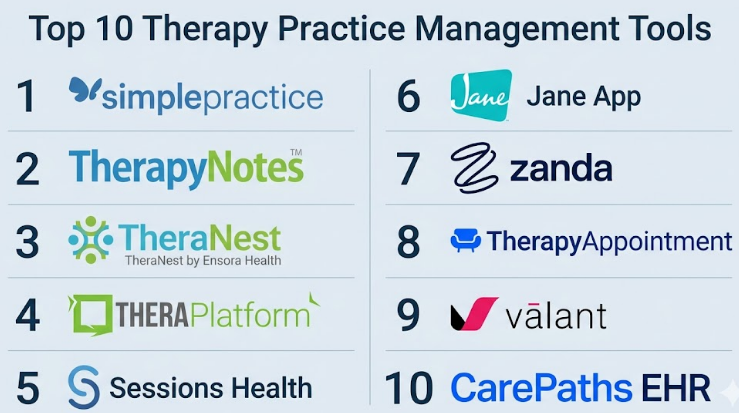
Top 10 Therapy Practice Management Tools
#1 — SimplePractice
Short description : SimplePractice is a widely used practice management platform for therapists, counselors, psychologists, wellness providers, and small healthcare practices. It focuses on scheduling, documentation, billing, telehealth, client communication, and intake workflows. The platform is especially popular among solo and small group practices that want an all-in-one system. It is designed to reduce manual admin work and make client management easier. SimplePractice is a strong fit for providers who want a clean interface with broad therapy practice features.
Key Features
- Online appointment scheduling
- Client portal and digital intake forms
- Progress notes and treatment plans
- Telehealth support
- Billing and payment tools
- Insurance claim support
- Appointment reminders and client communication
Pros
- Easy to use for solo and small group practices
- Strong all-in-one workflow for therapy practices
- Good fit for providers moving from paper or spreadsheets
Cons
- Pricing may increase as features or users grow
- Advanced customization may be limited for complex clinics
- Some workflows may feel too simple for enterprise teams
Platforms / Deployment
Web / iOS / Android
Cloud
Security & Compliance
HIPAA support is publicly positioned. Encryption and secure client communication are part of the platform’s healthcare focus. SOC 2, ISO 27001, and detailed audit-log specifics are Not publicly stated.
Integrations & Ecosystem
SimplePractice supports common practice workflows around payments, insurance, telehealth, and client communication. Its ecosystem is built mainly for therapists and wellness providers who want fewer separate tools.
- Payment processing
- Insurance billing workflows
- Telehealth
- Client portal
- Calendar and reminder workflows
- Document and form management
Support & Community
SimplePractice offers help resources, onboarding guidance, and customer support. Community strength is strong because of broad adoption among therapy and wellness professionals. Support tiers may vary by plan.
#2 — TherapyNotes
Short description : TherapyNotes is a therapy-focused EHR and practice management tool built for behavioral health professionals. It is commonly used by therapists, psychologists, psychiatrists, and group practices. The platform is known for documentation, scheduling, billing, claims, and practice administration. It is a strong option for practices that rely heavily on insurance billing and structured clinical notes. TherapyNotes works well for teams that want a dependable and therapy-specific platform.
Key Features
- Therapy-specific clinical notes
- Scheduling and calendar tools
- Billing and electronic claims
- Client portal
- Telehealth support
- Patient records management
- Reporting and administrative tools
Pros
- Strong fit for behavioral health workflows
- Good documentation and billing structure
- Useful for insurance-focused practices
Cons
- Interface may feel more traditional than newer tools
- May be more than needed for very small private-pay practices
- Customization flexibility may vary by workflow
Platforms / Deployment
Web
Cloud
Security & Compliance
HIPAA-focused platform for behavioral health. Encryption and secure access controls are expected in healthcare workflows. SOC 2 and ISO 27001 details are Not publicly stated.
Integrations & Ecosystem
TherapyNotes focuses on the core behavioral health practice ecosystem, especially billing, documentation, and client management.
- Claims and billing workflows
- Client portal
- Telehealth
- Payment-related workflows
- Scheduling tools
- Clinical documentation templates
Support & Community
TherapyNotes has a mature support model and strong market presence among behavioral health providers. Documentation, training resources, and customer support are generally available. Support details may vary.
#3 — TheraNest by Ensora Health
Short description : TheraNest is a mental health EHR and practice management platform for therapists, psychologists, social workers, and counseling practices. It supports scheduling, notes, billing, telehealth, and client management. The tool is suitable for solo practitioners and group practices that want a therapy-focused system. It is part of Ensora Health’s broader behavioral and therapy software ecosystem. TheraNest is useful for practices looking for practical features without heavy enterprise complexity.
Key Features
- Client scheduling
- Progress notes and treatment plans
- Billing and invoicing
- Telehealth support
- Client portal
- Reporting tools
- Practice administration features
Pros
- Designed for mental health practices
- Balanced feature set for small and growing teams
- Useful reporting and billing workflows
Cons
- Some advanced workflows may require configuration
- May not fit very large enterprise behavioral health networks
- User experience may vary by practice size
Platforms / Deployment
Web
Cloud
Security & Compliance
HIPAA-focused use case is publicly associated with mental health EHR workflows. Detailed SOC 2, ISO 27001, RBAC, and audit-log claims are Not publicly stated.
Integrations & Ecosystem
TheraNest connects core therapy practice tasks into one workflow, with emphasis on client care, payments, documentation, and billing.
- Telehealth
- Billing and invoicing
- Client portal
- Scheduling
- Reporting
- Documentation workflows
Support & Community
Support and onboarding resources are available through the vendor ecosystem. Community strength is solid among mental health professionals. Support depth may vary by plan and practice size.
#4 — TheraPlatform
Short description : TheraPlatform is an all-in-one EHR, practice management, and teletherapy platform for therapists and behavioral health providers. It is especially useful for practices that need online therapy tools, client engagement features, documentation, billing, and scheduling. The platform supports remote care and paperless workflows. It can be a good fit for speech therapists, mental health providers, occupational therapists, and other therapy practices. Its teletherapy orientation makes it attractive for hybrid and virtual-first providers.
Key Features
- Teletherapy tools
- Scheduling and reminders
- Clinical documentation
- Client portal
- Billing and payments
- Therapy activities and resources
- Practice management workflows
Pros
- Strong teletherapy focus
- Good fit for remote and hybrid care
- Useful for different therapy specialties
Cons
- May require setup time to use full feature depth
- Some practices may not need all teletherapy tools
- Advanced enterprise integrations may be limited
Platforms / Deployment
Web
Cloud
Security & Compliance
HIPAA-oriented platform for therapy workflows. Encryption and secure communication are expected features. SOC 2, ISO 27001, and detailed audit controls are Not publicly stated.
Integrations & Ecosystem
TheraPlatform combines therapy practice operations with virtual care tools. Its ecosystem is useful for providers who deliver sessions online and need admin workflows in the same place.
- Teletherapy
- Client portal
- Billing
- Scheduling
- Documentation
- Therapy resources
Support & Community
Documentation, support, and onboarding resources are available. Community strength is moderate and focused on therapy professionals using virtual care workflows.
#5 — Sessions Health
Short description : Sessions Health is a modern EHR and practice management platform designed for mental health professionals. It focuses on simplicity, ethical design, scheduling, notes, billing, telehealth, and client care. The tool is suitable for therapists who want a clean user experience without unnecessary complexity. It is often considered by solo and small group providers looking for a focused mental health platform. Sessions Health is a good fit for practices that value usability and client-friendly workflows.
Key Features
- Scheduling and appointment management
- Clinical notes
- Billing and payments
- Client portal
- Telehealth
- Intake forms
- Reporting and practice tools
Pros
- Clean and therapist-friendly interface
- Good fit for solo and small practices
- Balanced workflow for modern mental health care
Cons
- May not offer the same depth as larger enterprise systems
- Advanced customization may be limited
- Some integrations may depend on plan or availability
Platforms / Deployment
Web
Cloud
Security & Compliance
HIPAA-compliant positioning is publicly stated. Detailed SOC 2, ISO 27001, SSO/SAML, and audit-log information is Not publicly stated.
Integrations & Ecosystem
Sessions Health supports a focused ecosystem for mental health practices, especially around client management, billing, scheduling, and secure care delivery.
- Telehealth
- Payments
- Client portal
- Scheduling
- Intake forms
- Documentation
Support & Community
Support resources and help documentation are available. Community strength is growing, especially among therapists looking for a simpler EHR experience.
#6 — Jane App
Short description : Jane App is a practice management platform used by many health and wellness professionals, including therapists, counselors, chiropractors, physiotherapists, and allied health clinics. It is known for online booking, scheduling, charting, billing, and client communication. Jane is useful for multidisciplinary clinics where therapy services are part of a broader care model. It has a polished user experience and strong appointment management features. It is especially suitable for clinics that value easy scheduling and front-desk workflows.
Key Features
- Online booking
- Scheduling and calendar management
- Charting and clinical notes
- Billing and payments
- Client communication
- Intake forms
- Reporting tools
Pros
- Strong scheduling and booking experience
- Good for multidisciplinary clinics
- User-friendly design for staff and providers
Cons
- Mental-health-specific workflows may be less deep than dedicated therapy EHRs
- Pricing can increase with team size
- Some advanced billing needs may require review before purchase
Platforms / Deployment
Web / iOS / Android
Cloud
Security & Compliance
Healthcare-oriented security features are publicly positioned. HIPAA-related guidance is available for relevant users. SOC 2 and ISO 27001 details are Not publicly stated.
Integrations & Ecosystem
Jane App supports clinics that need smooth scheduling, payments, charting, and client management. It is especially useful where multiple provider types work together.
- Online booking
- Payment processing
- Client forms
- Charting workflows
- Calendar tools
- Reporting
Support & Community
Jane has a strong help center, training resources, and an active customer base across health and wellness practices. Support availability may vary by plan and region.
#7 — Zanda
Short description : Zanda is an all-in-one practice management platform for healthcare and therapy practices. It helps providers manage clients, appointments, clinical notes, invoicing, payments, and communication. Zanda is useful for practices that want a clean practice operations system with strong administrative support. It is suitable for therapists, allied health professionals, and growing clinics. The platform focuses on reducing manual admin work and improving client management.
Key Features
- Client management
- Appointment scheduling
- Clinical notes
- Invoicing and payments
- Online forms
- Communication tools
- Reporting and practice insights
Pros
- Good all-in-one workflow for clinics
- Useful for admin-heavy practices
- Supports different allied health and therapy use cases
Cons
- May not be as mental-health-specific as some dedicated tools
- Feature availability may vary by region or plan
- Enterprise-level customization may be limited
Platforms / Deployment
Web
Cloud
Security & Compliance
Zanda publicly emphasizes data security. Specific certifications such as SOC 2 or ISO 27001 are Not publicly stated. HIPAA suitability may depend on region and configuration.
Integrations & Ecosystem
Zanda focuses on operational practice workflows, including client communication, invoicing, and clinical record management.
- Payments
- Invoicing
- Online forms
- Scheduling
- Client communication
- Reporting
Support & Community
Support resources and onboarding guidance are available. Community strength is moderate, with stronger relevance in healthcare and allied health practice markets.
#8 — TherapyAppointment
Short description : TherapyAppointment is a practice management system built for therapists and behavioral health professionals. It supports scheduling, billing, client records, documentation, reminders, and insurance-related workflows. The platform is suitable for solo practitioners and group therapy practices that need a focused system. It is especially relevant for providers who want practical tools without unnecessary complexity. TherapyAppointment is a strong option for day-to-day therapy administration.
Key Features
- Appointment scheduling
- Client records
- Documentation tools
- Billing workflows
- Insurance-related support
- Client communication
- Reminders and practice management tools
Pros
- Focused on therapy practice needs
- Practical for solo and small group providers
- Useful billing and scheduling workflows
Cons
- Interface may not feel as modern as newer tools
- Limited fit for large enterprise systems
- Advanced integrations may be limited
Platforms / Deployment
Web
Cloud
Security & Compliance
HIPAA-oriented therapy practice use case is publicly associated with the platform category. Specific details on SOC 2, ISO 27001, SSO/SAML, and audit logs are Not publicly stated.
Integrations & Ecosystem
TherapyAppointment supports the core needs of therapy practices, especially scheduling, billing, and client management.
- Billing workflows
- Scheduling
- Client communication
- Documentation
- Reminders
- Practice administration
Support & Community
Support and documentation are available. Community strength is stable among therapy professionals who prefer focused practice management tools.
#9 — Valant
Short description : Valant is a behavioral health EHR and practice management platform designed for mental health organizations. It is often considered by larger practices, clinics, and behavioral health groups that need structured workflows. The platform supports clinical documentation, billing, scheduling, reporting, and administrative operations. Valant is more suitable for teams with deeper operational needs than very small solo practices. It can support clinical and administrative coordination across behavioral health settings.
Key Features
- Behavioral health EHR
- Clinical documentation
- Scheduling
- Billing and revenue workflows
- Reporting and analytics
- Client records
- Practice administration
Pros
- Strong fit for behavioral health organizations
- Useful for structured clinical workflows
- Better suited for larger practices than simple tools
Cons
- May feel complex for solo providers
- Implementation may require more planning
- Pricing and setup details may vary
Platforms / Deployment
Web
Cloud
Security & Compliance
Behavioral health EHR with healthcare security expectations. HIPAA-related suitability is part of the category use case. Specific SOC 2, ISO 27001, and SSO/SAML details are Not publicly stated.
Integrations & Ecosystem
Valant supports behavioral health operations with a focus on structured clinical and administrative workflows.
- Billing workflows
- Reporting
- Scheduling
- Clinical documentation
- Client management
- Administrative tools
Support & Community
Valant provides support and onboarding resources for behavioral health organizations. Support strength is generally better aligned with larger teams and structured practices.
#10 — CarePaths EHR
Short description : CarePaths EHR is a behavioral health EHR and practice management platform for mental health providers and organizations. It supports therapy operations such as scheduling, documentation, billing, telehealth, secure communication, and client management. The tool is useful for behavioral health teams that need a cloud-based system with clinical and administrative workflows. It can support both care delivery and back-office processes. CarePaths is a practical option for therapy teams needing an integrated behavioral health platform.
Key Features
- Behavioral health EHR
- Scheduling
- Telehealth support
- Client portal
- Billing workflows
- Secure messaging
- Clinical documentation
Pros
- Behavioral health-focused design
- Useful for integrated care workflows
- Supports both clinical and administrative needs
Cons
- May not be as widely known as some larger competitors
- Interface and onboarding experience should be tested during demo
- Public details on advanced compliance controls may be limited
Platforms / Deployment
Web
Cloud
Security & Compliance
Behavioral health and HIPAA-oriented use case is publicly associated with the platform. Detailed SOC 2, ISO 27001, SSO/SAML, RBAC, and audit-log information is Not publicly stated.
Integrations & Ecosystem
CarePaths supports core behavioral health workflows in one system, especially care delivery and practice operations.
- Telehealth
- Client portal
- Scheduling
- Billing
- Secure messaging
- Documentation
Support & Community
Support and onboarding details may vary. Community visibility is moderate compared with larger therapy software brands.
Comparison Table
| Tool Name | Best For | Platform(s) Supported | Deployment | Standout Feature | Public Rating |
|---|---|---|---|---|---|
| SimplePractice | Solo therapists and small group practices | Web, iOS, Android | Cloud | All-in-one therapy workflow | N/A |
| TherapyNotes | Insurance-focused behavioral health practices | Web | Cloud | Strong notes and billing workflow | N/A |
| TheraNest by Ensora Health | Mental health practices | Web | Cloud | Therapy-focused EHR and billing | N/A |
| TheraPlatform | Teletherapy and hybrid therapy practices | Web | Cloud | Built-in teletherapy tools | N/A |
| Sessions Health | Modern solo and small mental health practices | Web | Cloud | Clean therapist-friendly experience | N/A |
| Jane App | Multidisciplinary clinics | Web, iOS, Android | Cloud | Online booking and scheduling | N/A |
| Zanda | Allied health and therapy clinics | Web | Cloud | Practice operations and invoicing | N/A |
| TherapyAppointment | Solo and small therapy practices | Web | Cloud | Practical therapy admin workflows | N/A |
| Valant | Larger behavioral health organizations | Web | Cloud | Behavioral health EHR depth | N/A |
| CarePaths EHR | Behavioral health teams | Web | Cloud | Integrated behavioral health workflows | N/A |
Evaluation & Therapy Practice Management Tools
| Tool Name | Core (25%) | Ease (15%) | Integrations (15%) | Security (10%) | Performance (10%) | Support (10%) | Value (15%) | Weighted Total (0–10) |
|---|---|---|---|---|---|---|---|---|
| SimplePractice | 9 | 9 | 8 | 8 | 8 | 8 | 8 | 8.40 |
| TherapyNotes | 9 | 8 | 8 | 8 | 8 | 8 | 8 | 8.25 |
| TheraNest by Ensora Health | 8 | 8 | 7 | 8 | 8 | 7 | 8 | 7.75 |
| TheraPlatform | 8 | 8 | 7 | 8 | 8 | 7 | 8 | 7.75 |
| Sessions Health | 8 | 9 | 7 | 8 | 8 | 7 | 8 | 7.90 |
| Jane App | 8 | 9 | 8 | 8 | 8 | 8 | 7 | 8.10 |
| Zanda | 8 | 8 | 7 | 7 | 8 | 7 | 8 | 7.65 |
| TherapyAppointment | 7 | 8 | 7 | 7 | 8 | 7 | 8 | 7.45 |
| Valant | 9 | 7 | 8 | 8 | 8 | 8 | 7 | 8.00 |
| CarePaths EHR | 8 | 7 | 7 | 7 | 8 | 7 | 7 | 7.35 |
These scores are comparative, not absolute. A higher score does not mean the tool is best for every practice. Solo therapists may value ease and price more, while larger clinics may value reporting, billing depth, access controls, and scalability. Always validate features, security, support, and pricing during demos before making a final decision.
Which Therapy Practice Management Tools
Solo / Freelancer
Solo therapists should focus on simplicity, affordability, fast setup, and low admin effort. SimplePractice, Sessions Health, TherapyNotes, and TherapyAppointment are strong options for independent providers.
The best choice depends on whether the therapist needs private-pay billing, insurance claims, telehealth, or a very simple client portal. A solo practice should avoid overly complex enterprise tools unless growth is planned soon.
SMB
Small and growing therapy practices need scheduling, billing, documentation, client portals, role-based workflows, and reporting. SimplePractice, TherapyNotes, TheraNest, Jane App, Zanda, and TheraPlatform are good fits.
SMBs should look closely at provider-based pricing, billing workflows, staff permissions, and how easy it is to train new team members.
Mid-Market
Mid-market practices need stronger reporting, better billing operations, staff management, standardized documentation, and support for multiple providers or locations. Valant, TherapyNotes, TheraNest, Jane App, and Zanda may fit this segment well.
These teams should run a pilot before switching, especially if they already have years of records, billing data, and client workflows in another system.
Enterprise
Enterprise behavioral health organizations need scalability, structured workflows, reporting, compliance controls, role permissions, and implementation support. Valant is often more suitable for this type of environment, while TherapyNotes and other tools may fit depending on complexity.
Enterprise buyers should evaluate SSO/SAML, audit logs, RBAC, data export, API availability, implementation support, uptime expectations, and compliance documentation.
Budget vs Premium
Budget-focused buyers should shortlist tools with clear pricing, essential features, and no unnecessary add-ons. TherapyAppointment, Sessions Health, and some plans from other platforms may be practical.
Premium buyers should focus on advanced billing, telehealth, reporting, support, and client experience. SimplePractice, TherapyNotes, Valant, and Jane App may be worth evaluating depending on practice size.
Feature Depth vs Ease of Use
If ease of use matters most, SimplePractice, Sessions Health, and Jane App are strong candidates. If feature depth matters more, TherapyNotes, Valant, TheraNest, and CarePaths EHR may be better.
The best approach is to test the daily workflow: create a client, schedule a session, write a note, send an invoice, process a payment, and review reporting.
Integrations & Scalability
Practices that depend on payments, billing, calendars, telehealth, and forms should review integration options carefully. Jane App, SimplePractice, TherapyNotes, and TheraNest have stronger ecosystem relevance for many buyers.
Scalability is not just about adding users. It also includes data migration, provider permissions, multi-location support, reporting, and billing complexity.
Security & Compliance Needs
Therapy practices handle sensitive health information, so security should not be treated as optional. Buyers should ask about HIPAA support, encryption, MFA, audit logs, access controls, data backup, and breach response procedures.
For larger clinics, also ask about SSO/SAML, RBAC, vendor risk documentation, data retention, and export options. If these details are not publicly stated, request them during vendor review.
Frequently Asked Questions
1. What is therapy practice management software?
Therapy practice management software helps therapists manage appointments, notes, billing, payments, telehealth, client forms, and communication. It reduces manual admin work and keeps practice operations organized.
2. How much do therapy practice management tools usually cost?
Most tools use subscription pricing, often based on provider count, features, or plan level. Pricing can vary widely, so buyers should compare monthly cost, add-ons, payment fees, and billing-related charges.
3. Are these tools suitable for solo therapists?
Yes, many platforms are designed specifically for solo therapists and small private practices. Solo providers should prioritize ease of use, simple billing, telehealth, and a clean client portal.
4. Can therapy practice management tools support insurance billing?
Many therapy platforms support insurance billing or claims workflows. However, the depth can vary, so practices should test claim creation, submission, denial handling, and payment posting before choosing.
5. Are these tools HIPAA compliant?
Many therapy tools are built for HIPAA-related workflows, especially in the United States. Buyers should still verify business associate agreements, encryption, access controls, audit logs, and compliance documentation.
6. What are the most common mistakes when choosing a tool?
Common mistakes include choosing based only on price, ignoring billing needs, skipping security review, not testing client portal workflows, and failing to plan data migration. A short pilot can prevent costly switching problems.
7. How long does onboarding usually take?
Simple solo practice setup may take a few days, while group practices can take several weeks. Timeline depends on data migration, form setup, billing configuration, staff training, and workflow complexity.
8. Can these tools replace telehealth software?
Many therapy practice management tools include built-in telehealth. If a practice already uses a separate telehealth platform, it should compare video quality, client experience, consent workflows, and billing integration.
9. What integrations should therapy practices look for?
Important integrations include payments, calendar syncing, insurance claims, telehealth, forms, accounting, secure messaging, and reporting. Larger practices may also need APIs, data exports, and identity management support.
10. Is it difficult to switch from one therapy software to another?
Switching can be challenging if the practice has many client records, notes, invoices, and billing history. Buyers should ask about data export, import support, migration fees, downtime, and training before switching.
Conclusion
Therapy Practice Management Tools have become essential for modern therapy practices that want to reduce admin work, improve client experience, protect sensitive information, and run smoother daily operations. The right platform can help with scheduling, intake forms, clinical notes, telehealth, billing, payments, reminders, and reporting. However, the “best” tool depends on context. A solo therapist may need a simple and affordable system, while a growing behavioral health clinic may need deeper billing, reporting, permissions, and compliance controls. Shortlist two or three tools, run a practical pilot, test the real workflow, validate integrations, review security details, and choose the platform that fits your practice today while still supporting future growth.
