Introduction
Virtual Event Platforms are software solutions that enable organizations to host, manage, and deliver online events such as webinars, conferences, summits, workshops, and networking sessions. These platforms replace or complement physical venues by offering digital spaces for live streaming, audience interaction, networking, and analytics.
In today’s hybrid-first world, virtual events are no longer optional—they are a core part of marketing, training, and community-building strategies. Businesses now demand platforms that can deliver immersive experiences, real-time engagement, and measurable ROI, all while supporting global audiences without geographical limitations.
Real-world use cases:
- Hosting global webinars and product launches
- Virtual conferences and expos
- Online training and certification programs
- Community meetups and networking events
- Internal company town halls and HR events
What buyers should evaluate:
- Streaming quality and reliability
- Audience engagement features (chat, polls, Q&A)
- Networking capabilities
- Scalability for large audiences
- Integration with CRM and marketing tools
- Analytics and reporting depth
- Customization and branding
- Security and data privacy
- Ease of use for hosts and attendees
Best for: Marketing teams, event organizers, enterprises, educators, and communities that need scalable, global, and interactive event experiences.
Not ideal for: Small informal meetings or basic video calls where simple tools like conferencing apps are sufficient.
Key Trends in Virtual Event Platforms
- AI-driven personalization: Recommending sessions, networking matches, and content dynamically
- Immersive experiences: Use of 3D environments and interactive event spaces
- Hybrid integration: Seamless blending of physical and virtual attendees
- Advanced networking tools: AI matchmaking and virtual lounges
- On-demand content delivery: Recorded sessions with analytics tracking
- Gamification: Leaderboards, rewards, and engagement incentives
- Mobile-first participation: Dedicated apps for real-time updates and interaction
- Security enhancements: Stronger encryption and compliance controls
- API-first ecosystems: Easy integration with CRM, marketing, and analytics platforms
How We Selected These Tools (Methodology)
- Evaluated global adoption and brand recognition
- Assessed virtual-first feature capabilities (streaming, engagement, networking)
- Reviewed performance reliability at scale
- Considered security and compliance readiness
- Analyzed integration ecosystems
- Evaluated ease of use for organizers and attendees
- Checked support quality and onboarding experience
- Considered fit across SMB, mid-market, and enterprise users
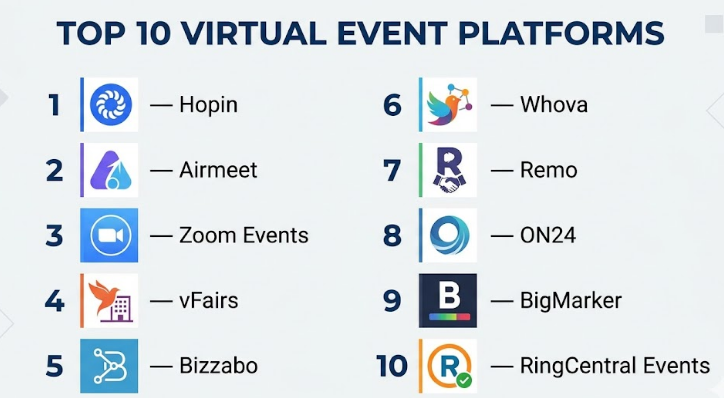
Top 10 Virtual Event Platforms
#1 — Hopin
Short description (5-6 lines):
Hopin is a leading virtual event platform designed to host large-scale online and hybrid events. It offers a structured event experience with stages, breakout sessions, and networking areas. The platform is widely used by enterprises and event organizers looking to deliver immersive digital experiences. Its scalability makes it suitable for global audiences.
Key Features
- Multi-stage event hosting
- Breakout sessions and networking
- Live streaming capabilities
- Event analytics dashboard
- Ticketing and registration
- Custom branding options
Pros
- Highly scalable platform
- Strong interactive features
Cons
- Pricing can be high
- Setup may require learning
Platforms / Deployment
Web
Cloud
Security & Compliance
Not publicly stated
Integrations & Ecosystem
Hopin integrates with marketing, CRM, and streaming tools.
- CRM platforms
- Email marketing tools
- Streaming services
Support & Community
Good documentation and enterprise-level support.
#2 — Airmeet
Short description (5-6 lines):
Airmeet focuses on community-driven virtual events with strong networking capabilities. It offers virtual lounges and social tables that simulate real-life networking. Ideal for webinars, meetups, and conferences.
Key Features
- Networking lounges
- Live sessions and webinars
- Audience engagement tools
- Event analytics
- Custom branding
Pros
- Excellent networking experience
- Easy setup
Cons
- Limited offline support
- Scaling requires higher plans
Platforms / Deployment
Web
Cloud
Security & Compliance
Not publicly stated
Integrations & Ecosystem
- CRM tools
- Marketing automation
- Streaming integrations
Support & Community
Responsive support and active user base.
#3 — Zoom Events
Short description (5-6 lines):
Zoom Events extends the popular Zoom platform into a full virtual event solution. It allows organizers to host multi-session events, conferences, and webinars using familiar tools.
Key Features
- Multi-session event hosting
- Webinar and meeting integration
- Ticketing system
- Networking chat
- Analytics
Pros
- Familiar interface
- Reliable streaming
Cons
- Limited advanced event features
- Customization options are basic
Platforms / Deployment
Web / Windows / macOS / iOS / Android
Cloud
Security & Compliance
MFA, encryption
Not publicly stated for certifications
Integrations & Ecosystem
- CRM systems
- Productivity tools
- Calendar integrations
Support & Community
Strong global support and documentation.
#4 — vFairs
Short description (5-6 lines):
vFairs provides a customizable virtual event platform with 3D environments and expo booths. It is widely used for career fairs, trade shows, and conferences.
Key Features
- 3D virtual environments
- Expo booths
- Live chat and networking
- Event analytics
- Custom branding
Pros
- Immersive experience
- Strong customization
Cons
- Learning curve
- Higher cost for advanced features
Platforms / Deployment
Web
Cloud
Security & Compliance
Not publicly stated
Integrations & Ecosystem
- CRM tools
- Marketing platforms
- Payment systems
Support & Community
Dedicated support for enterprise users.
#5 — Bizzabo
Short description (5-6 lines):
Bizzabo is a hybrid event platform focusing on audience engagement and analytics. It is used by marketing teams for branded event experiences.
Key Features
- Hybrid event management
- Audience engagement tools
- Analytics dashboard
- Custom branding
- Networking features
Pros
- Strong analytics
- Great user experience
Cons
- Pricing may be high
- Complex features
Platforms / Deployment
Web / Mobile
Cloud
Security & Compliance
Not publicly stated
Integrations & Ecosystem
- CRM
- Marketing automation
- Analytics tools
Support & Community
Good onboarding and support.
#6 — Whova
Short description (5-6 lines):
Whova offers a comprehensive virtual event solution with strong attendee engagement and mobile support. It is widely used for conferences and academic events.
Key Features
- Event app
- Networking tools
- Agenda management
- Engagement features
- Analytics
Pros
- Easy to use
- Strong engagement
Cons
- Limited customization
- Pricing not transparent
Platforms / Deployment
Web / Mobile
Cloud
Security & Compliance
Not publicly stated
Integrations & Ecosystem
- CRM
- Social media
- Email platforms
Support & Community
Responsive support.
#7 — Remo
Short description (5-6 lines):
Remo provides a unique virtual event experience with table-based networking. It is designed for workshops, networking events, and small conferences.
Key Features
- Table-based networking
- Live presentations
- Chat and engagement tools
- Analytics
- Custom layouts
Pros
- Unique networking style
- Easy interaction
Cons
- Limited scalability
- Basic analytics
Platforms / Deployment
Web
Cloud
Security & Compliance
Not publicly stated
Integrations & Ecosystem
- CRM tools
- Streaming tools
- Email platforms
Support & Community
Good support for smaller events.
#8 — ON24
Short description (5-6 lines):
ON24 is an enterprise-grade virtual event platform focused on webinars and digital experiences. It provides deep analytics and engagement tracking.
Key Features
- Webinar hosting
- Audience engagement tools
- Analytics and reporting
- Content management
- Personalization
Pros
- Strong analytics
- Enterprise-grade features
Cons
- Expensive
- Complex setup
Platforms / Deployment
Web
Cloud
Security & Compliance
Not publicly stated
Integrations & Ecosystem
- CRM systems
- Marketing automation
- Analytics tools
Support & Community
Strong enterprise support.
#9 — BigMarker
Short description (5-6 lines):
BigMarker is a webinar and virtual event platform with strong marketing features. It supports live, automated, and hybrid events.
Key Features
- Webinar hosting
- Automation tools
- Custom branding
- Analytics
- Marketing tools
Pros
- Flexible event formats
- Good automation
Cons
- UI can feel outdated
- Learning curve
Platforms / Deployment
Web
Cloud
Security & Compliance
Not publicly stated
Integrations & Ecosystem
- CRM
- Email marketing
- Payment tools
Support & Community
Good documentation and support.
#10 — RingCentral Events
Short description (5-6 lines):
RingCentral Events (formerly Hopin Events) offers a complete virtual event solution integrated with communication tools.
Key Features
- Event hosting
- Networking features
- Live streaming
- Analytics
- Branding options
Pros
- Integrated communication tools
- Scalable
Cons
- Pricing varies
- Setup complexity
Platforms / Deployment
Web
Cloud
Security & Compliance
Not publicly stated
Integrations & Ecosystem
- CRM
- Communication tools
- Marketing platforms
Support & Community
Enterprise-grade support.
Comparison Table (Top 10)
| Tool Name | Best For | Platform(s) Supported | Deployment | Standout Feature | Public Rating |
|---|---|---|---|---|---|
| Hopin | Large events | Web | Cloud | Multi-stage events | N/A |
| Airmeet | Networking events | Web | Cloud | Virtual lounges | N/A |
| Zoom Events | Webinars | Multi-platform | Cloud | Familiar UI | N/A |
| vFairs | Expo events | Web | Cloud | 3D environments | N/A |
| Bizzabo | Hybrid events | Web/Mobile | Cloud | Engagement tools | N/A |
| Whova | Conferences | Web/Mobile | Cloud | Networking | N/A |
| Remo | Small networking | Web | Cloud | Table networking | N/A |
| ON24 | Enterprise webinars | Web | Cloud | Analytics | N/A |
| BigMarker | Marketing webinars | Web | Cloud | Automation | N/A |
| RingCentral Events | Enterprise | Web | Cloud | Integrated comms | N/A |
Evaluation & Scoring of Virtual Event Platforms
| Tool Name | Core (25%) | Ease (15%) | Integrations (15%) | Security (10%) | Performance (10%) | Support (10%) | Value (15%) | Weighted Total |
|---|---|---|---|---|---|---|---|---|
| Hopin | 9 | 7 | 8 | 7 | 9 | 8 | 7 | 8.1 |
| Airmeet | 8 | 8 | 7 | 6 | 8 | 7 | 8 | 7.7 |
| Zoom Events | 8 | 9 | 8 | 7 | 9 | 8 | 8 | 8.3 |
| vFairs | 8 | 7 | 7 | 6 | 8 | 7 | 7 | 7.4 |
| Bizzabo | 9 | 8 | 8 | 7 | 8 | 8 | 7 | 8.0 |
| Whova | 8 | 9 | 7 | 6 | 8 | 8 | 8 | 7.9 |
| Remo | 7 | 8 | 6 | 6 | 7 | 7 | 8 | 7.2 |
| ON24 | 9 | 7 | 8 | 7 | 9 | 8 | 6 | 8.0 |
| BigMarker | 8 | 7 | 7 | 6 | 8 | 7 | 7 | 7.4 |
| RingCentral Events | 8 | 7 | 8 | 7 | 8 | 8 | 7 | 7.8 |
How to interpret scores:
- Scores are relative comparisons within this category
- Higher scores indicate stronger overall performance
- Enterprise tools score higher in features but lower in ease
- SMB tools offer better value and usability
Which Virtual Event Platforms
Solo / Freelancer
Use Remo or Airmeet for simple, engaging events.
SMB
Zoom Events or Whova offer balance between ease and features.
Mid-Market
Bizzabo and BigMarker provide strong engagement and automation.
Enterprise
Hopin, ON24, and RingCentral Events are best for scale and complexity.
Budget vs Premium
- Budget: Remo, Airmeet
- Premium: ON24, Hopin
Feature Depth vs Ease of Use
- Deep features: ON24, Bizzabo
- Easy to use: Zoom Events, Whova
Integrations & Scalability
- Strong integrations: Zoom Events, ON24
- Limited: Remo
Security & Compliance Needs
- Enterprise platforms offer better security controls
- SMB tools may need integrations
Frequently Asked Questions (FAQs)
1. What is a virtual event platform?
A virtual event platform is software used to host and manage online events with features like streaming, chat, and networking.
2. How much do virtual event platforms cost?
Pricing varies from free plans to enterprise subscriptions depending on features and scale.
3. Can virtual events replace physical events?
They can complement or replace them depending on goals, but hybrid formats are most common.
4. Are these platforms scalable?
Yes, most platforms support thousands of attendees.
5. What features should I prioritize?
Focus on engagement tools, analytics, and integration capabilities.
6. How secure are virtual event platforms?
Security varies; enterprise tools offer better compliance and controls.
7. Can I integrate with CRM systems?
Yes, most platforms support CRM and marketing integrations.
8. How long does setup take?
Basic events can be set up in hours; complex events may take days.
9. Do these platforms support mobile users?
Many platforms support mobile access or apps.
10. What are alternatives to virtual event platforms?
Webinar tools or video conferencing apps can be used for smaller events.
Conclusion
Virtual event platforms have become essential for organizations looking to engage audiences beyond physical boundaries. From simple webinars to complex global conferences, these tools enable scalable, interactive, and data-driven event experiences. However, the right platform depends heavily on your specific needs—whether it’s ease of use, advanced analytics, networking capabilities, or enterprise-grade scalability. Instead of chasing a single “best” solution, focus on aligning features with your event goals. Start by shortlisting two or three platforms, run a pilot event, and evaluate performance, integrations, and attendee feedback before making a final decision.
