Introduction
Marketplace platforms are software solutions that allow businesses to create, manage, and scale online marketplaces where multiple vendors can sell products or services to customers. Think of platforms like multi-vendor eCommerce stores, service marketplaces, or B2B procurement hubs—these systems handle listings, payments, commissions, and vendor management in one place.
In today’s digital economy, marketplace platforms have become critical. Businesses are shifting from single-brand selling to ecosystem-driven models where third-party sellers expand inventory, improve customer choice, and drive revenue growth. With AI-driven recommendations, automation, and global commerce becoming standard, modern marketplace platforms are evolving rapidly.
Real-world use cases include:
- Multi-vendor eCommerce platforms (like Amazon-style marketplaces)
- B2B supplier marketplaces
- Freelance/service marketplaces
- Rental and booking marketplaces
- Digital product marketplaces (courses, templates, software)
What buyers should evaluate:
- Vendor management capabilities
- Commission and pricing models
- Payment gateway flexibility
- Scalability and performance
- Customization and extensibility
- Security and compliance features
- Integration ecosystem
- User experience (admin + vendor + buyer)
- AI and automation features
Best for: Startups, SMBs, enterprises, eCommerce businesses, B2B platforms, and digital entrepreneurs looking to build scalable multi-vendor ecosystems.
Not ideal for: Single-product businesses, small stores with limited catalogs, or companies that don’t require vendor onboarding or marketplace dynamics.
Key Trends in Marketplace Platforms
- AI-powered personalization: Product recommendations, dynamic pricing, and search optimization using AI models
- Headless marketplace architecture: Separation of frontend and backend for flexibility and faster innovation
- No-code/low-code customization: Faster deployment without heavy engineering resources
- Embedded payments & fintech integrations: Seamless checkout, wallets, and split payments
- Globalization support: Multi-currency, multi-language, and cross-border compliance
- API-first ecosystems: Easy integration with CRM, ERP, logistics, and analytics tools
- Automation of vendor onboarding: AI-assisted vendor verification and onboarding workflows
- Composable commerce: Modular platforms allowing businesses to choose best-of-breed components
- Data-driven insights: Advanced analytics dashboards for sellers and admins
- Security-first design: Enhanced RBAC, encryption, and compliance frameworks
How We Selected These Tools (Methodology)
- Strong market adoption and brand recognition across industries
- Comprehensive feature sets for marketplace operations
- Proven performance and scalability in real-world deployments
- Availability of security and compliance capabilities
- Rich integration ecosystem and API support
- Fit across startups, SMBs, and enterprise use cases
- Positive developer and customer experience signals
- Continuous innovation in AI and automation features
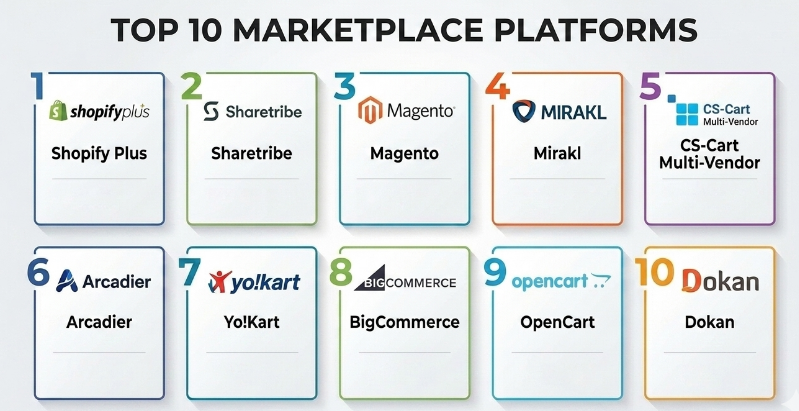
Top 10 Marketplace Platforms
#1 — Shopify Plus
Short description: Shopify Plus is an enterprise-grade version of Shopify that enables businesses to build scalable multi-vendor marketplaces using apps and integrations. It is widely used by growing brands and enterprises due to its ease of use and strong ecosystem.
Key Features
- Multi-vendor support via apps
- Scalable cloud infrastructure
- Built-in payment processing
- AI-powered product recommendations
- Custom checkout experiences
- Automation workflows
Pros
- Easy to set up and manage
- Strong app ecosystem
Cons
- Requires apps for marketplace functionality
- Limited deep backend customization
Platforms / Deployment
Web / Cloud
Security & Compliance
SSL encryption, MFA, RBAC, GDPR support
Integrations & Ecosystem
Extensive integrations with CRM, ERP, logistics tools
- Payment gateways
- Marketing tools
- Analytics platforms
Support & Community
Strong documentation, large community, premium support tiers
#2 — Sharetribe
Short description: Sharetribe is a purpose-built marketplace platform designed for startups and entrepreneurs to quickly launch service or product marketplaces.
Key Features
- Built-in marketplace templates
- Vendor management
- Payment and commission handling
- No-code customization
- API-based extensibility
Pros
- Fast deployment
- Marketplace-first design
Cons
- Limited advanced enterprise features
- Customization may require developers
Platforms / Deployment
Web / Cloud
Security & Compliance
Not publicly stated
Integrations & Ecosystem
Supports APIs and integrations
- Payment providers
- Custom APIs
Support & Community
Good onboarding support; smaller community compared to larger platforms
#3 — Magento (Adobe Commerce)
Short description: Magento is a powerful eCommerce platform widely used for building complex multi-vendor marketplaces with deep customization.
Key Features
- Multi-vendor extensions
- Advanced catalog management
- Headless commerce support
- AI-driven recommendations
- Enterprise scalability
Pros
- Highly customizable
- Strong enterprise capabilities
Cons
- Requires technical expertise
- High implementation cost
Platforms / Deployment
Cloud / Self-hosted
Security & Compliance
RBAC, encryption, compliance tools (varies by deployment)
Integrations & Ecosystem
Large ecosystem
- ERP systems
- CRM tools
- Payment gateways
Support & Community
Large global community, enterprise support available
#4 — Mirakl
Short description: Mirakl is a leading enterprise marketplace platform used by large organizations to launch and scale B2B and B2C marketplaces.
Key Features
- Enterprise marketplace management
- Vendor onboarding automation
- AI-driven catalog enrichment
- Commission management
- API-first architecture
Pros
- Enterprise-grade scalability
- Strong automation features
Cons
- Expensive
- Complex setup
Platforms / Deployment
Cloud
Security & Compliance
SSO, RBAC, enterprise-grade security (details vary)
Integrations & Ecosystem
Strong integrations
- ERP systems
- Payment platforms
- Analytics tools
Support & Community
Enterprise-level support and onboarding
#5 — CS-Cart Multi-Vendor
Short description: CS-Cart Multi-Vendor is a dedicated marketplace platform offering built-in vendor management and marketplace features.
Key Features
- Multi-vendor dashboard
- Commission management
- Product catalog control
- SEO tools
- Mobile-friendly design
Pros
- Built specifically for marketplaces
- One-time license option
Cons
- UI may feel outdated
- Limited enterprise features
Platforms / Deployment
Self-hosted
Security & Compliance
Basic security features; compliance varies
Integrations & Ecosystem
Moderate ecosystem
- Payment gateways
- Shipping integrations
Support & Community
Decent support, moderate community
#6 — Arcadier
Short description: Arcadier is a cloud-based marketplace builder that supports various marketplace types including services, rentals, and products.
Key Features
- Multi-marketplace templates
- White-label solutions
- API extensibility
- Multi-currency support
- Vendor dashboards
Pros
- Flexible marketplace types
- Easy setup
Cons
- Limited customization at lower tiers
- Scaling may require upgrades
Platforms / Deployment
Cloud
Security & Compliance
Not publicly stated
Integrations & Ecosystem
API-based integrations
- Payment systems
- External tools
Support & Community
Good onboarding support
#7 — Yo!Kart
Short description: Yo!Kart is a self-hosted marketplace platform designed for startups and SMBs with built-in multi-vendor features.
Key Features
- Multi-vendor support
- Payment integrations
- Mobile apps
- Customizable design
- Commission management
Pros
- Affordable
- Ready-to-use marketplace features
Cons
- Limited scalability for large enterprises
- Requires hosting management
Platforms / Deployment
Self-hosted
Security & Compliance
Basic security features
Integrations & Ecosystem
Supports integrations
- Payment gateways
- Shipping tools
Support & Community
Good support; smaller ecosystem
#8 — BigCommerce
Short description: BigCommerce is a SaaS eCommerce platform that can be extended into a marketplace using integrations and APIs.
Key Features
- Headless commerce support
- Multi-channel selling
- API-first architecture
- Built-in analytics
- Scalable infrastructure
Pros
- Strong scalability
- Flexible integrations
Cons
- Marketplace features require customization
- Learning curve for advanced setups
Platforms / Deployment
Cloud
Security & Compliance
SSL, PCI compliance, security features
Integrations & Ecosystem
Large ecosystem
- CRM
- ERP
- Marketing tools
Support & Community
Strong support and documentation
#9 — OpenCart (Multi-Vendor Extensions)
Short description: OpenCart is an open-source eCommerce platform that can be extended into a marketplace using plugins.
Key Features
- Open-source flexibility
- Multi-vendor extensions
- Customizable modules
- Multi-store support
- Lightweight system
Pros
- Free core platform
- Highly customizable
Cons
- Requires extensions
- Limited built-in marketplace features
Platforms / Deployment
Self-hosted
Security & Compliance
Varies depending on setup
Integrations & Ecosystem
Plugin-based ecosystem
- Payment integrations
- Extensions
Support & Community
Large open-source community
#10 — Dokan (WordPress Plugin)
Short description: Dokan is a WordPress plugin that enables multi-vendor marketplace functionality on WooCommerce stores.
Key Features
- Vendor dashboards
- Commission system
- Product management
- Integration with WooCommerce
- Subscription models
Pros
- Easy for WordPress users
- Cost-effective
Cons
- Dependent on WordPress ecosystem
- Performance depends on hosting
Platforms / Deployment
Web / Self-hosted
Security & Compliance
Varies depending on WordPress setup
Integrations & Ecosystem
Strong WordPress ecosystem
- WooCommerce plugins
- Payment gateways
Support & Community
Large community, documentation available
Comparison Table (Top 10)
| Tool Name | Best For | Platform(s) Supported | Deployment | Standout Feature | Public Rating |
|---|---|---|---|---|---|
| Shopify Plus | Enterprise eCommerce | Web | Cloud | App ecosystem | N/A |
| Sharetribe | Startups | Web | Cloud | Marketplace-first design | N/A |
| Magento | Enterprise | Web | Hybrid | Deep customization | N/A |
| Mirakl | Large enterprises | Web | Cloud | Vendor automation | N/A |
| CS-Cart | SMB marketplaces | Web | Self-hosted | Built-in marketplace features | N/A |
| Arcadier | Flexible marketplaces | Web | Cloud | Multi-type marketplaces | N/A |
| Yo!Kart | SMBs | Web | Self-hosted | Ready-to-use solution | N/A |
| BigCommerce | Scaling businesses | Web | Cloud | API-first design | N/A |
| OpenCart | Developers | Web | Self-hosted | Open-source flexibility | N/A |
| Dokan | WordPress users | Web | Self-hosted | WooCommerce integration | N/A |
Evaluation & Scoring of Marketplace Platforms
| Tool Name | Core (25%) | Ease (15%) | Integrations (15%) | Security (10%) | Performance (10%) | Support (10%) | Value (15%) | Weighted Total |
|---|---|---|---|---|---|---|---|---|
| Shopify Plus | 9 | 9 | 9 | 8 | 9 | 9 | 7 | 8.7 |
| Sharetribe | 8 | 9 | 7 | 7 | 8 | 8 | 8 | 8.1 |
| Magento | 10 | 6 | 9 | 9 | 9 | 8 | 6 | 8.4 |
| Mirakl | 10 | 7 | 9 | 9 | 9 | 9 | 6 | 8.6 |
| CS-Cart | 8 | 7 | 7 | 7 | 7 | 7 | 8 | 7.5 |
| Arcadier | 8 | 8 | 7 | 7 | 7 | 7 | 8 | 7.6 |
| Yo!Kart | 7 | 7 | 6 | 6 | 7 | 7 | 8 | 7.1 |
| BigCommerce | 9 | 8 | 9 | 8 | 9 | 8 | 7 | 8.4 |
| OpenCart | 7 | 6 | 7 | 6 | 7 | 6 | 9 | 7.0 |
| Dokan | 7 | 8 | 8 | 6 | 7 | 7 | 8 | 7.5 |
How to interpret scores:
These scores are comparative across tools, not absolute. Higher scores indicate better overall balance across features, usability, and ecosystem. Enterprise tools score high on capabilities but may lose points on ease or cost, while SMB tools often score higher on value and simplicity.
Which Marketplace Platforms
Solo / Freelancer
Choose Sharetribe or Dokan for simplicity and quick setup. These require minimal technical effort.
SMB
CS-Cart, Yo!Kart, or Arcadier provide good balance between cost and features.
Mid-Market
BigCommerce or Shopify Plus offer scalability with manageable complexity.
Enterprise
Magento or Mirakl are best for large-scale, complex marketplaces.
Budget vs Premium
- Budget: OpenCart, Dokan, Yo!Kart
- Premium: Shopify Plus, Mirakl
Feature Depth vs Ease of Use
- Deep features: Magento, Mirakl
- Easy to use: Shopify Plus, Sharetribe
Integrations & Scalability
- Strong integrations: BigCommerce, Shopify
- Scalable architecture: Mirakl, Magento
Security & Compliance Needs
- Enterprise security: Mirakl, Magento
- Basic needs: SMB platforms
Frequently Asked Questions (FAQs)
1. What is a marketplace platform?
A marketplace platform is software that enables multiple vendors to sell products or services through a single digital platform with centralized management.
2. How do marketplace platforms make money?
They typically generate revenue through commissions, subscriptions, listing fees, or transaction fees.
3. Are marketplace platforms suitable for startups?
Yes, tools like Sharetribe and Arcadier are designed specifically for startups and early-stage businesses.
4. What is the biggest challenge in building a marketplace?
Balancing supply and demand (vendors and buyers) is one of the biggest challenges.
5. Can I migrate from one marketplace platform to another?
Yes, but it requires careful data migration, integration mapping, and testing.
6. How long does it take to launch a marketplace?
It depends on the platform—ranging from days (no-code) to months (custom enterprise builds).
7. What integrations are essential?
Payment gateways, shipping providers, CRM, analytics, and marketing tools are essential.
8. Are marketplace platforms secure?
Most modern platforms offer security features, but implementation and configuration matter significantly.
9. Do I need technical skills to manage a marketplace?
Some platforms are no-code, but advanced customization typically requires developers.
10. What are alternatives to marketplace platforms?
Custom-built platforms, single-vendor eCommerce solutions, or SaaS storefront builders.
Conclusion
Marketplace platforms have evolved into powerful ecosystems that enable businesses to scale beyond traditional eCommerce models. Whether you’re launching a startup marketplace or managing an enterprise-level platform, the right choice depends on your specific needs—technical capabilities, budget, scalability, and integration requirements. Some tools excel in ease of use, while others dominate in customization and enterprise-grade features.
