Introduction
Sales Force Automation (SFA) software helps businesses automate and streamline sales processes such as lead management, contact tracking, pipeline visibility, and sales forecasting. In simple terms, it replaces manual sales tasks with structured workflows, ensuring that sales teams focus more on closing deals rather than managing data.
In the 2026+ business landscape, SFA is no longer optional. With remote teams, digital-first customer journeys, and data-driven decision-making, organizations need real-time visibility into their sales pipeline. Automation improves efficiency, reduces human error, and increases conversion rates.
Real-world use cases include:
- Managing and tracking leads from multiple channels
- Automating follow-ups and sales workflows
- Forecasting revenue and pipeline performance
- Improving collaboration between sales, marketing, and support teams
- Tracking customer interactions and engagement
What buyers should evaluate:
- Lead and pipeline management capabilities
- Workflow automation and customization
- Reporting and forecasting features
- Integration with CRM, marketing, and ERP tools
- Scalability for growing teams
- Mobile accessibility for field sales
- AI-driven insights and automation
- Ease of onboarding and usability
- Security and compliance features
Best for: Sales teams, account managers, field sales professionals, startups, SMBs, and enterprises across industries such as SaaS, retail, finance, and manufacturing.
Not ideal for: Freelancers or very small businesses with minimal sales processes; basic CRM tools or spreadsheets may be sufficient in such cases.
Key Trends in Sales Force Automation (SFA)
- AI-powered sales assistants: Automating lead scoring, recommendations, and follow-ups
- Hyper-automation: End-to-end sales workflow automation including approvals and escalations
- Mobile-first design: Strong emphasis on field sales enablement
- Revenue intelligence platforms: Combining SFA with analytics and forecasting
- Low-code/no-code customization: Faster deployment without heavy IT dependency
- Omnichannel integration: Unified view across email, chat, social, and calls
- Real-time analytics dashboards: Immediate insights into sales performance
- Predictive forecasting: AI-based revenue predictions
- Embedded communication tools: Integration with messaging and collaboration platforms
- Data privacy and compliance focus: Stronger governance and audit capabilities
How We Selected These Tools (Methodology)
- Evaluated global market adoption and enterprise usage
- Assessed feature completeness across the full sales lifecycle
- Reviewed performance, uptime, and reliability signals
- Considered security capabilities and compliance readiness
- Analyzed integration ecosystems and extensibility
- Examined user experience and onboarding ease
- Evaluated fit for SMB, mid-market, and enterprise segments
- Prioritized tools with AI innovation and automation capabilities
- Balanced ease of use vs feature depth
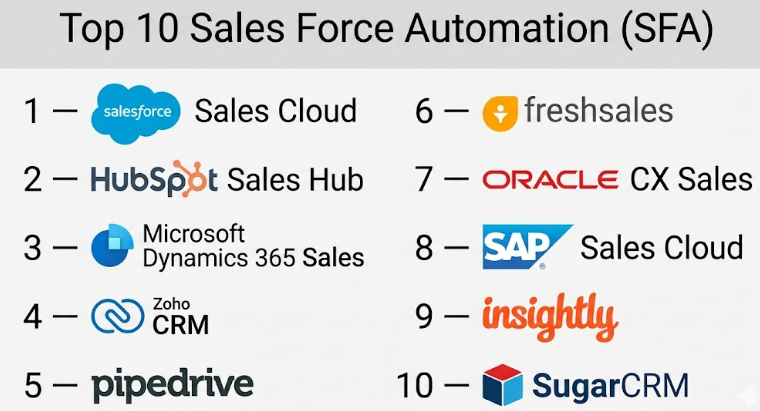
Top 10 Sales Force Automation (SFA) Software
#1 — Salesforce Sales Cloud
Short description: A leading SFA and CRM platform widely used by enterprises for managing complex sales operations.
Key Features
- Lead and opportunity management
- AI-driven insights (Einstein AI)
- Sales forecasting
- Workflow automation
- Custom dashboards and reporting
- Territory management
Pros
- Highly scalable and customizable
- Extensive ecosystem and integrations
Cons
- Expensive for small businesses
- Requires training for full utilization
Platforms / Deployment
Web / iOS / Android — Cloud
Security & Compliance
SSO, MFA, encryption, RBAC, audit logs, GDPR support
Integrations & Ecosystem
Deep ecosystem with thousands of integrations.
- Marketing automation tools
- ERP systems
- Customer support platforms
- APIs for extensibility
Support & Community
Large global community, extensive documentation, enterprise-grade support.
#2 — HubSpot Sales Hub
Short description: A user-friendly SFA solution ideal for SMBs and growing businesses.
Key Features
- Contact and deal tracking
- Email automation
- Pipeline management
- Sales analytics
- Meeting scheduling
- CRM integration
Pros
- Easy to use
- Fast onboarding
Cons
- Limited advanced customization
- Costs increase with scaling
Platforms / Deployment
Web / iOS / Android — Cloud
Security & Compliance
SSO, encryption, GDPR support
Integrations & Ecosystem
- Marketing tools
- CRM systems
- Email platforms
- APIs
Support & Community
Strong support and learning resources for SMB users.
#3 — Microsoft Dynamics 365 Sales
Short description: An enterprise-grade SFA solution integrated with the Microsoft ecosystem.
Key Features
- Lead and opportunity tracking
- AI insights and forecasting
- Integration with Microsoft tools
- Workflow automation
- Reporting dashboards
Pros
- Strong integration with Microsoft ecosystem
- Scalable for enterprise needs
Cons
- Complex setup
- Requires Microsoft environment familiarity
Platforms / Deployment
Web / Windows / Mobile — Cloud
Security & Compliance
Enterprise-grade controls, RBAC, encryption
Integrations & Ecosystem
- Microsoft Office
- Teams
- ERP systems
- APIs
Support & Community
Strong enterprise support and documentation.
#4 — Zoho CRM
Short description: A cost-effective SFA platform suitable for SMBs and mid-sized businesses.
Key Features
- Lead and deal management
- Workflow automation
- AI assistant (Zia)
- Reporting tools
- Multichannel communication
Pros
- Affordable pricing
- Rich feature set for SMBs
Cons
- UI can feel cluttered
- Limited scalability for very large enterprises
Platforms / Deployment
Web / iOS / Android — Cloud
Security & Compliance
SSO, encryption, GDPR support
Integrations & Ecosystem
- Zoho ecosystem apps
- CRM tools
- APIs
Support & Community
Good support with active user community.
#5 — Pipedrive
Short description: A sales-focused SFA tool designed for simplicity and pipeline visibility.
Key Features
- Visual sales pipeline
- Activity tracking
- Automation workflows
- Reporting tools
- Email integration
Pros
- Very easy to use
- Strong pipeline visualization
Cons
- Limited advanced features
- Basic analytics compared to competitors
Platforms / Deployment
Web / iOS / Android — Cloud
Security & Compliance
Encryption, access controls
Integrations & Ecosystem
- Email platforms
- CRM tools
- APIs
Support & Community
Responsive support for SMB users.
#6 — Freshsales (Freshworks)
Short description: A modern SFA solution with built-in communication tools and AI capabilities.
Key Features
- Lead scoring
- Built-in phone and email
- AI-based insights
- Workflow automation
- Sales forecasting
Pros
- All-in-one platform
- Easy setup
Cons
- Limited customization
- Advanced features locked in higher tiers
Platforms / Deployment
Web / iOS / Android — Cloud
Security & Compliance
SSO, encryption
Integrations & Ecosystem
- Freshworks suite
- CRM tools
- APIs
Support & Community
Good onboarding and support resources.
#7 — Oracle CX Sales
Short description: A powerful enterprise SFA platform designed for large organizations.
Key Features
- AI-driven recommendations
- Sales automation
- Forecasting tools
- Workflow management
- Analytics dashboards
Pros
- Strong enterprise capabilities
- Advanced analytics
Cons
- Complex implementation
- High cost
Platforms / Deployment
Web / Cloud
Security & Compliance
Enterprise-grade controls, encryption
Integrations & Ecosystem
- Oracle ERP
- CRM systems
- APIs
Support & Community
Enterprise-level support and services.
#8 — SAP Sales Cloud
Short description: A comprehensive SFA solution integrated with SAP business systems.
Key Features
- Lead and opportunity management
- Sales analytics
- Workflow automation
- Mobile sales support
- Forecasting tools
Pros
- Strong integration with SAP
- Enterprise scalability
Cons
- Requires SAP ecosystem
- Complex setup
Platforms / Deployment
Web / Mobile — Cloud
Security & Compliance
Enterprise-grade compliance and controls
Integrations & Ecosystem
- SAP ERP
- CRM systems
- APIs
Support & Community
Strong enterprise support.
#9 — Insightly
Short description: A CRM with SFA capabilities suitable for small to mid-sized businesses.
Key Features
- Lead and project management
- Workflow automation
- Reporting tools
- Email tracking
- Pipeline visibility
Pros
- Easy to use
- Good value for SMBs
Cons
- Limited advanced analytics
- Smaller ecosystem
Platforms / Deployment
Web / Mobile — Cloud
Security & Compliance
Not publicly stated
Integrations & Ecosystem
- CRM tools
- Productivity apps
- APIs
Support & Community
Basic support with growing community.
#10 — SugarCRM
Short description: A flexible and customizable SFA platform for mid-market and enterprise organizations.
Key Features
- Sales automation
- AI insights
- Workflow management
- Reporting dashboards
- Customer journey tracking
Pros
- Highly customizable
- Strong analytics
Cons
- Requires configuration effort
- UI may not be intuitive for beginners
Platforms / Deployment
Web — Cloud / Self-hosted
Security & Compliance
Encryption, RBAC
Integrations & Ecosystem
- CRM tools
- ERP systems
- APIs
Support & Community
Active community and enterprise support options.
Comparison Table (Top 10)
| Tool Name | Best For | Platform(s) Supported | Deployment | Standout Feature | Public Rating |
|---|---|---|---|---|---|
| Salesforce Sales Cloud | Enterprise | Web/Mobile | Cloud | AI-driven insights | N/A |
| HubSpot Sales Hub | SMB | Web/Mobile | Cloud | Ease of use | N/A |
| Microsoft Dynamics 365 Sales | Enterprise | Web/Windows/Mobile | Cloud | Microsoft integration | N/A |
| Zoho CRM | SMB | Web/Mobile | Cloud | Affordable features | N/A |
| Pipedrive | SMB | Web/Mobile | Cloud | Visual pipeline | N/A |
| Freshsales | SMB | Web/Mobile | Cloud | Built-in communication | N/A |
| Oracle CX Sales | Enterprise | Web | Cloud | Advanced analytics | N/A |
| SAP Sales Cloud | Enterprise | Web/Mobile | Cloud | SAP integration | N/A |
| Insightly | SMB | Web/Mobile | Cloud | Simplicity | N/A |
| SugarCRM | Mid-market | Web | Cloud/Self-hosted | Customization | N/A |
Evaluation & Scoring of Sales Force Automation (SFA)
| Tool Name | Core (25%) | Ease (15%) | Integrations (15%) | Security (10%) | Performance (10%) | Support (10%) | Value (15%) | Weighted Total |
|---|---|---|---|---|---|---|---|---|
| Salesforce Sales Cloud | 9 | 7 | 10 | 9 | 9 | 9 | 6 | 8.5 |
| HubSpot Sales Hub | 8 | 9 | 8 | 8 | 8 | 8 | 8 | 8.2 |
| Microsoft Dynamics 365 Sales | 9 | 7 | 9 | 9 | 9 | 8 | 7 | 8.3 |
| Zoho CRM | 8 | 8 | 7 | 7 | 8 | 7 | 9 | 8.0 |
| Pipedrive | 7 | 9 | 7 | 7 | 7 | 7 | 8 | 7.6 |
| Freshsales | 8 | 8 | 7 | 7 | 8 | 7 | 8 | 7.8 |
| Oracle CX Sales | 9 | 6 | 9 | 9 | 9 | 8 | 6 | 8.2 |
| SAP Sales Cloud | 9 | 6 | 9 | 9 | 9 | 8 | 6 | 8.2 |
| Insightly | 7 | 8 | 6 | 6 | 7 | 6 | 8 | 7.2 |
| SugarCRM | 8 | 7 | 8 | 8 | 8 | 7 | 7 | 7.9 |
How to interpret scores:
- Scores compare tools within this category
- Enterprise tools score higher on features and security
- SMB tools score higher on ease of use and value
- Weighted totals reflect balanced performance
- Choose based on your business needs, not just the score
Which Sales Force Automation (SFA) Software
Solo / Freelancer
Use lightweight tools like Pipedrive or Insightly for basic pipeline tracking.
SMB
HubSpot, Zoho CRM, and Freshsales provide a balance of features and usability.
Mid-Market
SugarCRM and Freshsales offer scalability and customization.
Enterprise
Salesforce, Microsoft Dynamics, SAP, and Oracle are best for large organizations.
Budget vs Premium
- Budget: Zoho CRM, Insightly
- Premium: Salesforce, SAP, Oracle
Feature Depth vs Ease of Use
- Deep features: Salesforce, Oracle
- Easy to use: HubSpot, Pipedrive
Integrations & Scalability
- Strong integrations: Salesforce, Microsoft
- Moderate integrations: SMB tools
Security & Compliance Needs
- High compliance: SAP, Oracle, Salesforce
- Basic needs: SMB-focused tools
Frequently Asked Questions (FAQs)
1. What is Sales Force Automation software?
It automates sales tasks such as lead tracking, pipeline management, and forecasting, improving efficiency and accuracy.
2. How is SFA different from CRM?
SFA focuses on sales processes, while CRM includes broader customer relationship management features.
3. How much does SFA software cost?
Pricing varies from affordable SMB plans to enterprise-level subscriptions depending on features and users.
4. Is SFA suitable for small businesses?
Yes, many tools are designed specifically for SMBs with easy onboarding and lower costs.
5. Can SFA integrate with other tools?
Most SFA platforms integrate with CRM, ERP, marketing, and communication tools.
6. Does SFA improve sales performance?
Yes, automation and insights help sales teams close deals faster and more efficiently.
7. Is training required?
Basic tools require minimal training, while enterprise platforms may need structured onboarding.
8. Can SFA handle remote teams?
Yes, most tools are cloud-based and support mobile access.
9. What are common mistakes when adopting SFA?
Poor data quality, lack of training, and choosing overly complex tools are common issues.
10. Can I switch SFA tools later?
Yes, but data migration and integration setup require planning and effort.
Conclusion
Sales Force Automation software has become a critical component of modern sales operations. As businesses scale and sales processes grow more complex, relying on manual tracking is no longer sustainable. SFA tools bring structure, automation, and intelligence to the sales lifecycle, enabling teams to focus on what matters most—closing deals and building customer relationships. The right tool depends on your business size, complexity, and integration needs. SMBs should prioritize ease of use and quick deployment, while enterprises should focus on scalability, analytics, and compliance. Instead of choosing a tool based solely on features, evaluate how well it fits your workflows and team capabilities.
