Introduction
Compensation Management Tools are software platforms designed to help organizations plan, manage, and optimize employee compensation, including salaries, bonuses, incentives, stock options, and pay equity. These tools bring structure and transparency to what is often a complex and sensitive process.
In today’s workforce environment, compensation is no longer just about payroll. Companies must align pay with performance, market benchmarks, and internal fairness while ensuring compliance and employee satisfaction. With hybrid work models, global hiring, and increased focus on pay transparency, compensation tools have become critical for modern HR and finance teams.
Real-world use cases:
- Managing annual salary review cycles and promotions
- Designing bonus and incentive programs
- Ensuring pay equity across teams and regions
- Benchmarking compensation against market data
- Managing stock-based compensation and rewards
What buyers should evaluate:
- Compensation planning and modeling capabilities
- Pay equity and benchmarking tools
- Workflow automation for review cycles
- Integration with HRIS and payroll systems
- Reporting and analytics depth
- Scalability across departments and geographies
- Security and role-based access control
- Ease of use for managers and HR teams
- Customization of compensation structures
Best for: HR leaders, compensation analysts, finance teams, and business leaders in mid-sized to enterprise organizations that require structured and scalable compensation planning.
Not ideal for: Very small teams or startups with simple salary structures where spreadsheets or basic HR tools may be sufficient.
Key Trends in Compensation Management Tools
- AI-driven compensation insights: Predictive analytics for salary adjustments and performance-linked pay
- Pay transparency tools: Helping organizations comply with emerging transparency regulations
- Real-time benchmarking: Integration with market salary data sources
- Automated compensation cycles: Streamlining annual and quarterly review processes
- Equity and stock management integration: Managing RSUs, ESOPs, and grants
- Cloud-native platforms: Scalable and accessible across global teams
- Employee experience focus: Self-service dashboards for compensation visibility
- Integration-first approach: Deep connections with HRIS, payroll, and performance systems
- Compliance-driven design: Built-in checks for equal pay and legal requirements
How We Selected These Tools (Methodology)
- Evaluated market presence and adoption across industries
- Assessed depth of compensation planning features
- Reviewed performance during large compensation cycles
- Considered security and access control mechanisms
- Analyzed integration ecosystem with HR and finance tools
- Checked fit across SMB, mid-market, and enterprise segments
- Evaluated ease of use for HR and managers
- Compared reporting, analytics, and benchmarking capabilities
- Reviewed support quality and onboarding experience
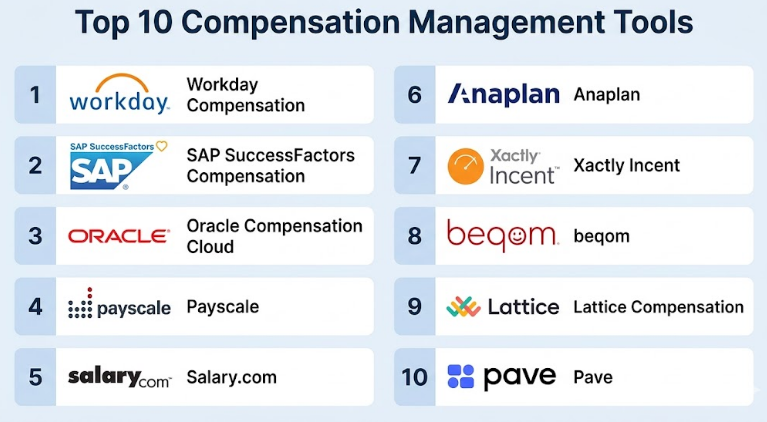
Top 10 Compensation Management Tools
#1 — Workday Compensation
Short description (2–3 lines): Enterprise-grade compensation planning tool integrated within the Workday HCM ecosystem, ideal for large organizations.
Key Features
- Compensation cycle management
- Pay equity analysis
- Global compensation support
- Advanced analytics and reporting
- Bonus and incentive planning
- Integration with performance data
Pros
- Highly scalable
- Deep analytics capabilities
Cons
- Complex implementation
- High cost
Platforms / Deployment
Web
Cloud
Security & Compliance
SSO, RBAC, encryption; SOC 2, ISO (varies)
Integrations & Ecosystem
Integrated within Workday ecosystem
- HR modules
- Payroll systems
- APIs
Support & Community
Enterprise-level support; strong ecosystem
#2 — SAP SuccessFactors Compensation
Short description (2–3 lines): A robust compensation planning tool within SAP’s HR suite, designed for global enterprises.
Key Features
- Salary and bonus planning
- Pay equity analysis
- Workflow automation
- Global compensation support
- Reporting dashboards
Pros
- Strong compliance capabilities
- Global scalability
Cons
- Complex configuration
- Expensive
Platforms / Deployment
Web
Cloud
Security & Compliance
SSO, encryption, audit logs; GDPR, ISO (varies)
Integrations & Ecosystem
- SAP ecosystem
- HR systems
- APIs
Support & Community
Strong enterprise support
#3 — Oracle Compensation Cloud
Short description (2–3 lines): Oracle’s compensation solution offering advanced planning, modeling, and analytics for enterprises.
Key Features
- Compensation modeling
- Bonus and incentive planning
- Pay equity tools
- Reporting and analytics
- Integration with HR systems
Pros
- Strong analytics
- Enterprise scalability
Cons
- Steep learning curve
- Implementation complexity
Platforms / Deployment
Web
Cloud
Security & Compliance
SSO, encryption; Not publicly stated certifications
Integrations & Ecosystem
- Oracle ERP
- HR tools
- APIs
Support & Community
Enterprise support; extensive documentation
#4 — Payscale
Short description (2–3 lines): A compensation benchmarking and planning platform focused on market data and pay transparency.
Key Features
- Salary benchmarking
- Market data insights
- Compensation planning tools
- Pay equity analysis
- Reporting dashboards
Pros
- Strong benchmarking data
- Easy to use
Cons
- Limited HR features
- Less suitable for large enterprises
Platforms / Deployment
Web
Cloud
Security & Compliance
Encryption, MFA; Not publicly stated
Integrations & Ecosystem
- HR systems
- APIs
Support & Community
Good support for SMB and mid-market
#5 — Salary.com
Short description (2–3 lines): A compensation management platform offering benchmarking, analytics, and planning tools.
Key Features
- Salary benchmarking
- Compensation planning
- Pay equity tools
- Analytics dashboards
- Job pricing
Pros
- Reliable market data
- Comprehensive features
Cons
- UI can be complex
- Pricing varies
Platforms / Deployment
Web
Cloud
Security & Compliance
Encryption; Not publicly stated
Integrations & Ecosystem
- HR tools
- APIs
Support & Community
Established vendor with strong support
#6 — Anaplan
Short description (2–3 lines): A planning platform that supports compensation modeling alongside financial and workforce planning.
Key Features
- Compensation modeling
- Scenario planning
- Workforce planning integration
- Analytics dashboards
- Workflow automation
Pros
- Flexible modeling
- Strong forecasting
Cons
- Requires expertise
- Setup complexity
Platforms / Deployment
Web
Cloud
Security & Compliance
SSO, encryption; Not publicly stated
Integrations & Ecosystem
- Finance tools
- HR systems
- APIs
Support & Community
Strong enterprise support
#7 — Xactly Incent
Short description (2–3 lines): A specialized tool for managing sales compensation and incentive programs.
Key Features
- Incentive compensation management
- Commission tracking
- Performance analytics
- Forecasting tools
- Workflow automation
Pros
- Strong for sales teams
- Accurate commission tracking
Cons
- Limited general compensation features
- Focused use case
Platforms / Deployment
Web
Cloud
Security & Compliance
Encryption, RBAC; Not publicly stated
Integrations & Ecosystem
- CRM tools
- HR systems
- APIs
Support & Community
Good support for sales organizations
#8 — beqom
Short description (2–3 lines): A unified compensation platform supporting salary, bonuses, and equity management.
Key Features
- Total compensation management
- Pay equity analysis
- Equity management
- Compensation planning
- Analytics dashboards
Pros
- Comprehensive compensation coverage
- Flexible configuration
Cons
- Complex setup
- Enterprise-focused
Platforms / Deployment
Web
Cloud
Security & Compliance
SSO, encryption; Not publicly stated
Integrations & Ecosystem
- HR systems
- Payroll tools
- APIs
Support & Community
Enterprise support
#9 — Lattice Compensation
Short description (2–3 lines): A compensation planning module integrated with performance management tools.
Key Features
- Compensation planning
- Performance-based pay alignment
- Review workflows
- Analytics dashboards
- Reporting tools
Pros
- Strong performance integration
- User-friendly
Cons
- Limited enterprise features
- Less global coverage
Platforms / Deployment
Web
Cloud
Security & Compliance
Encryption, RBAC; Not publicly stated
Integrations & Ecosystem
- HR tools
- Performance systems
- APIs
Support & Community
Growing ecosystem; good documentation
#10 — Pave
Short description (2–3 lines): A modern compensation platform focused on benchmarking and pay transparency for startups and growing companies.
Key Features
- Real-time compensation benchmarking
- Equity management
- Compensation planning
- Analytics dashboards
- Market data insights
Pros
- Modern UI
- Strong benchmarking
Cons
- Limited enterprise features
- Newer platform
Platforms / Deployment
Web
Cloud
Security & Compliance
Encryption; Not publicly stated
Integrations & Ecosystem
- HR systems
- APIs
Support & Community
Growing support and community
Comparison Table (Top 10)
| Tool Name | Best For | Platform(s) Supported | Deployment | Standout Feature | Public Rating |
|---|---|---|---|---|---|
| Workday Compensation | Enterprise | Web | Cloud | Deep analytics | N/A |
| SAP SuccessFactors Compensation | Enterprise | Web | Cloud | Global scalability | N/A |
| Oracle Compensation Cloud | Enterprise | Web | Cloud | Advanced modeling | N/A |
| Payscale | SMB/Mid | Web | Cloud | Salary benchmarking | N/A |
| Salary.com | Mid-market | Web | Cloud | Market data insights | N/A |
| Anaplan | Enterprise | Web | Cloud | Scenario planning | N/A |
| Xactly Incent | Sales teams | Web | Cloud | Incentive management | N/A |
| beqom | Enterprise | Web | Cloud | Total compensation | N/A |
| Lattice Compensation | SMB/Mid | Web | Cloud | Performance integration | N/A |
| Pave | Startups | Web | Cloud | Real-time benchmarking | N/A |
Evaluation & Scoring of Compensation Management Tools
| Tool Name | Core (25%) | Ease (15%) | Integrations (15%) | Security (10%) | Performance (10%) | Support (10%) | Value (15%) | Weighted Total |
|---|---|---|---|---|---|---|---|---|
| Workday Compensation | 9 | 6 | 9 | 9 | 9 | 8 | 6 | 8.1 |
| SAP SuccessFactors Compensation | 9 | 6 | 9 | 9 | 9 | 8 | 6 | 8.1 |
| Oracle Compensation Cloud | 9 | 6 | 8 | 8 | 9 | 8 | 6 | 7.9 |
| Payscale | 8 | 9 | 7 | 7 | 8 | 8 | 8 | 8.0 |
| Salary.com | 8 | 7 | 7 | 7 | 8 | 8 | 7 | 7.6 |
| Anaplan | 9 | 6 | 9 | 8 | 9 | 8 | 6 | 8.0 |
| Xactly Incent | 8 | 7 | 8 | 7 | 8 | 7 | 7 | 7.6 |
| beqom | 9 | 6 | 8 | 8 | 8 | 7 | 6 | 7.8 |
| Lattice Compensation | 7 | 9 | 7 | 7 | 7 | 7 | 8 | 7.6 |
| Pave | 7 | 9 | 7 | 7 | 7 | 7 | 8 | 7.6 |
How to interpret scores:
These scores reflect relative strengths across categories, not absolute rankings. Enterprise tools score higher on features and scalability, while SMB-focused tools score better on ease of use and value. Always align scoring with your organization’s needs.
Which Compensation Management Tools
Solo / Freelancer
Most freelancers do not need compensation tools. Basic accounting or invoicing software is sufficient.
SMB
Pave, Lattice Compensation, and Payscale are strong choices due to ease of use and affordability.
Mid-Market
Salary.com and Anaplan offer more structured planning and analytics capabilities.
Enterprise
Workday, SAP, Oracle, and beqom provide deep functionality and scalability.
Budget vs Premium
- Budget: Pave, Lattice
- Premium: Workday, SAP, Oracle
Feature Depth vs Ease of Use
- Deep features: Workday, SAP
- Easy to use: Pave, Payscale
Integrations & Scalability
- Strong integrations: Workday, Anaplan
- Moderate: Lattice, Pave
Security & Compliance Needs
- High compliance: SAP, Workday
- Moderate: Pave, Lattice
Frequently Asked Questions (FAQs)
1. What is a compensation management tool?
It is software that helps organizations plan and manage salaries, bonuses, and incentives in a structured and compliant way.
2. How are these tools priced?
Pricing usually depends on employee count, features, and integration requirements.
3. Can these tools handle global compensation?
Yes, enterprise tools like Workday and SAP support global compensation planning.
4. What is pay equity analysis?
It ensures employees are paid fairly across gender, role, and location.
5. Are these tools secure?
Most use encryption and role-based access, but certifications vary by vendor.
6. How long does implementation take?
SMB tools can be set up quickly, while enterprise tools may take months.
7. Can compensation tools integrate with payroll?
Yes, most tools integrate with payroll and HR systems via APIs.
8. What are common mistakes when selecting a tool?
Ignoring scalability, integrations, and compliance requirements.
9. Do these tools support bonuses and incentives?
Yes, most platforms include bonus and incentive planning features.
10. Are there alternatives to compensation tools?
Small teams may use spreadsheets or basic HR software instead.
Conclusion
Compensation Management Tools play a critical role in aligning employee pay with business goals, performance, and market standards. As organizations grow, manual processes become inefficient and error-prone, making structured compensation platforms essential. Enterprise tools like Workday, SAP, and Oracle provide deep functionality for large-scale operations, while newer platforms like Pave and Lattice offer simplicity and modern user experiences for growing companies. The right tool depends on your organization’s size, complexity, and strategic goals. Instead of selecting a tool based on popularity alone, shortlist two or three options that align with your needs. Run a pilot, evaluate usability, validate integrations, and ensure compliance support before making a final decision.
