Introduction
Modern software delivery demands a unified approach where security is not a final hurdle but an integrated component of the development lifecycle. This guide serves as a comprehensive resource for professionals aiming to Certified DevSecOps Engineer credentials within the devopsschool ecosystem. Whether you are an experienced system administrator or a security specialist, aligning your expertise with industry-standard practices is essential for growth. For those looking to bridge the gap between development and security, platforms like aiopsschool offer foundational support that complements this journey. By understanding the core competencies required, engineers can effectively navigate the complexities of cloud-native environments and secure their professional future.
What is the Certified DevSecOps Engineer?
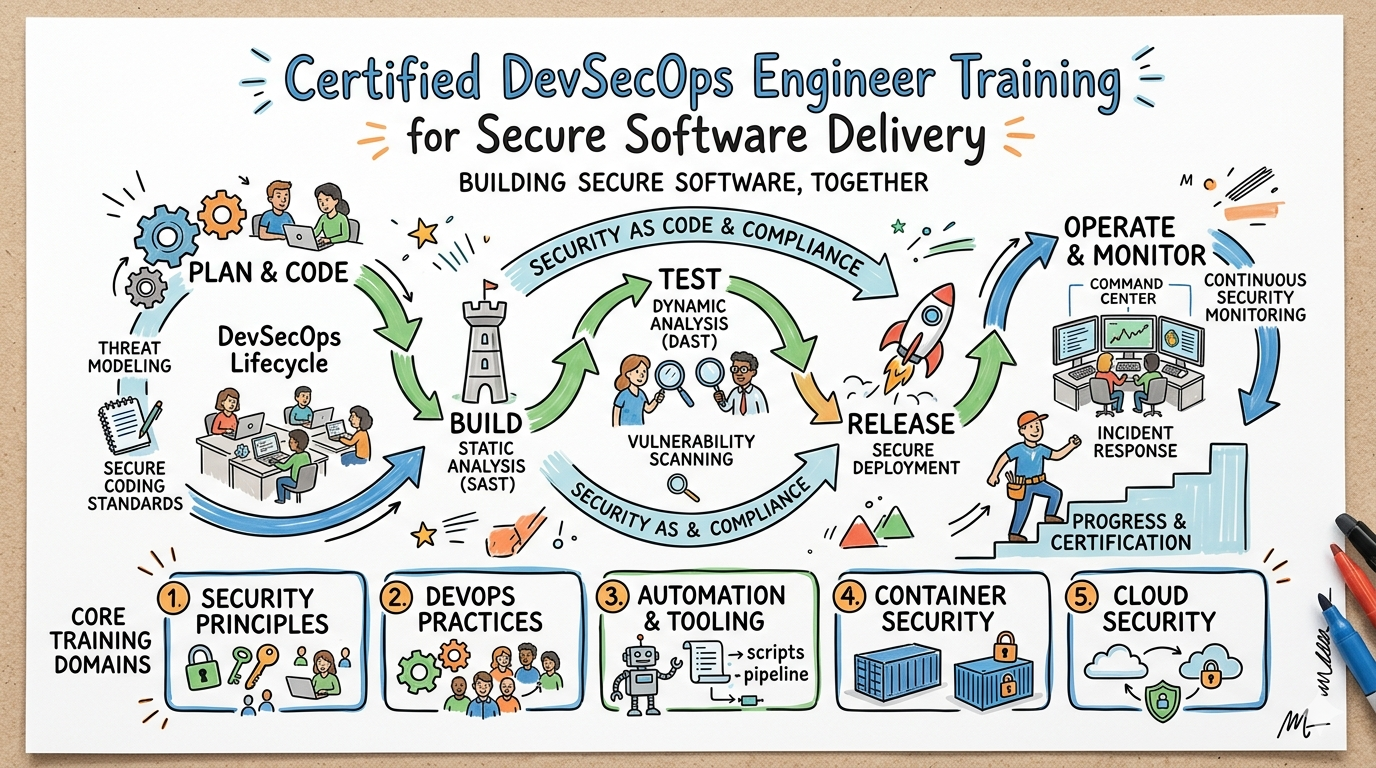
The Certified DevSecOps Engineer represents a professional standard for individuals who architect and maintain secure software delivery pipelines. It exists to validate the ability to embed security practices such as SAST, DAST, and container scanning directly into CI/CD workflows without compromising velocity. This certification moves beyond theoretical knowledge, focusing instead on production-focused outcomes that protect enterprise assets from emerging threats. It aligns with modern engineering workflows where platform stability and security are viewed as shared responsibilities across the entire development organization.
Who Should Pursue Certified DevSecOps Engineer?
This certification is designed for software engineers, site reliability engineers, and cloud architects who want to deepen their security footprint. It is equally relevant for security professionals who need to understand how to apply their expertise within fast-paced, automated DevOps environments. Managers and technical leaders looking to standardize security practices across their teams will find the curriculum highly applicable for internal alignment. Both global teams and domestic engineering cohorts in India will find the focus on automated governance highly beneficial for scaling operations securely.
Why Certified DevSecOps Engineer
In an era where infrastructure as code and microservices dominate, the ability to secure these components is a high-demand skill set. This certification provides a clear framework for professionals to demonstrate their proficiency, ensuring they stay relevant as tools and platforms evolve over time. The return on investment is measured by increased operational efficiency, reduced risk of security breaches, and the ability to lead complex engineering initiatives. Professionals who hold this credential are well-positioned to drive organizational change, shifting the culture from reactive security to proactive, automated protection.
Certified DevSecOps Engineer Certification Overview
The program is delivered via Certified DevSecOps Engineer and is hosted on devopsschool. It offers a structured approach to learning, focusing on practical labs and real-world scenarios rather than rote memorization. Ownership of the certification signifies a mastery of the tools and methodologies required to secure modern infrastructure. The assessment approach ensures that candidates can solve actual problems, providing credibility that is recognized by industry peers and employers alike.
Certified DevSecOps Engineer Certification Tracks & Levels
The certification path is tiered to accommodate varying levels of expertise, ranging from foundational concepts to advanced architectural design. Foundation levels introduce the core principles of shifting security left, while professional levels dive into specific tool integrations and compliance automation. Advanced levels are reserved for those who can design enterprise-wide security strategies. These tracks are designed to mirror the actual career progression of a modern security engineer, allowing for continuous growth and specialization.
Complete Certified DevSecOps Engineer Certification Table
| Track | Level | Who it’s for | Prerequisites | Skills Covered | Recommended Order |
| Security | Foundation | Junior Engineers | Basic Linux | Security Fundamentals | 1 |
| Security | Professional | DevSecOps Engineers | Security Foundation | Pipeline Automation | 2 |
| Security | Advanced | Lead Engineers | Professional Cert | Governance & Compliance | 3 |
Detailed Guide for Each Certified DevSecOps Engineer Certification
Certified DevSecOps Engineer – Professional Level
What it is
This certification validates the practical ability to implement security controls within a CI/CD pipeline. It covers everything from threat modeling to automated infrastructure hardening.
Who should take it
It is intended for engineers with at least one year of experience in DevOps or security operations who want to formalize their expertise.
Skills you’ll gain
- Automated vulnerability scanning
- Secret management in pipelines
- Compliance as code
- Container orchestration security
Real-world projects you should be able to do
- Integrate static analysis tools into Jenkins or GitLab CI
- Configure automated policies for Kubernetes clusters
- Implement secrets rotation for cloud infrastructure
Preparation plan
- 7-14 days: Focus on foundational security concepts and tool documentation.
- 30 days: Complete hands-on labs and build a sample secure pipeline from scratch.
- 60 days: Review enterprise-level security architecture and prepare for practical exam scenarios.
Common mistakes
- Focusing only on tool usage instead of security principles.
- Ignoring the cultural aspect of DevSecOps collaboration.
- Neglecting to understand the underlying infrastructure requirements.
Best next certification after this
- Same-track: Advanced DevSecOps Architect
- Cross-track: Certified SRE Engineer
- Leadership: IT Security Manager
Choose Your Learning Path
DevOps Path
The DevOps path focuses on the lifecycle of application delivery. It emphasizes the integration of development and operations teams to increase throughput. By mastering these skills, you ensure that security is a byproduct of efficient workflow rather than an obstacle to it.
DevSecOps Path
This path centers on the security-first mindset. It teaches engineers how to weave security into the fabric of the delivery pipeline. The focus is on automated protection, risk mitigation, and creating a culture where security is everyone’s responsibility.
SRE Path
The SRE path is about site reliability and operational excellence. It focuses on monitoring, alerting, and incident response within a secure framework. Professionals learn to balance velocity with system stability and rigorous security standards.
AIOps Path
The AIOps path integrates artificial intelligence into operational workflows. It involves using data-driven insights to automate security incident detection and resolution. This is ideal for those managing large-scale, complex environments.
MLOps Path
The MLOps path specifically addresses the security of machine learning models and data pipelines. It covers protecting data integrity, model provenance, and preventing adversarial attacks on AI systems. This is a highly specialized and growing field.
DataOps Path
DataOps focuses on the secure and efficient management of data throughout its lifecycle. It involves automating data quality, movement, and governance. This path ensures that data-heavy applications are both compliant and high-performing.
FinOps Path
FinOps addresses the financial aspect of cloud infrastructure. It teaches engineers how to manage costs effectively while maintaining security. This is critical for organizations looking to optimize their cloud spend without sacrificing protective measures.
Role → Recommended Certified DevSecOps Engineer Certifications
| Role | Recommended Certifications |
| DevOps Engineer | Professional DevSecOps Engineer |
| SRE | SRE Security Specialist |
| Platform Engineer | Infrastructure Security Expert |
| Cloud Engineer | Cloud Security Architect |
| Security Engineer | Certified DevSecOps Engineer |
| Data Engineer | DataOps Security Practitioner |
| FinOps Practitioner | FinOps Security Professional |
| Engineering Manager | Security Governance Leader |
Next Certifications to Take After Certified DevSecOps Engineer
Same Track Progression
Once you have mastered the professional level, the next step is to pursue architectural certifications. These focus on multi-cloud security strategies, complex governance models, and leading large-scale organizational transformations.
Cross-Track Expansion
Broadening your skills into SRE or FinOps provides a more holistic view of the ecosystem. Understanding how security interacts with infrastructure reliability or financial optimization makes you a more versatile engineer.
Leadership & Management Track
Transitioning to leadership involves focusing on strategy, people management, and security governance. These certifications help bridge the gap between technical execution and business-level decision-making.
Training & Certification Support Providers for Certified DevSecOps Engineer
DevOpsSchool provides a robust platform for hands-on learning and professional development. They focus on delivering industry-relevant content that bridges the gap between academic theory and the practical demands of modern enterprise environments.
Cotocus specializes in advanced training programs that cater to the evolving needs of the tech industry. Their approach emphasizes project-based learning and mentorship, ensuring that candidates are prepared for real-world challenges.
Scmgalaxy is a key resource for engineers looking to master configuration management and pipeline automation. Their training modules are highly practical, focusing on the tools that professionals actually use in their daily work.
BestDevOps offers curated learning paths that simplify the complex landscape of modern engineering. They are known for their clear, concise explanations and focus on core competencies that drive professional success.
devsecopsschool serves as the primary hub for those dedicated to the intersection of development and security. Their specialized curriculum is designed to create experts who can navigate both domains with confidence.
sreschool provides in-depth training on reliability and operational stability. Their programs are essential for engineers who want to build and maintain secure, high-performance systems at scale.
aiopsschool focuses on the integration of artificial intelligence into IT operations. Their training helps professionals leverage data-driven insights to automate security and operational tasks effectively.
dataopsschool addresses the critical need for secure and efficient data management. They offer comprehensive guides on data governance, security, and pipeline automation for modern data engineers.
finopsschool is the go-to resource for engineers who need to master the financial aspects of cloud management. Their training bridges the gap between technical infrastructure and budgetary responsibility.
Frequently Asked Questions
- What is the difficulty level of the certification?The certification is designed to be challenging but achievable for professionals with practical experience. It tests your ability to apply concepts in real-world scenarios rather than just theoretical knowledge.
- How much time is required to prepare?Preparation time varies based on your existing experience level and familiarity with the tools. Most professionals find that 30 to 60 days of consistent study is sufficient for the professional level.
- Are there specific prerequisites for the exam?While there are no hard barriers, having basic knowledge of Linux, cloud platforms, and CI/CD pipelines is strongly recommended. Hands-on experience is the best prerequisite you can bring to the table.
- What is the return on investment for this certification?The ROI is realized through enhanced career prospects, higher earning potential, and the ability to solve complex security problems efficiently. It is a long-term investment in your professional credibility.
- Should I complete foundation levels before moving to professional?Yes, following the recommended path ensures you have a solid understanding of core principles. This progression prevents knowledge gaps and builds a stronger foundation for advanced topics.
- How does this certification compare to vendor-specific exams?This certification is vendor-neutral, focusing on methodologies and practices that apply across different platforms. It is highly valued for its focus on universal engineering principles.
- Is this training suitable for managers?Yes, managers who understand the technical details of DevSecOps are better equipped to lead teams and make informed decisions. It helps in aligning technical strategy with business goals.
- How do I maintain my certification status?Maintaining certification involves staying active in the community and participating in continuous learning. Regular updates to your skills ensure your credential remains relevant in a changing landscape.
- Can I use these skills immediately in my current role?Absolutely, the practical nature of the curriculum means that most concepts can be applied the very next day. You will find immediate opportunities to improve your pipeline security.
- Does the certification cover compliance?Yes, compliance and governance are key components of the curriculum. You will learn how to automate the validation of security policies to meet industry standards.
- Is the exam entirely practical-based?The certification emphasizes hands-on application, meaning you will be assessed on your ability to complete tasks in simulated or real environments. This validates your actual engineering capability.
- Where can I find study materials?The official hosting platforms provide comprehensive documentation, lab guides, and additional resources. Engaging with the community and active forums is also highly recommended.
FAQs on Certified DevSecOps Engineer
- What makes this certification unique?It focuses on the practical integration of security within the development lifecycle rather than just security theory.
- Is it suitable for beginners?Engineers with foundational knowledge in development or operations will find it a natural next step in their career.
- Does it cover Kubernetes security?Yes, container and orchestration security are central pillars of the professional certification curriculum.
- Can I take the exam remotely?The program is designed for flexible delivery, allowing professionals globally to participate and complete their certification.
- How does this help with cloud-native security?It provides the exact framework needed to secure microservices, serverless, and containerized cloud-native architectures.
- Are there any hidden costs?The program is transparent regarding its structure and requirements, ensuring there are no surprises during your learning journey.
- How is the certification recognized globally?It is respected by industry leaders for its focus on practical, production-grade skills and rigorous assessment standards.
- Will this certification make me a security expert?It provides the essential knowledge and framework to build your expertise and drive professional results in the security domain.
Final Thoughts: Is Certified DevSecOps Engineer Worth It?
Investing in your professional growth through a structured certification path is a strategic career move. This program offers a clear, practical, and experience-driven way to validate your skills in an increasingly security-conscious industry. If you are looking to elevate your career and take a lead role in modernizing software delivery, this certification is a logical and valuable step. Focus on the hands-on labs, engage deeply with the material, and you will find that the knowledge gained is directly applicable to your daily work. Approach the certification not as a badge, but as a commitment to maintaining high standards in your engineering practice.
