Introduction
IT Service Management (ITSM) tools are platforms designed to manage and deliver IT services efficiently across an organization. In simple terms, ITSM tools help IT teams handle incidents, service requests, changes, assets, and workflows in a structured and standardized way.
Unlike basic help desk software, ITSM platforms follow frameworks like ITIL to ensure consistent service delivery, improved governance, and better alignment between IT and business goals. Modern ITSM tools go beyond ticketing—they include automation, AI-driven insights, self-service portals, and integration with DevOps and cloud environments.
As organizations scale and adopt hybrid infrastructures, ITSM tools have become critical for maintaining service reliability, reducing downtime, and improving user experience.
Common use cases include:
- Incident and problem management
- Change and release management
- Service request fulfillment
- Asset and configuration management (CMDB)
- IT operations and workflow automation
Key evaluation criteria buyers should consider:
- ITIL-aligned processes and workflows
- Incident, problem, and change management capabilities
- CMDB and asset management features
- Automation and AI capabilities
- Self-service portals and knowledge base
- Integration with DevOps, cloud, and monitoring tools
- Reporting and analytics
- Scalability and customization
- Security and compliance
- Ease of use and implementation
Best for: IT departments, enterprises, managed service providers, and organizations managing complex IT environments and service delivery processes.
Not ideal for: Very small teams with minimal IT complexity or businesses that only need basic ticketing without structured IT processes.
Key Trends in Portfolio & IT Service Management (ITSM) Tools for the Future
- AI-driven IT operations (AIOps): Predictive incident detection and automated resolution
- Shift-left IT support: Increased use of self-service portals and knowledge bases
- Low-code/no-code workflows: Faster customization of IT processes
- Integration with DevOps pipelines: Bridging IT operations and development
- Cloud-native ITSM platforms: Scalable and flexible deployments
- Experience-focused ITSM: Improving employee and end-user experience
- Automation-first approach: Reducing manual intervention in repetitive tasks
- Unified service management: Extending ITSM to HR, finance, and other departments
- Advanced analytics and reporting: Data-driven decision-making
- Security and compliance alignment: Strong governance and audit capabilities
How We Selected These Tools (Methodology)
- Evaluated market leadership and adoption
- Assessed ITSM feature completeness (incident, change, CMDB, etc.)
- Reviewed automation and AI capabilities
- Considered ease of use and implementation complexity
- Analyzed integration ecosystems with DevOps and cloud tools
- Included tools suitable for SMB, mid-market, and enterprise
- Evaluated scalability and customization options
- Considered security and compliance signals
- Reviewed support, documentation, and community strength
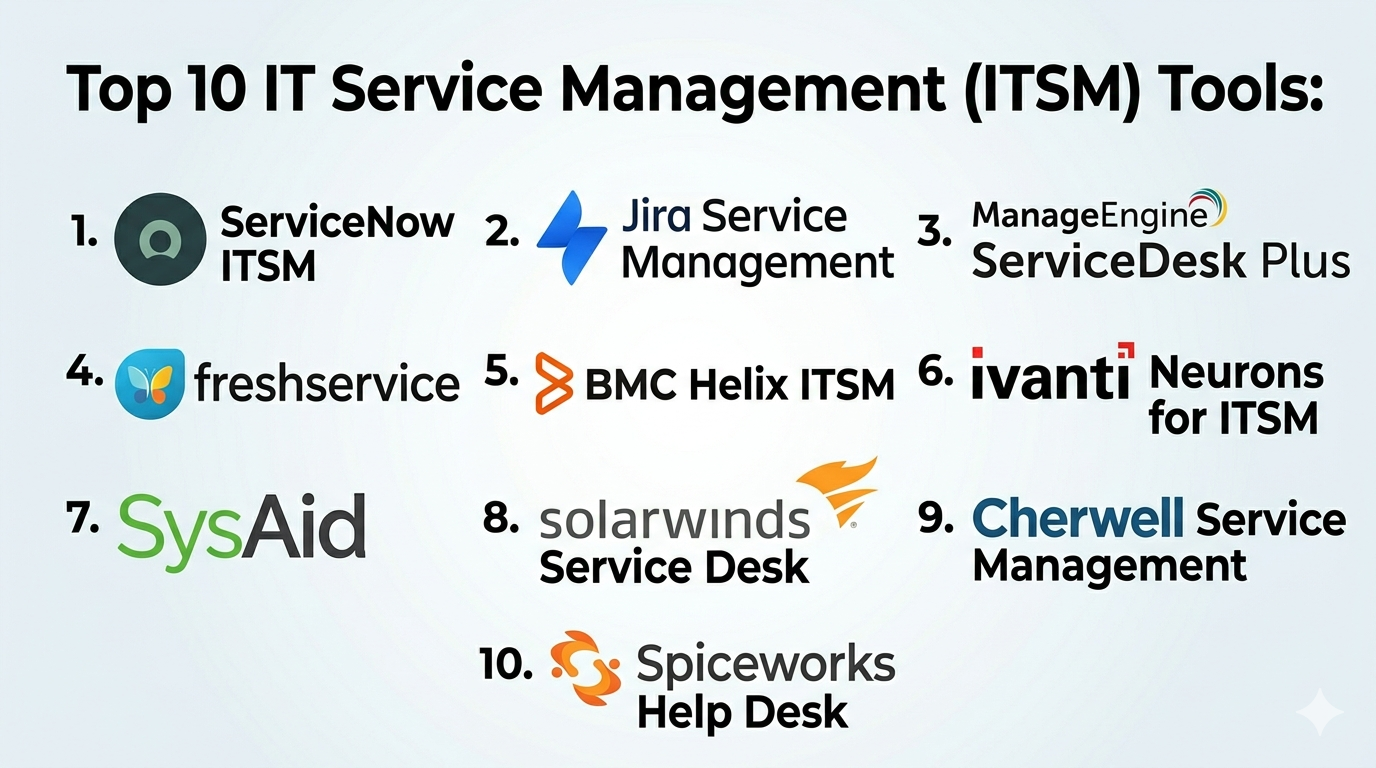
Top 10 IT Service Management (ITSM) Tools
#1 — ServiceNow ITSM
Short description: A leading enterprise ITSM platform offering comprehensive service management, automation, and customization capabilities.
Key Features
- Incident, problem, and change management
- CMDB and asset management
- Workflow automation
- AI-powered insights
- Self-service portals
- Advanced reporting
Pros
- Highly customizable
- Enterprise-grade scalability
Cons
- Expensive
- Complex implementation
Platforms / Deployment
Web
Cloud / Hybrid
Security & Compliance
- SSO, encryption
- Compliance varies
Integrations & Ecosystem
ServiceNow integrates with a wide range of enterprise tools.
- DevOps tools
- Cloud platforms
- APIs
Support & Community
Strong enterprise support and partner ecosystem.
#2 — Jira Service Management
Short description: An ITSM solution designed for DevOps and agile teams, tightly integrated with the Atlassian ecosystem.
Key Features
- Incident and change management
- Automation workflows
- Integration with Jira Software
- Self-service portals
- SLA tracking
Pros
- Strong DevOps integration
- Flexible workflows
Cons
- Learning curve for non-technical users
- Requires Atlassian ecosystem
Platforms / Deployment
Web / Desktop / Mobile
Cloud
Security & Compliance
- SSO, encryption
- Compliance varies
Integrations & Ecosystem
- Atlassian tools
- DevOps integrations
- APIs
Support & Community
Large community and extensive documentation.
#3 — ManageEngine ServiceDesk Plus
Short description: A comprehensive ITSM tool offering strong asset management and ITIL-aligned processes.
Key Features
- Incident and problem management
- Change management
- Asset and CMDB
- Automation
- Reporting
Pros
- Strong ITSM capabilities
- On-premise option
Cons
- UI may feel outdated
- Learning curve
Platforms / Deployment
Web
Cloud / On-premise
Security & Compliance
Not publicly stated
Integrations & Ecosystem
- IT tools
- APIs
Support & Community
Reliable enterprise support.
#4 — Freshservice
Short description: A modern ITSM platform from Freshworks, designed for ease of use and automation.
Key Features
- Incident and change management
- Asset management
- Automation workflows
- Self-service portal
- Reporting
Pros
- User-friendly interface
- Quick implementation
Cons
- Limited deep customization
- Fewer enterprise features
Platforms / Deployment
Web / Mobile
Cloud
Security & Compliance
Not publicly stated
Integrations & Ecosystem
- Freshworks suite
- APIs
Support & Community
Strong SMB and mid-market support.
#5 — BMC Helix ITSM
Short description: An enterprise-grade ITSM solution with advanced automation and AI capabilities.
Key Features
- Incident and change management
- AI-driven insights
- CMDB
- Automation
- Multi-cloud support
Pros
- Strong enterprise features
- Advanced automation
Cons
- Complex implementation
- High cost
Platforms / Deployment
Web
Cloud / Hybrid
Security & Compliance
- SSO, encryption
- Compliance varies
Integrations & Ecosystem
- Enterprise tools
- APIs
Support & Community
Enterprise-level support.
#6 — Ivanti Neurons for ITSM
Short description: A modern ITSM platform focusing on automation and user experience.
Key Features
- Incident and problem management
- Automation workflows
- Self-service portal
- Asset management
- Reporting
Pros
- Strong automation
- Good UX
Cons
- Limited ecosystem visibility
- Pricing not transparent
Platforms / Deployment
Web
Cloud
Security & Compliance
Not publicly stated
Integrations & Ecosystem
- APIs
- IT tools
Support & Community
Moderate support and documentation.
#7 — SysAid
Short description: An ITSM platform offering automation and asset management for mid-sized organizations.
Key Features
- Incident management
- Asset management
- Automation
- Reporting
- Self-service portal
Pros
- Easy to use
- Good automation features
Cons
- Limited scalability
- UI improvements needed
Platforms / Deployment
Web
Cloud / On-premise
Security & Compliance
Not publicly stated
Integrations & Ecosystem
- APIs
- IT tools
Support & Community
Reliable support.
#8 — SolarWinds Service Desk
Short description: A cloud-based ITSM solution focused on simplicity and efficiency.
Key Features
- Incident management
- Asset management
- Automation
- Reporting
- Self-service
Pros
- Easy to deploy
- Affordable
Cons
- Limited advanced features
- Smaller ecosystem
Platforms / Deployment
Web
Cloud
Security & Compliance
Not publicly stated
Integrations & Ecosystem
- IT tools
- APIs
Support & Community
Good SMB-focused support.
#9 — Cherwell Service Management
Short description: A flexible ITSM platform with strong customization and workflow capabilities.
Key Features
- Incident and change management
- Workflow automation
- Asset management
- Reporting
- Customization tools
Pros
- Highly customizable
- Good workflow flexibility
Cons
- Interface can feel outdated
- Implementation complexity
Platforms / Deployment
Web
Cloud / On-premise
Security & Compliance
Not publicly stated
Integrations & Ecosystem
- APIs
- IT tools
Support & Community
Enterprise support.
#10 — Spiceworks Help Desk
Short description: A free help desk and ITSM tool suitable for small IT teams.
Key Features
- Ticketing system
- Asset tracking
- Reporting
- Alerts
- Community support
Pros
- Free to use
- Easy setup
Cons
- Limited advanced ITSM features
- Not suitable for large enterprises
Platforms / Deployment
Web
Cloud
Security & Compliance
Not publicly stated
Integrations & Ecosystem
- Basic integrations
- Community plugins
Support & Community
Strong community-driven support.
Comparison Table (Top 10)
| Tool Name | Best For | Platform(s) Supported | Deployment | Standout Feature | Public Rating |
|---|---|---|---|---|---|
| ServiceNow | Enterprise | Web | Hybrid | Customization | N/A |
| Jira Service Mgmt | DevOps teams | Web, Mobile | Cloud | DevOps integration | N/A |
| ManageEngine | IT teams | Web | Hybrid | Asset mgmt | N/A |
| Freshservice | SMB | Web, Mobile | Cloud | Ease of use | N/A |
| BMC Helix | Enterprise | Web | Hybrid | AI automation | N/A |
| Ivanti | Mid-market | Web | Cloud | Automation | N/A |
| SysAid | Mid-market | Web | Hybrid | Simplicity | N/A |
| SolarWinds | SMB | Web | Cloud | Affordability | N/A |
| Cherwell | Enterprise | Web | Hybrid | Customization | N/A |
| Spiceworks | Small teams | Web | Cloud | Free tool | N/A |
IT Service Management (ITSM) Tools
| Tool Name | Core (25%) | Ease (15%) | Integrations (15%) | Security (10%) | Performance (10%) | Support (10%) | Value (15%) | Weighted Total |
|---|---|---|---|---|---|---|---|---|
| ServiceNow | 9 | 6 | 9 | 9 | 9 | 9 | 6 | 8.4 |
| Jira Service Mgmt | 8 | 7 | 9 | 8 | 8 | 8 | 8 | 8.1 |
| ManageEngine | 8 | 7 | 7 | 7 | 8 | 8 | 8 | 7.8 |
| Freshservice | 8 | 9 | 8 | 6 | 8 | 8 | 9 | 8.3 |
| BMC Helix | 9 | 6 | 8 | 9 | 9 | 9 | 6 | 8.3 |
| Ivanti | 7 | 8 | 7 | 6 | 7 | 7 | 7 | 7.2 |
| SysAid | 7 | 8 | 7 | 6 | 7 | 7 | 8 | 7.4 |
| SolarWinds | 7 | 8 | 7 | 6 | 7 | 7 | 8 | 7.4 |
| Cherwell | 8 | 6 | 7 | 7 | 8 | 8 | 7 | 7.6 |
| Spiceworks | 6 | 9 | 5 | 5 | 6 | 7 | 9 | 6.9 |
How to interpret scores:
- Scores are relative comparisons across tools
- Higher totals indicate better overall balance
- Enterprise tools excel in features and scalability
- SMB tools lead in ease of use and value
- Choose based on your organization’s complexity and needs
Which IT Service Management (ITSM) Tools Is Right for You?
Solo / Freelancer
- Best choices: Spiceworks, Freshservice
- Focus on simplicity and low cost
SMB
- Best choices: Freshservice, SolarWinds
- Balance usability and features
Mid-Market
- Best choices: Jira Service Management, ManageEngine
- Need integrations and scalability
Enterprise
- Best choices: ServiceNow, BMC Helix
- Prioritize customization and compliance
Budget vs Premium
- Budget: Spiceworks, SolarWinds
- Premium: ServiceNow, BMC
Feature Depth vs Ease of Use
- Easy: Freshservice, SysAid
- Advanced: ServiceNow, BMC
Integrations & Scalability
- Strong: Jira, ServiceNow
- Flexible: ManageEngine
Security & Compliance Needs
- High: ServiceNow, BMC
- Moderate: SMB tools
Frequently Asked Questions (FAQs)
What is ITSM software?
It manages IT services and processes like incidents and changes.
Is ITSM only for large enterprises?
No, many tools are designed for SMBs as well.
What is ITIL?
A framework for IT service management best practices.
Do ITSM tools include automation?
Yes, automation is a core feature.
Can ITSM tools integrate with DevOps?
Yes, many support DevOps integrations.
Are these tools cloud-based?
Most are cloud-based with some hybrid options.
How long does implementation take?
From days to months depending on complexity.
Are ITSM tools secure?
Most offer strong security and compliance features.
Can non-IT teams use ITSM tools?
Yes, many extend to HR and other departments.
What is the pricing model?
Typically subscription-based per user or module.
Conclusion
IT Service Management (ITSM) tools are essential for organizations looking to deliver structured, efficient, and scalable IT services. From handling incidents to managing complex workflows and assets, these platforms play a critical role in maintaining operational stability.
