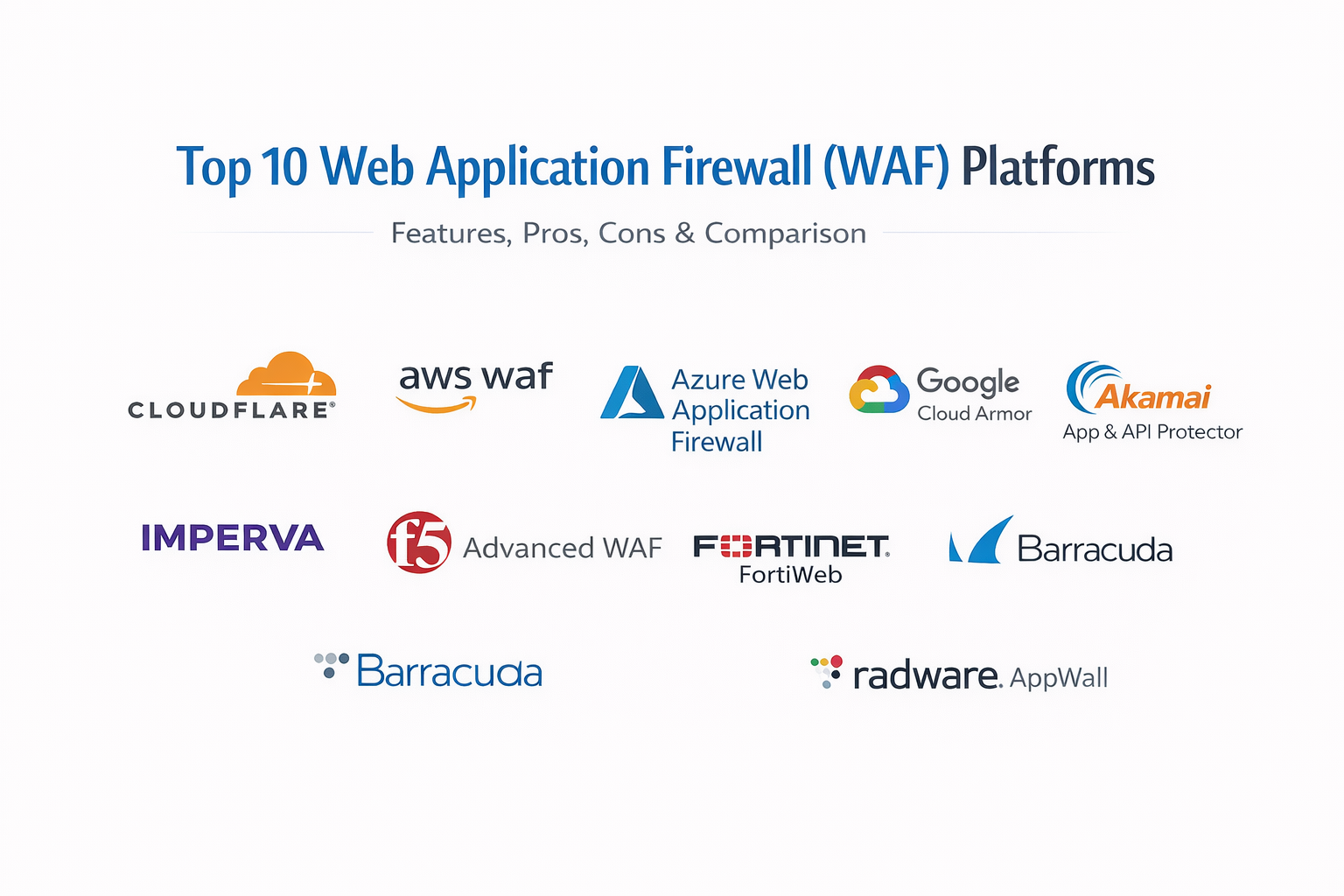
Introduction
Web Application Firewall (WAF) platforms are security solutions designed to protect web applications by filtering and monitoring HTTP/HTTPS traffic between users and servers. In simple terms, a WAF acts as a protective shield that blocks malicious requests—such as SQL injection, cross-site scripting (XSS), and bot attacks—before they reach your application.
With businesses increasingly relying on web applications, APIs, and cloud-native architectures, WAF platforms have become a critical layer of security. They help organizations safeguard sensitive data, maintain uptime, and meet compliance requirements while defending against evolving cyber threats.
Common Use Cases
- Protecting websites and web applications from attacks
- Securing APIs and microservices
- Preventing DDoS and bot-based attacks
- Enforcing security policies and compliance requirements
- Monitoring and analyzing web traffic
What Buyers Should Evaluate
- Threat detection and mitigation capabilities
- Ease of deployment and configuration
- Integration with cloud platforms and CDNs
- Performance impact and latency
- Automation and rule management
- API security features
- Reporting and analytics
- Scalability across traffic loads
- Compliance and security certifications
- Cost and pricing model
Best for: Security teams, DevOps engineers, SaaS companies, enterprises, and organizations running public-facing web applications or APIs.
Not ideal for: Internal-only applications with minimal exposure or small projects where basic security controls are sufficient.
Key Trends in Web Application Firewall (WAF) Platforms
- AI-driven threat detection: Machine learning models identifying unknown attack patterns
- API-first security: WAFs expanding to protect APIs and microservices
- Cloud-native WAFs: Fully managed, scalable solutions replacing hardware appliances
- Bot management integration: Detection and mitigation of automated threats
- Zero Trust security models: Identity-aware access controls
- Automation and adaptive policies: Dynamic rule tuning based on traffic patterns
- Edge deployment: WAF integrated with CDN and edge networks
- DevSecOps integration: Security embedded into CI/CD pipelines
- Advanced analytics: Real-time threat visibility and insights
- Compliance support: Built-in tools for regulatory requirements
How We Selected These Tools (Methodology)
- Evaluated market adoption and reputation
- Assessed core WAF capabilities and threat protection features
- Compared ease of deployment and management
- Reviewed performance and scalability
- Analyzed integration with cloud, CDN, and DevOps tools
- Considered security features and compliance readiness
- Included tools for enterprise and SMB use cases
- Evaluated automation and AI capabilities
- Prioritized platforms with modern architectures and innovation
Top Web Application Firewall (WAF) Platforms
#1 — Cloudflare WAF
Short description: A widely used cloud-based WAF offering strong security, performance, and global edge protection.
Key Features
- Global edge network protection
- DDoS mitigation
- Bot management
- Custom rule engine
- API security
- Real-time analytics
Pros
- Easy deployment
- Strong performance and scalability
Cons
- Advanced features require higher plans
- Rule tuning may be needed
Platforms / Deployment
Cloud
Security & Compliance
DDoS protection, encryption, RBAC; compliance not publicly stated
Integrations & Ecosystem
Cloudflare integrates with modern web infrastructure and edge services.
- CDN services
- APIs
- DevOps tools
- Edge computing platforms
Support & Community
Strong documentation and large community
#2 — AWS WAF
Short description: A scalable WAF designed for applications running within AWS environments.
Key Features
- Managed rule sets
- Custom rule creation
- Integration with AWS services
- Real-time monitoring
- Automation via APIs
Pros
- Seamless AWS integration
- Highly scalable
Cons
- Complex pricing
- Best suited for AWS users
Platforms / Deployment
Cloud
Security & Compliance
IAM integration, encryption; compliance not publicly stated
Integrations & Ecosystem
- AWS ecosystem
- APIs
- DevOps tools
Support & Community
Extensive documentation and enterprise support
#3 — Azure Web Application Firewall
Short description: Microsoft’s WAF solution integrated with Azure services for protecting cloud applications.
Key Features
- Managed rule sets
- OWASP protection
- Integration with Azure services
- Traffic monitoring
- Custom policies
Pros
- Strong integration with Azure
- Enterprise-ready
Cons
- Limited outside Azure ecosystem
- Configuration complexity
Platforms / Deployment
Cloud
Security & Compliance
RBAC, encryption; compliance not publicly stated
Integrations & Ecosystem
- Azure services
- APIs
- DevOps tools
Support & Community
Strong enterprise support
#4 — Google Cloud Armor
Short description: A cloud-native WAF providing protection for applications hosted on Google Cloud.
Key Features
- DDoS protection
- Custom security policies
- Global load balancing integration
- Real-time analytics
- API protection
Pros
- High scalability
- Strong performance
Cons
- Limited outside GCP
- Learning curve
Platforms / Deployment
Cloud
Security & Compliance
Encryption; compliance not publicly stated
Integrations & Ecosystem
- Google Cloud services
- APIs
Support & Community
Good documentation
#5 — Akamai App & API Protector
Short description: An enterprise-grade WAF with strong edge security and global performance.
Key Features
- Edge-based protection
- Bot management
- API security
- Advanced threat detection
- DDoS mitigation
Pros
- Strong global network
- Advanced security features
Cons
- Expensive
- Complex configuration
Platforms / Deployment
Cloud
Security & Compliance
DDoS protection, encryption; compliance not publicly stated
Integrations & Ecosystem
- Akamai ecosystem
- APIs
- Enterprise tools
Support & Community
Premium enterprise support
#6 — Imperva WAF
Short description: A comprehensive WAF platform focused on advanced threat protection and compliance.
Key Features
- Threat intelligence
- DDoS protection
- Bot mitigation
- API security
- Compliance reporting
Pros
- Strong security capabilities
- Good compliance features
Cons
- Higher cost
- Complex setup
Platforms / Deployment
Cloud / Hybrid
Security & Compliance
Encryption, RBAC; compliance not publicly stated
Integrations & Ecosystem
- APIs
- Cloud platforms
- Security tools
Support & Community
Enterprise support
#7 — F5 Advanced WAF
Short description: A powerful WAF solution offering deep application security and customization.
Key Features
- Advanced threat protection
- Behavioral analytics
- Bot defense
- API security
- Custom policies
Pros
- Highly customizable
- Strong enterprise capabilities
Cons
- Complex deployment
- Requires expertise
Platforms / Deployment
Cloud / On-premise / Hybrid
Security & Compliance
RBAC, encryption; compliance not publicly stated
Integrations & Ecosystem
- F5 ecosystem
- APIs
- Enterprise integrations
Support & Community
Enterprise-level support
#8 — Fortinet FortiWeb
Short description: A WAF solution integrated with Fortinet’s security ecosystem.
Key Features
- Threat protection
- Machine learning detection
- API security
- Bot mitigation
- Centralized management
Pros
- Strong security features
- Good integration with Fortinet
Cons
- Vendor lock-in
- UI complexity
Platforms / Deployment
Hybrid
Security & Compliance
RBAC, encryption; compliance not publicly stated
Integrations & Ecosystem
- Fortinet ecosystem
- APIs
Support & Community
Strong support
#9 — Barracuda WAF
Short description: A user-friendly WAF platform offering cloud and appliance-based protection.
Key Features
- Application protection
- DDoS mitigation
- Bot protection
- Reporting tools
- Easy deployment
Pros
- Easy to use
- Flexible deployment
Cons
- Limited advanced features
- Smaller ecosystem
Platforms / Deployment
Cloud / Appliance
Security & Compliance
Basic security; compliance not publicly stated
Integrations & Ecosystem
- APIs
- Cloud integrations
Support & Community
Good support
#10 — Radware AppWall
Short description: A security-focused WAF designed for protecting applications against advanced threats.
Key Features
- Behavioral-based security
- DDoS protection
- API protection
- Threat intelligence
- Real-time monitoring
Pros
- Strong security focus
- Good performance
Cons
- Less mainstream
- Complex configuration
Platforms / Deployment
Cloud / Hybrid
Security & Compliance
Encryption, RBAC; compliance not publicly stated
Integrations & Ecosystem
- APIs
- Security tools
Support & Community
Moderate support
Comparison Table (Top 10)
| Tool Name | Best For | Platform(s) Supported | Deployment | Standout Feature | Public Rating |
|---|---|---|---|---|---|
| Cloudflare | All sizes | Web | Cloud | Edge protection | N/A |
| AWS WAF | AWS users | Web | Cloud | AWS integration | N/A |
| Azure WAF | Azure users | Web | Cloud | Azure integration | N/A |
| Google Armor | GCP users | Web | Cloud | Load balancing integration | N/A |
| Akamai | Enterprises | Web | Cloud | Global edge network | N/A |
| Imperva | Enterprises | Web | Hybrid | Threat intelligence | N/A |
| F5 | Enterprises | Web | Hybrid | Customization | N/A |
| FortiWeb | Fortinet users | Web | Hybrid | ML detection | N/A |
| Barracuda | SMB | Web | Cloud | Ease of use | N/A |
| Radware | Security-focused | Web | Hybrid | Behavioral security | N/A |
Web Application Firewall (WAF) Platforms (Scoring Model)
| Tool Name | Core (25%) | Ease (15%) | Integrations (15%) | Security (10%) | Performance (10%) | Support (10%) | Value (15%) | Weighted Total |
|---|---|---|---|---|---|---|---|---|
| Cloudflare | 9 | 9 | 9 | 9 | 9 | 8 | 8 | 8.8 |
| AWS WAF | 9 | 7 | 9 | 8 | 9 | 8 | 7 | 8.3 |
| Azure WAF | 8 | 7 | 8 | 8 | 8 | 8 | 7 | 7.9 |
| Google Armor | 8 | 7 | 8 | 8 | 9 | 7 | 7 | 7.9 |
| Akamai | 9 | 6 | 8 | 9 | 9 | 9 | 6 | 8.2 |
| Imperva | 9 | 6 | 8 | 9 | 8 | 8 | 6 | 8.0 |
| F5 | 9 | 5 | 8 | 9 | 9 | 8 | 6 | 8.0 |
| FortiWeb | 8 | 7 | 7 | 8 | 8 | 8 | 7 | 7.8 |
| Barracuda | 7 | 9 | 6 | 7 | 7 | 7 | 9 | 7.6 |
| Radware | 8 | 6 | 7 | 8 | 8 | 7 | 7 | 7.6 |
How to interpret:
- Scores reflect relative comparison across tools
- Higher scores indicate stronger overall performance
- Enterprise tools excel in features and security
- SMB tools perform well in ease of use and value
- Choose based on your application architecture
Which Service Mesh Platforms Is Right for You?
Solo / Freelancer
Cloudflare or Barracuda offer simple deployment and ease of use for small-scale applications.
SMB
Cloudflare and Barracuda provide affordable, scalable protection with minimal setup.
Mid-Market
AWS WAF, Azure WAF, and FortiWeb offer balanced features and integration capabilities.
Enterprise
Akamai, Imperva, F5, and Radware provide advanced security and scalability for complex environments.
Budget vs Premium
- Budget: Cloudflare (basic plans), Barracuda
- Premium: Akamai, F5, Imperva
Feature Depth vs Ease of Use
- Advanced: F5, Akamai
- Easy: Cloudflare, Barracuda
Integrations & Scalability
- Best integrations: AWS WAF, Azure WAF
- Highly scalable: Cloudflare, Akamai
Security & Compliance Needs
- High security: Imperva, F5
- Moderate: Cloudflare, Barracuda
Web Application Firewall (WAF) Platforms (FAQs)
What is a WAF?
A WAF protects web applications by filtering malicious HTTP/HTTPS traffic.
Do I need a WAF?
Yes, if you run public-facing applications or APIs.
How much do WAFs cost?
Pricing varies based on traffic, features, and deployment model.
Can WAFs block all attacks?
They significantly reduce risk but should be part of a layered security strategy.
Are cloud WAFs better?
They offer scalability and ease of use, but depend on requirements.
Can WAFs protect APIs?
Yes, modern WAFs include API protection features.
Do WAFs affect performance?
Minimal impact if properly configured.
What are common mistakes?
Overly strict rules or misconfigurations causing false positives.
Can I switch WAF providers?
Yes, but requires careful migration.
Do WAFs help with compliance?
Yes, they assist with meeting security standards.
Conclusion
Web Application Firewall (WAF) platforms are essential for protecting modern web applications and APIs from a wide range of cyber threats while ensuring performance and reliability. Enterprise-grade solutions like Akamai, F5, and Imperva offer deep security capabilities and customization for complex environments, while platforms like Cloudflare and Barracuda provide simpler, scalable options for smaller teams or faster deployments. The right choice ultimately depends on your infrastructure, traffic scale, and security requirements, so it’s important to evaluate a few options, test their effectiveness in real-world scenarios, and ensure they integrate seamlessly with your existing systems before making a final decision.
