Introduction
Public Key Infrastructure (PKI) tools are systems that manage digital certificates and cryptographic keys used to secure communication, verify identities, and enable encryption across networks. In simple terms, PKI ensures that data exchanged between systems is trusted, encrypted, and tamper-proof.
As organizations move toward zero-trust architectures, cloud-native systems, and API-driven ecosystems, PKI has become a critical backbone for digital trust. From securing websites with SSL/TLS to enabling machine-to-machine authentication in microservices, PKI tools are essential in modern security strategies.
Real-world use cases include:
- Managing SSL/TLS certificates for websites and applications
- Securing APIs and microservices communication
- Enabling device authentication in IoT environments
- Code signing and software integrity verification
- Identity management in enterprise systems
What buyers should evaluate:
- Certificate lifecycle management (issuance, renewal, revocation)
- Scalability for large environments
- Automation capabilities (ACME, APIs)
- Integration with DevOps and cloud platforms
- Security standards and compliance support
- Role-based access control and audit logs
- Multi-domain and multi-cloud support
- Ease of deployment and usability
Best for: Security teams, DevOps engineers, IT administrators, enterprises, SaaS providers, fintech companies, and organizations managing large-scale digital identities.
Not ideal for: Small projects with minimal certificate needs or static environments where manual certificate handling is sufficient.
Key Trends in Public Key Infrastructure (PKI) Tools
- Automation-first PKI: Automated certificate issuance and renewal using ACME protocols
- Short-lived certificates: Reducing risk by limiting certificate lifespan
- Zero Trust integration: PKI is central to identity-based security models
- Machine identity management: Growing focus on securing workloads, containers, and APIs
- Cloud-native PKI services: Managed PKI offerings replacing traditional on-prem setups
- AI-driven certificate monitoring: Detecting anomalies in certificate usage
- DevOps integration: PKI embedded into CI/CD pipelines
- Post-quantum cryptography readiness: Early adoption of quantum-resistant algorithms
- Centralized certificate visibility: Dashboards for tracking certificate health and expiry
- Compliance-driven PKI: Built-in audit and regulatory support
How We Selected These Tools (Methodology)
- Considered market adoption and enterprise usage
- Evaluated certificate lifecycle management capabilities
- Assessed automation and API support
- Reviewed security architecture and compliance readiness
- Analyzed integration ecosystem and DevOps compatibility
- Compared deployment flexibility (cloud vs on-prem)
- Evaluated ease of use and operational complexity
- Considered scalability for large infrastructures
- Reviewed vendor reliability and support maturity
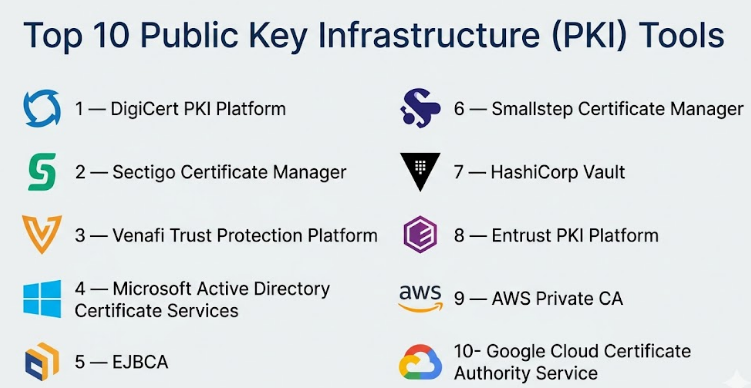
Top 10 Public Key Infrastructure (PKI) Tools
#1 — DigiCert PKI Platform
Short description (2–3 lines): A comprehensive enterprise-grade PKI solution focused on certificate lifecycle management, automation, and high-scale deployments. Ideal for large organizations and regulated industries.
Key Features
- Certificate lifecycle automation
- Centralized certificate management
- ACME protocol support
- Advanced reporting and analytics
- Multi-domain certificate management
- Integration with enterprise systems
Pros
- Strong brand reputation in PKI
- Scalable for enterprise environments
Cons
- Premium pricing
- Complex setup for smaller teams
Platforms / Deployment
Cloud / Hybrid
Security & Compliance
Encryption, audit logs, RBAC; detailed certifications not publicly stated
Integrations & Ecosystem
Supports enterprise integrations and automation tools:
- DevOps pipelines
- Identity systems
- Network security tools
Support & Community
Enterprise-level support with strong documentation.
#2 — Sectigo Certificate Manager
Short description: A platform for managing SSL/TLS certificates and PKI operations with automation and lifecycle control.
Key Features
- Automated certificate lifecycle management
- ACME support
- Certificate discovery tools
- Centralized dashboard
- Multi-CA support
Pros
- User-friendly interface
- Cost-effective compared to competitors
Cons
- Limited advanced enterprise features
- Performance may vary in large deployments
Platforms / Deployment
Cloud
Security & Compliance
Encryption, audit logs; compliance not publicly stated
Integrations & Ecosystem
- Cloud platforms
- Web servers
- DevOps tools
Support & Community
Standard support with documentation.
#3 — Venafi Trust Protection Platform
Short description: A leading enterprise PKI and machine identity management platform designed for large-scale environments.
Key Features
- Machine identity management
- Certificate lifecycle automation
- Policy enforcement
- Threat detection
- Multi-cloud support
Pros
- Strong automation capabilities
- Enterprise-grade scalability
Cons
- High cost
- Complex onboarding
Platforms / Deployment
Cloud / Hybrid
Security & Compliance
Advanced policy enforcement, encryption; certifications not publicly stated
Integrations & Ecosystem
- Cloud platforms
- Security tools
- DevOps systems
Support & Community
Enterprise support and strong ecosystem.
#4 — Microsoft Active Directory Certificate Services (AD CS)
Short description: A Windows-based PKI solution integrated with Active Directory for managing certificates within enterprise networks.
Key Features
- Certificate authority management
- Integration with Active Directory
- Certificate issuance and revocation
- Policy-based management
- Smart card authentication
Pros
- Deep integration with Microsoft ecosystem
- Cost-effective for Windows environments
Cons
- Limited outside Windows
- Manual management overhead
Platforms / Deployment
Windows / On-prem
Security & Compliance
RBAC, encryption; compliance details not publicly stated
Integrations & Ecosystem
- Active Directory
- Windows Server
- Enterprise applications
Support & Community
Strong enterprise support and community.
#5 — EJBCA (Keyfactor)
Short description: An open-source and enterprise PKI platform supporting high-scale certificate management and automation.
Key Features
- Open-source flexibility
- Certificate lifecycle management
- High scalability
- ACME support
- Multi-CA support
Pros
- Highly customizable
- Suitable for large-scale deployments
Cons
- Requires expertise
- Setup complexity
Platforms / Deployment
Cloud / Self-hosted
Security & Compliance
Encryption, audit logs; compliance not publicly stated
Integrations & Ecosystem
- DevOps tools
- Cloud platforms
- IoT systems
Support & Community
Strong open-source and enterprise support.
#6 — Smallstep Certificate Manager
Short description: A modern, developer-friendly PKI tool designed for automated certificate management.
Key Features
- ACME-based automation
- Developer-friendly APIs
- Lightweight deployment
- Secure certificate issuance
- Cloud-native design
Pros
- Easy to use
- Strong DevOps integration
Cons
- Limited enterprise features
- Smaller ecosystem
Platforms / Deployment
Cloud / Self-hosted
Security & Compliance
Encryption; compliance not publicly stated
Integrations & Ecosystem
- Kubernetes
- CI/CD tools
- APIs
Support & Community
Growing community support.
#7 — HashiCorp Vault (PKI Secrets Engine)
Short description: A flexible PKI solution embedded within Vault, enabling dynamic certificate generation.
Key Features
- Dynamic certificate issuance
- Short-lived certificates
- Integration with secrets management
- API-driven automation
- Role-based access control
Pros
- Highly flexible
- Multi-cloud compatibility
Cons
- Operational complexity
- Requires expertise
Platforms / Deployment
Cloud / Hybrid
Security & Compliance
Encryption, RBAC, audit logs; certifications not publicly stated
Integrations & Ecosystem
- Kubernetes
- Cloud providers
- DevOps pipelines
Support & Community
Strong community and enterprise support.
#8 — Entrust PKI Platform
Short description: A comprehensive PKI solution for managing identities, certificates, and encryption keys.
Key Features
- Certificate lifecycle management
- Identity-based security
- Policy enforcement
- Multi-cloud support
- Compliance tools
Pros
- Strong compliance focus
- Enterprise-grade reliability
Cons
- Higher cost
- Complex setup
Platforms / Deployment
Cloud / Hybrid
Security & Compliance
Encryption, audit logs; certifications not publicly stated
Integrations & Ecosystem
- Enterprise systems
- Security platforms
Support & Community
Enterprise-level support.
#9 — AWS Private CA
Short description: A managed private certificate authority service integrated with AWS infrastructure.
Key Features
- Private CA creation
- Automated certificate issuance
- Integration with AWS services
- Policy management
- Audit logging
Pros
- Easy to deploy in AWS
- Scalable
Cons
- AWS lock-in
- Limited multi-cloud
Platforms / Deployment
Cloud
Security & Compliance
IAM, encryption, audit logs; compliance not publicly stated
Integrations & Ecosystem
- AWS services
- IAM
Support & Community
Strong AWS support ecosystem.
#10 — Google Cloud Certificate Authority Service
Short description: A managed CA service for issuing and managing certificates within Google Cloud.
Key Features
- Scalable certificate issuance
- Managed CA
- Integration with GCP
- Automated lifecycle management
- Policy controls
Pros
- Easy integration with GCP
- Developer-friendly
Cons
- Limited outside GCP
- Smaller ecosystem
Platforms / Deployment
Cloud
Security & Compliance
Encryption, IAM; compliance not publicly stated
Integrations & Ecosystem
- GCP services
- APIs
Support & Community
Good documentation and support.
Comparison Table (Top 10)
| Tool Name | Best For | Platform(s) Supported | Deployment | Standout Feature | Public Rating |
|---|---|---|---|---|---|
| DigiCert PKI | Enterprise | Web | Hybrid | Certificate automation | N/A |
| Sectigo | SMB/Enterprise | Web | Cloud | Cost-effective | N/A |
| Venafi | Enterprise | Web | Hybrid | Machine identity mgmt | N/A |
| AD CS | Windows orgs | Windows | On-prem | AD integration | N/A |
| EJBCA | Flexible PKI | Linux/Web | Hybrid | Open-source | N/A |
| Smallstep | Developers | Web/Linux | Hybrid | ACME automation | N/A |
| HashiCorp Vault | DevOps teams | Web/Linux | Hybrid | Dynamic certificates | N/A |
| Entrust PKI | Enterprises | Web | Hybrid | Compliance focus | N/A |
| AWS Private CA | AWS users | Web | Cloud | Managed CA | N/A |
| Google CA Service | GCP users | Web | Cloud | Scalable CA | N/A |
Evaluation & Scoring of Public Key Infrastructure (PKI) Tools
| Tool Name | Core | Ease | Integrations | Security | Performance | Support | Value | Weighted Total |
|---|---|---|---|---|---|---|---|---|
| DigiCert | 9 | 8 | 8 | 9 | 9 | 8 | 7 | 8.5 |
| Sectigo | 8 | 8 | 7 | 8 | 8 | 7 | 8 | 7.9 |
| Venafi | 10 | 7 | 9 | 10 | 9 | 9 | 6 | 8.9 |
| AD CS | 7 | 6 | 7 | 8 | 7 | 8 | 8 | 7.3 |
| EJBCA | 9 | 6 | 8 | 9 | 8 | 8 | 8 | 8.2 |
| Smallstep | 7 | 9 | 7 | 8 | 7 | 7 | 9 | 7.8 |
| Vault | 10 | 6 | 10 | 9 | 8 | 9 | 7 | 8.6 |
| Entrust | 9 | 6 | 8 | 10 | 8 | 8 | 7 | 8.3 |
| AWS Private CA | 8 | 8 | 8 | 9 | 9 | 8 | 7 | 8.3 |
| Google CA | 8 | 8 | 8 | 9 | 8 | 8 | 7 | 8.1 |
Interpretation: Scores are comparative and based on feature depth, usability, integration strength, and enterprise readiness. Higher scores indicate broader capabilities, but selection should align with infrastructure and use case.
Which Public Key Infrastructure (PKI) Is Right for You?
Solo / Freelancer
Use lightweight tools like Smallstep for automation.
SMB
Sectigo or AWS Private CA offers simplicity and affordability.
Mid-Market
EJBCA or HashiCorp Vault provides flexibility.
Enterprise
Venafi, DigiCert, or Entrust for large-scale environments.
Budget vs Premium
- Budget: Smallstep, Sectigo
- Premium: Venafi, DigiCert
Feature Depth vs Ease of Use
- Easy: Sectigo
- Advanced: Venafi, Vault
Integrations & Scalability
- Multi-cloud: Vault, Venafi
- Single cloud: AWS, GCP
Security & Compliance Needs
- High compliance: Entrust, Venafi
- Standard: AWS, Sectigo
Frequently Asked Questions (FAQs)
What is PKI?
A system that manages digital certificates and encryption keys.
Why is PKI important?
It ensures secure communication and identity verification.
Is PKI only for enterprises?
No, SMBs and developers also use PKI tools.
What is a certificate authority?
An entity that issues and manages digital certificates.
Can PKI be automated?
Yes, modern tools support full automation.
What is ACME?
A protocol for automated certificate management.
How does PKI support DevOps?
By enabling automated security in pipelines.
Is PKI expensive?
Varies depending on tool and scale.
Can PKI work in multi-cloud?
Yes, many tools support hybrid environments.
What are common mistakes?
Manual processes, expired certificates, and poor monitoring.
Conclusion
Public Key Infrastructure tools are fundamental to establishing trust in digital systems. As organizations scale across cloud platforms, adopt microservices, and secure APIs, the need for automated, scalable, and reliable PKI solutions becomes critical. There is no universal solution that fits all use cases. Tools like AWS Private CA and Google Cloud CA Service are ideal for cloud-native teams, while HashiCorp Vault and EJBCA offer flexibility for hybrid environments. Enterprise platforms such as Venafi, DigiCert, and Entrust provide deep control, compliance, and scalability for complex infrastructures.
