Introduction
Order Management Systems (OMS) are software platforms that help businesses manage the full lifecycle of customer orders—from order capture and inventory allocation to fulfillment, shipping, and returns. In simple terms, an OMS acts as the control center for order flow across sales channels, warehouses, and logistics systems.
As businesses move toward omnichannel commerce, real-time fulfillment, and global distribution, OMS platforms have become essential. In today’s environment, customers expect fast, accurate, and transparent order processing. This means companies must coordinate inventory, logistics, and customer data seamlessly.
Common use cases include:
- Managing orders across eCommerce, retail, and marketplaces
- Coordinating inventory across multiple warehouses
- Automating order routing and fulfillment decisions
- Handling returns and exchanges efficiently
- Supporting B2B and B2C order workflows
What buyers should evaluate:
- Order orchestration capabilities
- Inventory visibility and allocation logic
- Integration with ERP, CRM, and eCommerce platforms
- Scalability for high transaction volumes
- Workflow customization and automation
- Reporting and analytics
- Security and compliance controls
- Deployment flexibility (cloud vs hybrid)
Best for: Retailers, eCommerce brands, logistics providers, manufacturers, and enterprises managing multi-channel or high-volume orders.
Not ideal for: Very small businesses with simple order flows, or companies already using tightly integrated ERP systems with sufficient native order management features.
Key Trends in Order Management Systems (OMS)
- AI-driven order routing: Intelligent systems optimize fulfillment based on cost, speed, and inventory location.
- Real-time inventory visibility: Unified inventory across stores, warehouses, and third-party logistics providers.
- Composable commerce architectures: OMS platforms integrate into modular tech stacks instead of monolithic systems.
- Headless OMS solutions: APIs-first design for flexible front-end integrations.
- Automation of returns management: Reverse logistics and returns workflows becoming more automated.
- Cloud-native deployments: Increasing adoption of SaaS-based OMS for scalability and agility.
- Omnichannel fulfillment: Buy online, pick up in store (BOPIS) and ship-from-store capabilities.
- Security-first architecture: Strong focus on encryption, access control, and compliance.
- Integration ecosystems: Pre-built connectors with ERP, CRM, WMS, and marketplaces.
- Usage-based pricing models: Shift toward scalable pricing tied to order volume.
How We Selected These Tools (Methodology)
- Evaluated market adoption and brand recognition across industries
- Assessed feature completeness, including order orchestration and inventory management
- Reviewed performance and scalability signals for high-volume environments
- Considered security posture and enterprise readiness
- Analyzed integration capabilities and API support
- Included tools serving different business sizes (SMB to enterprise)
- Balanced cloud-native and hybrid deployment options
- Considered ease of implementation and usability
- Reviewed vendor ecosystem and partner support
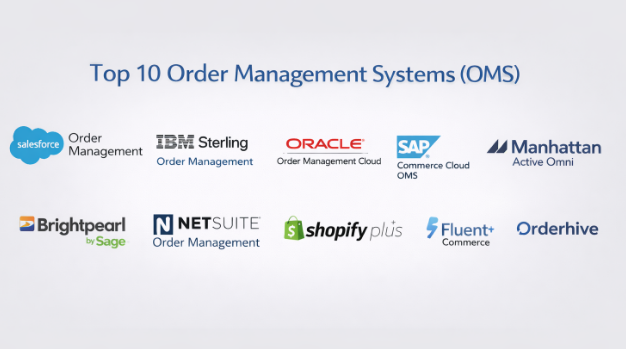
Top 10 Order Management Systems (OMS)
#1 — Salesforce Order Management
Short description: A cloud-based OMS tightly integrated with Salesforce Commerce Cloud, designed for enterprises managing omnichannel commerce.
Key Features
- Order orchestration across channels
- Real-time inventory visibility
- Automated fulfillment workflows
- Returns and refund management
- AI-driven insights and analytics
- Customer service integration
Pros
- Strong ecosystem with CRM and commerce tools
- Scalable for enterprise use cases
Cons
- High cost for smaller businesses
- Requires Salesforce expertise
Platforms / Deployment
Cloud
Security & Compliance
SSO, RBAC, encryption; compliance details vary
Integrations & Ecosystem
Integrates deeply with Salesforce ecosystem and external platforms.
- CRM and customer data platforms
- eCommerce storefronts
- ERP systems
- APIs for custom integrations
Support & Community
Strong enterprise support and large ecosystem of partners.
#2 — IBM Sterling Order Management
Short description: A robust OMS platform focused on enterprise-level order orchestration and supply chain optimization.
Key Features
- Advanced order orchestration
- Distributed order management
- AI-powered fulfillment optimization
- Inventory visibility
- Global order processing
Pros
- Highly scalable
- Strong AI and analytics capabilities
Cons
- Complex implementation
- Expensive licensing
Platforms / Deployment
Cloud / Hybrid
Security & Compliance
Enterprise-grade security; compliance varies
Integrations & Ecosystem
- ERP systems
- Supply chain platforms
- Logistics providers
- APIs and middleware support
Support & Community
Enterprise-level support with strong documentation.
#3 — Oracle Order Management Cloud
Short description: A comprehensive OMS integrated with Oracle ERP for large enterprises.
Key Features
- End-to-end order lifecycle management
- Order promising and fulfillment
- Integration with Oracle ERP
- Workflow automation
- Global order handling
Pros
- Strong ERP integration
- Suitable for complex enterprises
Cons
- Steep learning curve
- Requires Oracle ecosystem commitment
Platforms / Deployment
Cloud
Security & Compliance
SSO, encryption, RBAC; compliance varies
Integrations & Ecosystem
- Oracle ERP and SCM
- CRM systems
- APIs for integration
Support & Community
Enterprise support with Oracle ecosystem.
#4 — SAP Commerce Cloud OMS
Short description: SAP’s OMS solution integrated with its commerce and ERP platforms.
Key Features
- Omnichannel order management
- Inventory synchronization
- Order routing
- Returns management
- SAP ERP integration
Pros
- Strong enterprise capabilities
- Integrated with SAP ecosystem
Cons
- High implementation complexity
- Expensive
Platforms / Deployment
Cloud / Hybrid
Security & Compliance
Enterprise-grade security; details vary
Integrations & Ecosystem
- SAP ERP
- CRM platforms
- Logistics systems
- APIs
Support & Community
Strong enterprise support network.
#5 — Manhattan Active Omni
Short description: A cloud-native OMS focused on omnichannel retail and fulfillment optimization.
Key Features
- Real-time inventory visibility
- Order orchestration
- Omnichannel fulfillment
- AI-based optimization
- Unified commerce platform
Pros
- Retail-focused capabilities
- Cloud-native design
Cons
- Primarily suited for large retailers
- Implementation complexity
Platforms / Deployment
Cloud
Security & Compliance
Not publicly stated
Integrations & Ecosystem
- Retail POS systems
- Warehouse systems
- APIs
Support & Community
Enterprise support; limited public community.
#6 — Brightpearl by Sage
Short description: An OMS designed for retail and wholesale SMBs, combining inventory, accounting, and order management.
Key Features
- Order and inventory management
- Accounting integration
- Automation workflows
- Multi-channel sales support
- Reporting dashboards
Pros
- Easy to use
- Good for SMB retail
Cons
- Limited enterprise features
- Less flexible for customization
Platforms / Deployment
Cloud
Security & Compliance
Not publicly stated
Integrations & Ecosystem
- eCommerce platforms
- Accounting tools
- APIs
Support & Community
Good SMB support and onboarding.
#7 — NetSuite Order Management
Short description: A cloud-based OMS integrated with NetSuite ERP, ideal for mid-market businesses.
Key Features
- Unified order management
- Inventory and fulfillment
- Financial integration
- Workflow automation
- Multi-channel support
Pros
- Strong ERP integration
- Scalable
Cons
- Requires NetSuite ecosystem
- Customization complexity
Platforms / Deployment
Cloud
Security & Compliance
SSO, RBAC; compliance varies
Integrations & Ecosystem
- NetSuite ERP
- CRM systems
- APIs
Support & Community
Strong support for ERP users.
#8 — Shopify Plus (OMS capabilities)
Short description: Provides built-in OMS features for eCommerce businesses using Shopify Plus.
Key Features
- Order tracking
- Multi-channel sales
- Fulfillment integrations
- Inventory management
- Automation workflows
Pros
- Easy to use
- Fast deployment
Cons
- Limited advanced OMS features
- Less suitable for complex supply chains
Platforms / Deployment
Cloud
Security & Compliance
MFA, encryption; compliance varies
Integrations & Ecosystem
- Shopify ecosystem
- Apps and plugins
- APIs
Support & Community
Strong community and documentation.
#9 — Fluent Commerce
Short description: A cloud-native, API-first OMS built for composable commerce architectures.
Key Features
- Headless OMS
- Order orchestration
- Inventory visibility
- Workflow customization
- API-first design
Pros
- Highly flexible
- Developer-friendly
Cons
- Requires technical expertise
- Smaller ecosystem
Platforms / Deployment
Cloud
Security & Compliance
Not publicly stated
Integrations & Ecosystem
- APIs for custom integrations
- eCommerce platforms
- ERP systems
Support & Community
Growing community and vendor support.
#10 — Orderhive (Now Cin7 Orderhive)
Short description: A cloud-based OMS for SMBs managing inventory and orders across channels.
Key Features
- Order processing automation
- Inventory tracking
- Shipping integrations
- Multi-channel support
- Reporting
Pros
- Affordable
- Easy setup
Cons
- Limited enterprise features
- Basic analytics
Platforms / Deployment
Cloud
Security & Compliance
Not publicly stated
Integrations & Ecosystem
- Marketplaces
- Shipping providers
- APIs
Support & Community
SMB-focused support.
Comparison Table (Top 10)
| Tool Name | Best For | Platform(s) Supported | Deployment | Standout Feature | Public Rating |
|---|---|---|---|---|---|
| Salesforce Order Management | Enterprise commerce | Web | Cloud | CRM integration | N/A |
| IBM Sterling OMS | Large enterprises | Web | Cloud/Hybrid | AI-driven orchestration | N/A |
| Oracle OMS | ERP-heavy enterprises | Web | Cloud | ERP integration | N/A |
| SAP Commerce Cloud OMS | SAP users | Web | Cloud/Hybrid | SAP ecosystem | N/A |
| Manhattan Active Omni | Retail enterprises | Web | Cloud | Omnichannel focus | N/A |
| Brightpearl | SMB retail | Web | Cloud | Built-in accounting | N/A |
| NetSuite OMS | Mid-market | Web | Cloud | ERP integration | N/A |
| Shopify Plus | eCommerce SMB | Web | Cloud | Ease of use | N/A |
| Fluent Commerce | Developers | Web | Cloud | API-first OMS | N/A |
| Orderhive | Small businesses | Web | Cloud | Affordable OMS | N/A |
Evaluation & Scoring of Order Management Systems (OMS)
| Tool Name | Core (25%) | Ease (15%) | Integrations (15%) | Security (10%) | Performance (10%) | Support (10%) | Value (15%) | Weighted Total |
|---|---|---|---|---|---|---|---|---|
| Salesforce Order Management | 9 | 7 | 9 | 8 | 9 | 9 | 7 | 8.4 |
| IBM Sterling OMS | 10 | 6 | 9 | 9 | 9 | 9 | 6 | 8.5 |
| Oracle OMS | 9 | 6 | 8 | 8 | 9 | 8 | 6 | 8.0 |
| SAP Commerce Cloud OMS | 9 | 6 | 8 | 8 | 9 | 8 | 6 | 8.0 |
| Manhattan Active Omni | 9 | 7 | 8 | 7 | 9 | 7 | 7 | 8.0 |
| Brightpearl | 7 | 8 | 7 | 6 | 7 | 7 | 8 | 7.4 |
| NetSuite OMS | 8 | 7 | 8 | 7 | 8 | 8 | 7 | 7.8 |
| Shopify Plus | 7 | 9 | 8 | 7 | 8 | 8 | 8 | 8.0 |
| Fluent Commerce | 8 | 6 | 9 | 7 | 8 | 7 | 7 | 7.8 |
| Orderhive | 6 | 8 | 7 | 6 | 7 | 7 | 9 | 7.3 |
How to interpret:
- Scores reflect relative strengths within this category, not absolute performance.
- Enterprise tools score higher in core features and scalability but lower in value.
- SMB tools score better in ease and affordability but lack advanced orchestration.
- Choose based on your operational complexity, not just the total score.
Which Order Management Systems (OMS)
Solo / Freelancer
Simple tools like Shopify Plus or Orderhive are sufficient for managing small order volumes.
SMB
Brightpearl and Shopify Plus offer a balance of features and ease of use.
Mid-Market
NetSuite OMS provides strong ERP integration and scalability.
Enterprise
IBM Sterling, SAP, Oracle, and Salesforce OMS are best for complex operations.
Budget vs Premium
- Budget: Orderhive, Shopify
- Premium: IBM Sterling, SAP, Salesforce
Feature Depth vs Ease of Use
- Feature depth: IBM, Oracle, SAP
- Ease of use: Shopify, Brightpearl
Integrations & Scalability
Choose API-first platforms like Fluent Commerce for flexibility.
Security & Compliance Needs
Enterprise tools provide stronger governance and compliance capabilities.
Frequently Asked Questions (FAQs)
1. What is an Order Management System?
An OMS is a software platform that manages order processing, inventory, and fulfillment across channels.
2. How much does an OMS cost?
Pricing varies widely based on scale and features; typically subscription-based.
3. How long does implementation take?
Implementation can take weeks for SMB tools and months for enterprise systems.
4. Can OMS integrate with ERP systems?
Yes, most OMS platforms support ERP integration via APIs or connectors.
5. What are common mistakes when choosing an OMS?
Choosing based only on price, ignoring scalability and integration needs.
6. Is OMS suitable for small businesses?
Yes, but simpler tools are usually better suited.
7. How does OMS improve customer experience?
By ensuring accurate, fast, and transparent order processing.
8. Can OMS handle returns?
Yes, most modern OMS platforms include returns management features.
9. Is cloud OMS better than on-premise?
Cloud OMS offers scalability and lower maintenance but depends on business needs.
10. How do I switch from one OMS to another?
Plan migration carefully, validate integrations, and run parallel systems during transition.
Conclusion
Order Management Systems are a critical part of modern commerce operations. Whether you are running a small online store or a global supply chain, the ability to manage orders efficiently impacts customer satisfaction, operational costs, and scalability. There is no single “best” OMS for every business. Enterprise organizations may prioritize advanced orchestration and global scalability, while SMBs often focus on ease of use and affordability. The right choice depends on your order volume, integration needs, and operational complexity.
