Introduction
Master Data Management (MDM) tools help organizations create a single, trusted source of truth for critical business data like customers, products, suppliers, and locations. Instead of having fragmented and inconsistent data across systems, MDM tools unify, clean, and govern master data so every team works with accurate and consistent information.
In 2026 and beyond, MDM has become even more critical due to AI-driven analytics, multi-cloud architectures, and strict compliance requirements. Poor master data can break dashboards, misguide AI models, and create compliance risks. Modern MDM platforms now combine data quality, governance, and lineage into a single ecosystem.
Common use cases include:
- Creating a unified customer view across CRM, ERP, and marketing tools
- Product data standardization for e-commerce and supply chain
- Regulatory compliance and audit readiness
- Improving analytics accuracy and reporting consistency
- Enabling AI/ML models with clean, governed data
What buyers should evaluate:
- Data modeling flexibility (customer, product, multi-domain)
- Data quality and cleansing capabilities
- Workflow and governance features
- Integration with existing systems (ERP, CRM, BI)
- Scalability and performance
- Cloud vs on-premise deployment
- Automation and AI capabilities
- Security and compliance readiness
- Ease of implementation and maintenance
Best for: Large enterprises, mid-market companies, data-driven organizations, and industries like finance, retail, healthcare, and manufacturing.
Not ideal for: Small teams with limited datasets or organizations without complex data integration needs—simple data catalogs or ETL tools may suffice.
Key Trends in Master Data Management (MDM) Tools
- AI-driven data matching and deduplication improving data accuracy
- Multi-domain MDM adoption (customer + product + supplier in one system)
- Cloud-native MDM platforms becoming the default
- Real-time data synchronization across systems
- Integration with data governance and catalog tools
- Low-code/no-code workflows for business users
- API-first architectures enabling flexible integrations
- Embedded data quality engines within MDM platforms
- Data privacy and compliance automation (GDPR, regional laws)
- Usage-based pricing models replacing traditional licensing
How We Selected These Tools (Methodology)
- Considered global adoption and enterprise usage
- Evaluated core MDM capabilities (multi-domain, hierarchy management)
- Assessed data quality and governance features
- Reviewed performance and scalability indicators
- Analyzed security and compliance readiness
- Checked integration ecosystem (ERP, CRM, cloud platforms)
- Included cloud-native and traditional MDM tools
- Evaluated usability for both technical and business users
- Balanced enterprise-grade and flexible modern tools
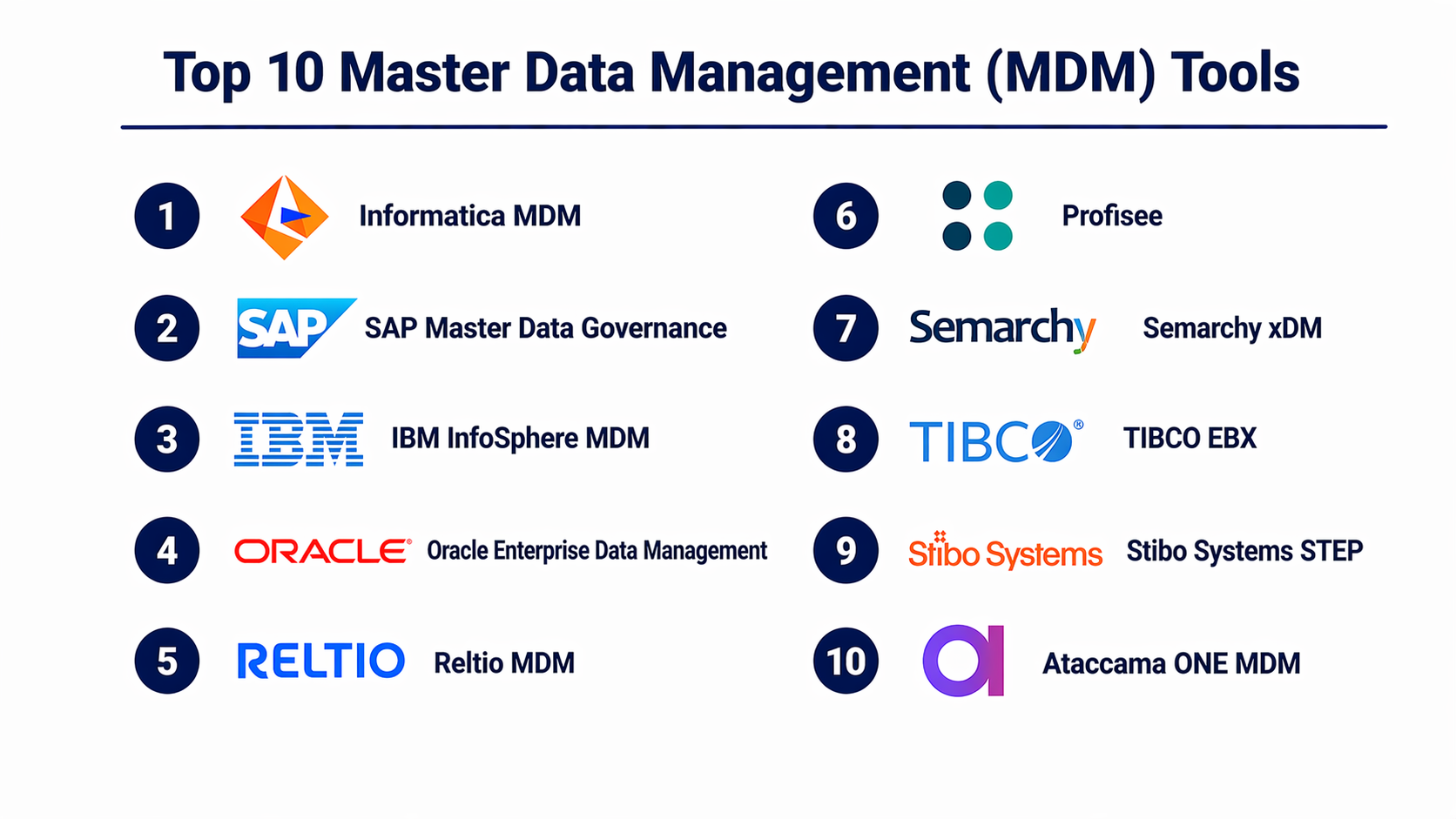
Top 10 Master Data Management (MDM) Tools
#1 — Informatica MDM
Short description: A leading enterprise MDM platform offering deep data governance, quality, and multi-domain capabilities.
Key Features
- Multi-domain MDM support
- AI-powered data matching
- Data quality and profiling
- Workflow and governance tools
- Hierarchy management
- Real-time data integration
Pros
- Highly scalable for large enterprises
- Strong governance and compliance features
Cons
- Complex implementation
- Higher cost
Platforms / Deployment
Cloud / On-premise / Hybrid
Security & Compliance
SSO, RBAC, encryption (others not publicly stated)
Integrations & Ecosystem
Strong integration ecosystem with enterprise systems
- ERP and CRM platforms
- Data warehouses
- APIs for extensibility
Support & Community
Enterprise-grade support; extensive documentation
#2 — SAP Master Data Governance
Short description: MDM solution tightly integrated with SAP systems, ideal for SAP-centric enterprises.
Key Features
- Centralized master data governance
- Workflow automation
- Data validation rules
- Multi-domain support
- SAP-native integration
Pros
- Seamless SAP integration
- Strong governance workflows
Cons
- Limited flexibility outside SAP ecosystem
- Complex configuration
Platforms / Deployment
Cloud / On-premise
Security & Compliance
RBAC, audit logs (others not publicly stated)
Integrations & Ecosystem
Best suited for SAP ecosystem
- SAP ERP
- SAP S/4HANA
Support & Community
Strong enterprise support via SAP
#3 — IBM InfoSphere MDM
Short description: Enterprise-grade MDM platform focused on scalability and complex data environments.
Key Features
- Multi-domain data management
- Advanced data matching
- Data governance tools
- Real-time integration
- Flexible data models
Pros
- Handles complex enterprise environments
- Strong scalability
Cons
- Steep learning curve
- Requires significant resources
Platforms / Deployment
Cloud / On-premise
Security & Compliance
Not publicly stated
Integrations & Ecosystem
Supports enterprise tools
- Databases
- Middleware
Support & Community
Enterprise support with IBM ecosystem
#4 — Oracle Enterprise Data Management
Short description: Oracle’s MDM solution focused on finance, enterprise hierarchies, and governance.
Key Features
- Data governance workflows
- Hierarchy management
- Financial data alignment
- Audit and compliance tracking
- Data versioning
Pros
- Strong financial data capabilities
- Reliable enterprise performance
Cons
- Limited outside Oracle ecosystem
- UI can be complex
Platforms / Deployment
Cloud
Security & Compliance
Not publicly stated
Integrations & Ecosystem
Best with Oracle stack
- Oracle ERP
- Oracle Cloud
Support & Community
Enterprise support
#5 — Reltio MDM
Short description: Cloud-native MDM platform designed for real-time data management and analytics.
Key Features
- Real-time data synchronization
- AI-driven data matching
- Multi-domain support
- Graph-based data modeling
- API-first architecture
Pros
- Modern cloud-native design
- Strong real-time capabilities
Cons
- Pricing varies
- Requires integration planning
Platforms / Deployment
Cloud
Security & Compliance
Not publicly stated
Integrations & Ecosystem
Modern integrations
- CRM systems
- Data platforms
Support & Community
Growing ecosystem; enterprise support
#6 — Profisee
Short description: Mid-market friendly MDM platform focused on usability and integration with Microsoft ecosystem.
Key Features
- Multi-domain MDM
- Data stewardship tools
- Integration with Microsoft tools
- Workflow automation
- Data quality management
Pros
- Easier to implement
- Good value for mid-market
Cons
- Limited advanced features compared to enterprise tools
- Ecosystem dependency
Platforms / Deployment
Cloud / On-premise
Security & Compliance
Not publicly stated
Integrations & Ecosystem
Strong Microsoft integration
- SQL Server
- Power BI
Support & Community
Good support; smaller community
#7 — Semarchy xDM
Short description: Unified MDM and data integration platform with flexible deployment options.
Key Features
- Multi-domain MDM
- Data integration and governance
- Workflow management
- Data quality tools
- Flexible deployment
Pros
- Balanced feature set
- Flexible deployment
Cons
- UI may require learning
- Moderate complexity
Platforms / Deployment
Cloud / On-premise / Hybrid
Security & Compliance
Not publicly stated
Integrations & Ecosystem
Supports multiple data systems
- Databases
- APIs
Support & Community
Good enterprise support
#8 — TIBCO EBX
Short description: MDM platform known for governance, workflow, and reference data management.
Key Features
- Master and reference data management
- Workflow automation
- Data governance
- Data modeling
- Version control
Pros
- Strong governance capabilities
- Flexible data modeling
Cons
- Complex setup
- UI can feel dated
Platforms / Deployment
Cloud / On-premise
Security & Compliance
Not publicly stated
Integrations & Ecosystem
Enterprise integrations
- Data platforms
- APIs
Support & Community
Enterprise-level support
#9 — Stibo Systems STEP
Short description: MDM platform focused on product information and multi-domain data management.
Key Features
- Product data management
- Multi-domain MDM
- Workflow automation
- Data governance
- Omnichannel support
Pros
- Strong for product data
- Scalable for retail
Cons
- Specialized use case focus
- Implementation effort
Platforms / Deployment
Cloud / On-premise
Security & Compliance
Not publicly stated
Integrations & Ecosystem
Supports retail and ERP integrations
Support & Community
Enterprise support available
#10 — Ataccama ONE MDM
Short description: Unified platform combining MDM, data quality, and governance with AI capabilities.
Key Features
- AI-powered data quality
- MDM and governance integration
- Data lineage support
- Workflow automation
- Data profiling
Pros
- Strong AI-driven insights
- Unified platform approach
Cons
- Learning curve
- Pricing varies
Platforms / Deployment
Cloud / Hybrid
Security & Compliance
Not publicly stated
Integrations & Ecosystem
Supports modern data stack
- Cloud platforms
- APIs
Support & Community
Growing ecosystem; enterprise support
Comparison Table (Top 10)
| Tool Name | Best For | Platform(s) Supported | Deployment | Standout Feature | Public Rating |
|---|---|---|---|---|---|
| Informatica MDM | Large enterprises | Web | Hybrid | AI data matching | N/A |
| SAP MDG | SAP users | Web | Hybrid | SAP integration | N/A |
| IBM InfoSphere | Complex systems | Web | Hybrid | Scalability | N/A |
| Oracle EDM | Finance teams | Web | Cloud | Hierarchy management | N/A |
| Reltio | Real-time MDM | Web | Cloud | Real-time sync | N/A |
| Profisee | Mid-market | Web | Hybrid | Microsoft integration | N/A |
| Semarchy xDM | Flexible MDM | Web | Hybrid | Unified platform | N/A |
| TIBCO EBX | Governance | Web | Hybrid | Workflow engine | N/A |
| Stibo STEP | Product data | Web | Hybrid | Product MDM | N/A |
| Ataccama ONE | AI-driven MDM | Web | Hybrid | Data quality + MDM | N/A |
Evaluation & Scoring of Master Data Management (MDM) Tools
| Tool Name | Core | Ease | Integrations | Security | Performance | Support | Value | Weighted Total |
|---|---|---|---|---|---|---|---|---|
| Informatica | 9 | 6 | 9 | 8 | 9 | 9 | 6 | 8.2 |
| SAP MDG | 8 | 6 | 8 | 8 | 8 | 8 | 6 | 7.7 |
| IBM | 9 | 5 | 8 | 8 | 9 | 9 | 6 | 8.0 |
| Oracle | 8 | 6 | 7 | 7 | 8 | 8 | 6 | 7.5 |
| Reltio | 8 | 7 | 8 | 7 | 8 | 7 | 7 | 7.7 |
| Profisee | 7 | 8 | 7 | 6 | 7 | 7 | 8 | 7.4 |
| Semarchy | 8 | 7 | 8 | 7 | 7 | 7 | 7 | 7.6 |
| TIBCO EBX | 8 | 6 | 7 | 7 | 7 | 7 | 6 | 7.3 |
| Stibo STEP | 8 | 6 | 7 | 7 | 8 | 7 | 6 | 7.4 |
| Ataccama | 8 | 7 | 8 | 7 | 8 | 7 | 7 | 7.7 |
How to interpret scores:
- Scores compare tools relative to each other
- “Core” reflects MDM capability depth
- “Ease” shows usability and onboarding effort
- “Value” reflects cost vs features
- Enterprise tools often score higher in capability but lower in ease
Which Master Data Management (MDM) Tools Right for You?
Solo / Freelancer
MDM tools are usually overkill; lightweight data tools are better.
SMB
Profisee or Semarchy provide a good balance of cost and functionality.
Mid-Market
Reltio or Ataccama offer modern features with scalability.
Enterprise
Informatica, SAP, and IBM are best for complex data environments.
Budget vs Premium
- Budget: Profisee, Semarchy
- Premium: Informatica, SAP, IBM
Feature Depth vs Ease of Use
- Deep features: Informatica, IBM
- Easier tools: Profisee, Reltio
Integrations & Scalability
Choose tools with strong API and cloud integrations for future growth.
Security & Compliance Needs
Highly regulated industries should prefer enterprise-grade solutions.
Frequently Asked Questions (FAQs)
What is an MDM tool?
It centralizes and manages critical business data across systems.
Is MDM only for large enterprises?
Mostly yes, but mid-market solutions are growing.
How long does implementation take?
From weeks to months depending on complexity.
Are MDM tools cloud-based?
Many are cloud-native, but hybrid options exist.
Do MDM tools improve data quality?
Yes, through validation, cleansing, and governance.
What industries use MDM most?
Finance, retail, healthcare, manufacturing.
Are open-source MDM tools available?
Few exist; most are enterprise solutions.
What is the biggest challenge in MDM?
Data integration and governance alignment.
Can MDM tools support AI?
Yes, by providing clean and structured data.
How to choose the right tool?
Evaluate based on data complexity, budget, and integrations.
Conclusion
Master Data Management tools play a foundational role in modern data strategies by ensuring consistency, accuracy, and governance across critical business data. As organizations adopt AI, cloud platforms, and real-time analytics, the importance of having reliable master data continues to grow. While enterprise tools like Informatica, SAP, and IBM offer deep capabilities for complex environments, newer platforms such as Reltio and Ataccama provide more flexible, cloud-native alternatives.
