Introduction
Financial Planning & Analysis (FP&A) software helps organizations plan budgets, forecast future performance, analyze financial data, and support strategic decision-making. In simple terms, these tools go beyond bookkeeping by helping finance teams understand where the business is going, not just where it has been.
In today’s fast-changing business environment, FP&A tools have become critical. Organizations are dealing with volatile markets, complex revenue models, and increasing pressure to deliver real-time insights. Modern FP&A platforms now include AI-driven forecasting, scenario planning, and automated reporting, allowing finance teams to act faster and more accurately.
Common use cases include:
- Budgeting and financial forecasting
- Scenario modeling and “what-if” analysis
- Cash flow planning and revenue projections
- Executive dashboards and reporting
- Strategic decision support
What buyers should evaluate:
- Forecasting accuracy and flexibility
- Ease of modeling and scenario planning
- Integration with ERP and accounting systems
- Real-time data processing
- Collaboration features for teams
- Security and access controls
- Reporting and visualization capabilities
- Scalability across departments
- Pricing and ROI
Best for: Finance teams, CFOs, startups scaling rapidly, mid-market companies, and enterprises needing advanced planning and forecasting capabilities.
Not ideal for: Very small businesses with simple accounting needs or teams that only require basic bookkeeping without advanced forecasting.
Key Trends in Financial Planning & Analysis (FP&A) Software
- AI-driven forecasting: Machine learning models are improving forecast accuracy and reducing manual effort.
- Continuous planning: Moving from annual budgets to rolling forecasts and real-time updates.
- Driver-based planning: Linking financial outcomes to operational metrics like sales, hiring, or production.
- Cloud-native platforms: SaaS solutions dominate with better scalability and collaboration.
- Integrated data ecosystems: Seamless connections with ERP, CRM, HR, and data warehouses.
- Self-service analytics: Finance and business users can build their own reports without IT support.
- Scenario simulation: Advanced “what-if” analysis for risk and opportunity planning.
- Data governance focus: Strong emphasis on audit trails, access control, and compliance.
- Embedded AI copilots: Tools assisting finance teams with insights and recommendations.
- Visualization-first dashboards: Real-time, interactive dashboards for executives.
How We Selected These Tools (Methodology)
- Evaluated market adoption and enterprise usage
- Assessed depth of forecasting and planning features
- Reviewed ease of use for finance and non-finance users
- Considered performance and scalability across large datasets
- Analyzed integration capabilities with ERP and BI tools
- Evaluated security features and governance controls
- Compared pricing models and value for money
- Checked support quality and onboarding experience
- Balanced tools for SMB, mid-market, and enterprise segments
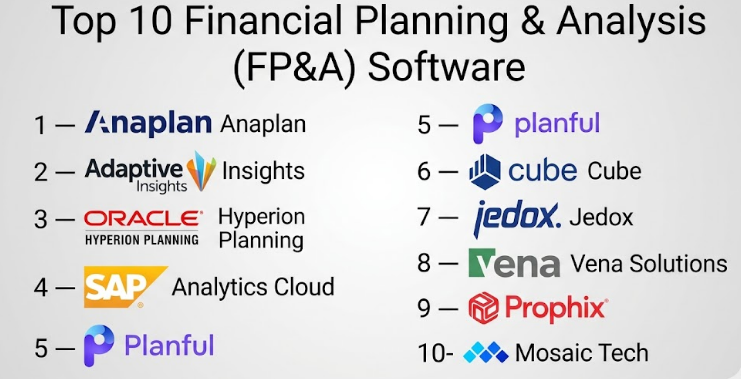
Top 10 Financial Planning & Analysis (FP&A) Software
#1 — Anaplan
Short description (2–3 lines): A leading enterprise FP&A platform known for its powerful modeling engine and scalability. Designed for large organizations needing connected planning across departments.
Key Features
- Multi-dimensional modeling
- Scenario planning
- Real-time collaboration
- Workflow automation
- Advanced forecasting
- Enterprise scalability
Pros
- Highly flexible modeling
- Strong enterprise capabilities
Cons
- Steep learning curve
- Expensive
Platforms / Deployment
Web
Cloud
Security & Compliance
RBAC, audit logs, encryption
Other certifications: Not publicly stated
Integrations & Ecosystem
Strong integration capabilities with enterprise systems.
- ERP systems
- Data warehouses
- BI tools
- APIs for customization
Support & Community
Enterprise-level support with structured onboarding.
#2 — Adaptive Insights (Workday Adaptive Planning)
Short description (2–3 lines): Cloud FP&A solution focused on budgeting, forecasting, and reporting for mid-market and enterprise companies.
Key Features
- Budgeting and forecasting
- Workforce planning
- Financial consolidation
- Real-time dashboards
- Scenario modeling
Pros
- Easy to use compared to enterprise tools
- Strong reporting
Cons
- Limited customization compared to competitors
- Pricing can be high
Platforms / Deployment
Web
Cloud
Security & Compliance
Encryption, RBAC
Other certifications: Not publicly stated
Integrations & Ecosystem
Good integration with ERP and HR systems.
- ERP platforms
- HR systems
- BI tools
Support & Community
Strong support with enterprise focus.
#3 — Oracle Hyperion Planning
Short description (2–3 lines): Traditional enterprise FP&A platform known for deep financial planning capabilities and integration with Oracle ecosystem.
Key Features
- Advanced financial planning
- Budgeting workflows
- Consolidation features
- Scenario modeling
- Enterprise reporting
Pros
- Very powerful features
- Strong compliance capabilities
Cons
- Complex implementation
- High cost
Platforms / Deployment
Web
Cloud / Hybrid
Security & Compliance
RBAC, audit logs
Other certifications: Not publicly stated
Integrations & Ecosystem
Strong Oracle ecosystem integrations.
Support & Community
Enterprise-grade support.
#4 — SAP Analytics Cloud (Planning)
Short description (2–3 lines): Integrated analytics and planning platform combining BI and FP&A capabilities.
Key Features
- Planning and forecasting
- Data visualization
- Predictive analytics
- Collaboration tools
- Real-time dashboards
Pros
- Combines BI and FP&A
- Strong visualization
Cons
- Complex setup
- Requires SAP ecosystem knowledge
Platforms / Deployment
Web
Cloud
Security & Compliance
Encryption, RBAC
Other certifications: Not publicly stated
Integrations & Ecosystem
Deep SAP integrations.
Support & Community
Enterprise support and strong ecosystem.
#5 — Planful
Short description (2–3 lines): Modern FP&A platform focused on continuous planning and financial consolidation.
Key Features
- Continuous planning
- Financial consolidation
- Budgeting workflows
- Reporting automation
- Scenario analysis
Pros
- Strong consolidation features
- User-friendly
Cons
- Limited customization
- Smaller ecosystem
Platforms / Deployment
Web
Cloud
Security & Compliance
Encryption, RBAC
Other certifications: Not publicly stated
Integrations & Ecosystem
Moderate integrations.
Support & Community
Good support with growing community.
#6 — Cube
Short description (2–3 lines): Spreadsheet-native FP&A platform designed for teams that rely heavily on Excel or Google Sheets.
Key Features
- Spreadsheet integration
- Real-time data sync
- Forecasting tools
- Scenario planning
- Collaboration
Pros
- Easy adoption for Excel users
- Quick setup
Cons
- Limited advanced features
- Not ideal for large enterprises
Platforms / Deployment
Web
Cloud
Security & Compliance
Encryption
Other certifications: Not publicly stated
Integrations & Ecosystem
Strong spreadsheet integrations.
Support & Community
Good onboarding and support.
#7 — Jedox
Short description (2–3 lines): FP&A platform focused on planning, reporting, and analytics with strong Excel integration.
Key Features
- Integrated planning
- Data modeling
- Financial reporting
- Scenario analysis
- Excel integration
Pros
- Flexible modeling
- Excel-friendly
Cons
- UI can feel dated
- Learning curve
Platforms / Deployment
Web / Windows
Cloud / Hybrid
Security & Compliance
RBAC, encryption
Other certifications: Not publicly stated
Integrations & Ecosystem
Wide integration support.
Support & Community
Strong enterprise support.
#8 — Vena Solutions
Short description (2–3 lines): Excel-based FP&A platform designed for organizations wanting familiar workflows with enterprise capabilities.
Key Features
- Excel interface
- Budgeting workflows
- Scenario modeling
- Reporting automation
- Data integration
Pros
- Familiar interface
- Strong workflow control
Cons
- Dependency on Excel
- Limited UI modernization
Platforms / Deployment
Web / Windows
Cloud
Security & Compliance
Encryption, RBAC
Other certifications: Not publicly stated
Integrations & Ecosystem
Moderate integrations.
Support & Community
Reliable support.
#9 — Prophix
Short description (2–3 lines): Mid-market FP&A solution with strong automation and reporting capabilities.
Key Features
- Budgeting and forecasting
- Workflow automation
- Financial reporting
- Scenario analysis
- Dashboards
Pros
- Strong automation
- Good for mid-market
Cons
- Limited enterprise scalability
- UI improvements needed
Platforms / Deployment
Web / Windows
Cloud
Security & Compliance
RBAC, encryption
Other certifications: Not publicly stated
Integrations & Ecosystem
Moderate integrations.
Support & Community
Good support.
#10 — Mosaic Tech
Short description (2–3 lines): Modern FP&A platform designed for startups and growth companies with real-time insights.
Key Features
- Real-time dashboards
- Forecasting tools
- SaaS metrics tracking
- Scenario planning
- Data integrations
Pros
- Startup-focused
- Modern UI
Cons
- Limited enterprise features
- Smaller ecosystem
Platforms / Deployment
Web
Cloud
Security & Compliance
Encryption
Other certifications: Not publicly stated
Integrations & Ecosystem
Startup-focused integrations.
Support & Community
Growing support ecosystem.
Comparison Table (Top 10)
| Tool Name | Best For | Platform(s) Supported | Deployment | Standout Feature | Public Rating |
|---|---|---|---|---|---|
| Anaplan | Enterprise | Web | Cloud | Multi-dimensional modeling | N/A |
| Adaptive Insights | Mid/Enterprise | Web | Cloud | Workforce planning | N/A |
| Oracle Hyperion | Enterprise | Web | Hybrid | Deep financial planning | N/A |
| SAP Analytics Cloud | Enterprise | Web | Cloud | BI + FP&A | N/A |
| Planful | Mid-market | Web | Cloud | Continuous planning | N/A |
| Cube | SMB | Web | Cloud | Spreadsheet integration | N/A |
| Jedox | Mid/Enterprise | Web, Windows | Hybrid | Excel integration | N/A |
| Vena Solutions | Mid-market | Web, Windows | Cloud | Excel-based workflows | N/A |
| Prophix | Mid-market | Web, Windows | Cloud | Automation | N/A |
| Mosaic Tech | Startup | Web | Cloud | Real-time insights | N/A |
Evaluation & Scoring of Financial Planning & Analysis (FP&A) Software
| Tool Name | Core (25%) | Ease (15%) | Integrations (15%) | Security (10%) | Performance (10%) | Support (10%) | Value (15%) | Weighted Total |
|---|---|---|---|---|---|---|---|---|
| Anaplan | 10 | 7 | 9 | 9 | 9 | 9 | 7 | 8.8 |
| Adaptive Insights | 9 | 8 | 8 | 8 | 8 | 8 | 8 | 8.2 |
| Oracle Hyperion | 10 | 6 | 9 | 9 | 9 | 9 | 6 | 8.6 |
| SAP Analytics Cloud | 9 | 7 | 9 | 8 | 9 | 8 | 7 | 8.3 |
| Planful | 8 | 8 | 7 | 8 | 8 | 8 | 8 | 7.9 |
| Cube | 7 | 9 | 7 | 7 | 8 | 7 | 8 | 7.8 |
| Jedox | 8 | 7 | 8 | 8 | 8 | 8 | 7 | 7.9 |
| Vena Solutions | 8 | 8 | 7 | 8 | 8 | 8 | 7 | 7.9 |
| Prophix | 8 | 8 | 7 | 8 | 8 | 8 | 8 | 8.0 |
| Mosaic Tech | 7 | 9 | 7 | 7 | 8 | 7 | 8 | 7.7 |
How to interpret scores:
- Scores are relative comparisons within this category.
- Enterprise tools score higher on features but lower on ease and value.
- SMB-focused tools balance usability and cost better.
- No single tool is best for all scenarios—context matters.
- Use scores as a guide, not a final decision factor.
Which Financial Planning & Analysis (FP&A) Software
Solo / Freelancer
Cube or Mosaic Tech provide simple, lightweight planning.
SMB
Planful, Cube, and Prophix are strong options.
Mid-Market
Adaptive Insights, Jedox, and Vena Solutions offer scalability.
Enterprise
Anaplan, SAP Analytics Cloud, and Oracle Hyperion are ideal.
Budget vs Premium
- Budget: Cube, Mosaic
- Premium: Anaplan, Oracle, SAP
Feature Depth vs Ease of Use
- Deep features: Anaplan, Oracle
- Ease of use: Cube, Mosaic
Integrations & Scalability
- Strong integrations: SAP, Oracle
- Moderate: Planful, Vena
Security & Compliance Needs
- High: Oracle, SAP, Anaplan
- Moderate: Cube, Mosaic
Frequently Asked Questions (FAQs)
1. What is FP&A software used for?
It helps organizations plan budgets, forecast outcomes, and analyze financial data for decision-making.
2. How is FP&A different from accounting software?
Accounting tracks past transactions, while FP&A focuses on future planning and analysis.
3. Is FP&A software suitable for small businesses?
Yes, but simpler tools are better suited for smaller teams.
4. How long does implementation take?
It ranges from days for simple tools to months for enterprise platforms.
5. Can FP&A tools integrate with ERP systems?
Yes, most modern tools offer strong ERP integrations.
6. Are these tools secure?
Most offer encryption and access controls, but compliance varies.
7. What are common mistakes when choosing FP&A tools?
Overlooking integration needs and underestimating complexity.
8. Do these tools support real-time data?
Yes, especially cloud-based solutions.
9. Can non-finance teams use FP&A tools?
Many tools now offer user-friendly dashboards for business users.
10. What is the cost of FP&A software?
Pricing varies widely based on features and company size.
Conclusion
Financial Planning & Analysis software has evolved into a critical layer for modern business strategy, enabling organizations to move from static budgeting to dynamic, data-driven decision-making. Tools like Anaplan and Oracle Hyperion offer deep enterprise capabilities, while platforms such as Cube and Mosaic Tech focus on speed, usability, and accessibility for smaller teams. Meanwhile, solutions like Adaptive Insights, Planful, and Prophix strike a balance between power and usability for mid-market organizations. Choosing the right FP&A tool depends on your organization’s complexity, data maturity, and growth plans. Instead of selecting based on brand alone, it is more effective to shortlist two or three platforms, test their modeling capabilities, validate integrations with your existing systems, and assess ease of adoption across teams. A structured pilot approach will help ensure long-term success.
