Introduction
Database Monitoring Tools are systems that help teams track, analyze, and optimize database performance, availability, and health in real time. In simple terms, they allow you to see what’s happening inside your database—such as slow queries, resource usage, and unusual activity—before it impacts users or business operations.
In modern architectures where applications rely heavily on databases, even minor performance issues can lead to outages, poor user experience, or revenue loss. As systems scale across cloud, hybrid, and distributed environments, database monitoring tools have become a core component of observability and reliability strategies.
Real-world use cases include:
- Identifying and optimizing slow queries
- Monitoring uptime and availability
- Detecting anomalies and unusual database behavior
- Capacity planning and performance tuning
- Supporting DevOps and SRE teams with insights
What buyers should evaluate:
- Real-time monitoring and alerting
- Query-level visibility and diagnostics
- Integration with observability platforms
- Scalability across environments
- AI-driven insights and automation
- Multi-database support
- Ease of deployment and configuration
- Dashboard usability and reporting
- Cost-effectiveness
Best for: DevOps engineers, DBAs, SRE teams, cloud architects, SaaS companies, and enterprises managing performance-critical databases.
Not ideal for: Small or low-traffic applications where manual monitoring or basic logging is sufficient.
Key Trends in Database Monitoring Tools
- AI-powered root cause analysis: Tools automatically identify performance bottlenecks
- Unified observability platforms: Monitoring integrated with logs, traces, and metrics
- Cloud-native monitoring: Designed for distributed and containerized environments
- Real-time anomaly detection: Immediate alerts for unusual database activity
- Deep query analytics: Visibility into execution plans and performance issues
- Agentless monitoring options: Reduced overhead and faster deployment
- Integration with CI/CD pipelines: Monitoring embedded into DevOps workflows
- Predictive performance insights: Forecasting issues before they occur
- Auto-discovery of dependencies: Mapping database relationships with services
- Multi-database support: Covering SQL and NoSQL systems
How We Selected These Tools (Methodology)
- Evaluated market adoption and industry relevance
- Assessed core monitoring capabilities and features
- Reviewed AI-driven insights and automation
- Compared integration with cloud and DevOps tools
- Analyzed performance and scalability
- Evaluated ease of setup and usability
- Considered multi-database support
- Reviewed vendor maturity and ecosystem strength
- Assessed fit across SMB, mid-market, and enterprise use cases
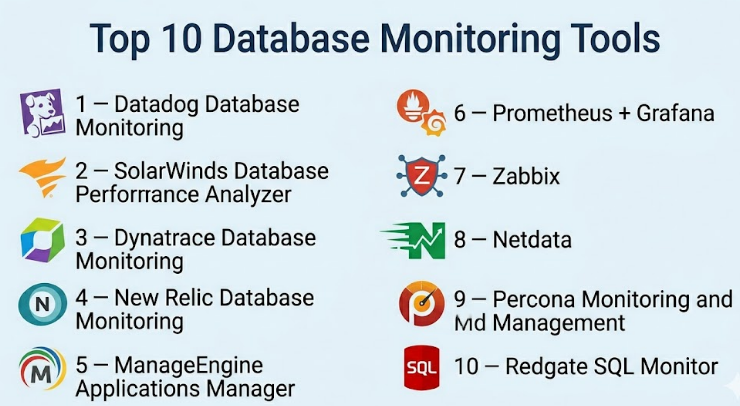
Top 10 Database Monitoring Tools
#1 — Datadog Database Monitoring
Short description (2–3 lines): A cloud-based platform offering deep visibility into database performance, queries, and infrastructure metrics. Best suited for cloud-native and DevOps-driven environments.
Key Features
- Query-level performance insights
- Real-time dashboards and alerts
- Full-stack observability
- Historical trend analysis
- AI-based anomaly detection
- Multi-database support
Pros
- Strong integration ecosystem
- Advanced analytics and visualization
Cons
- Pricing increases with scale
- Initial configuration effort
Platforms / Deployment
Cloud
Security & Compliance
Encryption, RBAC, audit logs; certifications not publicly stated
Integrations & Ecosystem
- Cloud platforms
- Container environments
- DevOps and logging tools
Support & Community
Strong documentation and enterprise support.
#2 — SolarWinds Database Performance Analyzer
Short description: A performance-focused monitoring tool providing deep insights into query behavior and database bottlenecks.
Key Features
- Query performance monitoring
- Wait-time analysis
- Performance baselining
- Alerting system
- Multi-database support
Pros
- Excellent query diagnostics
- Easy deployment
Cons
- User interface can feel dated
- Licensing complexity
Platforms / Deployment
Cloud / On-prem
Security & Compliance
Not publicly stated
Integrations & Ecosystem
- Database platforms
- Infrastructure tools
Support & Community
Reliable enterprise support.
#3 — Dynatrace Database Monitoring
Short description: An AI-powered observability platform that provides automated insights into database performance and system dependencies.
Key Features
- AI-based root cause analysis
- Full-stack observability
- Dependency mapping
- Real-time monitoring
- Intelligent alerting
Pros
- Advanced automation capabilities
- Minimal manual configuration
Cons
- Premium pricing
- Learning curve
Platforms / Deployment
Cloud / Hybrid
Security & Compliance
Encryption, RBAC; certifications not publicly stated
Integrations & Ecosystem
- Cloud environments
- DevOps tools
- Application monitoring
Support & Community
Enterprise-level support.
#4 — New Relic Database Monitoring
Short description: A developer-friendly monitoring platform offering real-time insights into database performance and application interactions.
Key Features
- Query tracking
- Real-time dashboards
- Application-database correlation
- Alerting system
- Cloud-native monitoring
Pros
- Easy integration
- Developer-focused design
Cons
- Cost increases with usage
- Requires tuning for advanced use
Platforms / Deployment
Cloud
Security & Compliance
Encryption, audit logs; certifications not publicly stated
Integrations & Ecosystem
- APIs
- Cloud services
- DevOps tools
Support & Community
Strong community and documentation.
#5 — ManageEngine Applications Manager
Short description: A comprehensive monitoring solution that includes database performance tracking along with application monitoring.
Key Features
- Database performance metrics
- Query monitoring
- Resource tracking
- Alerts and reporting
- Multi-database support
Pros
- Cost-effective for SMBs
- All-in-one monitoring solution
Cons
- Limited advanced analytics
- Interface complexity
Platforms / Deployment
Cloud / On-prem
Security & Compliance
Not publicly stated
Integrations & Ecosystem
- Applications
- Databases
- Infrastructure
Support & Community
Good support for multiple business sizes.
#6 — Prometheus + Grafana
Short description: An open-source monitoring stack used for collecting metrics and visualizing database performance.
Key Features
- Time-series data collection
- Custom dashboards
- Alerting system
- Flexible query language
- Open-source ecosystem
Pros
- Highly customizable
- Cost-effective
Cons
- Requires setup and maintenance
- Not beginner-friendly
Platforms / Deployment
Linux / Cloud / Self-hosted
Security & Compliance
Varies / N/A
Integrations & Ecosystem
- Kubernetes
- Exporters for databases
- Cloud environments
Support & Community
Strong open-source community.
#7 — Zabbix
Short description: A scalable monitoring platform that supports database monitoring alongside infrastructure tracking.
Key Features
- Real-time monitoring
- Alerting system
- Visualization dashboards
- Multi-environment support
- Agent-based monitoring
Pros
- Open-source and scalable
- Cost-effective
Cons
- Complex setup
- Interface limitations
Platforms / Deployment
Linux / Windows / Cloud
Security & Compliance
RBAC, encryption; certifications not publicly stated
Integrations & Ecosystem
- Infrastructure systems
- Databases
- Network tools
Support & Community
Strong community support.
#8 — Netdata
Short description: A lightweight monitoring tool providing real-time performance insights for databases and systems.
Key Features
- Real-time metrics
- Lightweight agent
- Auto-discovery
- Interactive dashboards
- Anomaly detection
Pros
- Easy to deploy
- Instant visibility
Cons
- Limited enterprise features
- Requires tuning
Platforms / Deployment
Linux / Windows / macOS / Cloud
Security & Compliance
Varies / N/A
Integrations & Ecosystem
- Databases
- Containers
- Infrastructure
Support & Community
Active open-source community.
#9 — Percona Monitoring and Management (PMM)
Short description: An open-source platform focused on monitoring MySQL, PostgreSQL, and MongoDB databases.
Key Features
- Query analytics
- Performance monitoring
- Alerting system
- Visualization dashboards
- Open-source
Pros
- Strong database-specific insights
- Free and flexible
Cons
- Limited database support
- Setup complexity
Platforms / Deployment
Linux / Cloud / Self-hosted
Security & Compliance
Varies / N/A
Integrations & Ecosystem
- MySQL
- PostgreSQL
- MongoDB
Support & Community
Strong open-source support.
#10 — Redgate SQL Monitor
Short description: A specialized monitoring tool designed for SQL Server environments with strong performance insights.
Key Features
- SQL Server monitoring
- Query performance analysis
- Alerting
- Reporting
- Performance diagnostics
Pros
- Deep SQL Server insights
- Easy to use
Cons
- Limited to SQL Server
- Not ideal for multi-database environments
Platforms / Deployment
Windows / Cloud
Security & Compliance
Not publicly stated
Integrations & Ecosystem
- SQL Server
- Microsoft ecosystem
Support & Community
Strong vendor support.
Comparison Table (Top 10)
| Tool Name | Best For | Platform(s) Supported | Deployment | Standout Feature | Public Rating |
|---|---|---|---|---|---|
| Datadog | Cloud teams | Web | Cloud | Full-stack observability | N/A |
| SolarWinds | DBAs | Web | Hybrid | Query analysis | N/A |
| Dynatrace | Enterprise | Web | Hybrid | AI insights | N/A |
| New Relic | Developers | Web | Cloud | App + DB monitoring | N/A |
| ManageEngine | SMB | Web | Hybrid | All-in-one monitoring | N/A |
| Prometheus + Grafana | DevOps | Linux | Self-hosted | Open-source flexibility | N/A |
| Zabbix | Enterprises | Linux/Windows | Hybrid | Scalable monitoring | N/A |
| Netdata | Real-time insights | Cross-platform | Hybrid | Instant metrics | N/A |
| Percona PMM | DB-specific | Linux | Self-hosted | Query analytics | N/A |
| Redgate SQL Monitor | SQL Server users | Windows | Hybrid | SQL optimization | N/A |
Evaluation & Scoring of Database Monitoring Tools
| Tool Name | Core | Ease | Integrations | Security | Performance | Support | Value | Weighted Total |
|---|---|---|---|---|---|---|---|---|
| Datadog | 10 | 8 | 10 | 9 | 9 | 9 | 7 | 9.1 |
| SolarWinds | 9 | 8 | 8 | 8 | 9 | 8 | 8 | 8.5 |
| Dynatrace | 10 | 7 | 9 | 9 | 9 | 9 | 6 | 8.9 |
| New Relic | 9 | 8 | 9 | 8 | 8 | 8 | 7 | 8.4 |
| ManageEngine | 8 | 8 | 7 | 8 | 8 | 8 | 9 | 8.2 |
| Prometheus + Grafana | 9 | 6 | 9 | 7 | 9 | 8 | 9 | 8.3 |
| Zabbix | 8 | 6 | 8 | 7 | 8 | 8 | 9 | 7.9 |
| Netdata | 8 | 9 | 7 | 7 | 9 | 7 | 9 | 8.2 |
| Percona PMM | 8 | 7 | 7 | 7 | 8 | 7 | 9 | 7.8 |
| Redgate SQL Monitor | 8 | 8 | 6 | 8 | 8 | 8 | 7 | 7.9 |
How to interpret the scores:
These scores are comparative and highlight strengths across features, usability, and value. Enterprise tools typically rank higher in advanced capabilities, while open-source tools excel in flexibility and cost efficiency. Choose based on your operational needs rather than just the highest score.
Which Database Monitoring Tools Is Right for You?
Solo / Freelancer
Choose lightweight tools like Netdata for quick setup and simplicity.
SMB
ManageEngine or New Relic offer a balance of ease and functionality.
Mid-Market
Datadog or SolarWinds provide strong analytics and scalability.
Enterprise
Dynatrace and Datadog deliver advanced AI-driven monitoring and automation.
Budget vs Premium
- Budget: Prometheus, Netdata
- Premium: Dynatrace, Datadog
Feature Depth vs Ease of Use
- Easy: Netdata, New Relic
- Advanced: Dynatrace, Prometheus
Integrations & Scalability
- Multi-cloud: Datadog, Dynatrace
- Specialized: Redgate, Percona
Security & Compliance Needs
- Enterprise-grade: Dynatrace, Datadog
- Standard: ManageEngine, Netdata
Frequently Asked Questions (FAQs)
What are Database Monitoring Tools?
They are tools that track database performance, health, and activity in real time.
Why are they important?
They help prevent downtime, improve performance, and identify issues early.
Do they monitor queries?
Yes, most tools provide detailed query-level insights.
Are they suitable for small businesses?
Yes, many tools are designed for SMBs as well.
Can they integrate with DevOps pipelines?
Yes, modern tools support CI/CD and DevOps integrations.
What is anomaly detection?
It identifies unusual patterns in database activity.
Do these tools impact performance?
Modern tools minimize performance overhead.
Are open-source tools reliable?
Yes, but they require setup and maintenance.
Can they monitor cloud databases?
Yes, most tools support cloud-native environments.
What are common mistakes?
Ignoring alerts, poor configuration, and lack of monitoring coverage.
Conclusion
Database Monitoring Tools are essential for maintaining performance, reliability, and stability in modern applications. As systems become more complex and data-driven, having real-time visibility into database behavior ensures faster issue resolution and better user experience. There is no single tool that fits every scenario. Platforms like Datadog and Dynatrace offer advanced AI-driven insights and scalability for enterprise environments, while open-source tools like Prometheus and Zabbix provide flexibility and cost efficiency. Tools like SolarWinds and New Relic offer a balanced approach for growing teams.
