Introduction
In the fast-paced world of modern software, the Certified MLOps Professional stands out as a critical credential for engineers aiming to bridge the gap between experimental data science and production-grade infrastructure. As enterprises scramble to move AI initiatives from local notebooks into robust, scalable systems, the ability to manage the full ML lifecycle has become a top-tier skill set. This guide is written for engineers and architects who want to move beyond the theory and master the actual practice of deploying AI, using the resources found at aiopsschool.
Introduction
The Certified MLOps Professional is more than just a certificate; it is a clear validation of your ability to handle the complexities of machine learning in production. This guide is built for software engineers, DevOps specialists, and data architects who understand that writing a great model is only 10% of the battle. We explore how to manage, deploy, and monitor ML systems with the same reliability as any other mission-critical service. By navigating the learning paths available at aiopsschool, you can transform your career and start making informed decisions about your professional future in the rapidly expanding world of platform engineering.
What is the Certified MLOps Professional?
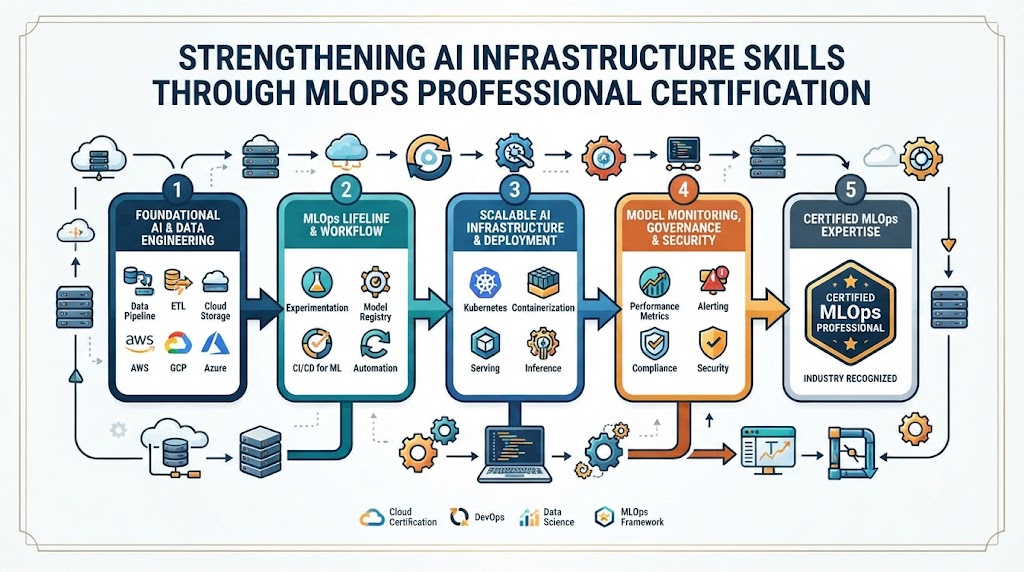
At its heart, the Certified MLOps Professional represents a standardized approach to the machine learning lifecycle. It moves away from the “data science” mindset—where the focus is often just on model accuracy—and pushes toward an “engineering” mindset, where reproducibility, scalability, and observability are paramount. This certification exists to bridge the divide between training a model and serving it reliably to millions of users. It covers everything from managing data lineage to automating CI/CD/CT pipelines, ensuring your work aligns with the high standards of modern, cloud-native enterprise environments.
Who Should Pursue Certified MLOps Professional?
This certification is essential for anyone involved in the lifecycle of AI products. If you are a DevOps engineer looking to expand your reach into AI workloads, this is your next step. Site Reliability Engineers (SREs) who need to extend their monitoring and recovery strategies to ML inference will find the curriculum directly applicable. Data engineers tasked with building reliable feature stores and platform engineers responsible for GPU-intensive infrastructure will also find immense value here. Whether you are working in a fast-growing startup in India or a global enterprise, this certification offers a universal language for building reliable machine learning systems.
Why Certified MLOps Professional
The tech landscape is shifting toward AI-integrated software, and companies are hungry for engineers who can do more than just build models; they need engineers who can “operationalize” them. This certification is valuable because it focuses on universal engineering principles—like versioning, automation, and resilience—that remain relevant regardless of which specific vendor tools you use today or tomorrow. By investing your time here, you are securing your long-term career relevance, gaining a high-ROI credential that proves you have the technical discipline to handle real-world, production-scale AI challenges.
Certified MLOps Professional Certification Overview
The Certified MLOps Professional program is structured to test your practical ability to handle the entire ML lifecycle. Hosted on aiopsschool, the assessment approach is grounded in real-world scenarios, forcing you to think about how code, data, and models interact in a live production environment. It isn’t just about passing a test; it’s about proving that you can architect a pipeline that doesn’t break when data changes or when user demand spikes. It is an industry-recognized benchmark that signals to employers that you understand how to deliver AI-driven value with engineering rigor.
Certified MLOps Professional Certification Tracks & Levels
The certification path is divided into tiered levels to help you grow from a practitioner into a master of the domain. The foundational levels focus on essential terminology and standard workflows, while professional and advanced tiers require you to demonstrate complex architectural design and incident management skills. You can specialize your learning based on your current role—whether that’s focusing on the data side, the infrastructure side, or the security side of the pipeline. Each level is carefully designed to build upon the last, providing a logical progression for your career growth.
Complete Certified MLOps Professional Certification Table
| Track | Level | Who it’s for | Prerequisites | Skills Covered | Recommended Order |
| Core | Foundation | New Practitioners | Coding Basics | ML Basics | 1 |
| Pipeline | Professional | DevOps/Data Eng | CI/CD Knowledge | Model Deployment | 2 |
| Platform | Advanced | Architects | Cloud/K8s | Scaling Models | 3 |
Detailed Guide for Each Certified MLOps Professional Certification
Certified MLOps Professional – Core Practitioner
What it is
This certification validates your core understanding of how to take a raw machine learning model and prepare it for a professional delivery environment.
Who should take it
Developers, data scientists, and engineers who are ready to transition from sandbox experimentation to a professional engineering environment.
Skills you’ll gain
- Organizing experiments for reproducibility
- Automating simple training loops
- Using model registries for version control
- Basic containerization of ML workloads
Real-world projects you should be able to do
- Package a model and its dependencies into a container.
- Configure a simple automated training pipeline.
- Implement a basic registry to keep track of model versions.
Preparation plan
- 7–14 days: Master the core terminology and standard lifecycle processes.
- 30 days: Engage with hands-on lab modules to solidify your understanding.
- 60 days: Build a sample project that features end-to-end automation.
Common mistakes
Neglecting to document or version-control the raw data used for training.
Best next certification after this
- Same-track: MLOps Pipeline Engineer.
- Cross-track: DevOps CI/CD Specialist.
- Leadership: Engineering Team Lead.
Choose Your Learning Path
DevOps Path
The DevOps path focuses on automating the infrastructure side of AI. You will learn to use GitOps principles for model deployment, ensuring that your ML services are updated with the same speed and reliability as your application code. This path is ideal for engineers who want to bring mature DevOps standards to the often-messy world of data science.
DevSecOps Path
The DevSecOps path is about hardening the entire AI pipeline. You will learn how to scan for vulnerabilities in data, prevent model poisoning, and ensure that your endpoints are secure against modern cyber threats. This path is essential for those working in regulated industries where security and data privacy are not optional.
SRE Path
The SRE path is for those obsessed with uptime and performance. You will learn to treat models like microservices, defining error budgets, implementing complex monitoring for drift, and automating auto-scaling for inference engines. This path is the go-to for engineers responsible for mission-critical AI systems.
AIOps / MLOps Path
This path explores how to use machine learning to improve the very infrastructure that runs it. You will learn to build systems that automatically monitor their own health, troubleshoot issues, and optimize resource allocation. It is a highly strategic path for those interested in building self-managing, intelligent platforms.
DataOps Path
The DataOps path focuses on the “data” in MLOps. You will learn how to automate data validation, quality checks, and ingestion pipelines to ensure that the “garbage in, garbage out” problem never plagues your models. This is vital for engineers who want to own the quality of the data driving their business decisions.
FinOps Path
The FinOps path deals with the reality of cloud costs. You will learn how to manage expensive GPU resources, optimize model training for lower cloud bills, and implement smart strategies for model serving that prevent cost spikes. This path is for engineers who want to prove the business ROI of their AI projects.
Role → Recommended Certified MLOps Professional Certifications
| Role | Recommended Certifications |
| DevOps Engineer | MLOps Pipeline Professional |
| SRE | MLOps Reliability Architect |
| Platform Engineer | MLOps Infrastructure Specialist |
| Cloud Engineer | Cloud ML Engineer |
| Security Engineer | Securing AI/ML Pipelines |
| Data Engineer | DataOps for MLOps |
| FinOps Practitioner | MLOps Cost & Efficiency |
| Engineering Manager | MLOps Leadership Strategy |
Next Certifications to Take After Certified MLOps Professional
Same Track Progression
Deepen your expertise by tackling advanced certification levels that focus on multi-cloud deployment, edge computing, and large-scale model optimization. These certifications will set you apart as a senior authority in the MLOps space.
Cross-Track Expansion
Look toward DataOps or SRE certifications to gain a wider perspective on how data systems and reliability engineering intersect. This multidisciplinary approach makes you an invaluable asset in any cross-functional engineering team.
Leadership & Management Track
If you want to move into management, seek out certifications that focus on technical leadership and organizational strategy. These paths help you translate complex MLOps benefits into business value and lead high-performing, cross-functional teams.
Training & Certification Support Providers for Certified MLOps Professional
DevOpsSchool provides deep, hands-on training that focuses on the practical application of MLOps in real enterprise environments.
Cotocus offers specialized programs designed for engineers who need to build, scale, and maintain complex AI production systems.
Scmgalaxy focuses on the intersection of source code management and MLOps, ensuring that every deployment is traceable and reliable.
BestDevOps provides high-quality learning resources and training paths that align with current industry best practices.
devsecopsschool offers a dedicated track for those who want to integrate security into the heart of their machine learning pipelines.
sreschool focuses on the observability and reliability aspects required to keep high-stakes ML models running smoothly.
aiopsschool serves as the primary hub for certifying your professional competence in the field of AI and operations.
dataopsschool provides the foundational training needed to manage the data streams that power modern machine learning.
finopsschool offers practical advice and certification training on optimizing the cost and efficiency of cloud-based AI infrastructure.
Frequently Asked Questions (General)
- How difficult is it to clear this certification?The difficulty is balanced to ensure that candidates possess both theoretical knowledge and the practical skills to solve real-world problems.
- What is the recommended preparation time?While it varies by individual, most engineers find that a focused study plan spanning one to two months is adequate.
- Are there any hard prerequisites?A working knowledge of software development and basic data science concepts is recommended for success.
- Is the certification recognized worldwide?Yes, the certification is based on universal engineering standards that are relevant across all global markets.
- How does this help my career trajectory?It acts as a formal validation of your specialized skills, making you more competitive for senior-level engineering roles.
- Can I take the exam from home?Yes, the program is designed to be accessible globally through remote testing options.
- Does the test include a hands-on component?The program emphasizes practical capability, and candidates are expected to demonstrate their ability to implement real pipelines.
- What if I need to retake the exam?Most certification programs have policies in place to allow for retakes after a designated review period.
- How often should I renew my certification?Staying current is key in tech; we recommend a renewal every two years to account for industry evolution.
- Is the content specific to one cloud platform?No, the syllabus teaches agnostic principles that can be applied to any major cloud or on-premise infrastructure.
- Are practice tests provided?Yes, candidates have access to mock assessments to help them evaluate their readiness.
- Who is the issuing body for this certification?The certification is issued by the hosting institution after the verification of your competencies.
FAQs on Certified MLOps Professional
- Is this just about tools like Kubeflow?No, it focuses on the engineering methodology and lifecycle processes rather than any single tool.
- Do I need to be a coding expert?You need to be proficient in Python, as it is the standard language for MLOps automation.
- Does it cover monitoring production models?Yes, production observability, drift detection, and alerting are core topics in the syllabus.
- Is this suitable for a junior DevOps engineer?Yes, it is a great way for juniors to gain a competitive advantage in a high-growth niche.
- How does this affect my salary prospects?Specializing in MLOps generally places you in a higher compensation bracket compared to generic cloud roles.
- Can I apply this to my current projects?Absolutely, the principles taught are designed to be applied immediately in your daily engineering work.
- What is the focus of the advanced level?The advanced level focuses on architectural strategy, cost optimization, and large-scale model orchestration.
- Does it include data governance?Yes, secure and compliant data handling is a key component of the professional curriculum.
Final Thoughts: Is Certified MLOps Professional Worth It?
If you are a professional who prides yourself on building reliable, scalable systems, this certification is a logical move. It cuts through the marketing noise and forces you to focus on the technical discipline that separates hobbyists from true production engineers. It is a rigorous, practical challenge that will test your current knowledge and expand your engineering horizons. In a future defined by AI, having a structured, expert-led understanding of how to manage these systems in production is an asset that will pay dividends throughout your career.
