Introduction
The bridge between building a machine learning model and actually running it in production is where most projects fail. For those of you working in the trenches of DevOps or data engineering, you know that a model in a notebook is just a science experiment—it’s not software until it’s automated, scalable, and reliable. The Certified MLOps Engineer program is built for engineers who want to stop babysitting models and start building resilient, self-sustaining pipelines. As you look at your career trajectory, this credential acts as a definitive benchmark for your ability to handle the complexities of AI infrastructure. This guide is your roadmap to navigating the Certified MLOps Engineer ecosystem provided by aiopsschool and ensuring you have the practical skills that senior employers are hunting for right now.
What is the Certified MLOps Engineer?
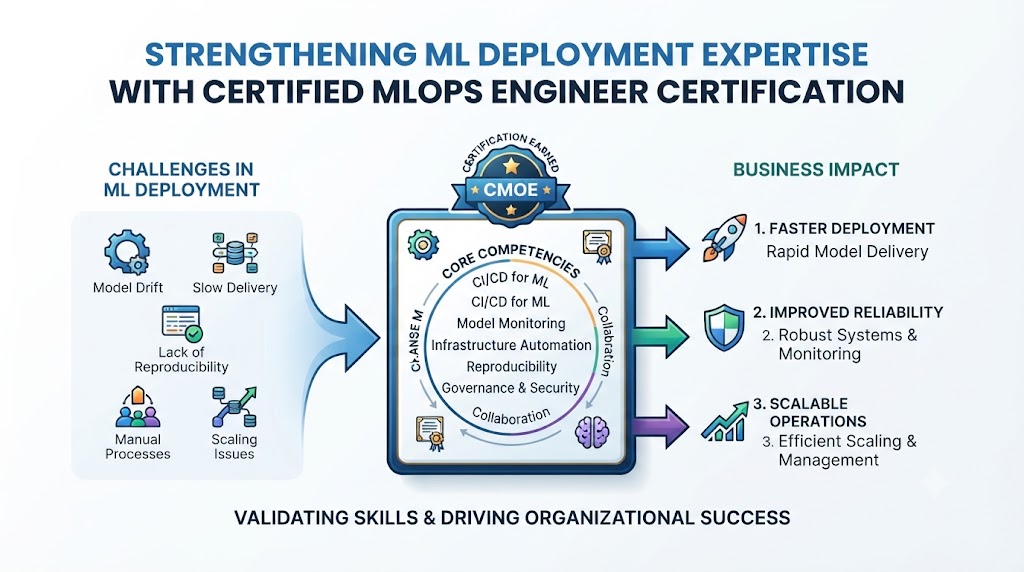
Think of the Certified MLOps Engineer as the specialized credential that verifies you can take an AI model and make it enterprise-ready. It exists because the industry finally realized that data science isn’t just about math—it is about software engineering, infrastructure automation, and continuous delivery. This program skips the fluff and focuses on the grit of the job: versioning datasets, automating training loops, and ensuring models don’t just work on a laptop but stay performant in a production cluster. It aligns perfectly with modern platform engineering, where the goal is to reduce toil and create repeatable, automated workflows.
Who Should Pursue Certified MLOps Engineer?
This path is built for the “builder” demographic—those who enjoy the intersection of code, infrastructure, and data. If you are a DevOps engineer tired of standard web apps, an SRE concerned about system reliability, or a data scientist who wants to own the deployment cycle, this is for you. It’s equally important for engineering managers tasked with building AI-ready teams, as it provides a common language for how we deliver ML. Whether you are scaling teams in India or contributing to global cloud-native projects, the certification proves you understand the full lifecycle from data ingestion to model retirement.
Why Certified MLOps Engineer
Technology evolves, but the core principles of reliability, automation, and observability are evergreen. This certification is valuable because it trains you on those fundamentals rather than tying your expertise to a single, fleeting vendor tool. In the current market, organizations are desperate for engineers who can bridge the “ML-to-Production” gap. By holding this certification, you prove that you can protect the organization’s investment in AI by ensuring models are secure, cost-effective, and always available. It’s an investment in your career longevity that pays off by making you the person who keeps the wheels turning when the AI goes live.
Certified MLOps Engineer Certification Overview
The Certified MLOps Engineer program is administered through the Certified MLOps Engineer framework and hosted on the aiopsschool platform. The certification process is designed to be pragmatic, meaning it values your ability to solve a complex pipeline problem over your ability to memorize definitions. It covers the end-to-end scope of machine learning operations, including the often-overlooked areas like model governance and infrastructure as code for ML. By completing this, you gain more than just a certificate; you get a clear, actionable methodology for how to manage intelligent systems at scale.
Certified MLOps Engineer Certification Tracks & Levels
The program is segmented into levels that match the natural evolution of an engineer’s career. The Foundation level clears the fog, covering the basic plumbing of data and model pipelines. The Professional level is where you gain the “battle scars” by handling drift detection and complex deployments. Finally, the Advanced level is for those designing high-availability systems that run millions of inferences per second. These tracks are designed to build on one another, allowing you to steadily climb the ladder from a junior contributor to a principal architect in the MLOps space.
Complete Certified MLOps Engineer Certification Table
| Track | Level | Who it’s for | Prerequisites | Skills Covered | Recommended Order |
| MLOps Core | Foundation | Beginners | Git, Python | CI/CD basics, Docker | 1 |
| Production MLOps | Professional | Pro Engineers | DevOps/Data background | Monitoring, Model drift | 2 |
| MLOps Architect | Advanced | Tech Leads | Prof level cert | Scalability, Governance | 3 |
Detailed Guide for Each Certified MLOps Engineer Certification
Certified MLOps Engineer – Foundation
What it is
This module establishes your baseline in MLOps, focusing on the core concepts required to move models from notebooks into basic automated pipelines.
Who should take it
It is perfect for early-career developers or those transitioning from pure IT support who need to understand how ML fits into the SDLC.
Skills you’ll gain
- Implementing Git workflows for model code.
- Basic containerizing of ML workloads.
- Understanding the CI/CD pipeline for machine learning.
Real-world projects you should be able to do
- Create a simple pipeline that trains and saves a model automatically.
- Containerize a Python script for consistent deployment.
- Setup a basic versioning system for your training data.
Preparation plan
- 7–14 days: Focus on foundational concepts and Python scripting for data.
- 30 days: Dive into the course content and complete all hands-on exercises.
- 60 days: Revisit the labs and simulate troubleshooting typical pipeline failures.
Common mistakes
Students often skip learning how to version data properly, which is the biggest pain point in real-world ML projects.
Best next certification after this
- Same-track: Certified MLOps Engineer – Professional
- Cross-track: Certified DevOps Engineer
- Leadership: Certified AIOps Manager
Choose Your Learning Path
DevOps Path
The DevOps path focuses on the heavy lifting of infrastructure. You will learn how to provision the necessary compute resources, manage kubernetes clusters, and ensure your model serving infrastructure is robust enough for enterprise-grade traffic.
DevSecOps Path
This path is all about hardening the ML supply chain. You will learn how to secure model endpoints, protect data during training, and manage credentials within your automated workflows to prevent unauthorized access or tampering.
SRE Path
The SRE path puts a heavy emphasis on uptime and performance. You will learn how to define SLIs and SLOs for model predictions, ensuring that your AI services meet the same reliability standards as any other critical piece of production software.
AIOps Path
The AIOps path is about “the machine learning for the machines.” You will explore how to use AI models to gain insights into your own infrastructure logs and metrics, effectively automating your incident response and capacity planning.
MLOps Path
The MLOps path is the heart of the certification. It covers the entire lifecycle, ensuring you understand how to manage data, train models, validate their accuracy, deploy them, and constantly monitor them for performance degradation.
DataOps Path
The DataOps path focuses on the “plumbing” of data. You will master the orchestration of data pipelines, ensuring that your models are always supplied with accurate, cleaned, and timely data, which is the cornerstone of any AI system.
FinOps Path
The FinOps path teaches you how to keep the cloud bill from exploding. You will learn strategies for efficient resource allocation, identifying idle training instances, and optimizing the cost-per-inference of your deployed models.
Role → Recommended Certified MLOps Engineer Certifications
| Role | Recommended Certifications |
| DevOps Engineer | Certified MLOps Engineer – Foundation & Professional |
| SRE | Certified MLOps Engineer – Professional |
| Platform Engineer | Certified MLOps Engineer – Professional |
| Cloud Engineer | Certified MLOps Engineer – Foundation |
| Security Engineer | Certified MLOps Engineer – Professional |
| Data Engineer | Certified MLOps Engineer – DataOps Track |
| FinOps Practitioner | Certified MLOps Engineer – FinOps Track |
| Engineering Manager | Certified MLOps Engineer – Professional |
Next Certifications to Take After Certified MLOps Engineer
Same Track Progression
Keep climbing the technical ladder by pursuing the Advanced Architect level. This level teaches you how to manage multi-tenant environments, hybrid-cloud setups, and the complex governance required when you have hundreds of models in production.
Cross-Track Expansion
Diversify your utility by picking up certifications in FinOps or Security. As an MLOps engineer, understanding the cost and security implications of your architecture makes you a much more valuable asset to your organization.
Leadership & Management Track
If you find yourself guiding teams, transition toward management certifications. Focus on AIOps leadership, where you learn how to mentor engineers and define the organizational processes required for successful AI adoption.
Training & Certification Support Providers for Certified MLOps Engineer
DevOpsSchool is a top-tier provider for those who want instructor-led training and a structured path to becoming a certified practitioner.
Cotocus delivers high-impact, real-world training that emphasizes deep technical understanding and practical application of concepts.
Scmgalaxy offers specialized guidance in the automation and configuration management space, helping you master the tools of the trade.
BestDevOps provides an extensive library of learning resources designed to help engineers keep pace with the rapidly moving infrastructure space.
devsecopsschool focuses on the critical intersection of security and development, providing the training you need to build safer pipelines.
sreschool provides the specialized knowledge required to keep complex systems running at peak performance and reliability.
aiopsschool is your central hub for specialized AI and ML infrastructure training, providing targeted certification and path guidance.
dataopsschool focuses on the engineering of data pipelines, ensuring you have the data quality and flow necessary for AI success.
finopsschool offers critical insights into managing the financial health of your cloud-native infrastructure, especially for expensive AI workloads.
Frequently Asked Questions
- How hard is it to get certified as an MLOps Engineer?The challenge lies in the multidisciplinary nature of the exam, which tests your ability to connect infrastructure, software, and data science concepts in a logical way.
- How much study time should I set aside each week?Most successful candidates dedicate at least 8 to 10 hours a week for a period of about two months to truly digest the material and practice the labs.
- Do I need a degree in Data Science to pass?Not at all. The certification focuses on operations and engineering, not academic data science, so your background in software or DevOps is actually more relevant.
- Is there value in this if I am already an experienced DevOps engineer?Yes, it formalizes your knowledge and gives you a structured framework to apply your existing DevOps skills to the specific challenges of machine learning.
- How does this certification help with my job search?It acts as a signal to recruiters that you possess a specialized, high-demand skill set that is currently under-supplied in the global market.
- Can I use my lab experience for real projects?Absolutely; the curriculum is designed so that the techniques you learn in the lab are immediately applicable to production environments at your job.
- Is there any overlap with standard cloud certifications?There is a slight overlap, but this certification takes you much deeper into the specific orchestration and automation patterns unique to ML workflows.
- What is the typical renewal process for the certification?The industry moves fast, so periodic updates or refresher assessments are typically encouraged to ensure your skills stay aligned with current tools.
- Does this cover the ethics of using AI in production?Modern MLOps practice includes model governance and bias monitoring, which are covered to ensure that your deployments remain fair and accountable.
- Can I choose the tools I learn during the certification?The certification teaches vendor-neutral principles, allowing you to apply the methodologies across whichever stack your company currently uses.
- Who provides the most support for students?Platforms like the ones listed in our providers section offer robust community support and mentorship to guide you through your learning journey.
- Is this certification worth the investment?When you calculate the potential increase in your salary and the reduction in your daily workload through better automation, the ROI becomes quite clear.
FAQs on Certified MLOps Engineer
- How do I know if my pipeline is “MLOps-ready”?If your pipeline is version-controlled, automated from data ingestion to model deployment, and observable via metrics, you are likely there.
- Is this just about using a specific MLOps platform?No, the goal is to teach you how to build the architecture yourself, so you are not locked into any single vendor’s ecosystem.
- How do I handle data drift in the certification?You will learn to implement automated monitoring that compares live data distributions to training data, triggering retrains as needed.
- Does this cover the infrastructure cost management?Yes, we teach you how to right-size your instances and automate the scaling of your inference nodes to optimize costs.
- Can I apply these skills to open-source tools?Definitely; the principles are entirely tool-agnostic and work perfectly with the popular open-source ecosystem in MLOps.
- Is there a focus on team collaboration?We emphasize versioning and documentation, which are the fundamental building blocks for collaboration between engineers and data scientists.
- How does this differ from simple machine learning training?Standard ML training teaches you how to build a model; this certification teaches you how to keep that model running reliably as a service.
- What should I focus on for the practical exam?Focus on the end-to-end integration of the pipeline—ensuring that your code, data, and configuration are all versioned and working in concert.
Final Thoughts: Is Certified MLOps Engineer Worth It?
Ultimately, this certification is for the engineer who wants to be more than just a task-executor; it’s for the one who wants to be a system designer. By mastering MLOps, you are positioning yourself at the center of the next great shift in software engineering. It isn’t about chasing the latest shiny tool; it’s about mastering the discipline of reliability and automation in a chaotic field. If you’re willing to put in the work to truly understand these patterns, the Certified MLOps Engineer credential is a powerful catalyst for your career growth. Take the leap, learn the craft, and start building systems that actually last.
