Introduction
DevOps has officially evolved from an industry buzzword into the foundational architecture of modern engineering teams. Today, it stands as one of the highest-paying career tracks in the entire information technology sector. As businesses globally migrate to cloud infrastructures and demand rapid software deployment, the financial compensation for managing these systems has scaled dramatically.
The surge in DevOps engineering salaries is primarily driven by an aggressive global shift toward cloud computing, containerized microservices, and continuous automation. Organizations have realized that software delivery velocity directly impacts their revenue and market competitiveness. Consequently, the professionals who build, secure, and maintain these delivery pipelines are being rewarded with top-tier compensation packages.
However, in today’s tech landscape, tool proficiency alone is no longer enough to command premium pay. Companies are transitioning away from hiring generic script executors to investing heavily in individuals who display structural problem-solving and an architectural understanding of system reliability. While certifications can validate your dedication, specialized engineering skills and practical outcome ownership are what truly dictate your market worth.
Whether you are an aspiring fresher, a systems administrator planning a pivot, or an experienced Cloud/SRE professional looking to maximize your compensation, this comprehensive guide provides an objective, data-backed breakdown of DevOps salary structures. Drawing directly from global market trends, we will map out real-world earning potentials, high-paying specializations, and the strategic skills needed to elevate your career.
Why DevOps Salaries Are High
The premium compensation associated with DevOps engineering isn’t an accident; it is a reflection of economic supply and structural demand in the software industry. Several core architectural shifts explain why organizations are paying a premium for these professionals:
- Accelerated Cloud Adoption: Enterprise infrastructure has moved permanently away from on-premise physical servers to multi-cloud environments. Designing, scaling, and optimizing these dynamic cloud landing zones requires deep expertise that commands higher budgets.
- The Mandate for Automation: Manual configuration is a liability. Companies require infrastructure-as-code (IaC) and comprehensive automation to eliminate human error and lower operational friction, making automation architects highly valuable assets.
- Kubernetes and Containerization Ecosystems: Microservices have introduced distributed system complexities. Managing container orchestration through Kubernetes at scale is a scarce and highly valued skill set that carries a clear market premium.
- Ubiquitous CI/CD Adoption: Continuous Integration and Continuous Deployment (CI/CD) pipelines are the literal lifelines of modern engineering teams. Maintaining deployment velocity without causing system downtime directly affects a company’s bottom line.
- The DevSecOps Imperative: Security cannot be an afterthought left for the end of a release cycle. The integration of continuous security, compliance-as-code, and pipeline vulnerability scanning has triggered a surge in demand for engineering profiles that understand both delivery and defense.
- Scarcity of True Talent: While many IT professionals understand basic tool syntax, there is a distinct lack of skilled engineers who understand core operational architecture, high-scale reliability, and cost optimization. This talent shortage allows top-tier engineers to command premium market rates.
Who Should Read This Guide
This salary and career roadmap is specifically built for tech professionals aiming to navigate their career trajectory intentionally, including:
- Freshers: Engineering graduates entering the industry looking to bypass traditional low-paying IT support queues.
- Developers: Software engineers wanting to shift into infrastructure, automation, and system design to increase their career leverage.
- Linux Administrators & Systems Engineers: Infrastructure traditionalists looking to upgrade legacy system knowledge into modern cloud environments.
- Cloud Engineers: Specialists looking to transition from basic cloud provisioning to comprehensive, high-paying automation roles.
- Automation Engineers: Professionals focusing on testing or scripting who want to scale their pipelines to enterprise-level environments.
- SRE & Platform Engineers: Advanced practitioners looking to benchmark their current compensation against global markets.
- DevSecOps Professionals: Security-minded engineers seeking to understand the financial upside of their specialization.
DevOps Salary Overview
The global DevOps compensation landscape is undergoing a clear fragmentation into distinct pay tiers:
- High-Scale Product Orgs & Big Tech: Heavily driven by stock equity and performance bonuses, where titles map closely to strict software engineering ladders.
- Enterprise & Regulated Sectors: Highly stable, bonus-heavy environments focused closely on governance and risk reduction.
- Services & Outsourcing Firms: Driven rigidly by client rate-cards, focusing primarily on baseline implementations.
Market patterns reveal that title inflation is real, but modern leveling systems are becoming far stricter. General “CI/CD pipeline builders” or basic “Kubernetes operators” are increasingly viewed as baseline skill sets rather than premium capabilities.
Instead, the highest salary growth is reserved for individuals who move from being simple pipeline executors to Platform Owners (treating internal infrastructure as a product) and from alert responders to Reliability Engineers (owning SLOs, error budgets, and architecture design). The closer your daily output is tied to minimizing corporate liability, preventing revenue-impacting downtime, or managing the cloud bill (FinOps), the higher your compensation ceiling will be.
DevOps Salary by Experience Level
Earning potential in DevOps scales dynamically as an engineer transitions from executing guided tasks to defining organizational technical strategy.
| Experience Level | Typical Roles | Skills Expected | Salary Growth Potential | Career Scope |
| Fresher / Junior | Junior DevOps Engineer, Cloud Associate | Basic scripting, Linux fundamentals, executing pre-built tasks, learning on-call workflows. | Baseline Market Entry | Task execution under direct mentorship; focused on learning core delivery tooling. |
| Mid-Level | DevOps Engineer, SRE I/II, Cloud Specialist | Independently modifying infra, writing CI/CD pipelines, managing container deployments, handling core on-call rotations. | Moderate to High | Ownership of standalone pipelines and cloud environments; minimal supervision required. |
| Senior | Senior DevOps Engineer, Senior SRE | System architecture design, leading major incident responses, advanced orchestration, mentoring junior staff, cost modeling. | Premium Market Rates | High; shapes multi-team technical choices and owns systemic uptime and infrastructure strategy. |
| Lead / Principal / Architect | Staff Engineer, Platform Architect, Principal SRE | Org-wide technical standards, multi-region reliability frameworks, cross-team platform engineering, high-level cloud governance. | Top-Tier Compensation Ceiling | Exceptional; possesses design authority over the entire enterprise development lifecycle and infrastructure budget. |
Highest Paying DevOps Roles
Different specializations carry distinct market premiums based on the complexity of the domain and the scarcity of skilled professionals.
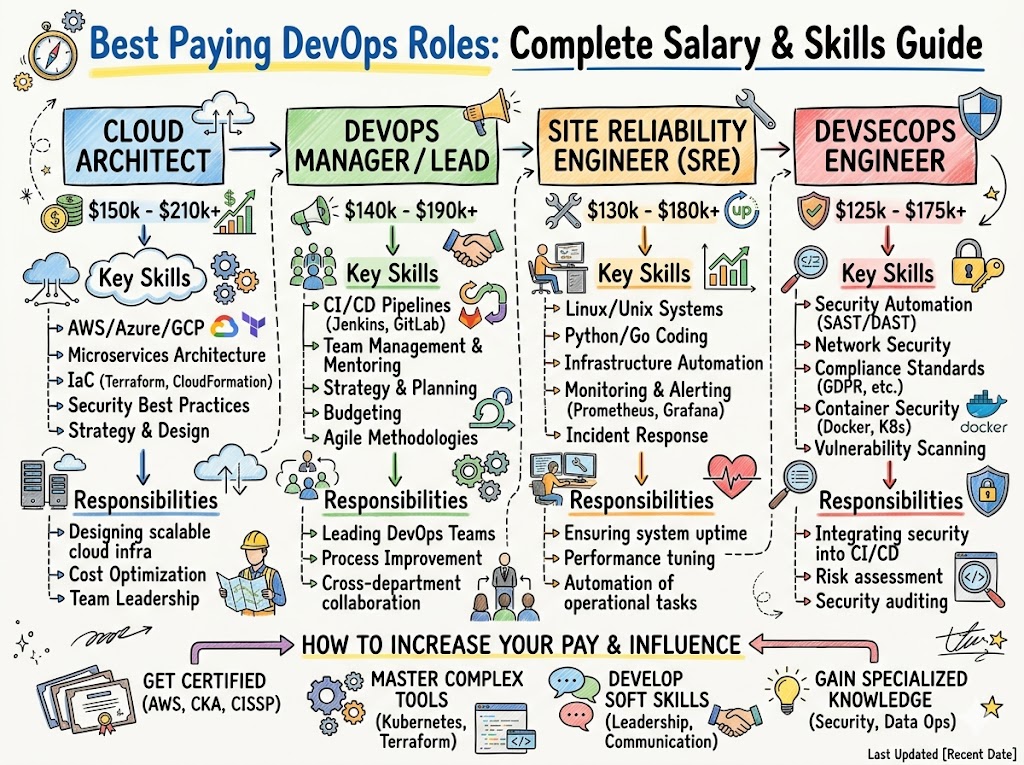
| Role | Main Skills | Difficulty Level | Salary Potential | Career Demand |
| DevOps Engineer | CI/CD, Infrastructure Automation, Cloud Provisioning | Medium | Baseline Premium | Consistently Stable |
| Site Reliability Engineer (SRE) | SLO management, Incident Response, Toil Reduction, Code Architecture | High | +0% to 15% above baseline | Extremely High |
| Platform Engineer | Internal Developer Platforms (IDPs), Paved Roads, Platform Product Thinking | High | +5% to 20% above baseline | Surging Growth |
| DevSecOps Engineer | Policy-as-code, Secure SDLC, Secrets Management, Vulnerability Scanning | High | +10% to 30% above baseline | Very Strong |
| Cloud Architect | Cloud Landing Zones, High-Availability Patterns, IAM Governance | Medium to High | -5% to +10% variations | Solid Enterprise Demand |
| Security Platform Engineer | Scalable Infrastructure Controls, Enterprise Developer Enablement | Very High | +15% to 35% above baseline | Scarce / Premium |
| FinOps / Cost Engineer | Capacity Economics, Unit Cost Optimization, Cloud Governance | Medium to High | +5% to 25% above baseline | Rapidly Emerging |
| Release / CI/CD Engineer | Pipeline Delivery, Release Orchestration, Baseline Automation | Medium | -15% to 0% variations | Flat / Standardizing |
DevOps Salary by Skills
Your specific tool mastery and architectural focus heavily dictate your compensation level. Basic skills establish your baseline, while advanced engineering capabilities unlock premium tiers.
- Baseline Essentials (Linux, Git, Python, Shell Scripting): These are mandatory foundational elements. A deep, non-negotiable understanding of Linux administration and systems behavior is critical; skipping these basics severely caps your long-term salary potential.
- Core Automation & Provisioning (Docker, Jenkins, Terraform, AWS/Azure/GCP): Standard tools across the mid-market. Knowing how to write a Terraform script or configure an AWS landing zone secures standard mid-level roles, but because these are common skills, they no longer command massive premiums on their own.
- The High-Value Triggers (Kubernetes, DevSecOps, Advanced Observability): True financial growth occurs when you master complex distributed systems orchestration (Kubernetes at scale), continuous security implementation (policy-as-code), and advanced enterprise telemetry (logging, metrics, tracing architecture paired with SLO tooling).
DevOps Salary by Certification
Certifications are excellent for structuring your learning and validating knowledge to recruiters, but they must be backed by real-world project experience to convert into high-paying job offers.
To explore validated educational pathways, review industry standards on Best DevOps Certifications.
| Certification Focus | Best For | Career Level | Skills Covered | Salary Impact |
| Cloud Practitioner / Associate | Freshers & IT Switchers | Entry-Level | Core cloud terminology, basic IAM, fundamental storage and compute. | Validates baseline hireability; minimal direct premium. |
| Professional Cloud Architect | Mid-to-Senior Engineers | Advanced | High-availability architecture, multi-region design, migration strategies. | Strong differentiator for enterprise and consulting roles. |
| Kubernetes Specializations (CKA/CKAD) | Cloud & Automation Engineers | Mid-to-Senior | Cluster configuration, application troubleshooting, networking, container orchestration. | Excellent validation for high-demand engineering teams. |
| Security & DevSecOps Certifications | DevSecOps Aspiants | Specialist | Continuous compliance, automated scanning, secure secrets infrastructure. | Triggers access to premium security-focused pay scales. |
DevOps Salary by Country or Region
DevOps base salaries fluctuate based on geographic location, local currency valuations, and regional market maturity. Below is a professional snapshot of the global annual base-salary landscape across multiple continents:
- United States (USD): One of the highest base compensation environments globally. A mid-level DevOps engineer typically sees a median base salary around $115,072, while specialized fields like DevSecOps command a higher median base around $135,785.
- Switzerland (CHF): Represents the top-tier market for European compensation. DevOps engineers command a local median base salary of 111,204 CHF (~$143,353 USD equivalent), with DevSecOps positions climbing to a local median of 131,221 CHF (~$169,156 USD).
- The Netherlands & Western Europe (EUR): Highly robust tech hubs with structured pay structures. In the Netherlands, a typical DevOps engineer sees a local median base of 75,757 EUR (~$89,537 USD), whereas a Platform Engineer commands roughly 84,848 EUR (~$100,281 USD).
- India (INR): A major global delivery engine transitioning quickly toward high-value product development. The median baseline DevOps salary centers around 2,085,429 INR (~$23,030 USD), while premium tracks like DevSecOps Engineer command a higher local median of 2,460,806 INR (~$27,176 USD). Note that top-tier domestic product firms and multi-national tech offices frequently pay well above standard service-sector averages.
- Kenya (KES): An emerging tech market within the East African ecosystem, showing a median local DevOps baseline of 1,965,270 KES (~$15,279 USD), scaling up to a local median of 2,319,000 KES (~$18,030 USD) for DevSecOps specialties.
- Remote Work Dynamics: Remote compensation is bifurcating. Hyperscale companies still pay premium, top-of-market rates for highly scarce skill profiles regardless of location, while mid-market firms are increasingly standardizing pay around strict geographic cost-of-living bands.
DevOps Salary by Company Type
Where you work impacts how you are compensated just as much as what you know.
- Startups: Offer rapid learning exposure and high equity potential, but carry lower initial base salaries and unpredictable on-call workloads. Earning growth here depends heavily on corporate scale-up success.
- Product Companies: Focus heavily on total compensation (TC), pairing highly competitive base salaries with rich equity grants and performance incentives. They have strict engineering bars but provide excellent long-term monetary growth.
- MNCs & Cloud-Native Firms: Highly structured career ladders where DevOps is treated as a core software discipline. Excellent, stable compensation with transparent paths for moving into high-paying senior leadership or principal engineering tiers.
- Service-Based Companies: Focus primarily on fixed client billing metrics. They offer stable, entry-level career tracks for freshers, but individual salary progression is bounded closely by rigid corporate rate cards.
Factors That Affect DevOps Salary
To intentionally increase your market compensation, focus on optimizing these core personal variables:
- Depth of Real-World Experience: The ability to recount how you navigated large-scale architecture failures or resolved complex system issues.
- Kubernetes and Orchestration Expertise: True multi-cluster management, custom controller implementations, and deep networking troubleshooting.
- Advanced Infrastructure Automation: Transitioning from simple script writing to creating reusable, enterprise-grade modules and modular landing zones.
- Multi-Cloud Agility: Designing systems that operate fluidly across various cloud architectures without hard vendor lock-in.
- Security and Compliance Integration: Embedding automated security barriers directly into the delivery flow rather than handling them manually.
- Measurable Project Contributions: Being able to clearly prove how your work shortened deployment times, minimized cloud spending, or boosted platform reliability.
- Professional Communication and Leadership: The capacity to lead cross-functional incidents smoothly, document complex designs clearly, and align infrastructure strategy with business priorities.
Best Skills for High DevOps Salary
Building a high-paying career requires an organized, step-by-step approach to learning technical skills.
[BEGINNER PATH]
Linux ──> Git ──> Networking Basics ──> Shell Scripting

[INTERMEDIATE PATH]
Docker ──> Jenkins ──> Terraform ──> Core Cloud (AWS/Azure/GCP)

[ADVANCED PATH]
Kubernetes ──> Cloud Architecture ──> DevSecOps ──> Platform Engineering
Beginner Skills
- Linux Fundamentals: Systems management, file permissions, process monitoring, and package administration.
- Git & Version Control: Branching strategies, pull request workflows, and basic repository governance.
- Networking Basics: DNS, TCP/IP tracking, subnets, and foundational load-balancing principles.
- Basic Scripting: Writing clean Bash or Python scripts to automate repetitive local tasks.
Intermediate Skills
- Container Basics (Docker): Writing optimized Dockerfiles, managing images, and controlling local container runtimes.
- CI/CD Foundation (Jenkins/GitLab CI): Setting up automated test, build, and simple delivery flows.
- Infrastructure-as-Code (Terraform): Writing modular infrastructure templates and managing cloud state files safely.
- Cloud Platform Basics: Managing basic compute instances, storage buckets, and IAM roles.
Advanced Skills
- Production Kubernetes: Operating clusters at scale, configuring ingress controllers, managing persistent storage, and optimization.
- Advanced Cloud Architecture: Designing high-availability, multi-region architectures with automated failover logic.
- GitOps Workflows: Utilizing tools like ArgoCD or Flux to drive declarative infrastructure states directly from Git.
- Observability & Telemetry: Establishing comprehensive logging, distributed tracing, and metrics frameworks to monitor SLO health.
- DevSecOps & Platform Design: Building secure developer paved-roads, automating secrets rotation, and formulating internal developer portals (IDPs).
Real-World Career Scenarios
Fresher Starting DevOps
A new engineering graduate focuses purely on learning Linux basics, Git workflows, and assisting with simple build setups. Their initial compensation starts at market baseline, but by actively documenting their learnings and helping reduce team toil, they can expect steady, reliable salary growth within their first two years.
Developer Moving Into DevOps
A software engineer already understands coding, APIs, and the software development lifecycle. By mastering infrastructure-as-code (Terraform) and cloud architecture design, they can position themselves as highly valuable hybrid assets, unlocking competitive mid-to-senior engineering salaries.
System Administrator Moving Into Cloud DevOps
A traditional sysadmin brings deep, invaluable knowledge of Linux systems, networking protocols, and underlying hardware behavior. By layering modern cloud provisioning and automated configuration on top of this background, they transition away from legacy maintenance into high-paying infrastructure modernization roles.
SRE or Platform Engineering Career Growth
An experienced engineer steps away from building simple standalone pipelines to own systemic reliability metrics, error budgets, and internal platform delivery. By driving cross-team standards and optimizing enterprise cloud investments, they move toward the highest compensation brackets in the technical engineering ladder.
Common Mistakes That Reduce Salary Growth
Avoid these frequent professional missteps to keep your career trajectory climbing:
- Learning Tools Abstractly Without Real Projects: Memorizing tool syntax without applying it to fix functional, messy deployment issues.
- Ignoring Linux Basics: Attempting to configure advanced Kubernetes clusters while struggling to debug standard Linux system errors or networking faults.
- Focusing Exclusively on Certificate Collection: Collecting numerous certifications while failing to build a robust portfolio of practical work.
- Avoiding Kubernetes Ecosystems: Steering clear of container orchestration because of its initial learning curve, which cuts you off from premium pay brackets.
- Neglecting Enterprise Security: Treating security as someone else’s problem rather than weaving automated guardrails into your daily work.
- Failing to Maintain a Public Portfolio: Missing out on recruiter interest by keeping all your code hidden instead of showcasing clean work on GitHub.
- Weak Engineering Communication: Being unable to explain technical architecture decisions simply to non-technical business partners.
Hands-On Projects to Increase Salary Opportunities
The most effective way to prove your skill set and command premium compensation is to build and showcase functional, end-to-end projects:
- Multi-Stage Secure CI/CD Pipeline: Build a robust pipeline that triggers on code commits, runs automated linting and unit testing, performs security vulnerability scanning, builds an optimized container image, and pushes it securely to a registry.
- Production-Grade Kubernetes Deployment: Configure a highly available cluster that leverages external ingress controllers, sets up explicit resource limits, manages secrets securely, and uses horizontal pod autoscaling under load.
- Declarative Infrastructure Automation: Use Terraform to design a multi-tier cloud environment across multiple environments (Dev/Prod) utilizing clean, reusable, and version-controlled modules.
- GitOps Delivery Workflow: Implement a continuous delivery mechanism using ArgoCD or Flux to keep your live cluster state completely synchronized with a declarative Git repository.
- Comprehensive Observability & Alerting Stack: Deploy a complete telemetry framework using Prometheus and Grafana to track custom application metrics, monitor system health, and fire structured alerts based on explicit SLO breaches.
- Automated DevSecOps Pipeline: Design an infrastructure pipeline that automatically evaluates your Terraform configurations against strict compliance-as-code rules before allowing any cloud deployment.
Career Roadmap for Better Salary Growth
To ensure your skills systematically translate into higher compensation tiers, follow this intentional learning path:
Step 1: The Systems Foundation
Focus entirely on building an ironclad foundation. Master the Linux command line, understand networking principles (DNS, routing, firewalls), and write clean scripts to handle local operational automation.
Step 2: The Core Automation Layer
Transition into standardizing infrastructure delivery. Master Git workflow management, learn to containerize applications cleanly with Docker, write modular infrastructure code using Terraform, and orchestrate basic application builds.
Step 3: Advanced Architecture Mastery
Elevate your value by managing complex systems. Scale your operational knowledge into multi-cluster Kubernetes environments, implement declarative GitOps delivery models, build comprehensive telemetry frameworks, and embed automated security barriers into every layer.
FAQs
Is DevOps a high-paying career?
Yes, DevOps is consistently ranked among the highest-paying tracks in information technology due to the direct impact automation and infrastructure stability have on a business’s bottom line.
Which DevOps skill gives the highest salary?
Advanced distributed systems engineering (such as Kubernetes at scale), DevSecOps governance, and platform architecture design currently carry the highest market premiums.
Is Kubernetes good for salary growth?
Absolutely. Orchestrating distributed applications with Kubernetes requires deep systems knowledge, making it a highly valued and scarce skill set that commands a premium.
Which cloud platform pays more?
Major providers like AWS, Azure, and Google Cloud all support high-paying roles. Your compensation depends on your ability to design robust architectures, not on the specific cloud vendor you choose.
Does certification increase salary?
Certifications validate your foundational knowledge and help pass automated recruiter screens, but your actual salary growth depends on your hands-on project experience and problem-solving abilities.
Is DevOps better than software development?
Neither is inherently better, but DevOps offers exceptional career leverage for those who enjoy focusing on system architecture, continuous automation, and large-scale operational reliability.
How long does it take to become a DevOps engineer?
It typically takes 6 to 12 months of structured, daily study to learn core DevOps fundamentals if you already possess a basic background in systems administration or software development.
Final Recommendation
Building a lucrative career in DevOps is a marathon focused on skill accumulation, not a sprint to collect certificates. To maximize your value, move past the mindset of a tool operator and start thinking like a system architect. Invest your energy into understanding underlying system behaviors, mastering container environments, and learning to treat your internal platform as a real product. Continuous learning is mandatory; the engineers who commit to continuous skill acquisition are the ones who will always command top-market compensation.
To connect with expert resources, explore technical training programs, or access industry mentorship, consult the comprehensive professional network available at Best DevOps.
