Introduction
The modern tech landscape shifts rapidly. Teams must ship features faster while keeping infrastructure stable, secure, and cost-efficient. Because of this, software development and IT operations have merged into a unified ecosystem. Today, professionals must navigate a vast array of disciplines: cloud architecture, container orchestration, infrastructure as code, continuous security, observability, and AI-driven workflows.
Navigating this ecosystem can feel overwhelming. With hundreds of badges, certificates, and learning paths available, engineering professionals often face choice paralysis. Selecting the wrong path can lead to wasted months studying outdated tools or chasing credentials that do not align with industry demands.
A structured certification roadmap changes the game. It transforms a scattered learning path into an intentional, milestone-driven career strategy. Earning the right credentials provides a structured way to master production-grade skills, validate your engineering expertise, and position yourself for high-impact roles.
What is a DevOps Certification?
A DevOps certification is an independent validation of an engineer’s ability to design, build, automate, and manage modern software delivery pipelines and cloud systems. Unlike traditional academic degrees that focus on theoretical computer science, these certifications focus heavily on practical application. They prove that you can handle real-world infrastructure, automate manual workflows, and resolve complex system failures under pressure.
These programs offer an organized way to master complex tools and methodologies, replacing fragmented tutorials with a comprehensive, production-ready curriculum. The top-tier programs require candidates to pass rigorous, performance-based exams in live sandbox environments. Earning these certifications demonstrates to peers and employers that you possess both the theoretical knowledge and the hands-on skills needed to run stable, scalable systems.
Why DevOps Certifications Matter
The demand for skilled engineering professionals far outpaces the available talent pool. Getting certified offers a reliable way to stand out in a competitive job market, fast-track your career growth, and gain deep technical confidence.
The Professional Benefits
- Marketable Career Credential: Certifications serve as a trusted HR filter, instantly verifying your technical baseline before technical interviews even begin.
- Structured Skill Acquisition: They force you to break out of comfort zones and learn tools, edge cases, and architectures you might not encounter in your day-to-day work.
- Higher Earning Potential: Industry studies show that certified cloud and platform engineers earn significantly higher compensation packages than non-certified peers.
- Organizational Authority: Certified professionals provide companies with the certified headcount required to maintain elite partner tiers with major cloud providers.
Step-by-Step Validation Process
To successfully leverage a certification for career advancement, follow this structured validation process:
1. Target Role & Skill Gap Analysis
   └── Analyze job descriptions for your target role to spot missing skills.

2. Select Blueprint & Enroll
   └── Choose a corresponding certification and review its official exam blueprint.

3. Hands-On Sandbox Practice
   └── Build and destroy real cloud infrastructure in an isolated testing environment.

4. Comprehensive Practice Exams
   └── Complete timed mock tests to build stamina and identify weak areas.

5. Schedule & Pass Proctored Exam
   └── Take the official proctored test to earn your verified digital credential.

6. Showcase & Deploy Skills
   └── Update your resume, publish your project code, and apply your skills at work.
Who Should Take DevOps Certifications?
These certifications are designed for anyone looking to build, secure, optimize, or manage modern application infrastructure. Whether you are entering the tech industry or are an experienced engineer looking to modernize your skill set, these credentials provide a clear path forward.
- Students & Freshers: Aspiring engineers looking to break into the industry by proving their practical knowledge and hands-on capability without traditional work experience.
- Software Engineers & QA Professionals: Developers wanting to understand where their code runs, break down silos, and build highly reliable, deployment-ready software.
- System Administrators & Cloud Engineers: Traditional IT professionals transitioning from manual server management to automated, programmatic cloud infrastructure.
- DevOps & Platform Engineers: Current practitioners aiming to validate their expertise, master advanced orchestration, and move into senior or principal architecture roles.
- SRE & DevSecOps Specialists: Engineers focusing on elite system availability, deep observability, continuous compliance, and automated security pipelines.
- Data, ML, & AI Engineers: Data professionals looking to apply software engineering discipline to data workflows and manage production AI pipelines using MLOps practices.
- IT Managers & Directors: Technical leaders who need a comprehensive understanding of automated workflows to guide teams and make smart architecture decisions.
Core Skills Covered in DevOps Certifications
Earning a comprehensive certification helps you build a versatile, production-ready technical skill set. These core competencies form the foundation of modern cloud engineering.
- Continuous Integration & Continuous Deployment (CI/CD): Designing automated workflows that compile, test, and deploy code updates safely and frequently.
- Infrastructure as Code (IaC): Writing clean, declarative code to automatically provision, update, and tear down complete cloud environments.
- Containerization & Orchestration: Packaging applications into lightweight, isolated containers and managing them across large, distributed clusters.
- Cloud Architecture & Resource Management: Designing resilient, secure, and cost-effective system architectures on major cloud platforms.
- Automated Security & Compliance: Integrating automated security scanning, vulnerability detection, and compliance monitoring directly into development pipelines.
- Observability & Performance Monitoring: Setting up centralized logging, distributed tracing, and real-time dashboards to spot and fix system anomalies before they impact users.
- Site Reliability Engineering (SRE): Applying software engineering principles to operations tasks to ensure high availability, scalability, and predictable performance.
- MLOps & AI Pipeline Automation: Automating the training, deployment, tracking, and monitoring of machine learning models in production environments.
The Top 20 Best DevOps Certifications
The table below outlines the top 20 certifications based on market demand, depth of curriculum, and career utility, mapping directly to the BestDevOps Certification Index.
Table 1: Leading Industry Certifications
| Certification Name | Best For | Skill Level | Career Direction |
| 1. DevOps Certified Professional (DCP) | Core DevOps Foundational Concepts & Tools | Beginner to Intermediate | DevOps Engineer, Release Manager |
| 2. DevSecOps Certified Professional (DSOCP) | Pipeline Security, Compliance, & Vulnerability Scanning | Intermediate to Advanced | DevSecOps Engineer, Security Architect |
| 3. Site Reliability Engineering (SRE) Certified Professional | System Availability, Metrics, & Incident Management | Intermediate to Advanced | SRE, Infrastructure Engineer |
| 4. Master in DevOps Engineering (MDE) | Advanced Multi-Tool Automation & Architecture | Advanced | Senior DevOps Engineer, Platform Lead |
| 5. Master in Azure DevOps | Microsoft Azure Cloud Pipeline Engineering | Intermediate to Advanced | Azure DevOps Engineer, Cloud Architect |
| 6. AWS Certified DevOps Engineer – Professional | AWS Cloud Automation, Governance, & Scaling | Advanced | AWS Cloud Engineer, DevOps Specialist |
| 7. Master in Python Programming | Scripting, Automation, & System Tooling Development | Beginner to Intermediate | Automation Engineer, Software Developer |
| 8. HashiCorp Certified: Terraform Associate | Declarative Multi-Cloud Infrastructure as Code | Intermediate | Cloud Engineer, Platform Engineer |
| 9. Certified Kubernetes Administrator (CKA) | Container Orchestration, Cluster Setup, & Management | Intermediate to Advanced | Kubernetes Admin, Systems Engineer |
| 10. Docker Certified Associate (DCA) | Containerization, Image Building, & Runtime Management | Intermediate | DevOps Engineer, Container Specialist |
| 11. Envoy Istio Certification Training | Service Mesh, Microservices Traffic, & Security | Advanced | Mesh Administrator, Network Architect |
| 12. MLOps Certification Training Course | Automating Machine Learning Lifecycles & Pipelines | Intermediate to Advanced | MLOps Engineer, Data Platform Engineer |
| 13. Google Cloud Professional Cloud DevOps Engineer | Google Cloud Automation, SRE Practices, & Engine Tooling | Advanced | GCP Cloud Engineer, Site Reliability Engineer |
| 14. Master in Machine Learning | Core ML Algorithm Design, Training, & Evaluation | Intermediate to Advanced | Machine Learning Engineer, Data Scientist |
| 15. Master in Artificial Intelligence | Enterprise AI Solution Architecture & Neural Networks | Advanced | AI Engineer, AI Solution Architect |
| 16. Master in AppDynamics | Enterprise Application Performance Management (APM) | Intermediate | Monitoring Specialist, Performance Engineer |
| 17. Master in Data Science | Large-scale Data Analysis, Engineering, & Analytics | Intermediate | Data Engineer, Analytics Specialist |
| 18. Master in Deep Learning | Complex Neural Networks & Computer Vision Models | Advanced | Deep Learning Scientist, AI Researcher |
| 19. Prometheus with Grafana | Cloud-Native Metrics Gathering & Visual Dashboards | Intermediate | Observability Engineer, Systems Monitor |
| 20. GitOps Certified Professional (GOCP) | Declarative Continuous Delivery via Git Repositories | Intermediate to Advanced | GitOps Practitioner, Platform Engineer |
Certification Deep Dive
To understand what a production-grade certification looks like, let’s explore the structural components, expectations, and hands-on milestones found in comprehensive engineering curriculums.
Real-World Use Case
Imagine an enterprise e-commerce platform facing a massive traffic surge during a global holiday sale. Without modern engineering practices, the manual provisioning of servers leads to slow response times, the lack of automated testing allows critical bugs to hit production, and a lack of real-time visibility leaves the team blind to database bottlenecks.
By applying the principles taught in these certification paths, engineers can automate infrastructure expansion using declarative code, validate new software releases through automated testing pipelines, protect user transactions with built-in security scans, and instantly isolate performance issues using distributed tracing dashboards.
Skills You Will Learn
- Multi-Cloud Architecture: Provisioning and managing highly resilient resources across platforms like AWS, Microsoft Azure, and Google Cloud Platform.
- Declarative Infrastructure: Writing, versioning, and maintaining clean code to manage physical and cloud environments programmatically.
- Container Lifecycle Management: Packaging complex microservices, optimizing container image sizes, and coordinating high-availability clusters.
- Automated Security (Shift-Left): Running automated dependency scans, container image reviews, and static application tests within active code repositories.
- Enterprise Observability: Setting up automated metric collection, centralized logging pipelines, and alert systems to track application and infrastructure health.
Career Scope
The market for cloud automation, site reliability, and platform engineering professionals continues to grow rapidly. Organizations across finance, healthcare, e-commerce, and technology rely heavily on automated systems to stay competitive. Completing these certification paths qualifies professionals for high-demand, specialized positions worldwide.
Difficulty Level
- Foundational / Associate Paths: Moderate difficulty. Focuses on core command-line usage, architectural concepts, and fundamental tool configuration.
- Professional / Expert Paths: High difficulty. Requires extensive hands-on troubleshooting, advanced systems design, and performance under tight time constraints.
Best Career Fit & Who Should Take It
These certifications are a perfect fit for engineering professionals who thrive on solving complex system puzzles, automating repetitive tasks, and building resilient software systems. They are highly recommended for technical professionals aiming to break down traditional operational silos and drive engineering efficiency across their organizations.
Hands-On Projects
To master these concepts, candidates build end-to-end production environments in isolated sandboxes, including:
- Multi-Stage CI/CD Pipeline: Automatically building, testing, and deploying a secure web application upon every code commit.
- Automated Cloud Architecture: Using declarative templates to launch a highly available, load-balanced, and secure network infrastructure.
- Monitored Container Cluster: Orchestrating microservices across a container cluster, complete with automated auto-scaling and real-time visualization dashboards.
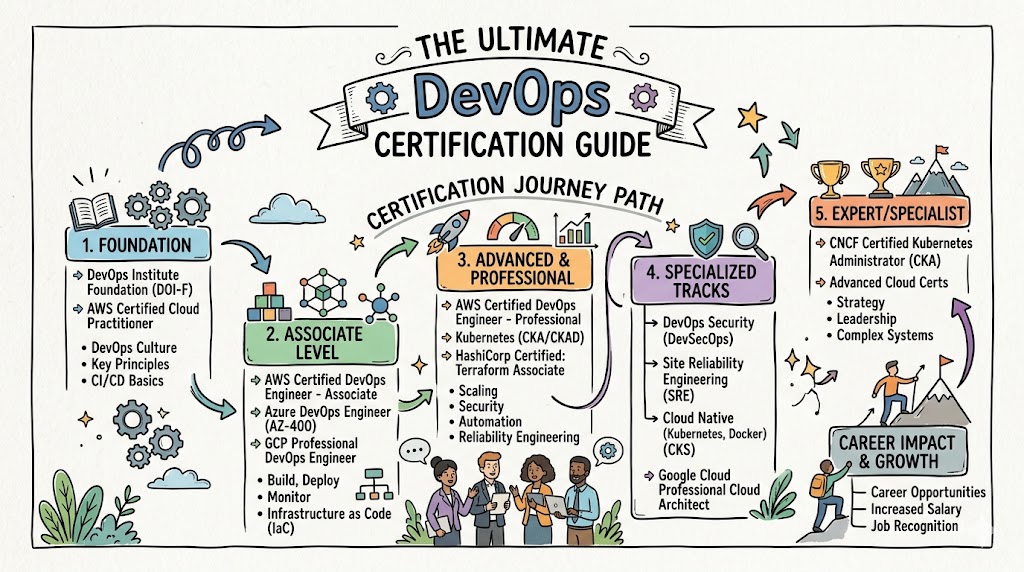
DevOps Certification Roadmap
A structured learning path ensures you invest time and effort into certifications that complement each other and align directly with your professional goals.
Table 2: Role-Based Educational Engineering Paths
| Target Career Goal | Recommended Certification Path | Why It Fits |
| Enterprise Cloud Engineer | DevOps Certified Professional (DCP) ➔ AWS Certified DevOps Professional OR Master in Azure DevOps | Combines foundational tool patterns with advanced, platform-specific cloud architecture. |
| Cloud-Native Kubernetes Specialist | Docker Certified Associate (DCA) ➔ Certified Kubernetes Administrator (CKA) ➔ Envoy Istio Training | Builds a solid understanding of containers before moving to advanced orchestration and service meshes. |
| DevSecOps Security Engineer | DevOps Certified Professional (DCP) ➔ DevSecOps Certified Professional (DSOCP) ➔ GitOps Professional | Integrates strict automated security testing and auditable code workflows into standard deployment pipelines. |
| Site Reliability Engineer (SRE) | SRE Certified Professional ➔ Certified Kubernetes Administrator (CKA) ➔ Prometheus & Grafana | Combines reliability theory with hands-on cluster management and production monitoring systems. |
| Production MLOps / AI Engineer | Master in Python Programming ➔ Master in Machine Learning ➔ MLOps Certification Course | Connects core algorithm development with automated infrastructure deployment and model lifecycle management. |
Types of DevOps Certifications
Certifications generally fall into three distinct categories, each serving a specific purpose within your professional development.
                     ┌───────────────────────────────┐
                     │   TYPES OF CERTIFICATIONS     │
                     └───────────────┬───────────────┘
                                     │
         ┌───────────────────────────┼───────────────────────────┐
         ▼                           ▼                           ▼
┌─────────────────┐         ┌─────────────────┐         ┌─────────────────┐
│ PLATFORM-AGNOSTIC│         │ CLOUD-SPECIFIC  │         │ TOOL-SPECIFIC   │
│  Foundations,   │         │  AWS, Azure,    │         │ Terraform, CKA, │
│ SRE, DevSecOps  │         │    and GCP      │         │  Prometheus     │
└─────────────────┘         └─────────────────┘         └─────────────────┘
1. Platform-Agnostic Certifications
These credentials focus on core principles, workflows, and methodologies that apply across any environment. Examples include the DevOps Certified Professional (DCP), DevSecOps Certified Professional (DSOCP), and SRE Certified Professional. They validate that you understand universal engineering patterns, architectural strategies, and cultural frameworks, regardless of the underlying cloud provider.
2. Provider-Specific Cloud Certifications
These tracks are tied directly to specific cloud vendors, such as AWS Certified DevOps Engineer – Professional, Master in Azure DevOps, and Google Cloud Professional Cloud DevOps Engineer. They ensure you know how to configure, secure, scale, and optimize proprietary vendor services, serverless products, and ecosystem-specific deployment pipelines.
3. Tool-Specific Certifications
These targeted programs validate deep operational expertise in a single industry-standard technology. Examples include the HashiCorp Certified: Terraform Associate, Certified Kubernetes Administrator (CKA), Docker Certified Associate (DCA), and Prometheus with Grafana. They prove you can deploy, configure, and troubleshoot these specific components in production environments.
Common Mistakes to Avoid
- Chasing Certifications Without Hands-On Practice: Memorizing answers to pass multiple-choice tests without building actual projects leaves you unprepared for real technical interviews and production environments.
- Skipping the Fundamentals: Trying to master advanced container orchestration or service meshes before thoroughly understanding basic networking, Linux systems administration, and core scripting.
- Ignoring the Cultural & Collaborative Aspects: Treating engineering workflows as purely a collection of tools, while overlooking the communication, feedback loops, and shared responsibility needed for long-term success.
- Over-Collecting Entry-Level Badges: Accumulating multiple introductory certificates across different platforms instead of advancing to professional and expert-level credentials that hold more weight in the industry.
- Letting Certifications Expire: Failing to track recertification windows or ignoring updates to exam blueprints, which can quickly make your credentials outdated as technology evolves.
Real-Life Examples of Certification Impact
- Example 1: Manual to Automated Cloud MigrationAn infrastructure engineering team used their Terraform and AWS certification training to replace a manual, error-prone cloud setup with a fully automated, multi-region architecture. This change reduced their environment setup times from days to under fifteen minutes.
- Example 2: Securing a High-Transaction Financial PipelineAfter completing a DevSecOps certification path, a security team integrated automated vulnerability and dependency scanning directly into their deployment workflows. This allowed them to catch over ninety percent of security vulnerabilities before any code reached production.
- Example 3: Resolving E-Commerce Downtime with SRE PracticesA platform team used their SRE and Prometheus/Grafana certification knowledge to implement service-level objectives and automated alerts. This helped them spot and fix memory leaks early, reducing system downtime by eighty percent during peak shopping events.
- Example 4: Scaling Container Operations SafelyA software engineering team leveraged their Kubernetes (CKA) training to migrate a fragmented microservices application into a highly resilient, auto-scaling cluster. This shift significantly reduced server costs while ensuring smooth performance during traffic spikes.
- Example 5: Automating Production AI DeploymentsAn enterprise data team used their MLOps certification training to build an automated machine learning pipeline. This allowed them to cut model deployment cycles from several weeks to a single day, complete with real-time data drift monitoring.
Frequently Asked Questions (FAQs)
1. Which certification should I take first if I am a complete beginner?
The DevOps Certified Professional (DCP) is an excellent starting point. It provides a comprehensive, platform-agnostic look at core engineering concepts, version control, continuous integration, and baseline infrastructure tools, giving you a solid foundation before you move on to specialized cloud or container paths.
2. How long does it typically take to prepare for an advanced certification like the CKA?
For an engineer with basic Linux and container experience, preparing for the Certified Kubernetes Administrator (CKA) exam usually requires six to twelve weeks of dedicated, hands-on practice. Because the exam is purely performance-based and conducted in a live terminal, hands-on familiarity with the command line is essential.
3. Do certifications guarantee a job in DevOps or Site Reliability Engineering?
While certifications do not automatically guarantee a job, they act as an excellent differentiator on your resume. They show employers that you possess verified technical skills, are committed to continuous learning, and understand production-grade workflows, which helps you secure technical interviews.
4. Is programming knowledge required to pass these certifications?
Basic scripting knowledge is highly beneficial. Paths like the Master in Python Programming help you learn to automate routine tasks, write custom infrastructure tools, and manage data pipelines, which are essential skills for any modern engineering role.
5. What is the difference between DevOps and Site Reliability Engineering (SRE)?
DevOps focuses primarily on breaking down silos between development and operations teams, automating deployment pipelines, and accelerating software delivery. SRE applies a software engineering mindset directly to operations challenges, focusing heavily on system reliability, availability, scaling, and incident response.
6. Why should I invest in tool-specific certifications like Terraform or Docker?
Tool-specific certifications prove you have deep, practical expertise in industry-standard technologies. Mastering tools like Terraform for infrastructure as code or Docker for containerization shows employers you can immediately contribute to modern, cloud-native engineering teams.
7. How often do these cloud and infrastructure certifications expire?
Most major engineering and cloud certifications are valid for two to three years. Because cloud services and software tools change rapidly, periodic recertification ensures your skills remain relevant and aligned with the latest industry standards.
8. Can I pass performance-based engineering exams using only video tutorials?
No, video tutorials alone are rarely enough for performance-based exams. Certifications like the CKA or various cloud professional tracks require you to solve real-world system issues in live sandbox environments, making hands-on practice absolutely essential.
9. How do MLOps certifications differ from traditional DevOps tracks?
Traditional DevOps focuses on automating the lifecycle of standard software code. MLOps certifications extend these automation principles to machine learning, covering the continuous integration, deployment, versioning, and monitoring of data sets and trained AI models.
10. Is it better to be a multi-cloud generalist or a single-cloud expert?
Starting with a strong foundation in a single major cloud provider (like AWS or Azure) helps you master cloud architecture deeply. Once you have that expertise, adding platform-agnostic or tool-specific certifications allows you to adapt easily to multi-cloud environments.
Conclusion
Building a successful career in modern software delivery requires a commitment to structured, continuous learning. By choosing the right certification path, practicing regularly in hands-on sandboxes, and aligning your training with clear role-based goals, you can systematically master the tools and practices that drive today’s tech infrastructure.
Combining foundational knowledge, specialized platform skills, and practical experience creates a powerful professional profile. To explore detailed course blueprints, connect with expert instructors, and access production-grade learning resources, visit the official BestDevOps Certification Hub and take the next step in your professional engineering journey today.
