Introduction
Insurance underwriting platforms are software systems that help insurers assess risk, decide policy eligibility, and price coverage accurately. Instead of relying on manual processes and spreadsheets, these platforms automate underwriting workflows using rules engines, analytics, and increasingly, AI-driven decision models.
In today’s fast-moving insurance market, underwriting platforms matter more than ever. Insurers are under pressure to improve speed, reduce operational costs, and deliver better customer experiences. Modern underwriting platforms enable straight-through processing, real-time data integration, and predictive risk modeling—key capabilities in a digital-first environment.
Real-world use cases include:
- Automating life and health policy approvals using risk scoring models
- Streamlining commercial insurance underwriting for SMEs
- Fraud detection using predictive analytics
- Integrating third-party data sources (credit, telematics, IoT)
- Accelerating quote-to-bind cycles in property and casualty insurance
What buyers should evaluate:
- Rule engine flexibility and customization
- AI/ML capabilities for risk scoring
- Integration with policy admin and claims systems
- Data ingestion and analytics capabilities
- Compliance and audit features
- Scalability and performance
- Ease of use for underwriters
- Deployment options (cloud vs hybrid)
- Vendor support and roadmap
Best for: Insurance carriers, MGAs, brokers, and underwriting teams in mid-market to enterprise environments looking to digitize and scale underwriting operations.
Not ideal for: Small agencies with minimal underwriting needs or those relying entirely on manual decision-making, where lightweight CRM or policy tools may suffice.
Key Trends in Insurance Underwriting Platforms
- AI-driven underwriting: Machine learning models are increasingly used for risk prediction, pricing optimization, and fraud detection.
- Straight-through processing (STP): Automation enables policies to be approved without manual intervention for low-risk cases.
- API-first ecosystems: Platforms are designed to integrate easily with external data providers and internal systems.
- Real-time data usage: Use of telematics, IoT, and behavioral data for dynamic underwriting decisions.
- Low-code/no-code rule engines: Business users can define underwriting rules without heavy developer involvement.
- Cloud-native deployments: SaaS-based underwriting platforms dominate due to scalability and flexibility.
- Regulatory compliance automation: Built-in audit trails and compliance frameworks reduce legal risks.
- Embedded insurance: Underwriting systems are integrated into third-party platforms (e-commerce, fintech).
- Customer-centric underwriting: Faster decisions and personalized policies improve user experience.
How We Selected These Tools (Methodology)
- Evaluated market adoption and brand recognition across global insurance providers
- Assessed feature completeness, including automation, analytics, and rule engines
- Considered performance and reliability signals based on enterprise usage
- Reviewed security posture indicators such as access controls and compliance capabilities
- Analyzed integration capabilities with policy, claims, and external data sources
- Ensured coverage across segments (enterprise, mid-market, niche platforms)
- Prioritized platforms with modern architecture (API-first, cloud-native)
- Considered vendor ecosystem and extensibility
- Focused on real-world applicability and scalability
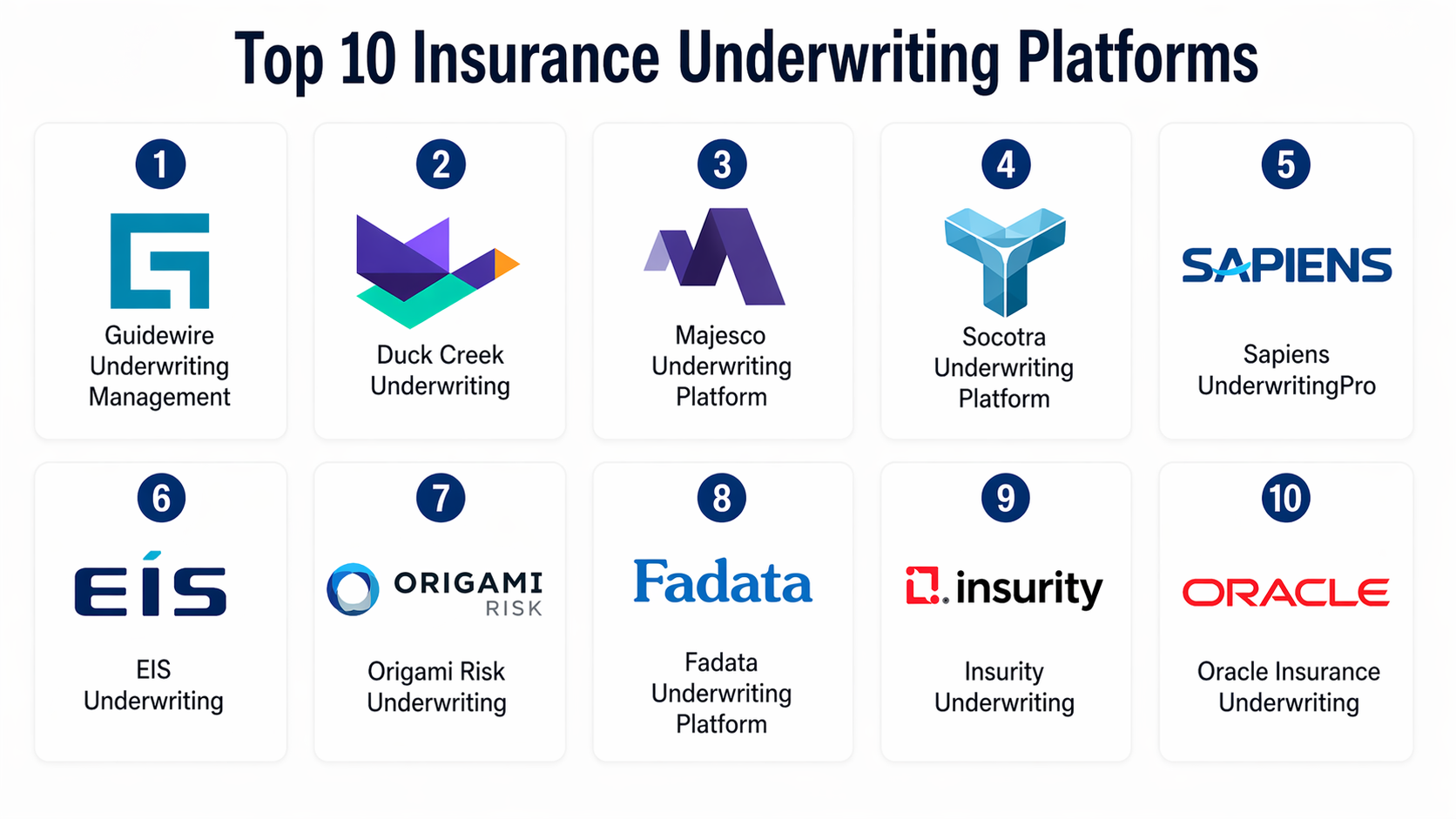
Top 10 Insurance Underwriting Platforms
#1 — Guidewire Underwriting Management
Short description :
Guidewire is one of the most widely adopted underwriting platforms in the insurance industry. It provides a robust underwriting management system tightly integrated with policy administration and claims. Designed for large insurers, it supports complex workflows, rule-based decisions, and analytics. Its ecosystem makes it a strong choice for enterprises. It is widely used in property and casualty insurance.
Key Features
- Advanced rule-based underwriting engine
- Workflow automation and case management
- Integration with Guidewire InsuranceSuite
- Data analytics and reporting
- Straight-through processing support
- Role-based dashboards
Pros
- Highly scalable for large enterprises
- Strong ecosystem and integrations
Cons
- Complex implementation
- Higher cost compared to SMB tools
Platforms / Deployment
Cloud / Hybrid
Security & Compliance
SSO, RBAC, audit logs, encryption (specific certifications not publicly stated)
Integrations & Ecosystem
Guidewire integrates deeply with its own suite and third-party systems.
- PolicyCenter and ClaimCenter
- External data providers
- APIs for customization
- Data warehouses
Support & Community
Strong enterprise support with extensive documentation and partner ecosystem.
#2 — Duck Creek Underwriting
Short description :
Duck Creek offers a flexible underwriting platform with strong SaaS capabilities. It enables insurers to configure underwriting rules and workflows easily. Known for its adaptability, it supports multiple lines of business. It is widely used by mid-to-large insurers. The platform emphasizes cloud deployment and rapid configuration.
Key Features
- Configurable rule engine
- SaaS-based architecture
- Workflow automation
- Integration with Duck Creek Suite
- Data-driven decisioning
- Multi-line support
Pros
- Flexible and configurable
- Strong cloud capabilities
Cons
- Requires skilled configuration
- May need customization for niche use cases
Platforms / Deployment
Cloud
Security & Compliance
MFA, RBAC, encryption (certifications not publicly stated)
Integrations & Ecosystem
- Duck Creek policy and billing modules
- Third-party data APIs
- Analytics tools
Support & Community
Enterprise-grade support with implementation partners.
#3 — Majesco Underwriting Platform
Short description :
Majesco provides a digital underwriting solution designed for modern insurers. It focuses on automation, analytics, and cloud-native deployment. The platform supports both personal and commercial lines. It is known for its flexible architecture and digital-first approach.
Key Features
- AI-driven risk scoring
- Automated workflows
- Cloud-native design
- Data integration capabilities
- Multi-product support
Pros
- Strong digital capabilities
- Good scalability
Cons
- Limited community resources
- Customization may require expertise
Platforms / Deployment
Cloud
Security & Compliance
Not publicly stated
Integrations & Ecosystem
- Policy and claims systems
- Third-party data providers
- APIs for integration
Support & Community
Varies / Not publicly stated
#4 — Socotra Underwriting Platform
Short description :
Socotra is a modern, API-first insurance platform with underwriting capabilities built into its core. It is designed for agility and rapid product launches. It is popular among insurtech startups and digital insurers. Its microservices architecture allows flexible deployment.
Key Features
- API-first architecture
- Real-time underwriting decisions
- Configurable rules engine
- Cloud-native platform
- Developer-friendly tools
Pros
- Highly flexible and modern
- Fast implementation
Cons
- Requires technical expertise
- Limited legacy integration support
Platforms / Deployment
Cloud
Security & Compliance
Not publicly stated
Integrations & Ecosystem
- REST APIs
- External data providers
- Developer integrations
Support & Community
Growing community with developer-focused support.
#5 — Sapiens UnderwritingPro
Short description :
Sapiens offers a comprehensive underwriting platform tailored for insurers. It supports automated decision-making and advanced analytics. The platform is designed for scalability and regulatory compliance. It serves both life and non-life insurance sectors.
Key Features
- Automated underwriting rules
- Predictive analytics
- Workflow management
- Multi-line support
- Regulatory compliance tools
Pros
- Strong analytics capabilities
- Suitable for large insurers
Cons
- Complex onboarding
- Limited flexibility for small teams
Platforms / Deployment
Cloud / Hybrid
Security & Compliance
Not publicly stated
Integrations & Ecosystem
- Core insurance systems
- External data sources
- APIs
Support & Community
Enterprise-level support.
#6 — EIS Underwriting
Short description :
EIS provides a cloud-native underwriting platform focused on digital transformation. It enables insurers to launch new products quickly and automate underwriting processes. The platform supports API integrations and modern data pipelines.
Key Features
- Digital underwriting workflows
- API-first integration
- Real-time data processing
- Cloud-native design
- Product configuration tools
Pros
- Fast product deployment
- Strong integration capabilities
Cons
- Learning curve for new users
- Pricing not transparent
Platforms / Deployment
Cloud
Security & Compliance
Not publicly stated
Integrations & Ecosystem
- External APIs
- Data providers
- Core insurance systems
Support & Community
Varies / Not publicly stated
#7 — Origami Risk Underwriting
Short description :
Origami Risk provides a flexible underwriting solution within its risk management platform. It is designed for insurers and risk managers. The platform supports workflow automation and data analytics.
Key Features
- Workflow automation
- Data analytics tools
- Configurable underwriting rules
- Integration capabilities
- Risk management features
Pros
- Flexible platform
- Good analytics
Cons
- Less specialized than competitors
- UI may feel outdated
Platforms / Deployment
Cloud
Security & Compliance
Not publicly stated
Integrations & Ecosystem
- Risk management tools
- APIs
- Data integrations
Support & Community
Varies / Not publicly stated
#8 — Fadata Underwriting Platform
Short description :
Fadata offers underwriting capabilities as part of its insurance core platform. It supports automation and digital transformation initiatives. It is widely used in European markets.
Key Features
- Rule-based underwriting
- Workflow automation
- Multi-line support
- Core system integration
- Reporting tools
Pros
- Strong core system integration
- Reliable performance
Cons
- Limited global presence
- Customization required
Platforms / Deployment
Cloud / Hybrid
Security & Compliance
Not publicly stated
Integrations & Ecosystem
- Core insurance systems
- APIs
- Data integrations
Support & Community
Regional support focus.
#9 — Insurity Underwriting
Short description :
Insurity provides underwriting solutions for property and casualty insurers. It focuses on automation and analytics. The platform is designed for mid-market insurers.
Key Features
- Automated underwriting workflows
- Analytics and reporting
- Integration capabilities
- Multi-line support
- Cloud deployment
Pros
- Easy to use
- Good for mid-market
Cons
- Limited advanced AI features
- Smaller ecosystem
Platforms / Deployment
Cloud
Security & Compliance
Not publicly stated
Integrations & Ecosystem
- APIs
- Data providers
- Core systems
Support & Community
Moderate support availability.
#10 — Oracle Insurance Underwriting
Short description :
Oracle offers underwriting capabilities within its insurance suite. It is designed for large enterprises requiring scalability and integration. The platform leverages Oracle’s cloud infrastructure and analytics capabilities.
Key Features
- Advanced analytics
- Workflow automation
- Integration with Oracle Cloud
- Rule-based underwriting
- Enterprise scalability
Pros
- Strong enterprise capabilities
- Reliable infrastructure
Cons
- High cost
- Complex setup
Platforms / Deployment
Cloud / Hybrid
Security & Compliance
SSO, encryption, RBAC (certifications not publicly stated)
Integrations & Ecosystem
- Oracle Cloud services
- Data analytics tools
- APIs
Support & Community
Strong enterprise support.
Comparison Table (Top 10)
| Tool Name | Best For | Platform(s) Supported | Deployment | Standout Feature | Public Rating |
|---|---|---|---|---|---|
| Guidewire | Enterprise insurers | Web | Cloud/Hybrid | Deep ecosystem integration | N/A |
| Duck Creek | Configurable SaaS underwriting | Web | Cloud | Flexible rule engine | N/A |
| Majesco | Digital-first insurers | Web | Cloud | AI-driven underwriting | N/A |
| Socotra | Insurtech startups | Web | Cloud | API-first architecture | N/A |
| Sapiens | Large insurers | Web | Cloud/Hybrid | Predictive analytics | N/A |
| EIS | Digital transformation | Web | Cloud | Fast product deployment | N/A |
| Origami Risk | Risk-focused underwriting | Web | Cloud | Analytics + risk tools | N/A |
| Fadata | European insurers | Web | Cloud/Hybrid | Core system integration | N/A |
| Insurity | Mid-market insurers | Web | Cloud | Ease of use | N/A |
| Oracle Insurance | Enterprise scalability | Web | Cloud/Hybrid | Enterprise analytics | N/A |
Evaluation & Insurance Underwriting Platforms
| Tool Name | Core (25%) | Ease (15%) | Integrations (15%) | Security (10%) | Performance (10%) | Support (10%) | Value (15%) | Weighted Total |
|---|---|---|---|---|---|---|---|---|
| Guidewire | 9 | 7 | 9 | 8 | 9 | 9 | 7 | 8.4 |
| Duck Creek | 8 | 8 | 8 | 8 | 8 | 8 | 8 | 8.0 |
| Majesco | 8 | 7 | 7 | 7 | 8 | 7 | 8 | 7.6 |
| Socotra | 7 | 8 | 9 | 7 | 8 | 7 | 8 | 7.8 |
| Sapiens | 8 | 7 | 8 | 8 | 8 | 8 | 7 | 7.9 |
| EIS | 8 | 7 | 9 | 7 | 8 | 7 | 8 | 7.9 |
| Origami Risk | 7 | 7 | 7 | 7 | 7 | 7 | 7 | 7.0 |
| Fadata | 7 | 6 | 7 | 7 | 7 | 7 | 7 | 6.9 |
| Insurity | 7 | 8 | 7 | 7 | 7 | 7 | 8 | 7.5 |
| Oracle Insurance | 9 | 6 | 9 | 8 | 9 | 9 | 6 | 8.3 |
How to interpret scores:
These scores are comparative and reflect overall positioning rather than absolute performance. Higher scores indicate stronger capabilities in enterprise scenarios. Lower scores may still be suitable depending on specific use cases, budget, or technical needs.
Which Insurance Underwriting Platforms
Solo / Freelancer
Lightweight tools or CRM-based solutions are better. Full underwriting platforms may be excessive.
SMB
Duck Creek or Insurity are suitable due to ease of use and flexibility.
Mid-Market
Majesco and EIS offer a balance of features and scalability.
Enterprise
Guidewire, Oracle, and Sapiens are ideal for large-scale operations.
Budget vs Premium
- Budget: Insurity, Origami Risk
- Premium: Guidewire, Oracle
Feature Depth vs Ease of Use
- Feature-heavy: Guidewire, Oracle
- Easier tools: Duck Creek, Insurity
Integrations & Scalability
- Best: Guidewire, Socotra, EIS
Security & Compliance Needs
- Enterprise-grade: Oracle, Guidewire
Frequently Asked Questions (FAQs)
1. What is an insurance underwriting platform?
It is software that helps insurers evaluate risk and decide policy terms using automation and analytics.
2. How much do these platforms cost?
Pricing varies widely based on scale, features, and deployment. Most enterprise tools use custom pricing.
3. How long does implementation take?
It can take from a few weeks to several months depending on complexity.
4. Do these platforms support AI?
Yes, many platforms now include AI-driven risk scoring and automation features.
5. Are they secure?
Most platforms include encryption, access controls, and audit logs, but certifications vary.
6. Can they integrate with existing systems?
Yes, modern platforms provide APIs and integration capabilities.
7. What industries use these tools?
Primarily insurance carriers, brokers, and reinsurers.
8. Is cloud deployment common?
Yes, most modern platforms are cloud-based.
9. What are common mistakes when choosing a platform?
Ignoring integration needs and underestimating implementation complexity.
10. Can I switch platforms easily?
Switching is complex and requires data migration and process redesign.
Conclusion
Insurance underwriting platforms have become essential for insurers looking to stay competitive in a digital-first environment. From automation and AI-driven decision-making to real-time data integration, these platforms significantly improve efficiency, accuracy, and customer experience. However, there is no one-size-fits-all solution. Enterprise insurers may benefit from platforms like Guidewire or Oracle, while mid-market players might find Duck Creek or Majesco more suitable. The right choice depends on your organization’s size, technical maturity, and business goals.
