Introduction
Asset Tracking (RFID) Software helps organizations monitor, manage, and track physical assets using RFID (Radio Frequency Identification) technology. Unlike barcode systems, RFID enables real-time tracking without direct line-of-sight, making it highly efficient for large-scale operations.
In modern environments, where supply chains are complex and asset visibility is critical, RFID-based tracking has become essential. Businesses need to reduce losses, improve utilization, and maintain compliance—all while operating at speed. With the rise of IoT and automation, RFID software now integrates deeply with analytics, AI, and enterprise systems.
Real-world use cases:
- Warehouse inventory tracking and automation
- Manufacturing asset lifecycle monitoring
- Hospital equipment tracking and compliance
- Retail stock visibility and theft prevention
- Logistics and supply chain asset tracking
What buyers should evaluate:
- RFID hardware compatibility
- Real-time tracking capabilities
- Scalability across locations
- Integration with ERP/WMS systems
- Data analytics and reporting
- Mobile and handheld device support
- Security and access controls
- Deployment flexibility (cloud/on-prem)
- Total cost of ownership
- Ease of implementation
Best for: Logistics companies, manufacturing plants, healthcare organizations, retail chains, and enterprises managing large volumes of physical assets.
Not ideal for: Small teams with limited assets or organizations that only need simple tracking—barcode or spreadsheet-based systems may suffice.
Key Trends in Asset Tracking (RFID) Software
- IoT integration: RFID systems increasingly connect with IoT sensors for enhanced tracking.
- AI-driven insights: Predictive analytics for asset utilization and maintenance.
- Cloud-based platforms: SaaS adoption continues to dominate deployments.
- Edge computing: Faster processing at the device level for real-time decisions.
- Automation workflows: Automatic alerts and task generation based on asset movement.
- Digital twins: Visualization of assets in virtual environments.
- Mobile-first tracking: Handheld RFID scanners integrated with apps.
- Security enhancements: Encryption and role-based access becoming standard.
- Interoperability: Seamless integration with ERP, WMS, and CMMS systems.
- Subscription pricing: Flexible SaaS pricing models replacing large upfront investments.
How We Selected These Tools (Methodology)
- Strong adoption in RFID and asset tracking markets
- Proven performance in real-world deployments
- Comprehensive RFID and asset management capabilities
- Integration support with enterprise systems
- Scalability across industries and geographies
- Vendor reliability and innovation track record
- Mobile and hardware ecosystem compatibility
- Security and compliance readiness
- Balance of usability and feature depth
- Suitability for SMB to enterprise segments
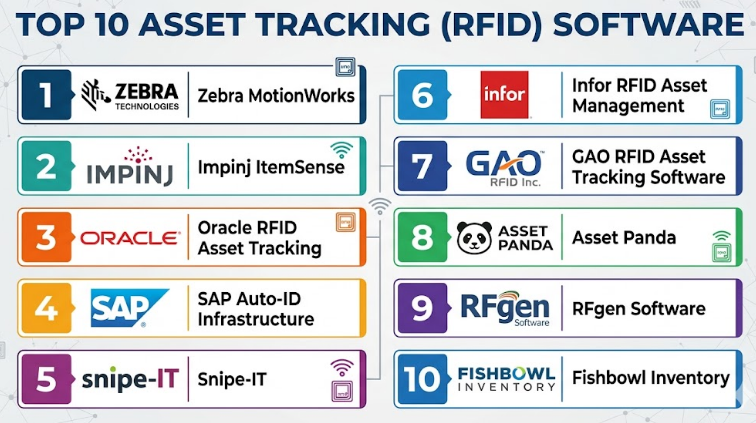
Top 10 Asset Tracking (RFID) Software
#1 — Zebra MotionWorks
Short description (5-6 lines):
Zebra MotionWorks is a leading RFID asset tracking platform designed for real-time visibility across operations. It integrates with Zebra hardware and provides analytics-driven insights. Widely used in logistics, healthcare, and manufacturing, it enables location tracking and asset monitoring. The platform supports large-scale deployments. It is ideal for enterprises seeking deep RFID integration.
Key Features
- Real-time location tracking
- RFID hardware integration
- Asset utilization analytics
- Event-based alerts
- Workflow automation
Pros
- Strong hardware integration
- Enterprise scalability
Cons
- Vendor lock-in risk
- Complex deployment
Platforms / Deployment
Web / Mobile
Cloud / On-prem
Security & Compliance
Not publicly stated
Integrations & Ecosystem
Zebra integrates deeply with enterprise systems and hardware devices.
- ERP integrations
- IoT devices
- API support
Support & Community
Strong enterprise support with vendor ecosystem.
#2 — Impinj ItemSense
Short description (5-6 lines):
Impinj ItemSense provides item-level RFID tracking with high accuracy. It focuses on inventory and asset visibility. The platform is widely used in retail and logistics. It offers real-time data processing and analytics. Designed for scalability, it supports large deployments.
Key Features
- Item-level tracking
- Real-time inventory updates
- RFID reader integration
- Data analytics
- Event management
Pros
- High accuracy tracking
- Strong performance
Cons
- Requires specialized hardware
- Complex setup
Platforms / Deployment
Web
Cloud
Security & Compliance
Not publicly stated
Integrations & Ecosystem
- RFID ecosystem integration
- API access
Support & Community
Vendor-driven support model.
#3 — Oracle RFID Asset Tracking
Short description (5-6 lines):
Oracle’s RFID Asset Tracking solution integrates with its enterprise applications. It offers strong data management and analytics capabilities. Designed for large organizations, it provides end-to-end visibility. It supports compliance and reporting. Best for enterprises already using Oracle systems.
Key Features
- Enterprise integration
- Asset tracking
- Analytics and reporting
- Compliance tracking
- Workflow automation
Pros
- Strong enterprise integration
- Scalable
Cons
- High cost
- Complex implementation
Platforms / Deployment
Web
Cloud / On-prem
Security & Compliance
Enterprise-grade controls (Not publicly stated in detail)
Integrations & Ecosystem
- Oracle ERP
- API ecosystem
Support & Community
Enterprise-level support.
#4 — SAP Auto-ID Infrastructure
Short description (5-6 lines):
SAP Auto-ID Infrastructure enables RFID-based tracking within SAP environments. It integrates seamlessly with SAP ERP systems. The platform is designed for enterprise use cases. It supports automation and real-time tracking. Ideal for SAP-centric organizations.
Key Features
- RFID data processing
- ERP integration
- Real-time tracking
- Automation workflows
- Analytics
Pros
- Deep SAP integration
- Enterprise-grade
Cons
- Limited outside SAP ecosystem
- High complexity
Platforms / Deployment
Web
Cloud / On-prem
Security & Compliance
Not publicly stated
Integrations & Ecosystem
- SAP ecosystem
- API support
Support & Community
Strong enterprise support.
#5 — Snipe-IT (with RFID integrations)
Short description (5-6 lines):
Snipe-IT is an open-source asset management platform that can integrate with RFID systems. It provides asset tracking and management features. It is popular among SMBs and IT teams. The platform is customizable and flexible. Suitable for organizations seeking cost-effective solutions.
Key Features
- Asset tracking
- Open-source customization
- User management
- Reporting
- API support
Pros
- Cost-effective
- Flexible
Cons
- Requires setup effort
- Limited native RFID features
Platforms / Deployment
Web
Cloud / Self-hosted
Security & Compliance
Not publicly stated
Integrations & Ecosystem
- API integrations
- Custom integrations
Support & Community
Strong open-source community.
#6 — Infor RFID Asset Management
Short description (5-6 lines):
Infor provides RFID-enabled asset tracking as part of its enterprise solutions. It offers real-time tracking and analytics. The platform is designed for industries like manufacturing and logistics. It supports scalability and integration. Ideal for large organizations.
Key Features
- Asset tracking
- RFID integration
- Analytics
- Workflow automation
- ERP integration
Pros
- Enterprise capabilities
- Strong integration
Cons
- Complex implementation
- Costly
Platforms / Deployment
Web
Cloud
Security & Compliance
Not publicly stated
Integrations & Ecosystem
- ERP integrations
- API
Support & Community
Enterprise support model.
#7 — GAO RFID Asset Tracking Software
Short description (5-6 lines):
GAO RFID offers asset tracking solutions with customizable features. It supports various industries including healthcare and logistics. The platform provides real-time tracking and reporting. It integrates with RFID hardware. Suitable for mid-sized organizations.
Key Features
- Real-time tracking
- Asset management
- Reporting
- RFID integration
Pros
- Customizable
- Industry-specific solutions
Cons
- Limited ecosystem
- Smaller vendor
Platforms / Deployment
Web
Cloud
Security & Compliance
Not publicly stated
Integrations & Ecosystem
- RFID hardware integration
Support & Community
Vendor-based support.
#8 — Asset Panda (RFID-enabled)
Short description (5-6 lines):
Asset Panda is a flexible asset tracking platform that supports RFID integrations. It offers customizable workflows and mobile access. It is widely used by SMBs and mid-market companies. The platform emphasizes ease of use. Suitable for growing businesses.
Key Features
- Asset tracking
- Mobile access
- Custom workflows
- Reporting
Pros
- Easy to use
- Flexible
Cons
- Limited advanced RFID features
- Customization complexity
Platforms / Deployment
Web / Mobile
Cloud
Security & Compliance
Not publicly stated
Integrations & Ecosystem
- API
- Business integrations
Support & Community
Good support for SMBs.
#9 — RFgen Software
Short description (5-6 lines):
RFgen provides mobile data collection and RFID tracking solutions. It integrates with ERP systems. The platform is designed for supply chain and warehouse operations. It supports real-time tracking. Suitable for mid-market companies.
Key Features
- RFID tracking
- Mobile data collection
- ERP integration
- Real-time updates
Pros
- Strong ERP integration
- Flexible deployment
Cons
- Requires configuration
- Limited UI polish
Platforms / Deployment
Web / Mobile
Cloud / On-prem
Security & Compliance
Not publicly stated
Integrations & Ecosystem
- ERP integrations
- API
Support & Community
Vendor support available.
#10 — Fishbowl Inventory (RFID integrations)
Short description (5-6 lines):
Fishbowl Inventory offers inventory management with RFID support. It is popular among SMBs. The platform integrates with accounting systems. It provides asset tracking and reporting. Suitable for small to mid-sized businesses.
Key Features
- Inventory tracking
- RFID support
- Reporting
- Integration with accounting
Pros
- Affordable
- Easy integration
Cons
- Limited enterprise features
- Basic RFID support
Platforms / Deployment
Web / Desktop
Cloud / On-prem
Security & Compliance
Not publicly stated
Integrations & Ecosystem
- Accounting integrations
- API
Support & Community
Good SMB support.
Comparison Table (Top 10)
| Tool Name | Best For | Platform(s) Supported | Deployment | Standout Feature | Public Rating |
|---|---|---|---|---|---|
| Zebra MotionWorks | Enterprise | Web, Mobile | Hybrid | Real-time tracking | N/A |
| Impinj ItemSense | Retail/logistics | Web | Cloud | Item-level tracking | N/A |
| Oracle RFID | Enterprise | Web | Hybrid | Enterprise integration | N/A |
| SAP Auto-ID | SAP users | Web | Hybrid | SAP integration | N/A |
| Snipe-IT | SMB | Web | Hybrid | Open-source | N/A |
| Infor RFID | Enterprise | Web | Cloud | Analytics | N/A |
| GAO RFID | Mid-market | Web | Cloud | Custom solutions | N/A |
| Asset Panda | SMB | Web, Mobile | Cloud | Custom workflows | N/A |
| RFgen | Mid-market | Web, Mobile | Hybrid | ERP integration | N/A |
| Fishbowl | SMB | Web, Desktop | Hybrid | Inventory focus | N/A |
Evaluation & Scoring of Asset Tracking (RFID) Software
| Tool Name | Core | Ease | Integrations | Security | Performance | Support | Value | Weighted Total |
|---|---|---|---|---|---|---|---|---|
| Zebra MotionWorks | 10 | 7 | 9 | 8 | 9 | 8 | 7 | 8.6 |
| Impinj ItemSense | 9 | 7 | 8 | 7 | 9 | 7 | 7 | 8.0 |
| Oracle RFID | 10 | 6 | 10 | 8 | 9 | 9 | 6 | 8.7 |
| SAP Auto-ID | 10 | 6 | 10 | 8 | 9 | 9 | 6 | 8.7 |
| Snipe-IT | 7 | 8 | 7 | 6 | 7 | 7 | 9 | 7.6 |
| Infor RFID | 9 | 6 | 9 | 8 | 8 | 8 | 6 | 8.2 |
| GAO RFID | 8 | 7 | 6 | 6 | 7 | 7 | 7 | 7.3 |
| Asset Panda | 8 | 8 | 7 | 6 | 7 | 8 | 8 | 7.8 |
| RFgen | 8 | 7 | 9 | 7 | 8 | 7 | 7 | 7.9 |
| Fishbowl | 7 | 8 | 7 | 6 | 7 | 7 | 8 | 7.6 |
How to interpret scores:
These scores are comparative and reflect strengths across different criteria. Enterprise platforms score higher in integrations and scalability, while SMB tools score better in ease of use and value. Choose based on your operational priorities rather than overall score.
Which Asset Tracking (RFID) Software
Solo / Freelancer
Snipe-IT or Fishbowl are practical choices due to affordability and flexibility.
SMB
Asset Panda and Fishbowl provide ease of use with moderate RFID capabilities.
Mid-Market
RFgen and GAO RFID offer better integrations and scalability.
Enterprise
Zebra MotionWorks, Oracle RFID, and SAP Auto-ID are best suited for large-scale deployments.
Budget vs Premium
- Budget: Snipe-IT, Fishbowl
- Premium: Oracle, SAP, Zebra
Feature Depth vs Ease of Use
- Feature depth: SAP, Oracle
- Ease of use: Asset Panda
Integrations & Scalability
- Strong: Oracle, SAP
- Moderate: RFgen
- Basic: SMB tools
Security & Compliance Needs
- High: Enterprise platforms
- Moderate: Mid-market tools
- Basic: SMB tools
Frequently Asked Questions (FAQs)
1. What is RFID asset tracking software?
It is a system that uses RFID technology to track and manage physical assets in real time without manual scanning.
2. How much does RFID software cost?
Costs vary based on scale, hardware, and deployment. Pricing is usually subscription-based or enterprise licensing.
3. Do I need special hardware?
Yes, RFID systems require tags, readers, and sometimes handheld scanners.
4. Is RFID better than barcodes?
RFID offers faster and automated tracking, especially for large-scale operations.
5. Can it integrate with ERP systems?
Yes, most enterprise solutions support ERP integration.
6. Is it secure?
Security varies by vendor; enterprise tools provide stronger controls.
7. How long does implementation take?
It can range from weeks to months depending on complexity.
8. Can small businesses use RFID?
Yes, but cost and complexity should be considered.
9. What industries use RFID tracking?
Retail, logistics, healthcare, manufacturing, and government sectors.
10. What are alternatives to RFID?
Barcodes, QR codes, and manual tracking systems are common alternatives.
Conclusion
Asset Tracking (RFID) Software is becoming a critical foundation for modern operations, especially in industries where asset visibility directly impacts efficiency and cost. While enterprise solutions like Oracle and SAP deliver deep integration and scalability, SMB-friendly platforms such as Asset Panda and Snipe-IT provide flexibility and affordability. The right choice depends on your operational complexity, hardware readiness, and integration needs. Instead of chasing the most feature-rich platform, focus on alignment with your workflows and long-term scalability. Start by shortlisting 2–3 tools, test them in a controlled pilot, and validate real-world performance before making a full investment.
